A Guide to Translate Documents for USCIS
Getting your documents translated for a USCIS application can feel daunting, but it boils down to one simple principle: they need a complete, accurate English version of your original document, backed by a signed statement from the translator. This isn't just paperwork; it's a formal declaration that the translation is true and correct, and getting it right is crucial to avoid delays or even a flat-out rejection.
What USCIS Actually Wants From Your Translations
When you're dealing with USCIS, every single detail matters. Their rules for translated documents are strict, and for good reason—they’re trying to prevent fraud and ensure every application is reviewed consistently. If you understand what they’re looking for from the get-go, you can put together a submission that sails right through.
One of the biggest points of confusion is the term "certified translation." USCIS doesn't have an official list of government-approved translators. What they actually require is a certification statement from the person who did the translation. It's a subtle but very important difference.
To give you a quick overview, here are the core requirements in a nutshell.
USCIS Translation Requirements At a Glance
The table below breaks down exactly what USCIS needs for every translated document you submit. Meeting these criteria is non-negotiable for a smooth application process.
| Requirement | What It Means | Why It Matters |
|---|---|---|
| Complete Translation | The entire document must be translated, including all stamps, seals, and signatures. | Missing even a small detail can lead to a Request for Evidence (RFE), delaying your case. |
| Certification Statement | A signed letter from the translator attesting to their competency and the translation's accuracy. | This makes the translator accountable and assures USCIS of the document's integrity. |
| Original Document Copy | A photocopy of the original foreign-language document must be included. | This allows the officer to compare the translation to the source, verifying its completeness. |
| Competent Translator | The translator must be fluent in both English and the source language. | An inaccurate translation can misrepresent facts and jeopardize your application. |
Getting these four elements right is the foundation of a successful submission. It shows the reviewing officer that you’ve prepared your case with care and diligence.
Who Can Actually Translate and Certify?
Here's some good news: the translator doesn't need a special license or government accreditation. They just need to be competent—meaning they're fluent enough in both languages to produce an accurate, word-for-word translation.
This is where people often think about asking a bilingual friend or family member to help out. While it seems like an easy fix, it's a risky move. USCIS might see a translation from a relative as biased, which could immediately raise red flags and trigger a Request for Evidence (RFE). The safest bet is always to use an objective third party, whether it’s a professional freelance translator or a reputable service. You can learn more about finding the right help with our guide to professional USCIS document translation services.
Key Takeaway: USCIS cares less about who the translator is and more about the quality and certification of their work. That signed letter is their sworn statement of accuracy, putting the integrity of the translation on them.
The “Why” Behind the Strict Rules
The sheer volume of applications USCIS handles is staggering. To put it in perspective, in just one quarter of fiscal year 2025, the agency received over 269,000 new I-130 family petitions. The total backlog of pending cases has ballooned to a record 11.3 million in 2025, creating a high-pressure environment where there's no time for ambiguity.
With that kind of caseload, USCIS needs unwavering standards. Requiring certified, complete, and properly formatted translations allows their officers to evaluate every case efficiently and fairly. The rules are there to create a level playing field for everyone.
Of course, translation is just one piece of a much larger puzzle. For instance, a guide for Canadians working in the US can offer crucial information on visas and taxes, showing how interconnected all these immigration steps are.
At the end of the day, following the translation rules from the start does more than just tick a box. It prevents needless delays and sends a clear message to the reviewing officer: your application is solid, credible, and ready for approval.
How to Create a Flawless USCIS Certification Letter
When you're submitting translated documents to USCIS, the certification letter is where the rubber meets the road. I've seen it time and time again: a simple mistake on this single page—a missing date, a forgotten signature, or wishy-washy wording—can trigger a dreaded Request for Evidence (RFE). That one little slip-up can bring your entire application to a grinding halt for weeks, sometimes even months.
Getting this letter right is your best insurance policy against unnecessary delays.
Think of the certification as a sworn statement. The translator is formally declaring to a federal agency, "I am competent in both of these languages, and I attest that this translation is a complete and accurate reflection of the original." It's a promise of quality and accountability, and USCIS takes it seriously.
The whole process boils down to three straightforward stages: you start with your original document, create the English translation, and then you seal the deal with the certification.
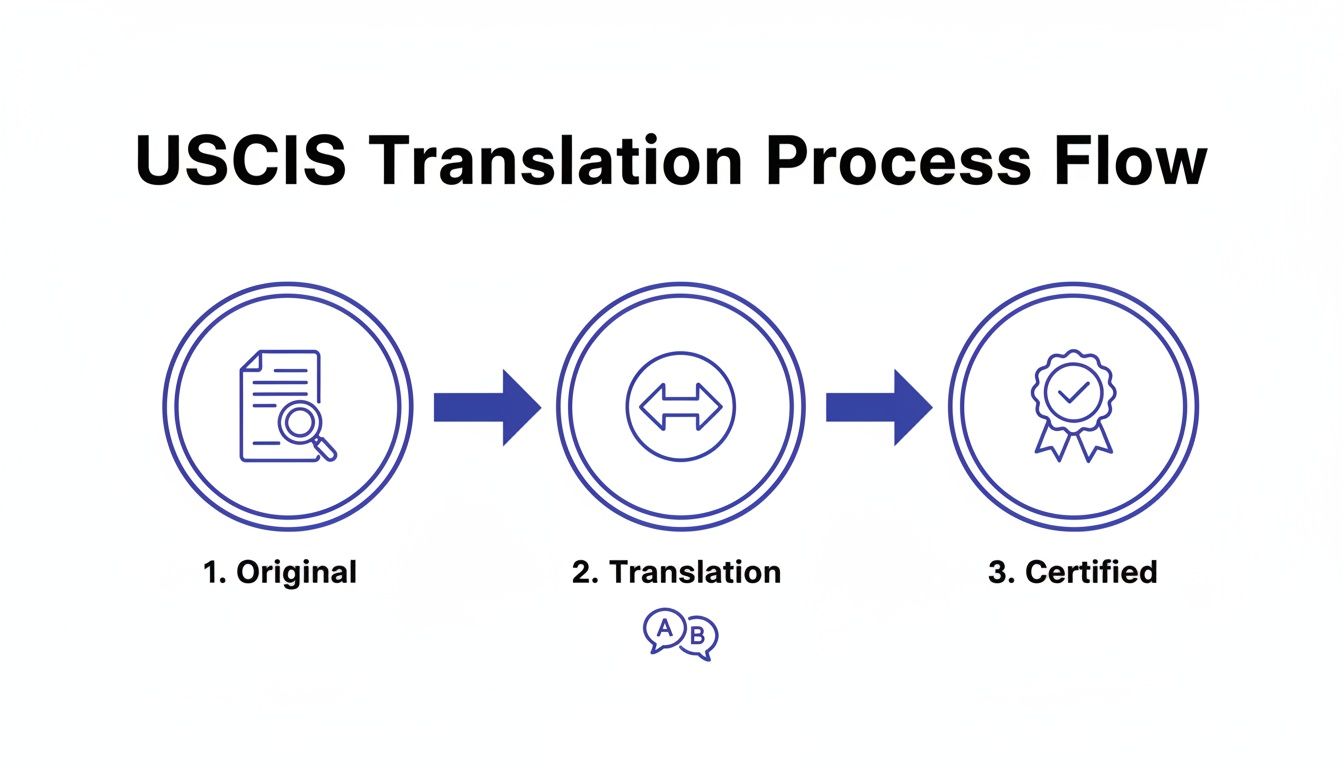
This workflow shows that the certification isn't just an afterthought. It's the final, official step that validates all the work for the immigration officer reviewing your file.
The Essential Components of a USCIS Certification
While USCIS doesn't hand you an official template, they are crystal clear about what this letter must contain. A compliant certification needs four key elements to be considered valid. Leave just one out, and you're practically inviting a rejection.
Here’s exactly what they're looking for:
- A statement of the translator's competence: The translator has to explicitly state that they are fluent in both English and the source language (e.g., Spanish, Mandarin, etc.).
- A declaration of accuracy: A firm sentence confirming the translation is complete and accurate to the best of their knowledge and ability.
- Identification of the translated document: The letter must name the specific document. For example, "Birth Certificate for Jane Doe" or "Marriage Certificate of John Smith."
- The translator’s info, signature, and date: The letter is incomplete without the translator's full name, their signature, a physical address, and the date they signed it.
This structure gives the USCIS officer everything they need to verify the translation's authenticity and follow up if there are any questions. Any professional translation service worth its salt will include this automatically. For instance, when you get your documents certified for official use, a compliant certification letter is always part of the package.
A Sample Certification You Can Use
To take out all the guesswork, here is a battle-tested template that hits every USCIS requirement. The language is direct, it includes every necessary component, and it leaves zero room for misinterpretation.
Certification by Translator
I, [Translator's Full Name], certify that I am fluent in the English and [Source Language] languages, and that the foregoing document is a true, accurate, and complete translation of the attached document titled "[Original Document Title]".
Signature: _____________________________
Printed Name: [Translator's Full Name]
Address: [Translator's Full Street Address]
Date: [MM/DD/YYYY]
This format is clean and effective. It explicitly covers competence, accuracy, and all the identifying details that USCIS demands.
Common Blunders to Avoid
Even with a perfect template, it's the little mistakes that can trip you up. The most frequent errors I see are simple but incredibly damaging.
Forgetting to physically sign the letter is an instant red flag for an officer. Another classic error is using weak language like, "I believe this translation is pretty accurate." It has to be a definitive, confident statement.
A missing date is another common pitfall; the date confirms exactly when the certification was made. Lastly, make sure the translator's full name is printed clearly below the signature—scribbled signatures are often illegible. Taking 60 seconds to double-check these small details before you mail your package can save you from a major headache down the road.
Formatting Your Documents to USCIS Standards
When it comes to translating documents for USCIS, what you see is just as important as what you read. Think about it from the perspective of the USCIS officer reviewing your case. They're looking at your original document and its English translation side-by-side. If the layouts are wildly different, they have to go on a treasure hunt to find the right information, which is the last thing you want.
The golden rule is simple: your translated document should be a visual mirror of the original. The closer the match, the easier it is for an officer to do a quick, line-by-line comparison. This simple step makes their job easier and reflects well on your entire application.
Why Visual Consistency Is a Deal-Breaker
A clean, parallel layout isn’t just about looking professional; it's about building trust. When columns, headers, and key data points line up perfectly, it sends a clear signal to the officer that the translation is a faithful and complete version of the original. It screams credibility.
On the other hand, a jumbled or poorly formatted translation can raise immediate red flags. It might suggest the work was rushed, is incomplete, or isn't a true word-for-word rendering. This is a very common reason for a Request for Evidence (RFE), a notice that can put your case on ice for months.
The image below shows exactly what this parallel formatting looks like in practice.
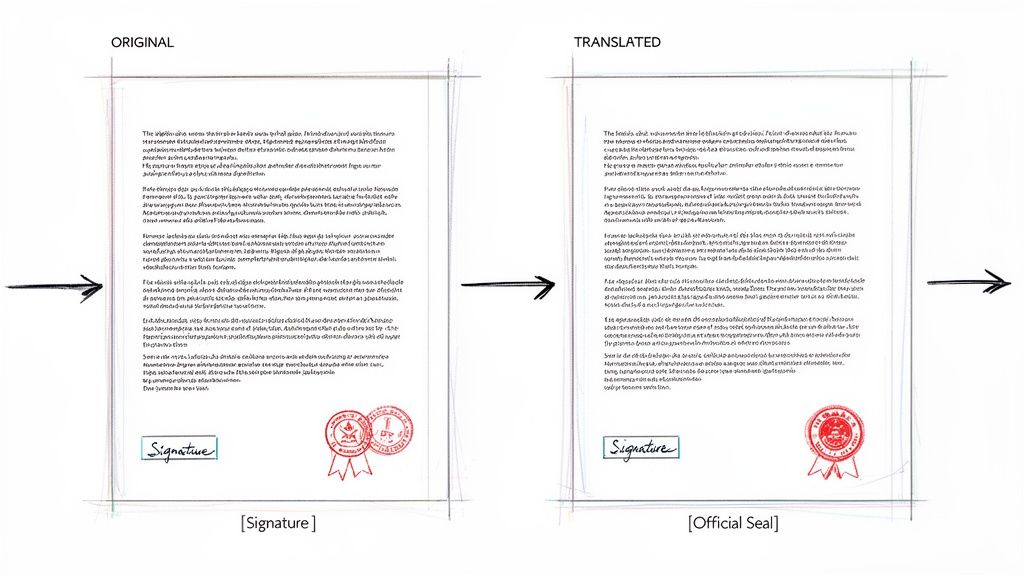
As you can see, a professional service ensures the structure of even a complex document is perfectly replicated, making the comparison process smooth and straightforward for the reviewer.
How to Handle Stamps, Seals, and Other Visuals
Official documents are rarely just text. They're covered in stamps, seals, signatures, and sometimes even handwritten notes or watermarks. Every single one of these elements must be accounted for in the translation. Simply ignoring them means your translation is incomplete.
The accepted industry standard is to use square brackets to describe these non-text components. This shows the USCIS officer that you've acknowledged every mark on the original page.
Here’s a quick guide on how to note these elements:
- Signatures: Note their presence with
[Signature]. - Seals or Stamps: Be descriptive, like
[Official Seal of the Ministry of Interior]or simply[Stamp]. - Handwritten Notes: If you can't read a note, just write
[Illegible handwriting]. - Logos or Emblems: Describe them, for example,
[Logo of the University of Barcelona].
This level of detail is absolutely critical. Treating your USCIS documents with this precision is similar to the rigor outlined in contract management best practices, where accuracy and compliance are paramount.
Practical Tips for Keeping the Layout Intact
Getting a mirror-image layout can be tricky, especially with dense documents like academic transcripts or legal agreements. One of the most effective methods is using tables in a word processor to recreate the original structure.
For instance, if your birth certificate has a column for the field name (like "Nombre") and another for the information ("Maria"), your translated document must have the exact same two-column format.
A Real-World Example: I once saw a case where an applicant submitted a translated bank statement, but all the transactions were listed in one long paragraph instead of the original table format. USCIS issued an RFE because the officer couldn't easily match up deposits and withdrawals. The applicant had to pay for a completely new, properly formatted translation, which delayed their case by over two months.
This is where modern tools can be a lifesaver. They are designed to analyze the structure of your original file, whether it's a PDF or DOCX, and automatically preserve that layout in the final translation. This not only saves you a ton of time but also virtually eliminates the risk of human formatting errors, ensuring your submission is clean, professional, and ready for a smooth review.
Common Translation Mistakes That Cause Delays
When you're trying to get documents translated for USCIS, even the smallest oversight can throw a massive wrench in the works. A seemingly harmless mistake can easily trigger a Request for Evidence (RFE), pausing your entire application and adding months of stressful waiting to your timeline.
Knowing the common pitfalls is the best way to steer clear of them.
One of the biggest and most frequent errors I see is people asking a bilingual friend or family member for help to save a few bucks. While their intentions are good, this is a terrible idea. USCIS can see a translation from a relative as biased, which immediately undermines its credibility.
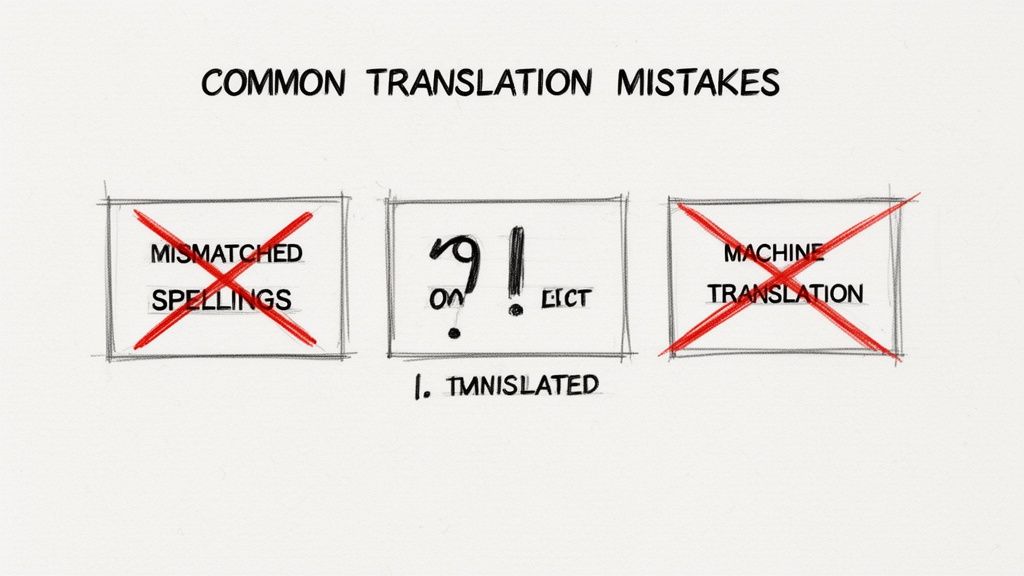
It’s not just about a potential conflict of interest, either. Professional translators are trained to handle the specific nuances of official documents—a skill that a casual speaker, no matter how fluent, almost never has. The risk of an RFE or an outright denial is simply too high to take this shortcut.
The Myth of a "Good Enough" Translation
Another critical mistake is submitting a partial translation. Some people figure that USCIS only cares about the main text fields on a birth certificate or diploma. This couldn't be more wrong. The agency requires a complete, word-for-word translation of absolutely everything on the page.
That means everything. We're talking about:
- Stamps and seals: All official markings must be noted, often with a description like
[Official Seal of the City of Lima]. - Signatures: Even hard-to-read signatures have to be accounted for, usually with
[Signature]. - Marginalia: Any handwritten notes, no matter how tiny, must be translated or noted as
[Illegible text]. - Headers and footers: Boilerplate text is just as important as the main content.
If you leave these details out, a USCIS officer will consider the translation incomplete, and they won’t think twice about sending it back. The same goes for relying on free online tools like Google Translate. While great for a quick email, those tools are not designed to produce the literal, certified translations USCIS demands. Using them is a surefire way to get your document rejected.
Real-World Scenario: An applicant for a marriage-based green card used an online tool for their spouse's birth certificate. The software completely ignored the text inside a government seal and misinterpreted a handwritten date. USCIS issued an RFE for an incomplete translation, delaying their case by three months and causing the couple a world of stress.
Inconsistencies and Minor Errors That Create Major Headaches
Subtle mistakes are often the most dangerous because they're so easy to miss. One of the most common issues is inconsistent name spelling. A name might be transliterated slightly differently across various documents, which creates immediate confusion and suspicion for the reviewing officer. For example, is the name "Aleksandr" or "Alexander"? Every single document has to be consistent.
Dates are another frequent trap. Many countries use a DD/MM/YYYY format, but USCIS operates on the American standard of MM/DD/YYYY. A simple swap of the day and month can completely change a birthdate or marriage date, raising serious questions about the document's authenticity.
These small details are precisely why a meticulous, professional approach is non-negotiable. If you're tackling complex paperwork, it helps to understand the fundamentals of translating legal documents. You can explore our detailed guide on translating legal documents to learn more about the precision required.
The consequences here are far from trivial. In fiscal year 2024, USCIS denied approximately 47,496 family-based and 13,485 employment-based green card applications. Inaccurate or incomplete translations are a major cause of the RFEs that can add months to that process. Avoiding these common mistakes isn’t just about following the rules; it's about protecting your timeline and giving your application the best possible chance of a smooth review.
Choosing Your Best Translation Method
When it comes to translating documents for USCIS, you've got a few different paths you can take. The right one really boils down to your budget, how fast you need the translation, and the specific nature of your documents. Making the right call from the start can save you a ton of stress and money down the line.
Your main options are to hire a freelance translator, go through a traditional translation agency, or use a modern AI-powered service. Each has its own distinct advantages and disadvantages, and knowing them is the key to a smooth application process.
For instance, a traditional agency might give you the most peace of mind with its multiple layers of review, but that assurance comes at a cost—they're almost always the slowest and most expensive. On the flip side, an AI tool can churn out a perfectly compliant translation for a standard birth certificate in minutes, and for a fraction of the price.
Professional Translators and Agencies
Hiring a human translator, whether a freelancer or through an agency, is the classic route. These professionals bring a level of expertise that’s absolutely critical for documents that are handwritten, legally dense, or full of cultural nuances. A skilled translator does more than just switch words; they understand the context and intent behind them.
Going with an agency usually adds a layer of project management and quality control, which can be a real comfort. But this human-driven process isn't without its downsides. It's often slow, with turnaround times that can stretch from a few days to several weeks, depending on their workload and your document's complexity.
And then there's the cost. Professional USCIS certified translations typically run between $20 to $50 per page. That price can go up quickly depending on the document. Simple birth and marriage certificates often land in the $25–$45 per page range, while more complex academic transcripts can easily cost $30–$60. Need it fast? Expect to pay rush fees, which can add another $20–$50 on top. You can find more details about these translation service costs on circletranslations.com.
This path is your best bet if:
- Your documents are complex, nuanced, or have hard-to-read handwriting.
- You aren't constrained by a tight budget or deadline.
- You just feel more comfortable with a traditional, hands-on service.
AI-Powered Translation Services
For most standard, typed documents needed for USCIS—think birth certificates, passports, diplomas, and bank statements—AI-powered services have completely changed the game. These platforms are built from the ground up for speed, affordability, and, most importantly, USCIS compliance.
Services like DocuGlot leverage sophisticated AI to generate accurate, word-for-word translations in minutes, not days. One of their biggest strengths is automatically preserving the original document's layout and formatting. This is a non-negotiable USCIS requirement that is incredibly tedious and easy to mess up when done by hand.
A Key Takeaway: The real value of an AI-first approach for USCIS documents is the powerful trio of speed, low cost, and perfect formatting preservation. For straightforward documents, it removes a massive amount of friction from the process.
That said, it’s crucial to understand their limits. While the best AI models are remarkably capable, they aren't the right tool for highly sensitive legal contracts or messy, handwritten documents where a human's judgment is irreplaceable. In those edge cases, paying for a final human review of the AI's output is a smart move.
Comparing Translation Options for USCIS
To make the decision clearer, let's look at a side-by-side comparison of how these different translation methods stack up for immigration paperwork.
| Feature | Freelance Translator | Traditional Agency | AI Service (DocuGlot) |
|---|---|---|---|
| Typical Cost | $20 - $40 per page | $30 - $60+ per page | ~$1 per page |
| Turnaround Time | 2-5 days | 3-10+ days | Minutes |
| USCIS Certification | Yes (provided by translator) | Yes (provided by agency) | Yes (instantly generated) |
| Formatting Preservation | Manual (time-consuming) | Manual (part of the service) | Automatic & Instant |
| Best For | Complex or handwritten docs | High-volume corporate needs | Standard, typed documents |
| Human Review | Included | Included (multi-level) | Optional add-on |
This table shows there’s no single "best" option—it all depends on what you're translating and what your priorities are.
Making the Right Choice for Your Situation
So, how do you decide? It really comes down to what you’re submitting. If you have a stack of cleanly printed, standard forms like a driver's license or marriage certificate, an AI-powered service offers an unbeatable mix of speed, accuracy, and affordability. You'll get your USCIS-compliant translations back almost instantly without the hefty price tag.
But if you’re dealing with a 100-year-old, handwritten family ledger or a complex legal contract full of jargon, the seasoned expertise of a human translator is well worth the investment. Their ability to decipher tricky handwriting and navigate subtle legal meanings provides a level of security that AI can't quite match yet.
Ultimately, your goal is simple: submit a translation that is accurate, complete, and properly certified. By weighing these options against your specific documents and needs, you can confidently choose the most efficient path to getting your USCIS application package ready for submission.
Answering Your Final Questions About USCIS Translations
Even with the best preparation, a few nagging questions always seem to surface when you're dealing with USCIS paperwork. It's completely normal to want to double-check the small stuff—after all, getting it right can save you from frustrating delays.
Let's clear up some of the most common questions we hear from applicants so you can move forward with total confidence.
Can I Just Translate My Own Documents?
This is a firm "no." No matter how fluent you are, USCIS will not accept a self-translation. The same goes for asking a friend or family member.
Think of it from their perspective: they need an objective, unbiased third party to attest to the accuracy of the translation. When you translate your own birth certificate, for example, you have a direct personal interest in the outcome. USCIS sees this as a conflict of interest and requires a formal certification from someone who is not personally connected to your application. This rule ensures the integrity and impartiality of the documents they review.
Does the Translation Need to Be Notarized?
This is one of the biggest points of confusion, but the answer is simple: notarization is not a USCIS requirement.
A notary's seal only verifies the identity of the person signing the document; it says nothing about the quality or accuracy of the translation itself. What USCIS actually cares about is the translator's signed certification statement. This letter is their promise that the translation is complete and correct and that they are competent to perform the work.
While adding a notary stamp won't hurt your application, it's an unnecessary step and an extra cost. Your time is much better spent making sure you have a strong certification letter from your translator.
The Bottom Line: A solid translator's certification is what matters, not a notary's stamp. That signed statement is the key to meeting USCIS requirements.
What if My Original Document Has a Typo or an Error?
This is a great question. A professional translator's duty is to create a complete and accurate reflection of the source document—warts and all. That means if your original birth certificate misspells a name or has a wrong date, the English translation must show that very same error.
The translator should never "fix" or interpret the original. Their job is to translate, not to edit.
If a part of the document is handwritten and completely unreadable, the standard practice is to note this in the translation with a bracketed comment like '[illegible]'. If you find a major error in one of your official documents, the right move is to get a corrected version from the issuing agency before you get it translated.
Should I Send My Original Documents or Copies?
Whatever you do, never send original documents to USCIS unless they specifically ask for them in a formal Request for Evidence (RFE). There's a very high chance you will never see them again, and losing an original birth certificate or marriage license can create a massive headache.
Here’s the correct process:
- Make a clear, high-quality photocopy of your original foreign-language document.
- Submit this photocopy along with its certified English translation.
This allows the USCIS officer to easily compare the two documents side-by-side. Keep your originals tucked away somewhere safe. This simple practice keeps your vital records secure and perfectly meets USCIS submission guidelines.
Ready to get fast, affordable, and perfectly formatted translations for your USCIS application? At DocuGlot, our AI-powered service delivers USCIS-compliant certified translations in minutes, preserving your document's original layout automatically. Get your instant quote today!
Tags
Ready to translate your documents?
DocuGlot uses advanced AI to translate your documents while preserving formatting perfectly.
Start Translating