How to Translate Legal Documents Accurately
When you're translating a simple email, a minor mistake is no big deal. But with a legal document, the standard is absolute perfection. A single misplaced comma in a contract or a subtle mistranslation of a key term can spiral into costly disputes, compliance nightmares, and staggering financial losses. Getting it right involves a meticulous process: carefully preparing your source files, picking the right translation workflow, and running it through a gauntlet of quality checks.
Why There's Zero Margin for Error in Legal Translation
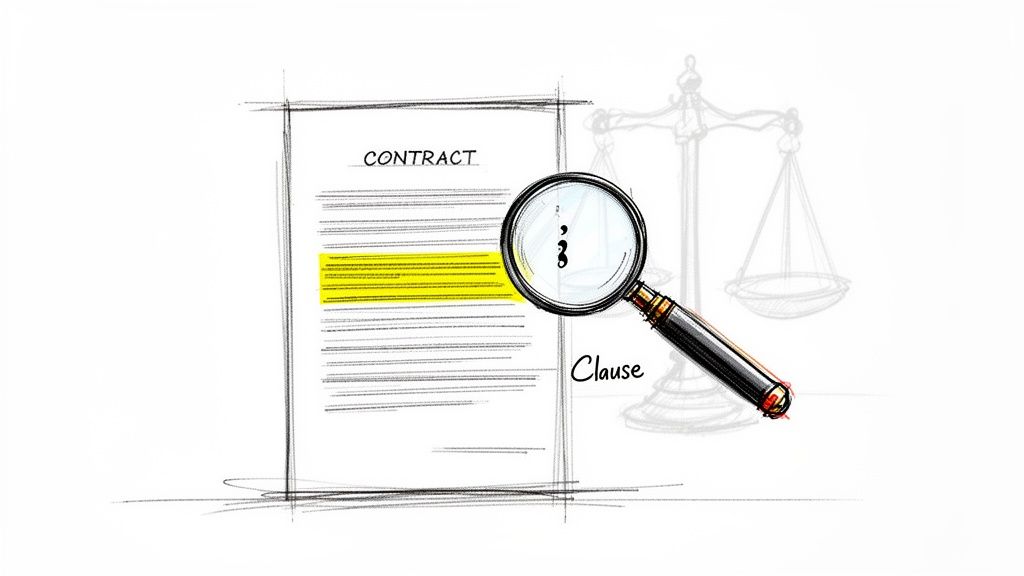
The stakes couldn't be higher. With marketing content, a little creative flair or a slight tonal shift is often welcome. In the legal world, that same flexibility can be catastrophic. Legal language is built on unyielding precision, where every single word, phrase, and punctuation mark carries immense weight and legal consequence. A small error doesn’t just cause a bit of confusion; it can completely invalidate an agreement or expose your organization to liabilities you never saw coming.
Picture a cross-border merger. The deal hinges on translated due diligence reports, shareholder agreements, and regulatory filings. If a term like "gross negligence" is translated with a slightly weaker meaning, it could fundamentally change liability clauses, potentially costing a company millions down the road. In another scenario, an improperly translated patent application could mean forfeiting your intellectual property rights in a new market.
The Maze of Different Legal Systems
One of the biggest hurdles is that legal systems are not one-size-fits-all. A concept like "force majeure" might have a well-understood definition in a common law country, but its interpretation under another nation's civil code could be wildly different. A literal, word-for-word translation would completely miss this critical distinction.
This is why a deep understanding of the process is non-negotiable. Your approach must account for:
- Jurisdictional Specificity: Legal language is tied to a local legal framework. Your translator needs to be fluent not just in two languages, but in two legal systems.
- Unwavering Confidentiality: Legal documents are packed with sensitive information—from trade secrets to personal data. A breach is not just an embarrassment; it's a disaster.
- Absolute Accuracy: There is no room for ambiguity. The translated document has to be a perfect legal mirror of the source text.
The real danger isn't a translation that's obviously wrong. It's the one that looks right but subtly twists a legal obligation or right. These are the silent errors that go unnoticed until they blow up in a courtroom.
Blending Modern Tools with Timeless Expertise
For decades, this work was done exclusively by highly specialized human translators, many of whom were lawyers themselves. Today, things are different. AI-powered tools bring incredible speed to the table, capable of processing huge volumes of text while maintaining complex formatting.
But trusting AI alone for a final, court-ready document is a massive gamble. The smartest approach today often marries the best of both worlds. A modern workflow might start with a high-quality draft from an advanced AI, which is then passed to a human legal expert for a meticulous review. This hybrid model gives you speed and cost-effectiveness without sacrificing the essential human oversight that legal work demands. Choosing the right path from the start is the most critical decision you'll make.
Setting Your Documents Up for Success
A high-quality legal translation doesn't begin the moment you upload a file. The real work—the most critical work, in fact—happens long before a single word gets translated. If you take the time to prepare your source documents properly, you can sidestep costly rework, clear up ambiguities, and speed up the entire process.
Think of it as setting the stage. A well-prepared document is the foundation for an accurate, legally sound translation, no matter if you're using AI, a human expert, or a hybrid approach. This prep phase is your single best shot at stamping out potential errors before they ever take root.
The global translation market hit approximately $75 billion in 2025, and with cross-border business booming, legal translation is a huge piece of that pie. Consider that some studies show mistranslations contribute to as many as 20% of international contract failures. The financial incentive to get this right from the very start is crystal clear. You can find more translation industry trends over at brightlinestranslation.com.
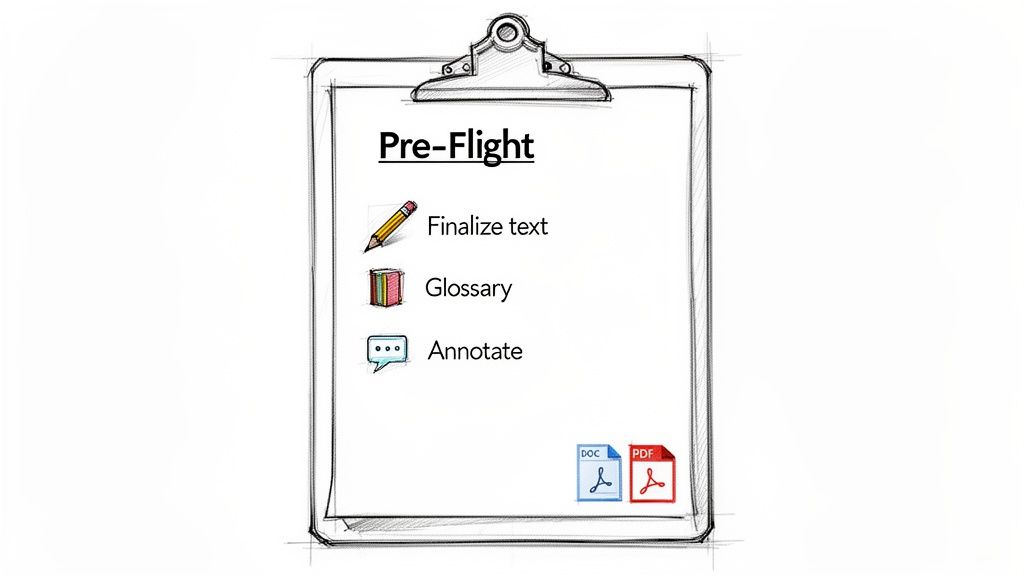
Finalize and Lock the Source Text
Here's the cardinal rule of document prep: only work with the final, approved version. Sending a draft for translation is a recipe for chaos. Any last-minute edits to the source text after translation has already started will mean re-translating those changes, which almost always comes with extra costs and delays.
It’s a version control nightmare that can quickly spiral out of control. It confuses the translator and dramatically increases the risk of inconsistencies slipping into the final translated version.
Pro Tip: Before you hand off that document, do one last read-through with every key stakeholder and get a definitive sign-off. Once it’s sent for translation, treat that source text as completely locked down. No more changes.
Create a Legal Terminology Glossary
Every legal case and every company has its own lingo. You have to ensure that terms like "Indemnifying Party" or specific product names are translated the exact same way across every single document to maintain legal integrity. A glossary—or a term base, as it's sometimes called—is a straightforward list of these crucial terms alongside their approved translations.
Putting this together upfront gives your translator explicit instructions. It eliminates guesswork and makes sure your company-specific language is perfectly preserved.
Here’s what your glossary should include:
- Key Terms: List any unique legal phrases, internal jargon, or technical terms that are non-negotiable.
- Approved Translations: For each term, provide the precise, pre-approved translation in the target language.
- Contextual Notes: Add a quick note explaining how a term should be used, especially if it could have multiple meanings.
Optimize Your Document Formatting
The format of your file can have a surprisingly big impact on the translation process, particularly when automated tools are involved. PDFs are everywhere, of course, but they can be a real headache for text extraction and preserving the original layout.
Whenever you can, stick with the original source file, like a Microsoft Word document (.DOCX). This format plays nice with just about all translation software and makes it far easier to keep complex elements like tables, headers, and footnotes perfectly intact.
If a PDF is all you have, make sure it’s a high-quality, text-based file—not a scanned image. Scanned documents have to be run through Optical Character Recognition (OCR) software to become editable text, a process that can introduce a whole new layer of errors you'll have to clean up before translation can even begin.
Annotate for Clarity and Context
Finally, don't hesitate to add comments and notes right inside the document itself. If a particular sentence is awkwardly phrased or contains a cultural reference that won’t translate directly, a quick note can be an invaluable guide for your translator.
This is especially helpful for clarifying things like:
- Ambiguous Phrases: Highlight any sentences that could be read in more than one way.
- Idiomatic Expressions: Point out any idioms and perhaps suggest the literal meaning you're trying to convey.
- Specific Instructions: Make a note of any text that should not be translated, such as company names, personal names, or addresses.
This small bit of effort provides crucial context that helps the translator make more informed choices, ultimately delivering a much more accurate final product.
Choosing the Right Translation Workflow
Deciding how to translate a legal document is one of the most critical calls you'll make. Should you trust an AI, bring in a seasoned legal translator, or use a mix of both? There’s no single right answer—it all comes down to the document’s purpose, its complexity, and your comfort with risk.
This isn't just about picking a tool; it's a strategic decision. Using a fast AI translation for an internal review of a low-stakes document can be a brilliant, cost-saving move. On the other hand, using that same AI for a contract headed to court is a disaster waiting to happen.
Make no mistake: errors in legal translation are never small. One industry report found that 40% of international businesses have dealt with disputes caused by poor translations, a problem that costs them millions. And while 83% of marketers might be fine using machine translation, the high stakes of legal work demand a much more careful approach. AI can slash human-error costs by 90% and is great for getting a first draft, but a human expert is often irreplaceable for the final, critical version. You can dig into the data on translation quality's business impact in this comprehensive industry report.
To make the right choice, you need to understand your options. Let's compare the three main workflows.
Comparing Translation Workflows: AI vs. Human vs. Hybrid
Each translation method has distinct advantages and is suited for different legal scenarios. This table breaks down the core differences to help you match the workflow to your specific needs.
| Feature | AI Translation (e.g., DocuGlot Basic) | Human Translation (Certified Professional) | Hybrid Workflow (AI + Human Review) |
|---|---|---|---|
| Best For | Internal review, non-binding drafts, research | Court filings, binding contracts, official submissions | Complex agreements, compliance docs, high-value content |
| Speed | Extremely fast (minutes) | Slow (days or weeks) | Fast (hours or days) |
| Cost | Low | High | Moderate |
| Accuracy | Good for gist, but misses legal nuance & context | Highest possible accuracy and legal defensibility | High, with human verification of all critical terms |
| Formatting | Excellent preservation of original layout | Manual and time-consuming | Excellent, with human fine-tuning |
| Scalability | Handles massive volumes effortlessly | Limited by human capacity | Highly scalable |
| Certification | No | Certificate of Translation Accuracy provided | Certificate of Translation Accuracy provided |
Ultimately, the hybrid model often presents the most balanced solution, but let's look at when you'd want to choose one of the other two approaches.
When to Use an AI-Only Translation
An AI-only workflow is all about speed and volume. Modern AI document translators are incredibly good at tearing through hundreds of pages in minutes, all while keeping the original file’s formatting—tables, headers, and all. This makes them a fantastic tool for specific, low-risk situations.
Think of it as a high-powered discovery tool. An AI-only approach is a great fit for:
- Internal Reviews: Your legal team needs to quickly get the gist of a huge batch of documents in another language for initial analysis.
- Non-Binding Drafts: You're working on early-stage contract drafts or internal memos where pixel-perfect precision isn't yet required.
- Research: You need to sift through foreign-language case law or statutes to gather background information.
The biggest win here is efficiency. You get a working translation almost instantly, letting your team make quick assessments without the days-long wait for a human translator. The trade-off, of course, is risk. AI can easily miss subtle legal nuances, cultural context, or specific jurisdictional phrasing that a human expert would spot immediately.
When to Rely on a Human Translator
For your most important documents, there's no substitute for a certified human translator. This is the gold standard for accuracy and legal defensibility. These professionals are much more than just bilingual—they are often lawyers or paralegals themselves, with deep expertise in fields like contract law, IP, or litigation.
Insist on a human-only workflow when the document is:
- Court-Ready: Anything being submitted in a legal proceeding, like evidence, affidavits, or pleadings.
- Binding Contracts: The final, executed versions of mergers, acquisitions, employment agreements, or international trade deals.
- Official Submissions: Immigration paperwork, patent applications, or regulatory filings that require a Certificate of Translation Accuracy.
A human translator doesn't just swap words; they translate legal intent. They grasp the weight of a specific term within a given legal system and ensure the translated document carries the exact same legal authority as the original.
This workflow gives you the highest possible assurance, but it comes at a price. It’s the most expensive option and takes the longest. For a large-scale project, relying solely on human translators can create a serious bottleneck.
The Power of the Hybrid Model
The hybrid workflow strikes a smart, pragmatic balance, blending the raw speed of AI with the fine-tuned precision of human expertise. It's no surprise this has become the go-to strategy for many law firms and corporate legal teams trying to balance cost, speed, and accuracy.
The process is simple and effective:
- An advanced AI platform like DocuGlot does the initial heavy lifting, translating the bulk of the text and perfectly preserving the document's structure.
- A professional human legal translator then steps in to perform a post-editing review of the AI-generated draft.
This approach works so well because it lets each part of the process play to its strengths. The AI handles the grunt work, and the human expert focuses their valuable time on nuance, verification, and ensuring absolute legal integrity. It's the ideal choice for a huge range of documents, from complex commercial agreements to compliance paperwork. Our guide to legal document translation shows exactly how this balanced approach delivers near-perfect results, faster and more affordably than going the human-only route.
Nailing the Terminology and Formatting in Legal Translation
Legal language isn't like everyday conversation; it's a completely different animal. Every word is chosen for a specific, high-stakes reason. A seemingly simple phrase in a U.S. contract, like "reasonable efforts," carries a legal weight and interpretation that can be worlds apart from its equivalent under E.U. law. Getting this right is everything.
This isn't just about finding the right words. It's about building a framework for accuracy and consistency, starting with a term base. Think of it as your project's private dictionary—a single source of truth that ensures everyone is on the same page.
Deciding on the best translation path—whether it’s pure AI, a human expert, or a hybrid approach—depends entirely on what you need the final document to do.
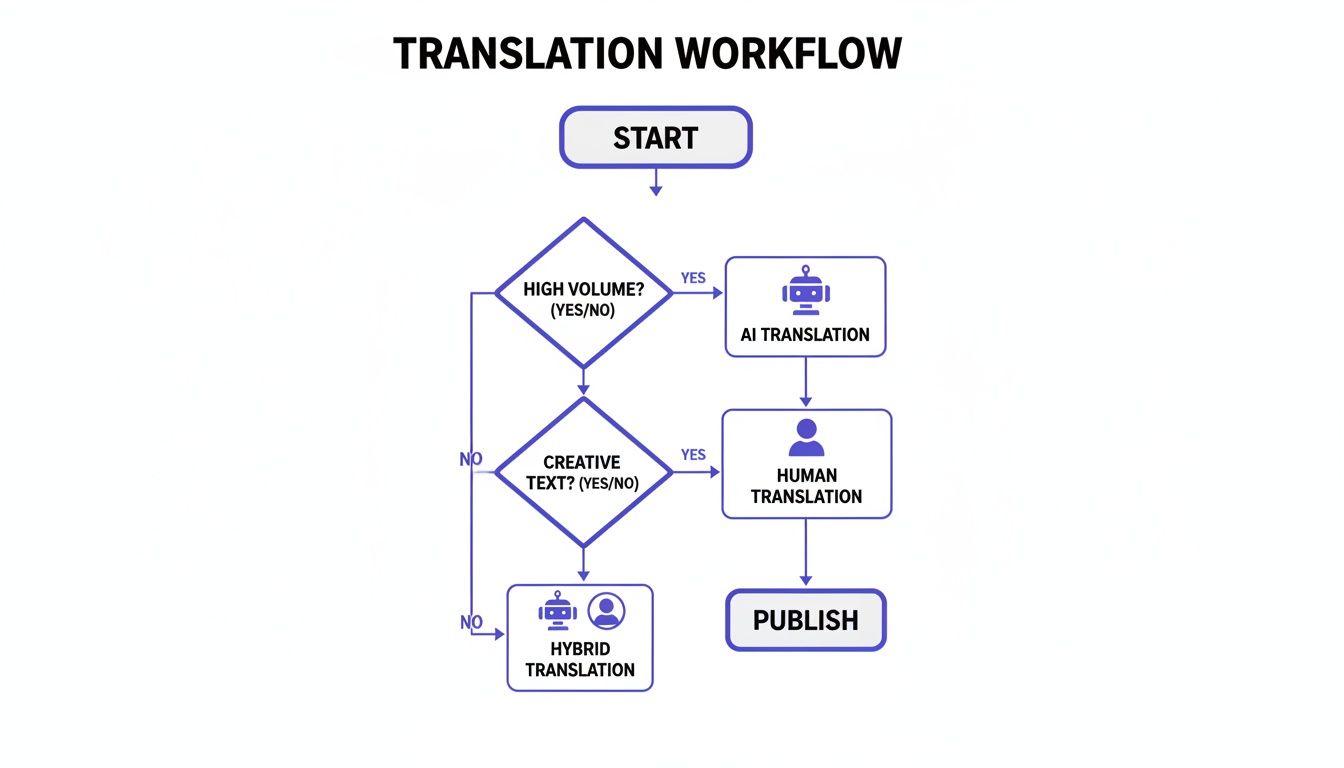
As you can see, the stakes of the document, from a casual internal review to a critical court filing, will dictate the workflow you choose.
Your Secret Weapon: The Legal Term Base
A term base, or glossary, is your first line of defense against ambiguity. It guarantees that critical phrases, company names, and defined legal terms are translated the exact same way every single time, across all your documents. This isn't just a matter of branding; it's a legal necessity.
A good term base should be a living document that captures:
- Core Legal Terms: List out every key definition from your source file, like "Indemnifying Party" or "Confidential Information."
- Approved Translations: Lock in the precise, lawyer-approved translation for each term.
- Contextual Notes: Add short, clear instructions on when and how to use a term, especially if it has a unique meaning in your case or industry.
Take a term like "without prejudice," for example. It has a very specific legal function that doesn't survive a literal, word-for-word translation. Your term base ensures the correct legal equivalent is used, not just something a dictionary spits out.
A well-maintained term base is the backbone of any serious legal translation project. It transforms translation from an art of interpretation into a science of precision, eliminating guesswork where it can least be afforded.
Don't Let Formatting Derail Your Document
Beyond the words, the actual structure of a legal document is often legally significant. The tables, numbered paragraphs, headers, and page numbers all have to stay perfectly intact. Imagine submitting a 100-page contract where all the paragraph cross-references are wrong because the layout shifted during translation. It’s a nightmare.
This is a classic headache, particularly when dealing with tricky file types. Manually rebuilding a document's layout is painstakingly slow and a recipe for human error.
This is exactly where modern, AI-powered translation tools shine. The best platforms are built to analyze a file’s structure—whether it's a DOCX or a complex PDF—and replicate it flawlessly in the translated version. You upload a file, and you download a perfect mirror image in the new language. If you wrestle with PDFs often, our guide on how to translate a PDF has some great, practical tips for keeping your formatting solid.
Navigating Different Jurisdictions
Getting the terms and formatting right also means thinking about the legal environment where the document will be used. What’s standard procedure in one country can be completely meaningless in another.
Keep an eye out for these common tripwires:
- Date Formats: A date like 05/06/2025 means May 6th in the U.S. but June 5th across most of Europe. In a contract, that one little mix-up could blow a critical deadline.
- Measurement Units: If your legal documents mention measurements, they need to be localized. You'll need to convert metric units to imperial for a U.S. audience (and vice-versa) for the document to make sense.
- Legal Formalities: Some jurisdictions demand specific boilerplate language or formal salutations that simply don't exist in the source language. A seasoned translator will know to add these to ensure local compliance.
True legal translation is a three-legged stool: consistent terminology, preserved formatting, and sharp awareness of jurisdictional rules. Nail all three, and you'll have a document that is not only accurate but legally sound and effective in its new home.
Getting to the Finish Line: Quality Assurance and Certification
Just because the last word is translated doesn't mean the job is done. For any legal document, the most crucial phase is the final check—the part where you confirm the translation is not just accurate, but legally sound. This final layer of quality assurance (QA) and formal certification is what elevates a simple text into a defensible legal instrument.
Skipping this step is like leaving the document's integrity to chance. A thorough QA process is designed to catch those subtle errors, confirm that tricky legal nuances have been handled correctly, and prepare the document for submission to courts, government agencies, or international bodies. Honestly, for high-stakes legal work, this isn't optional.
The Power of a Second Set of Eyes: The Bilingual Review
The absolute cornerstone of any solid legal translation QA is the bilingual review. This is so much more than a quick proofread. It’s a meticulous, side-by-side comparison of the source and target documents by a second qualified expert. Think of this person as your safety net, hunting for any discrepancy, no matter how small.
Your reviewer should be a native speaker of the target language who also has a strong background in that specific legal field. Their mission is to verify a few critical things:
- Pinpoint Accuracy: Are all facts, dates, names, and figures translated perfectly?
- Legal Nuance: Do key legal terms carry the correct weight and meaning in the new jurisdiction? This can be a minefield.
- Consistency: Is the terminology consistent from the first page to the last, and does it align with the project glossary?
- Tone and Formality: Does the language have the appropriate formal register required for a legal document?
This review is your best defense against the small, overlooked mistakes that can snowball into major legal headaches. It ensures the translated document is a true and faithful representation of the original in every legal sense.
Think of the bilingual review as the legal equivalent of a peer review for a scientific paper. It’s an essential validation step performed by an independent expert to ensure the work meets the highest standards of accuracy and integrity before it's published or submitted.
Making It Official: Certification and Notarization Explained
Once you’re confident in the translation's accuracy, you often need to make it official. This is where certification and notarization come in, providing the formal proof that your document is ready for its intended purpose.
A Certificate of Translation Accuracy is a signed statement from the translator or translation agency. It's a formal declaration that, to the best of their knowledge, the translation is a complete and accurate rendering of the original. Many official bodies, from immigration services to courts, require this as a standard part of any submission.
If you're navigating these official requirements, it helps to understand what's involved in obtaining a professional certified document translation.
Sometimes, you need another layer of validation. That's when notarization comes into play. A Notarized Translation means a licensed Notary Public has officially witnessed the translator signing the Certificate of Translation Accuracy, verifying their identity. The notary isn’t checking the translation itself; they're confirming that the signature on the certificate is legitimate.
And when you're dealing with documents that need to cross borders, it's vital to understand the different levels of authentication. You may need to look into the distinction between an Apostille and a Notary Public, since an Apostille is often required for documents to be recognized in countries that are part of the Hague Convention.
Knowing which one you need is key. Here’s a quick breakdown:
- Certified Translation: Usually required for most domestic purposes, like USCIS applications or local court filings.
- Notarized Translation: Often requested for things like academic transcripts, international business contracts, or certain government proceedings.
- Apostille: A must-have for documents to be legally recognized in foreign countries that are members of the Hague Apostille Convention.
Protecting Confidential Information During Translation
Legal documents are, by their very nature, a goldmine of sensitive information. We're talking about everything from proprietary trade secrets to personally identifiable information (PII). When you're deciding how to translate these materials, security can't just be a box you check at the end—it has to be baked into your process from the very beginning. A data breach linked to a translation project can trigger a cascade of legal and financial nightmares.
The first move you should make is to put any potential translation provider under a microscope. Don't just take their word for it when they promise confidentiality; you need to see concrete evidence of their security measures. A trustworthy service will have a solid foundation of both technical safeguards and procedural rules designed to protect your data at every single step.
Key Security Protocols to Verify
Before you even think about uploading a file, get confirmation that the provider has a serious security framework in place. Ask to see their policies on data handling, who can access files, and how they dispose of them. It's also worth brushing up on general best practices with this helpful guidance on handling confidential information.
Your security checklist must include these non-negotiables:
- End-to-End Encryption: Your files need to be encrypted both in transit (as they're being uploaded and downloaded) and at rest (when they're sitting on a server). This is the absolute baseline for protecting sensitive information.
- Strict Access Controls: Who on their team can see your documents? Access should be limited strictly to authorized personnel. Inquire about their internal rules and how they prevent prying eyes.
- Data Destruction Policy: Find out what happens to your files once the job is done. A secure provider will have a clear, automatic deletion policy. For instance, DocuGlot permanently removes all files after 24 hours to shrink the window of exposure.
- No Third-Party Sharing: The provider needs a zero-tolerance policy for sharing your documents with anyone outside their organization. This should be spelled out explicitly in their terms of service.
When you share a legal document, you are entrusting a provider with highly privileged information. Their security measures should be as strong as your own internal IT policies, with clear, auditable processes for data protection.
Ultimately, the smartest path is to work with a platform that has transparent, built-in security features. This gives you peace of mind, knowing your documents are locked down from the moment you upload them to the second they're permanently wiped from the system.
Common Questions About Legal Document Translation
When you're dealing with legal document translation, a few key questions always seem to pop up. Getting the right answers is crucial for making smart choices that protect your documents and your legal position. Let's break down some of the most common ones I hear.
How Much Does It Cost to Translate a Legal Document?
This is the big one, and the honest answer is: it depends. The price can swing wildly depending on the path you take.
Purely AI translation tools are your most budget-friendly option. They usually offer clear, per-word pricing and are great when you need a fast translation of less sensitive documents. On the other hand, a professional human translator will cost significantly more. They typically charge by the word or by the hour, and you can expect premium rates for highly technical legal content, like patent filings or complex litigation.
Many people find a sweet spot with a hybrid approach. You can use an AI tool for the heavy lifting—the initial draft—and then bring in a human expert to review and refine it. This often gives you the best balance of speed, accuracy, and cost. No matter which route you choose, always get a detailed quote upfront to avoid any sticker shock.
What's the Difference Between a Certified and a Notarized Translation?
This is a critical distinction that often trips people up.
A certified translation comes with a signed statement (often called a Certificate of Accuracy or an affidavit) from the translator or their agency. This statement is their professional guarantee that the translation is a complete and accurate reflection of the original document. This is the standard for most official business, like USCIS immigration paperwork or evidence submitted in court.
A notarized translation takes it one step further. A Notary Public watches the translator sign the certificate of accuracy and then adds their own seal and signature. The key thing to remember is that the notary isn't verifying the quality of the translation; they are only verifying the identity of the person who signed it. This extra layer of authentication is sometimes required for things like international academic records or certain high-stakes corporate documents.
Can I Just Use a Free Online Tool for a Legal Contract?
I'll be blunt: using a free, public translation website for a legal contract is a terrible idea. It's strongly discouraged for two huge reasons.
First, security is practically nonexistent. These platforms are not built to handle confidential information. When you upload your document, you're essentially putting it on a public server. Their terms of service often give them the right to use your data, which is a massive breach of confidentiality waiting to happen.
Second, they just aren't smart enough. These tools can't understand the subtle nuances, specific terminology, or jurisdictional context that are the lifeblood of a legal document. A single misplaced word can change the entire meaning of a clause. For anything remotely sensitive, you absolutely need a professional service that contractually guarantees your data will be kept secure and confidential.
Ready to translate your documents with confidence? DocuGlot offers a secure, AI-powered platform that preserves your original formatting while delivering fast, accurate results. Our system uses end-to-end encryption and automatically deletes your files after 24 hours, ensuring your sensitive information stays protected. Get your instant quote and start your translation at https://docuglot.com.
Tags
Ready to translate your documents?
DocuGlot uses advanced AI to translate your documents while preserving formatting perfectly.
Start Translating