Translating Documents for USCIS: Essential Guide to Certification and Formatting
When you're translating documents for USCIS, it's about much more than just switching words from one language to another. You need a certified translation—one that’s complete, accurate, and formatted just right. I’ve seen it happen time and again: a single mistake, like a wrong date or a missed stamp, can bring an entire application to a screeching halt.
Why USCIS Translation Quality Is Non-Negotiable
Navigating the U.S. immigration system is a marathon of details. Every single piece of paper matters. When you submit documents in a foreign language, the English translations you provide become a critical piece of your official record. The USCIS officers reviewing your case depend on these translations to confirm who you are, verify your eligibility, and ultimately, to trust your story. There's zero room for error.
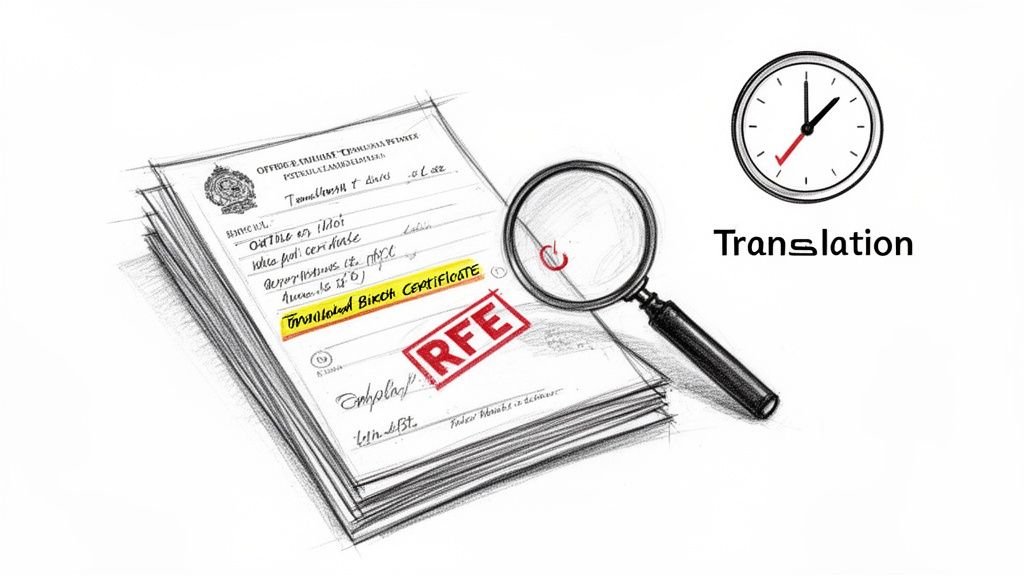
Let's consider a real-world scenario. You're submitting a marriage-based green card application (Form I-130). You get your foreign birth certificate translated, but the person doing it overlooks an official seal or a tiny note in the margin. To a USCIS officer, this isn't a minor slip-up. It's an incomplete document that immediately casts doubt on your submission. This is exactly the kind of thing that triggers a Request for Evidence (RFE), putting your application on ice for months while you scramble to fix it.
The Real-World Impact of Translation Errors
Even what seems like a small discrepancy can have a massive domino effect. An inaccurate translation can create misunderstandings that put your entire case at risk. For example, a poorly translated bank statement could accidentally misrepresent your income, leading an officer to question whether you meet the strict financial sponsorship requirements.
This isn't just hypothetical. Denial rates were hovering around 12% in FY 2023, and a significant chunk of those rejections were tied to documentation problems, including shoddy translations. While the average processing time for a family-based I-485 was about 8.2 months, that figure can easily stretch to over a year if your case gets flagged with an RFE due to translation issues. You can dig into more of these numbers over at The Language Doctors blog.
A certified translation isn't just a converted text; it's a legal document. USCIS treats it as such, and any perceived sloppiness can undermine the trustworthiness of your entire submission.
At the end of the day, the responsibility falls on you, the applicant. Your translated documents must be so clear and precise that they leave absolutely no room for question or ambiguity. This is why getting it right from the very beginning is so important.
USCIS Document Translation at a Glance
To simplify things, here's a quick rundown of what you need to keep in mind. Getting these three elements right is fundamental to a successful submission.
| Requirement | Why It Matters | Common Pitfall |
|---|---|---|
| Complete Translation | Every single word, stamp, and seal must be translated. USCIS needs to see an exact mirror of the original document. | Overlooking marginal notes, seals, or text on the back of the page, leading to an RFE for an "incomplete document." |
| Certification Statement | This signed statement from the translator attests to the accuracy of the translation and their competence in both languages. | Forgetting to include the translator's contact information, signature, or the date of translation. |
| Formatting | The translation should mimic the layout of the original as closely as possible to make it easy for the officer to compare them side-by-side. | Submitting a plain block of text that doesn't show where stamps or signatures were on the original document. |
Following these guidelines isn't just about checking boxes; it's about making the reviewer's job as easy as possible, which can only help your case.
Establishing Credibility and Completeness
Your goal should be to create a seamless experience for the USCIS officer reviewing your file. A professional, well-organized translation package shows you’re serious and respectful of the process. A solid package always includes:
- A perfect mirror of the original: The layout of the translation, right down to the placement of stamps, signatures, and seals, should reflect the source document.
- A flawless certification statement: This is the translator’s signed guarantee, confirming their fluency and the accuracy of their work. It's non-negotiable.
- Clarity and consistency: Make sure all names, dates, and places are spelled and formatted the same way across every single document you submit.
When you meet these standards, you aren't just handing over paperwork. You're building a credible, bulletproof case that’s primed for a smooth and timely review.
Decoding the USCIS Certified Translation Rules
Let's clear up a common and costly misconception right away. When you hear the term “certified translation” for USCIS, your mind might jump to expensive, state-licensed professionals. But that’s not what USCIS actually requires.
A “certified translation” is simply a translated document that includes a signed statement from the translator. This statement—often called a "Certificate of Accuracy"—is the translator's personal guarantee. They're attesting that the English version is a complete and accurate copy of the original.
That’s it. It’s a formal promise of quality, not a fancy government credential. This is a crucial distinction because it means you have options. The focus for USCIS isn't on the translator's title, but on the integrity of their signed statement.
Who Can Translate Your Documents?
So, who's qualified to do this? The rules are surprisingly flexible. The main requirement is that the translator must be fluent in both English and the document's original language. They need a solid command of both to get the translation right.
This opens the door to a few different people:
- A Professional Translator: This is often the safest and easiest route. Reputable translation companies know exactly what USCIS needs and include the certification as part of their standard service.
- A Fluent Friend or Colleague: A friend, family member, or coworker who is genuinely bilingual can absolutely do the translation. They just need to be willing to sign their name to the certification, which makes them legally responsible for its accuracy.
There's one major exception: you. As the applicant or petitioner, you can't translate your own documents. USCIS sees this as a conflict of interest and will reject any translation you certify yourself. It needs to come from an impartial third party.
The 3 Core Elements of a USCIS Certification
Every single certification statement must have three specific components. If you miss even one of these, you're practically inviting a Request for Evidence (RFE), which can derail your application for months.
- A Statement of Competence: The translator has to explicitly state that they are competent to translate from the foreign language into English.
- A Declaration of Accuracy: The statement must confirm the translation is complete and accurate to the best of their knowledge.
- The Translator's Contact Info: You'll need the translator's full name, signature, address, and the date they signed it. This makes them accountable for their work.
Think of the certification as the backbone of your submission. It's not just red tape; it's the legal assurance that the USCIS officer is reading a faithful and trustworthy version of the original document.
A Sample Certification Statement You Can Use
To put this into practice, here’s a simple template that ticks all the boxes for USCIS. This should be on a separate page, attached to both the copy of the original document and the English translation.
Translator Certification Statement
I, [Translator's Full Name], hereby certify that I am fluent in English and [Original Language], and that the foregoing document is a complete and accurate translation of the document titled "[Original Document Title]" from [Original Language] to English.
Signature: ____________________
Translator's Full Name: [Translator's Full Name]
Address: [Translator's Full Street Address, City, State, ZIP Code]
Telephone Number: [Translator's Phone Number]
Email Address: [Translator's Email Address]
Date: [Month, Day, Year]
Using a clear and complete certification like this one shows the reviewing officer that you've done your homework. It leaves no room for doubt about the translation's quality, helping your application move forward without unnecessary delays. By getting this small but critical detail right, you can avoid some of the most common pitfalls that stall immigration cases.
Assembling Your Submission-Ready Translation Package
You’ve got the translation finished and the certification is signed. Great. But don't just throw the papers in an envelope. How you assemble everything is the final, crucial step. A clean, organized submission makes the USCIS officer’s job easier and speaks volumes about the quality of your entire application.
Think of it this way: for every single foreign-language document, you're building a complete, self-contained unit. The goal is to leave absolutely no room for confusion.
Start with a High-Quality Copy of the Original
First things first, you need a perfect copy of the original document. This isn’t the time for a quick photo with your phone. Break out a flatbed scanner to get a high-resolution digital copy, or at the very least, make a crisp, clean photocopy.
Every single bit of that original document has to be crystal clear. That means:
- The front and the back, even if the back is totally blank.
- All stamps, seals, and signatures, no matter how faded they look.
- Any little handwritten notes tucked away in the margins.
This copy is your "source document." It's what the USCIS officer will use to compare against the translation. If it's blurry, cropped, or missing anything, it immediately casts doubt on the whole package.
Ensure the Translation is Truly Complete
"Complete" is a word USCIS takes very seriously. It means every single word from the original document has been translated into English. But it goes beyond just the text. You have to account for everything else on the page.
For instance, if the original birth certificate has an official seal, the translation must include a note like [Seal] in the exact same spot. The same applies to signatures, stamps, or even that bit of illegible handwriting you can't make out. Mark them as [Signature] or [Illegible text]. This shows the officer that you didn’t just ignore things you couldn't translate.
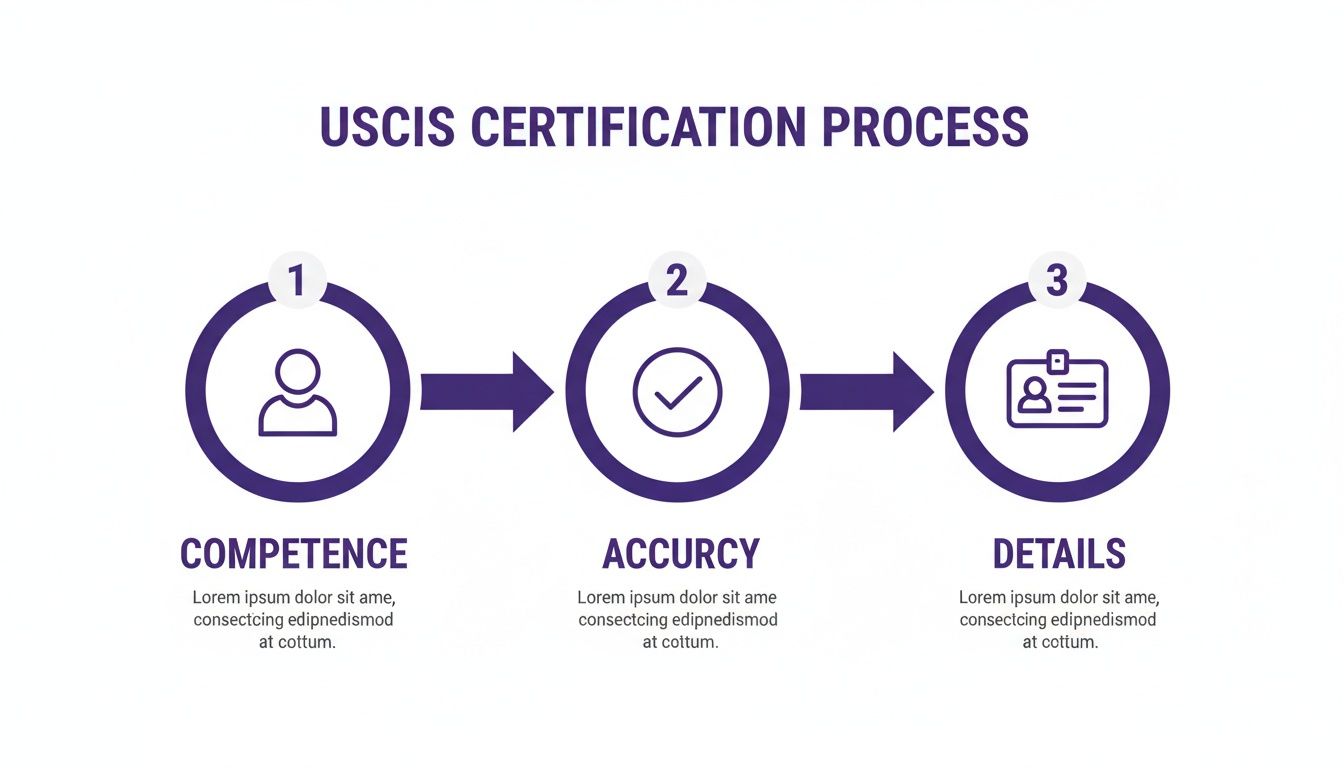
As you can see, a solid submission is built on three pillars: a competent translator, a guarantee of accuracy, and the translator’s full contact details. Together, these create a certification that USCIS can trust.
Mirror the Original Document’s Format
This is a detail people often miss, but it’s so important: the English translation should look as much like the original as possible. When the format is mirrored, the reviewing officer can quickly match up names, dates, and other key details between the two documents without having to hunt for them.
An accurate translation isn’t just about words—it’s about structure. When an officer can easily compare the source and translated documents line-by-line, it builds confidence in your submission and streamlines the review process.
If the source document has a table, your translation needs a table. If there’s a signature on the bottom right, the translated document should have [Signature] noted in that same spot. This meticulous attention to the layout shows you've been thorough and professional.
This is one area where specialized tools really shine. If you're curious, you can learn more about our USCIS-compliant document translation services, which are built to preserve the original formatting automatically.
Combine Everything into a Single Package
For each document you're translating, you're going to create one complete, individual package. Don’t mix and match. Your birth certificate translation package should be entirely separate from your marriage certificate package.
Here’s the right way to stack them:
- The English Translation: Put the final translated document right on top.
- The Certification Statement: The signed Certificate of Accuracy goes next.
- The Copy of the Original Document: The clear copy of the foreign-language document is the last piece of the puzzle.
Staple these three items together in that specific order. Now you have a single, unified file for that document, ready to go.
Keeping your paperwork in perfect order is a universal rule in immigration. For instance, the detailed process of applying for permanent residence in Canada also requires this level of organization to prevent delays. The principle is exactly the same for USCIS: clarity and organization are your best friends for a smooth review.
How Technology Is Making Complex USCIS Translations Easier
Anyone who’s prepared a USCIS application knows it’s a high-stakes puzzle. You're trying to get every word right, nail the certification, and make sure the translation is a perfect mirror of the original document. For years, that meant a painful, manual process that was an open invitation for human error, especially with documents full of tables, stamps, and tricky layouts like birth certificates or bank statements.
This old-school approach isn't just slow—it's risky. A simple formatting mistake, like a misaligned column on a translated bank statement, can throw a USCIS officer for a loop. That kind of confusion is a fast track to a Request for Evidence (RFE), which can put your entire application on ice.
This image perfectly captures how modern tools bring together security and innovation. It's that exact combination you need when you're handling the sensitive personal data required for USCIS filings.
The Game Changer: Perfect Format Preservation
The single biggest headache in translating documents for USCIS is keeping the original layout intact. An officer needs to be able to lay the original and the translation side-by-side and have them match up. This is where modern tech, especially AI-powered translation platforms, completely changes the game.
Instead of trying to manually rebuild a table or guess where a seal should go, these tools can analyze the structure of your original file. They instantly identify and preserve key elements:
- Headers and Footers: Kept exactly where they belong.
- Tables and Columns: The grid structure is maintained for easy, direct comparison.
- Text Styles: Visual consistency is locked in.
- Image Placement: Graphics, logos, and official seals stay in their original spots.
The technology then translates the text within this preserved structure, giving you a file that's a true mirror of the original. All that guesswork is gone, and so is the risk of a formatting-related RFE.
Speed and Efficiency for Those Tight Deadlines
Beyond formatting, the sheer speed of technology is a huge advantage. A traditional translation service can take days, sometimes weeks, depending on the document. If you're a legal professional or an applicant staring down a deadline, that wait can be incredibly stressful.
AI-driven platforms can translate and format a multi-page document in minutes. This kind of rapid turnaround lets you move so much faster. It gives you the breathing room to review everything, get the certification signed, and assemble your final package without that last-minute scramble. This trend is part of a larger shift in how law firms and technology are intersecting to drive efficiency, which is a massive help for complex immigration work.
By automating the most tedious parts of translation—the formatting and the initial text conversion—technology frees up human experts to focus on what they do best: confirming nuance, ensuring accuracy, and signing a compliant certification statement.
This completely transforms the workflow. It's no longer about painstakingly rebuilding a document from scratch. It's about using a powerful tool for the heavy lifting, followed by a quick human review to ensure quality.
Keeping Your Confidential Information Secure
Let's be honest, you're dealing with incredibly sensitive documents—passports, financial records, birth certificates. Security isn't just a feature; it's a necessity. Sending these files to unvetted freelancers or using free, generic online tools is a huge, unnecessary risk.
Professional-grade translation technology is built with security at its core. You should always look for platforms that offer:
- End-to-End Encryption: Your documents are protected from the moment you upload them to when they're stored.
- Automatic File Deletion: A good policy is to ensure your files aren't kept on a server indefinitely.
- Secure Data Handling: A clear promise that your private information won't be shared with anyone.
This is where specialized services really stand out. Tools like DocuGlot, for example, provide an AI-powered translation service that preserves PDF and DOCX formatting in over 100 languages. For teams dealing with sensitive files, features like encryption and automatic file deletion after 24 hours provide genuine peace of mind.
Ultimately, the right technology becomes your compliance partner. It helps you produce accurate, professionally formatted, and secure translations that meet USCIS's incredibly high standards.
Common Translation Mistakes and How to Sidestep Them
I've seen it happen countless times: a small, seemingly innocent mistake on a translated document brings an entire USCIS application to a screeching halt. The dreaded Request for Evidence (RFE) arrives, and what follows is weeks, sometimes months, of delays and unnecessary stress.
The frustrating part is that these errors usually aren't intentional. They're simple oversights. But to the USCIS officer reviewing your file, an incomplete translation or a missing signature looks the same—it raises questions. Let's walk through the most common pitfalls I see and, more importantly, how you can avoid them.
The "Incomplete Translation" Trap
This is probably the single biggest mistake people make. They translate the obvious parts of a document—the names, dates, and main text—but completely ignore everything else.
Here’s a real-world scenario: An applicant submits a beautiful translation of their diploma from their home country. The university name, degree, and graduation date are all perfect. But they forgot about the official university seal in the corner and a tiny, handwritten registrar’s note on the back.
To USCIS, this translation is incomplete. Every single marking on that original document needs to be accounted for in the English version. If something is missing, the officer has no way of knowing if it was important or if information is being deliberately hidden.
How to get it right:
- Translate absolutely everything. I mean it—stamps, seals, signatures, watermarks, barcodes, and any notes scribbled in the margins.
- Describe what you can't translate. For things like seals or signatures, you can't "translate" them, but you must acknowledge them. Use bracketed descriptions like
[Official University Seal]or[Signature]. - Acknowledge illegible text. If you can't read a word or a stamp, don't just skip it. Note it as
[Illegible text]in the corresponding spot on the translation. This shows you're being thorough.
The Flawed Certification Statement
Next up is the certification statement. This isn't just a friendly note from your translator; it's a formal declaration that USCIS takes very seriously. A weak or incomplete certification renders the entire translation invalid.
Imagine this: A friend who is fluent in both languages translates a marriage certificate and attaches a note that says, "I translated this. It's accurate. Signed, John Smith."
That's not going to fly. The USCIS officer needs to know who John Smith is, how to contact him, and what qualifies him to make this translation. That simple note offers no proof of competence or accountability.
The certification is your translator’s legal guarantee to USCIS. A flawed or missing statement invalidates the entire translation, no matter how accurate the content is.
How to get it right:
Your translator's certification statement must—at a minimum—include these four key elements:
- A statement confirming their competence to translate from the source language into English.
- A declaration that the translation is complete and accurate to the best of their knowledge and ability.
- The translator’s full name, signature, and current address.
- The date they signed the certification.
For a deeper dive into crafting these statements perfectly, check out our comprehensive guide on how to translate legal documents.
Forgetting to Include the Original Document
This one sounds almost too simple to be a real mistake, but it happens more often than you'd think. An applicant will carefully prepare the English translation and the certification statement but forget to include a copy of the actual foreign-language document.
This is a critical failure. The whole point of submitting these documents is to allow the USCIS officer to compare the original with your certified translation. Without the source document, the translation is just a piece of paper with no context or proof.
How to get it right:
Think of each translated document as a complete, three-part package. For every single document you translate, you need to assemble and submit the following, in this specific order:
- The complete English translation.
- The signed certification statement from the translator.
- A clear, high-quality copy of the original foreign-language document.
Staple these three pages together. Creating this self-contained packet for each document makes the officer's job easy, which is exactly what you want for a smooth and fast review.
Got Questions About USCIS Translations? We've Got Answers.
Even when you think you have all the rules down, a few tricky questions always seem to pop up right when you're in the middle of preparing your immigration paperwork. Getting straight answers can be a huge relief and save you from some serious last-minute stress. Let's walk through some of the most common questions I hear from people dealing with USCIS translations.
Do I Really Need to Get the Translator’s Certification Notarized?
Nope. This is probably the biggest myth out there. USCIS does not require notarization for a translator's certification statement.
It’s easy to see why people think this is a good idea—it feels more "official," right? But the reality is, USCIS guidelines are crystal clear on this. A simple, signed certification from a qualified translator is all you need.
While adding a notary's stamp won't get your application rejected, it’s an extra step and an expense you can skip. Your time is much better spent making sure the certification itself has everything USCIS actually asks for.
Forget the notary seal. Just focus on what USCIS actually looks for: a statement of fluency, a promise of accuracy, and the translator's full name, signature, address, and the date.
Can I Just Translate Documents for My Husband/Wife/Mom?
This one is a bit of a gray area, but the short answer is yes... with a big "but." You can't translate your own documents (like your own birth certificate if you're the main applicant). But you can usually translate documents for your spouse or another family member, as long as you aren't the petitioner or beneficiary in that specific filing.
The whole point is to avoid a conflict of interest. If you go this route, you must be completely fluent in both languages and provide the same professional certification statement anyone else would. You're basically vouching for your own abilities and the accuracy of your work.
Honestly, the safest bet is to use a neutral third party. It removes any doubt or perception of bias from the officer reviewing your case.
What if There’s a Typo on the Original Document?
This is so important: you must translate the document exactly as it is, mistakes and all. Your role as a translator is to create a perfect mirror of the original text, not to be an editor.
Don't try to fix spelling errors, wrong dates, or messed-up names in your translation. Changing anything, even with the best intentions, could be flagged by USCIS as misrepresenting the original document. It's a serious issue.
If you're worried an error on the original could cause a problem, here’s what you can do:
- Get it Corrected: The ideal solution is to go back to the source—the agency in your home country that issued the document—and ask for a corrected version.
- Add a Note: If getting a correction is impossible, you could attach a separate, brief letter explaining the error. But the translation itself must remain a faithful copy of the flawed original.
Should I Use a Human Translator or an AI Tool?
For USCIS submissions, the best strategy today is often a mix of both. The one thing you absolutely cannot skip is the human-signed certification statement. An AI tool can’t sign that for you.
AI translation platforms are fantastic for doing the initial heavy lifting. They're especially good at keeping the original formatting of complex documents like birth certificates, which is a huge deal for USCIS. This alone saves a ton of time and helps you avoid frustrating manual formatting mistakes.
Here's the workflow that gives you the best of both worlds:
- Use a specialized AI tool to get a fast, accurate, and perfectly formatted first draft of the translation.
- Have a fluent human—a professional or even a bilingual friend you trust—review the AI's work to catch any weird phrasing or cultural nuances.
- That same person then signs the certification statement, taking full responsibility for the final, polished document.
This approach gives you the speed and precision of modern tech while making sure you hit that critical human certification requirement that USCIS insists on.
Ready to pair the efficiency of AI with the compliance USCIS requires? DocuGlot provides AI-powered document translation that preserves your original formatting from start to finish. It makes that first step of your preparation faster and more accurate. Just upload your PDF or DOCX and get a translation ready for review in minutes. Give it a try now at DocuGlot.com.
Tags
Ready to translate your documents?
DocuGlot uses advanced AI to translate your documents while preserving formatting perfectly.
Start Translating