The Ultimate Guide to AI Powered Translation Service
Picture this: you've just spent hours getting a proposal formatted perfectly. The tables are aligned, the headers look sharp, and the layout is clean. You send it for translation, and what comes back is a total mess—shattered tables, misplaced headers, and a layout that’s completely unrecognizable.
This nightmare scenario is exactly what the new wave of AI-powered translation services was built to prevent. These tools are much smarter than simple word-for-word translators; they’re designed to keep the entire structure of your file intact.
Say Goodbye to Broken Translations and Formatting Headaches
For a long time, instant translation came with a huge trade-off: it would wreck your documents. Trying to translate anything more complicated than a block of plain text usually meant spending hours on tedious reformatting afterwards. Tables would collapse, bullet points would disappear, and all the professional polish you put into the original would vanish.
This was a major bottleneck for anyone—from legal teams to marketing departments—who relies on well-structured documents to communicate effectively.
The frustration pushed the technology in a new direction. Instead of just swapping words from one language to another, today's AI services focus on preserving the entire document. Think of them less like a dictionary and more like a digital restoration expert, carefully maintaining the layout, styling, and visual elements that give your content its impact.
A Market Driven by Real-World Needs
This shift toward smarter tools isn't a small trend; it reflects a massive global need for better cross-language communication. The market has absolutely exploded, jumping from $1.88 billion in 2023 to $2.34 billion in 2024. That's a staggering 24.9% compound annual growth rate.
This incredible growth tells a clear story: businesses everywhere urgently need to break down language barriers for everything from e-commerce product descriptions to critical legal contracts. Discover more insights about this rapid market growth and what it means for global business.
This guide will walk you through how services like DocuGlot are at the forefront of this change. We'll unpack the technology that allows these platforms to maintain everything from a complex DOCX file to the pixel-perfect layout of a PDF. The whole point is to make sure your message lands just as professionally in any language.
The core promise of a modern AI-powered translation service is simple: what you upload is what you get back, just in a new language. This complete format preservation is what separates basic tools from professional-grade solutions.
Whether you’re dealing with a quick memo or a dense technical manual, the expectation is the same. You need a translation that’s not just linguistically correct but also looks identical to the original. You can check out our detailed guide on how to translate a PDF to see this technology in action.
How AI Translation Actually Works Under the Hood
Forget thinking about AI translation as a simple word-for-word dictionary. A better way to picture it is like a highly skilled digital architect. Before even touching the words, this architect creates a perfect blueprint of your document, mapping out every header, table, image, and paragraph. This initial step is the secret to keeping your document’s layout intact.
The real magic happens with a technology called Neural Machine Translation (NMT). Imagine an enormous digital brain that has studied billions of sentences across hundreds of languages. Unlike older, clunkier systems that translated phrase by phrase, NMT models look at entire sentences to understand the context, tone, and nuances.
This ability to grasp context is what makes all the difference. Take the English word "set"—it has over 400 different meanings! An old-school tool would get tripped up, but an NMT model sees the surrounding words and knows if you mean "a set of keys," "to set the table," or "the sun will set." This is why modern AI translations feel so much more human and accurate.
The Document Reconstruction Process
When you upload a file, a sophisticated process kicks off behind the scenes. It's far more than just swapping words; it's a careful deconstruction and reconstruction of your entire document.
First, the platform takes in your file, whether it's a PDF, a DOCX, or another common format. It then does two key things at once:
- Text Extraction: The AI pulls out all the text that needs translating—from the main paragraphs and headings right down to the tiny captions under images.
- Structural Mapping: As it extracts the text, the system saves that "blueprint" we talked about, logging the exact location, fonts, and styles of every single element.
With the text isolated and the blueprint saved, the core translation begins. The power behind this comes from engines developed with specialized AI training software that fine-tunes their linguistic capabilities. Once the NMT engine finishes, the final, most critical phase starts.
The system meticulously places the new, translated text back into the original blueprint. It’s like pouring concrete into a perfectly formed mold. This is how a translated business proposal ends up with its tables, headers, and page numbers looking exactly like they did in the original.
This simple diagram shows the three-step flow you’ll find in just about any modern AI document translation service.
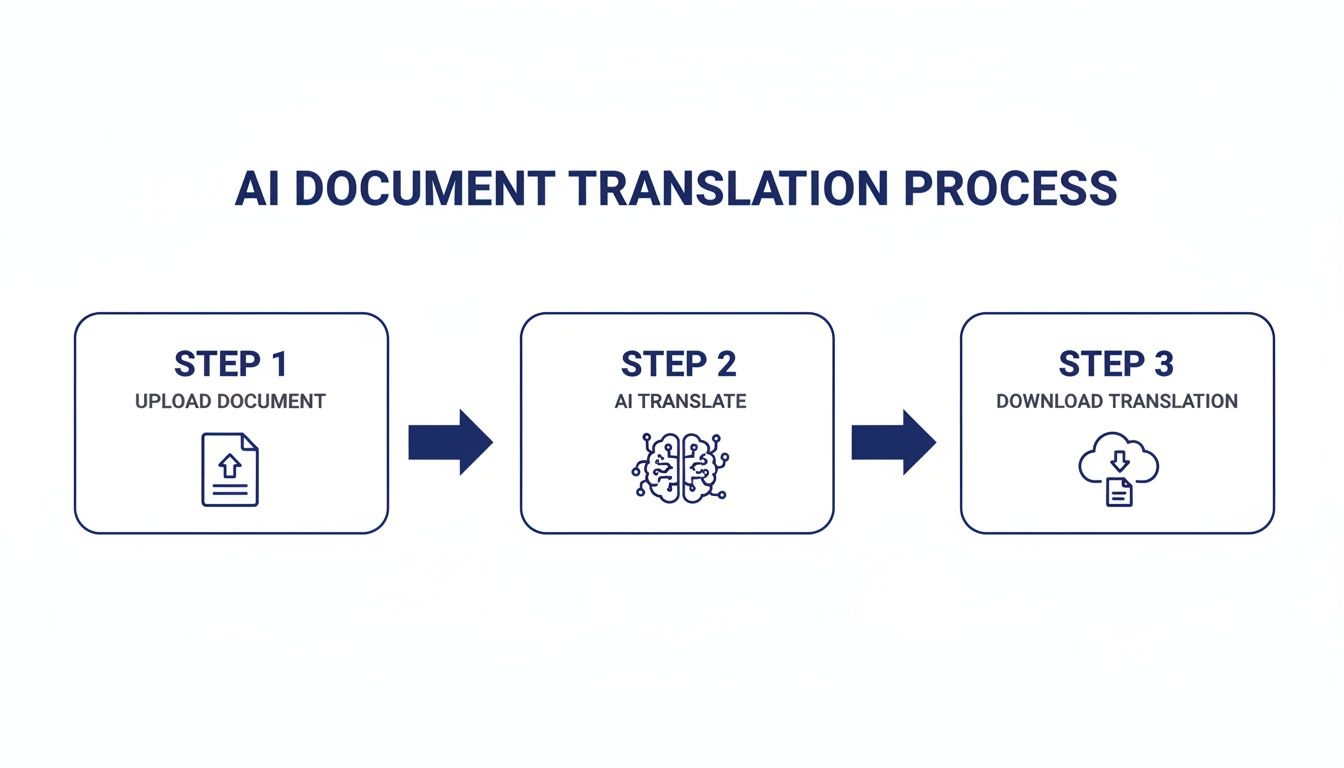
This workflow is what makes getting a professional-looking translated document so quick and accessible today.
Handling Context and Style
The best platforms go beyond just preserving the layout; they also work hard to capture the style of the original text. If a section of your document is written in a formal, technical tone, the AI tries to mirror that style in the new language. It can do this because it's been trained on a massive range of documents, from dense legal contracts to casual marketing blogs.
The AI learns to spot the linguistic patterns tied to different writing styles. This helps it make smarter choices about vocabulary and sentence structure, so the translated version reflects the original document's intent.
On top of that, modern services use "intelligent chunking" to tackle huge files. Instead of trying to translate a 300-page report all at once, the system breaks it into smaller, more manageable pieces. This technique keeps the AI from getting "lost" deep inside a document and ensures the quality stays consistent from the first page to the last.
If you're interested in going deeper into how these systems think, you can learn more about AI translation in our detailed guide. It's this blend of structural awareness, contextual translation, and smart processing that truly sets today’s AI services apart.
What Separates a Great AI Translator from a Merely Good One?
Not all AI translation platforms are created equal. While plenty of tools can translate a simple block of text, a truly professional AI-powered translation service is packed with features designed to handle the messy, complex documents we use every day. Knowing what to look for is the difference between finding a tool that saves you time and one that just creates more work.
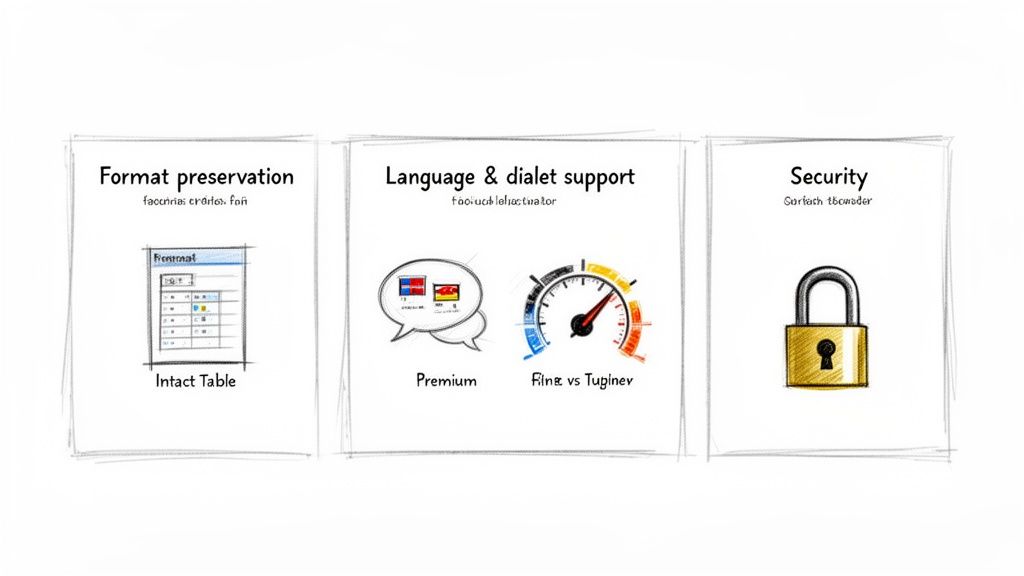
These core features are what turn a neat gadget into an essential business asset. Let's dig into what really matters.
Format Preservation Is Non-Negotiable
Picture this: you need to translate a 50-page business proposal. It’s full of charts, branded headers, and carefully placed images. You run it through a basic translation tool and get back a giant, shapeless wall of text. All that careful formatting? Gone.
This is exactly why format preservation is the single most important feature for professional use.
A top-tier platform doesn’t just swap out words; it rebuilds your entire document from the ground up. It intelligently analyzes the structure of your original file—whether it's a DOCX, PDF, or even a presentation—and makes sure the translated version is a perfect mirror image.
This means you can expect:
- Tables and charts to stay intact, with all data correctly aligned.
- Headers, footers, and page numbers to appear exactly where they should.
- Fonts, text styles, and colors to be perfectly preserved, keeping your branding consistent.
- Images and captions to remain in their original positions, maintaining crucial visual context.
Without this, you’re stuck with a tedious and error-prone reformatting job. True format preservation means the translated document is ready to send the moment you get it back. No extra work needed.
Deep Language and Dialect Support
Supporting "Spanish" is one thing. Understanding its regional soul is something else entirely. A great AI translation service gets that there’s a world of difference between the Spanish spoken in Spain and the dialects used across Latin America.
Look for a service that offers specific dialect support. This is what makes your content connect authentically with a local audience. A marketing campaign for Brazil needs to speak Brazilian Portuguese, not the variant from Portugal. The phrasing, the slang, the cultural references—they all matter.
This level of detail is a clear sign that the AI models were trained on diverse, region-specific data. The result is a far more natural and effective translation, one that avoids the clunky, awkward phrasing that screams, "This was translated by a machine."
Basic vs. Premium Translation Modes
Modern AI services often give you different "modes" of translation, letting you choose the right balance of speed, cost, and quality for the task at hand. This kind of flexibility is a game-changer for managing different types of content efficiently.
To help you decide which mode fits your needs, let's compare the two most common options you'll find in services like DocuGlot.
Comparing Translation Modes: Basic vs. Premium
| Feature | Basic Mode | Premium Mode |
|---|---|---|
| Best For | Internal communications, draft reviews, quick understanding | Client-facing reports, legal documents, marketing materials |
| AI Model | Standard, optimized for speed and high volume | Advanced, trained for context, nuance, and technical jargon |
| Quality | Good for general meaning and gist | Excellent for precision and publish-ready content |
| Speed | Fastest possible turnaround | Slightly longer processing time for higher accuracy |
| Cost | More budget-friendly | Higher investment for superior quality |
This choice empowers you. You can use the right tool for the right job, never overpaying for quality you don't need on an internal draft or, worse, sacrificing accuracy on a critical client-facing project.
Robust Security and Compliance
When you upload a document for translation, you're handing over your data. If that document is a sensitive legal contract, a confidential financial report, or proprietary research, security isn't just a nice-to-have feature—it's a dealbreaker.
A trustworthy AI-powered translation service must have airtight security protocols. Here’s what you should absolutely insist on:
- End-to-End Encryption: Your files need to be encrypted the entire time—while they're being uploaded (in transit) and while they're on the server (at rest).
- Clear Data Handling Policies: The provider must state, in no uncertain terms, that your documents will never be shared with third parties or used to train their AI models. Your data is yours alone.
- Automatic File Deletion: To minimize risk, the best services automatically and permanently delete your files from their servers after a short, defined period, such as 24 hours.
These measures aren't just about checking a box; they provide the peace of mind you need to translate even your most sensitive documents without exposing your organization to unnecessary risk.
Who Really Benefits from AI Document Translation?
When you hear “AI powered translation service,” it’s easy to picture a huge corporation localizing a Super Bowl ad campaign. But the real story is how this technology has become a powerful, everyday tool for people and businesses of all sizes. It's helping them solve very specific problems that, just a few years ago, would have been far too expensive or slow to tackle. The benefits go way beyond just saving money—we're talking about speed, precision, and maintaining a professional look and feel.
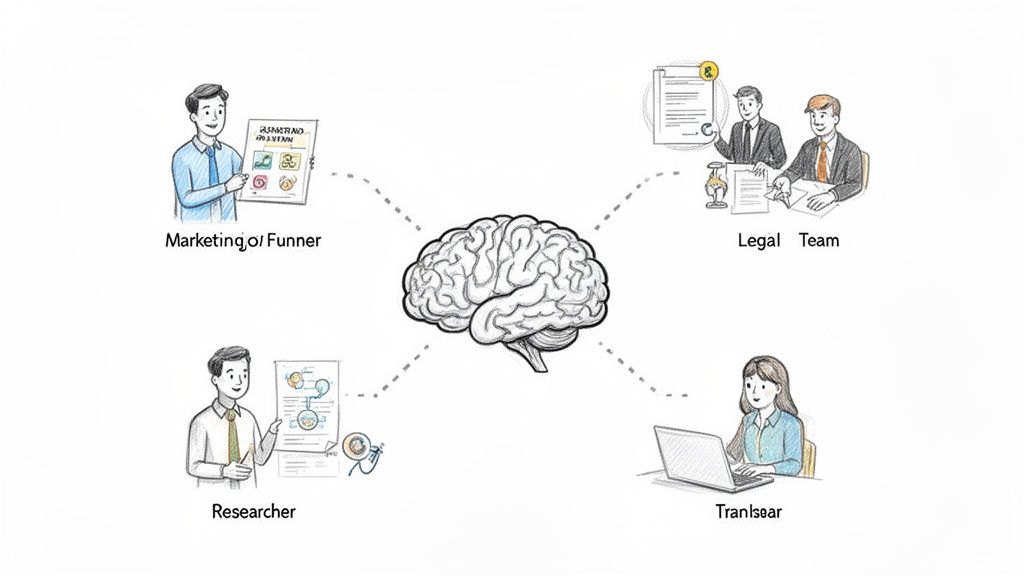
To really get a feel for its impact, let's look at a few professionals who are using this tech to clear hurdles and get things done.
The Agile Startup Founder
Imagine a founder launching a new software product. She has a shoestring budget but global ambitions, and she needs her marketing brochures, user guides, and website translated into five languages—yesterday. Calling up traditional translation agencies for each language would not only obliterate her budget but also push back her launch date.
For her, an AI service is a lifesaver. She can:
- Translate in Parallel: Upload all her documents at once and get back translated versions for all five languages in a few hours, not weeks.
- Preserve Branding: Make sure the sleek design of her marketing PDFs looks just as good in every language, keeping her brand image sharp and consistent.
- Control Costs: Pay just a fraction of what traditional services would charge, freeing up cash for what really matters: developing the product and getting the word out.
This kind of speed and affordability lets her play on the global stage right from the start, which used to be a luxury only big companies could afford. Ultimately, the goal is to improve the entire customer journey, a concept explored well in this guide on creating a seamless Omni Channel Customer Experience with Sitecore AI.
The Meticulous Legal Team
Now, think about a legal team in the middle of an international merger. They're swimming in contracts, compliance forms, and due diligence reports. In this high-stakes world, two things are absolutely critical: confidentiality and the exact structure of their documents. A single misplaced clause or a broken table could have serious legal consequences.
A professional-grade AI translation service gives them exactly what they need:
- Rock-Solid Security: With end-to-end encryption and automatic file deletion, the team can upload sensitive client data without a second thought.
- Perfect Format Retention: The service ensures that complex legal documents—with their numbered clauses, intricate tables, and precise formatting—come back looking exactly as they went in.
- Rapid First Drafts: They can get a surprisingly accurate initial translation of a massive contract in minutes, letting them dive into the review process almost immediately.
This blend of security and precision helps legal pros speed up their work without ever compromising the integrity or confidentiality of their documents.
The University Researcher
Finally, let's consider a university researcher who just finished a groundbreaking academic paper. It's packed with complex diagrams, data tables, and highly specific scientific terms. To collaborate with her international colleagues and get published in global journals, she needs to translate her work into English.
For academic and technical content, clarity and structural integrity are non-negotiable. The translation must be as precise as the research itself.
An advanced AI translation platform helps her get there by:
- Handling Technical Jargon: Premium AI models are trained on huge libraries of academic and technical papers, so they understand and correctly translate specialized terminology.
- Maintaining Visual Data: The service perfectly preserves the layout of her charts, graphs, and diagrams. This ensures the visual evidence backing up her findings stays clear and properly connected to the text.
- Supporting Academic Formats: It knows how to handle citations, footnotes, and appendices—all the critical pieces of a scholarly paper.
AI's role in translation is growing at a staggering rate. In fact, global AI use jumped by 1.2 percentage points in late 2025 alone. This isn't just a trend; it's a fundamental shift in how professionals and businesses operate. Millions now count on machine translation every single day, completely changing how we handle multilingual communication.
From startup founders to highly specialized professionals, the people who benefit most are those who need to communicate clearly and professionally across language barriers, without giving up speed, security, or their budget.
When to Combine AI Speed with Human Expertise
An AI powered translation service offers incredible speed, but knowing its limits is the key to getting great results. The conversation isn't really about "AI vs. human" anymore. It's about knowing when to team them up.
Think of translation quality as a spectrum. On one end, you have content where a good-enough, instant translation is all you need. On the other, you have documents where every single word carries immense weight.
For a huge chunk of day-to-day tasks, AI-only translation is a game-changer. It's fast, affordable, and perfect when the goal is simply to understand the core message.
This is the sweet spot for tasks like:
- Internal Communications: Quickly getting the gist of company-wide memos or project updates.
- Initial Research: Sifting through foreign-language articles or reports to see what's relevant.
- Personal Documents: Translating casual emails or letters where perfect prose isn't the priority.
In these cases, you're chasing comprehension, not perfection. The cost and time savings are just too good to ignore.
Knowing When the Stakes Are High
But as you move along that spectrum, the need for a human expert becomes crystal clear. For your most important, customer-facing, or legally-sensitive documents, even the best AI can’t replicate the nuance, cultural awareness, and precision of a professional translator.
This is where a hybrid approach, often called post-editing, really shines. The AI does the heavy lifting, producing a solid first draft in seconds. Then, a human expert steps in to refine, polish, and perfect it.
This model is quickly becoming the new standard. In a language services market valued at a massive $71.7 billion in 2024, AI is taking over the repetitive work. This frees up human linguists to focus on what they do best: ensuring a legal brief is airtight or a marketing campaign connects emotionally with a new audience.
When it absolutely has to be right, a human review is non-negotiable. The AI gives you a massive head start, but a professional translator ensures the final version is flawless, culturally on-point, and perfectly aligned with your intent.
When Human Review is a Must
So, when do you need to call in a human expert? Certain documents have consequences that are simply too high to leave to a machine alone.
Always budget for a human review for these types of content:
- Final-Version Marketing Copy: Your brand has a unique voice. A human ensures your clever taglines and persuasive calls-to-action land just right in the target culture, avoiding embarrassing or nonsensical translations.
- Legally Binding Contracts: In legal documents, every comma matters. A single misinterpreted clause can have disastrous financial or legal fallout, making expert human oversight essential.
- Patient Medical Records: Accuracy here is a matter of health and safety. From patient histories to treatment plans, there is zero room for ambiguity or error.
- Technical User Manuals: When dealing with complex machinery or software, instructions must be precise and easy to follow. Human review is critical for ensuring user safety and proper product function.
By understanding this quality spectrum, you can build a smarter translation workflow. Use the raw speed of an AI powered translation service for the initial translation, and then strategically bring in human expertise where it counts the most. For a more detailed breakdown, you can read our guide comparing AI versus human translation experts. This balanced strategy gives you the best of both worlds—unbeatable efficiency and uncompromising quality.
How to Choose the Right AI-Powered Translation Service for You
Alright, you've seen what the technology can do. Now comes the important part: picking the right partner. Choosing the best AI-powered translation service isn't just about finding a tool that works; it’s about finding one that slides right into your existing workflow and truly solves your specific problems. To do that, you have to ask the right questions.
Think of it like choosing any other critical piece of software for your business. You wouldn't buy a CRM without making sure it talks to your email system, or a project management tool that can't handle your team's size. You need to apply that same level of scrutiny here.
To help you cut through the noise, I’ve put together a practical checklist. Use these questions to vet any provider and figure out if they’re really the right match for what you need to accomplish.
Your Core Technical and Feature Checklist
First things first, let's talk tech. These are the non-negotiables—the features that determine if a service can even handle your basic requirements. Getting clear on these will quickly help you weed out the non-starters.
- Does it actually preserve the formatting of my files? Don't accept a vague "yes." You need to know if it fully supports the formats you live and breathe in, whether that's DOCX, PDFs, or even tricky presentation files. The whole point is to get back a document that's ready to go, not something you have to spend hours fixing.
- What languages and dialects are really on offer? Dig deeper than just a long list of languages. If your audience is in Argentina, you need a service that understands Argentine Spanish, not just a generic "Spanish." Authentic connection is in the details.
- Can I switch between quality modes? Flexibility is huge. Look for a service that gives you options: a quick, budget-friendly mode for internal drafts and a premium, high-accuracy mode for those critical, client-facing documents. This lets you manage costs smartly without ever compromising on quality when it counts.
Choosing a service is an investment in your global communication strategy. The right tool should feel like a natural extension of your team, speeding up processes without adding complexity.
Evaluating Security and Business Alignment
Once a service clears the technical hurdles, you need to see how it fits with your business operations, especially when it comes to security and cost. These aspects are every bit as important as the translation engine itself, particularly if you’re handling sensitive information.
Here are the critical business-focused questions to ask:
- What are your specific security and data privacy protocols? A provider worth their salt will have end-to-end encryption and a crystal-clear policy stating your data is never shared or used to train their models. Features like automatic file deletion within 24 hours are a great sign that they take your confidentiality seriously.
- Is the pricing easy to understand? Run from services with confusing credit systems or surprise fees. You should be able to see the exact cost of a translation before you hit "go." That’s the only way to manage your budget without nasty surprises.
- How easy is it to actually use? The best tools are incredibly powerful but feel simple. You shouldn't need an engineering degree just to upload a document. A clean, intuitive interface that walks you through the process is a hallmark of a well-thought-out service.
By working through these questions step-by-step, you can get past the shiny marketing claims and make a decision based on substance. This ensures you end up with an AI-powered translation service that doesn’t just give you accurate translations, but also acts as a secure, reliable, and straightforward partner for your business.
Got Questions About AI Translation? We've Got Answers.
Even after getting the basics down, you probably have a few practical questions. Let's dig into some of the most common things people ask when they're thinking about using an AI powered translation service.
How Accurate Is This Stuff, Really?
Honestly, modern AI translation is surprisingly good. We're talking about Neural Machine Translation (NMT), and for most business or academic documents, it's incredibly accurate. For many common language pairs, the output can be almost indistinguishable from a human's first draft, especially for clear, well-written text.
But "accuracy" isn't a simple yes or no. It really depends on the language pair, how technical or creative your source document is, and the sophistication of the AI model itself. If you're translating internal memos or just need to understand the gist of a document, AI is more than reliable.
When the stakes are high—think legal contracts or a big marketing campaign—the smartest approach is a hybrid one. Use AI to get the heavy lifting done in minutes, then have a professional human translator review and perfect it. You get the best of both worlds: incredible speed and total precision.
Can It Handle Messy Documents, Like PDFs with Tables and Charts?
Absolutely. This is actually one of the biggest differentiators between a basic online tool and a professional AI powered translation service. A good platform doesn't just see a wall of text; it's designed to understand the entire structure of your document.
It intelligently identifies and pulls text from all the tricky spots:
- Tables and charts
- Headers and footers
- Captions and text boxes
Once the text is translated, the system carefully reassembles the document, slotting the new content right back into its original place. This means you get a file back that looks just like the original, with all the formatting, fonts, and layouts intact.
Is It Safe to Upload Confidential Documents?
Security is non-negotiable, and any service worth its salt knows this. The best platforms are built with robust security measures from the ground up. You should be looking for providers who offer end-to-end encryption, which keeps your files secure from the moment you upload them until you download the finished product.
Just as important, a trustworthy provider will be transparent about their privacy policy. They should explicitly state that your documents are your property and are never shared or used for anything else. Top-tier services often go a step further and automatically purge all user files from their systems after a short period, like 24 hours, to ensure maximum confidentiality and meet standards like GDPR.
How Long Does It Take to Translate a Big Document?
This is where AI truly shines. Speed. A long, dense report that could tie up a human translator for the better part of a week can often be turned around by an AI service in a matter of minutes or, for massive files, an hour or two.
Of course, the exact time depends on the file's size and complexity. Most platforms will give you a time estimate right after you upload, and you'll typically get an email notification the second it's ready. You can just kick off the translation and get back to your day.
Ready to see just how fast and accurate your document translations can be? Give DocuGlot a try and get your translated files back in minutes, with the formatting perfectly preserved. Translate your first document now!
Tags
Ready to translate your documents?
DocuGlot uses advanced AI to translate your documents while preserving formatting perfectly.
Start Translating