A Practical Guide to AI Translation Technology
If you've ever used an early translation tool, you probably remember the clunky, word-for-word results. It was like using a digital dictionary—functional, but clumsy and completely devoid of nuance. Today’s AI translation is a different beast entirely. It’s less like a dictionary and more like a fluent speaker who understands the art and science of a language.
This massive shift is all thanks to new technologies that can finally grasp context, subtle meanings, and the real intent behind the words.
So, How Does AI Translation Actually Work?
To really get why modern translation tools are so powerful, you have to pop the hood and look at the engines driving them. The jump from basic word swapping to sophisticated, context-aware translation didn't happen overnight. It was a gradual evolution, built on major breakthroughs in how machines understand human language.
The first big leap was Neural Machine Translation (NMT). Instead of just looking at individual words, NMT models started reading whole sentences and even paragraphs at a time. Think of it like an apprentice translator learning to get the gist of a passage before trying to put it into another language. This holistic view was a game-changer, producing translations that flowed much more naturally than anything before.
From Apprentice to Master: The Rise of LLMs
NMT was a huge step, but the next phase brought a whole new level of sophistication. Enter Large Language Models (LLMs), which you can think of as the master craftsmen of the translation world. These models are trained on absolutely massive datasets—we're talking countless books, articles, and websites—giving them an incredible understanding of language, culture, and context.
LLMs don't just translate; they interpret. They can pick up on tricky idioms, subtle humor, and complex sentence structures with far greater accuracy because they’ve seen millions of real-world examples. This is what allows a tool like DocuGlot to produce translations that are not just technically correct but also feel right for the culture and context. Understanding this is easier when you look at modern approaches to AI content creation in general.
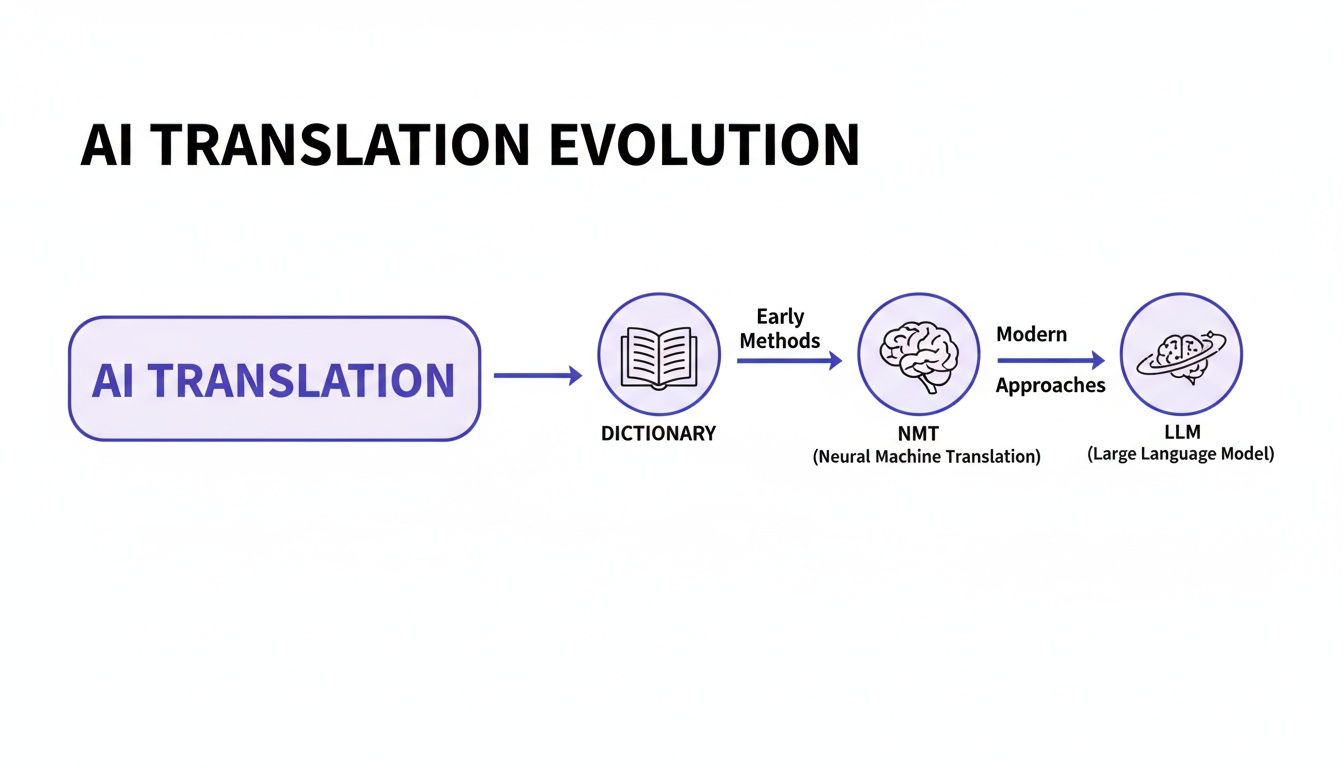
As this image shows, each new technology built on the last, taking us from rigid, rule-based systems to the dynamic, context-aware models we have today.
The Real-World Impact on Business
This technological leap has lit a fire under the market. The AI translation sector has ballooned from $1.8 billion in 2023 to a projected $13.5 billion by 2033—a compound annual growth rate of 22.3%. That explosive growth tells you just how essential this technology has become for any business operating on a global scale.
At its core, modern AI translation is about moving beyond literal meaning to capture true intent. This is why preserving the original document's structure—from tables to fonts—is so critical for professional use cases.
This is where platforms like DocuGlot come in. They put these advanced principles into practice by offering a service that keeps the entire visual and structural integrity of a document intact. Whether you’re translating a legal contract in a DOCX file or a marketing presentation in a PDF, the goal is to get back a translated file that is ready to use immediately. It’s about saving professionals from hours of painstaking reformatting.
The Real Strengths and Limitations of AI Translation
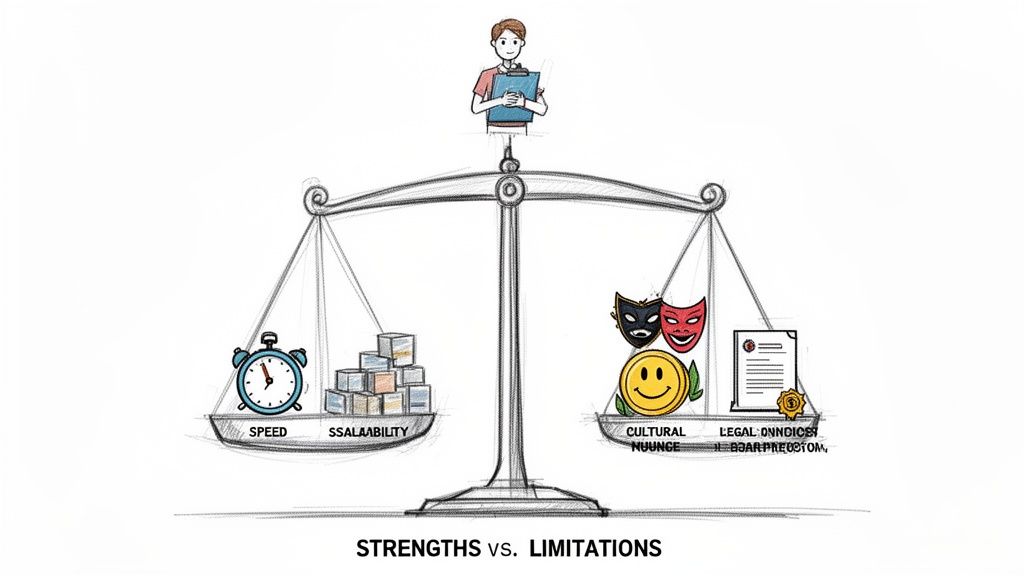
It’s one thing to understand the tech behind AI translation, but knowing when to use it—and when to keep a human in the driver's seat—is where the real value lies. Like any powerful tool, AI has its moments to shine and its blind spots. The trick is to adopt a "right tool for the job" mindset.
The most obvious advantage is its blistering speed. A human translator might spend days or even weeks on a hefty document, but an AI can churn through it in minutes. This changes the game for businesses needing to scale their localization efforts almost overnight.
Think about a company that needs to translate its entire library of support guides into five new languages before a product launch next week. That’s a job made for AI.
Unpacking the Primary Strengths
Speed is just the beginning. AI translation brings a few other heavy-hitting benefits to the table, especially when you're dealing with massive volumes of content or tight deadlines.
- Massive Scalability: AI systems don’t get tired. They can process a virtually unlimited amount of text at once, making them perfect for translating huge legal discovery files, entire e-commerce product catalogs, or years of internal company memos.
- Significant Cost Reduction: Let's be frank: AI is much cheaper than hiring a team of human translators, especially for bulk projects. Machine translation can easily cost half the price per word, putting global communication within reach for even small businesses.
- Consistency Across Documents: When you're translating a suite of related documents, an AI model will use the exact same terminology and style every single time. This is a huge win for things like technical manuals or branded materials where consistency is king.
This trio of speed, scale, and savings makes AI the ideal partner for getting first drafts on paper, translating internal communications, or handling any high-volume, lower-stakes content.
Recognizing the Clear Limitations
But for all its power, AI translation isn't magic. It operates on patterns it has learned from data, which means it can get tripped up by anything that requires a truly human touch. Ignoring these limitations can lead to embarrassing gaffes, costly mistakes, or even serious legal trouble.
One of its biggest weak spots is cultural nuance. An AI can translate the words of a joke perfectly but kill the punchline because it doesn't understand the humor. It can also translate a marketing slogan so literally that it strips away all the clever wordplay that made it memorable in the first place.
Culture, humor, and brand voice aren't just about words; they're about shared experiences and emotional connections that algorithms can’t quite grasp yet.
Where Human Oversight Is Non-Negotiable
Some documents are just too important to leave to an algorithm alone. In these high-stakes situations, AI is best used as a productivity booster—a way to get a solid first draft done quickly before a human expert provides the essential final polish.
Here are a few areas where you should always have a human in the loop:
- High-Stakes Legal Contracts: In legal documents, every single word matters. A slightly off translation can change the meaning of a clause and create massive legal risk.
- Brand-Defining Marketing Copy: Slogans, ad campaigns, and taglines depend on hitting the right emotional and cultural notes. A literal translation can fall flat or, even worse, be offensive.
- Sensitive Medical Information: Precision is non-negotiable when dealing with patient records or instructions for medication. Any ambiguity could have serious health consequences.
AI vs Human Translation A Quick Comparison
To put it all in perspective, here's a simple breakdown of how AI and human translation stack up against each other.
| Factor | AI Translation (e.g., DocuGlot) | Traditional Human Translation |
|---|---|---|
| Speed | Extremely fast (minutes to hours) | Slower (days to weeks) |
| Cost | Significantly lower, great for budgets | Higher premium price point |
| Scalability | Virtually unlimited | Limited by human capacity |
| Consistency | Perfect, machine-like consistency | Can vary between translators |
| Nuance & Creativity | Lacks cultural/emotional context | Excels at capturing nuance and style |
| Best For | High-volume, internal, or informational content | High-stakes, creative, or customer-facing content |
Ultimately, the choice isn't always "one or the other." The smartest approach often involves using both.
In the end, deciding between pure AI and a human-in-the-loop workflow really comes down to what the content is for. You can dive deeper with this comparison of AI versus human translation services to figure out what’s best for your needs. This balanced view shows AI for what it is: an incredible assistant, not a total replacement for human expertise.
How to Measure AI Translation Quality
So, how can you tell if an AI translation is actually any good? It’s not a simple yes-or-no question. The quality of a machine translation isn’t a fixed point on a scale; it's a spectrum that changes based on what you need that text to do. Learning how to gauge that quality is the key to making smart decisions.
On the technical side, developers often lean on metrics like the BLEU score. It's a bit like an automated grading system where the AI's output is checked against one or more "correct" human translations, awarding points for matching words and phrases. While this is helpful for the engineers building the tools, it doesn't really tell the whole story for everyday business needs.
For real-world use, quality comes down to two main ideas.
Fluency and Fidelity: The Two Pillars of Quality
Instead of getting bogged down in complex algorithms, you can evaluate a translation by asking two simple questions. These two pillars are the foundation of any good translation, whether it comes from a machine or a person.
- Fluency: Does it sound natural? A fluent translation just flows. It uses grammar, syntax, and phrasing that a native speaker would recognize, without any of the stiff, awkward language that screams "machine-translated."
- Fidelity: Does it preserve the original meaning? A translation with high fidelity is true to the source text's intent. Nothing important gets lost, added, or twisted along the way.
You can have one without the other. A translation might be perfectly fluent but completely wrong (it sounds great but misses the point), or it could have high fidelity but sound clunky and unnatural. The sweet spot, and what the best AI tools aim for, is a perfect balance of both.
A truly effective translation achieves a seamless blend of fluency and fidelity, ensuring the final text is not only accurate in its meaning but also natural and readable for the target audience.
The Fit-for-Purpose Principle
Here’s the most important part: context is everything. The level of quality you need for a quick internal email is worlds apart from what’s required for a legally binding contract or a splashy marketing campaign. This is what we call the fit-for-purpose principle.
It’s why you’ll see modern AI translation platforms offering different tiers of service. A "Basic" option might be perfect for getting the gist of an internal document where speed is the priority. A "Premium" mode, on the other hand, is built for handling high-stakes material where every nuance matters.
This tiered system is a direct reflection of how AI has progressed. For high-traffic language pairs, accuracy has shot up, reaching 94% for Spanish-to-English translations. But for less common, low-resource languages, that figure can drop to 70-80%. This gap is precisely why specialized modes are needed for sensitive content like medical prescriptions or technical papers.
Ultimately, evaluating AI translation is about matching the tool to the task. By focusing on fluency, fidelity, and the document's end-use, you can confidently select the right level of quality and get the job done right. If you want to dive deeper, you can find more insights about translation accuracy and its statistics to see just how far the technology has come.
Putting AI Translation to Work: Real-World Scenarios
It's one thing to talk about technology in theory, but where does the rubber really meet the road? The true test of AI translation is how it solves actual problems for people on the ground. Across different fields, professionals are using smart AI tools to cut through tedious work that once took days or weeks, making projects possible that were previously just too expensive or slow.
Let's dive into a few examples of how this technology is being used to handle complex, real-world documents, not just simple blocks of text.
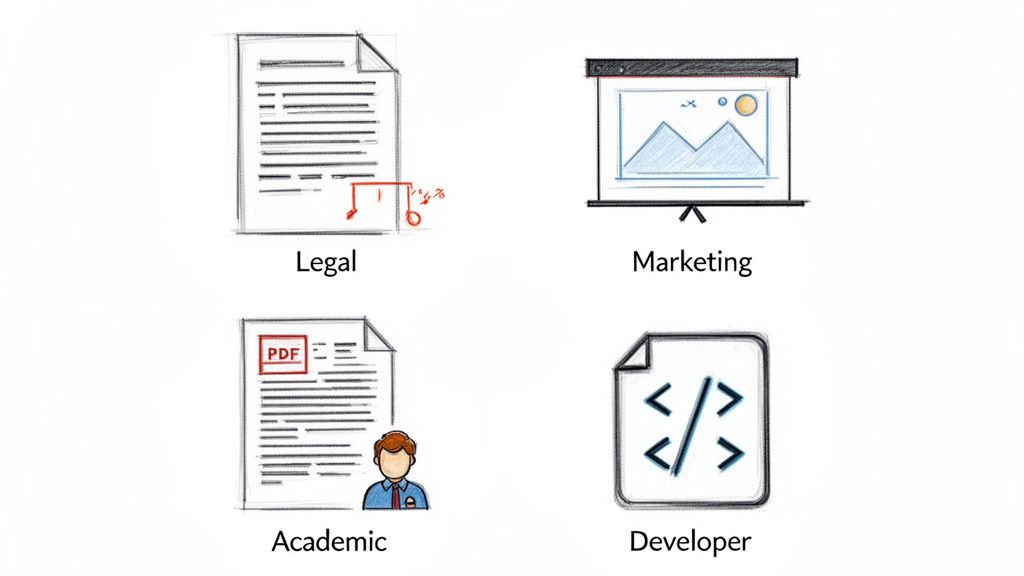
For Legal Teams: Taming the Document Beast
Anyone in the legal field knows the pain of discovery. A single case can unleash a tidal wave of documents—contracts, emails, briefs—often in several languages. Sifting through this manually is a slow, expensive grind that can bottleneck an entire case.
This is a perfect scenario for AI translation. Picture a law firm that's just been handed 5,000 pages of evidence in a foreign language, all in DOCX format. Instead of waiting weeks for a human team, an AI tool can process the entire batch in just a few hours. Crucially, a sophisticated service preserves the original formatting—footnotes, headers, tables, and all. The translated documents are ready for immediate review, helping legal teams find that needle in the haystack much faster. You can see a deeper dive into this at legal document translation.
For Marketing Departments: Launching Global Campaigns in a Flash
When a marketing team wants to go global, it's not just about translating words. They have a whole suite of creative assets—PowerPoint decks, polished PDFs, websites—that need to look right in every language. Maintaining brand consistency across different markets is a huge challenge.
Trying to manually rebuild a translated 50-slide PowerPoint presentation is a designer's worst nightmare. This is where layout-preserving AI translation comes in. A marketing manager can upload the final deck and get back a fully translated version with all the fonts, images, and slide structures perfectly intact. This slashes the time it takes to launch global campaigns, saves a ton on design rework, and keeps the brand looking sharp everywhere.
By handling the document structure automatically, AI translation frees up teams to focus on what actually matters: the message. The bottleneck shifts from tedious manual reformatting to high-value strategic review.
For Academics and Researchers: Speeding Up the Pace of Discovery
The academic world runs on shared knowledge. But what happens when a groundbreaking research paper is only available in German or Japanese? In the past, you were stuck with either a clunky, text-only translation from a free tool or a long wait for a pricey professional service.
Now, a researcher can upload a dense, multi-column academic PDF—complete with charts, tables, and citations—and get a clean, fully formatted translation back in minutes. This is a game-changer. It radically speeds up the research cycle and allows scholars to pull from a much broader pool of international work. A great practical example is figuring out the steps for creating a translated version of your Google Doc, which shows how this tech plugs into everyday tools.
For Software Developers: Keeping Documentation Clear and Consistent
In software development, good documentation is everything. Engineers often write technical guides and API references in Markdown (.md files) for its clean structure. When a product is used worldwide, that documentation has to be translated for a global developer community.
AI translation makes this incredibly simple. A developer can drop a whole folder of Markdown files into the tool and get back perfectly translated versions that preserve all the code blocks and formatting. This ensures the technical instructions are just as clear and precise in every language, which helps developers everywhere adopt the software more easily.
Here's a quick look at how these and other industries are putting AI translation to use:
Common Use Cases for AI Document Translation
| Industry / Role | Common Document Types | Primary Goal Solved by AI Translation |
|---|---|---|
| Legal | Contracts, Discovery Docs (PDF, DOCX) | Quickly screen huge volumes of foreign-language evidence while preserving legal formatting. |
| Marketing | Presentations (PPTX), Brochures (PDF) | Rapidly localize creative assets for global campaigns without costly redesign work. |
| Academia | Research Papers, Theses (PDF) | Access and synthesize global research faster by translating dense academic papers with formatting intact. |
| Finance | Financial Reports, Audits (XLSX, PDF) | Translate complex financial statements and reports for international stakeholders with full data integrity. |
| Software Dev | Technical Documentation (.md, HTML) | Localize API guides and tutorials for a global developer audience while keeping code blocks perfect. |
From law firms to software startups, the story is consistent. The right AI translation tool does more than just swap out words—it understands and preserves the structure of professional documents, delivering real, immediate value.
How to Choose the Right AI Translation Tool
Picking an AI translation tool can feel a bit like wading through a sea of options. Every platform promises speed and accuracy, but what really matters is how it fits into your actual workflow. The right choice can save you countless hours, while the wrong one can create a bigger mess than you started with.
The demand for these tools is undeniable. The global machine translation market was valued at $1,119.0 million in 2023 and is expected to more than double to $2,719.0 million by 2030. That growth isn't just a number; it's a reflection of businesses everywhere trying to connect with global audiences more efficiently. You can see the full breakdown in this research on the machine translation market. This boom means more powerful and specialized tools are hitting the market, but it also makes having a solid checklist more important than ever.
Prioritize Format Preservation
Here’s the single most important question you should ask: what happens to my document’s layout? A flawless translation is completely useless if you have to spend the next three hours rebuilding a 50-page report from scratch.
True efficiency comes from a tool that preserves the original structure of your document—tables, images, headers, and all. Think about translating a complex PDF. The goal is to get back a translated PDF that looks identical to the original, just in a new language. This is what a tool like DocuGlot is built to do.
- Check supported file types: Make sure the tool handles your go-to formats, whether that’s DOCX, PDF, PowerPoint, or something else.
- Look for layout integrity: The best services maintain everything from font styles and column layouts to table structures and image placement.
- Run a real-world test: Before you commit, upload a document with tricky formatting. See how it handles the challenge.
This one feature is often what separates a professional-grade tool from a basic text box translator. It’s the difference between a one-click solution and a tedious, multi-step project.
Scrutinize Security and Data Privacy
Uploading a document for translation means you're handing over your data. If that document is a sensitive legal contract, a confidential financial report, or proprietary research, security isn't just a feature—it's everything.
You need to be direct and ask tough questions about data handling. A trustworthy provider will be completely transparent about its security protocols.
Look for clear policies on data handling. Key features include end-to-end encryption to protect your files in transit and at rest, along with a strict, automatic deletion policy that removes your data from their servers after a short period.
At an absolute minimum, you should verify:
- Encryption: Are your files encrypted both during upload and while stored on their servers?
- Data Retention Policy: How long do they keep your files? Look for a platform with a clear, short-term deletion window, like DocuGlot's 24-hour policy.
- Third-Party Sharing: Does the company have a rock-solid policy stating they will never share your documents with anyone?
Evaluate User Experience and Support
Finally, the tool has to be easy to use. The whole point of using AI is to make your life simpler, not to add another complicated piece of software to learn. The process—uploading a file, picking your languages, and getting the finished product—should feel effortless.
Think about the entire experience. Is the pricing straightforward, or are there confusing credits and hidden fees? Will you be notified when your translation is ready? These small details make a huge difference in the long run.
A clean, intuitive process lets you focus on your actual work. If you want more tips, our guide on finding good translation software for your needs can help. By focusing on these three pillars—format preservation, security, and user experience—you can confidently pick a tool that will become a genuine asset, not another headache.
Common Questions About AI Translation
Once you get past the theory, the practical questions start popping up. It's one thing to understand how AI translation works, but it's another thing entirely to trust it with your real-world documents. Concerns about security, quality, and the future of human translators are completely valid.
Let’s tackle the big questions head-on. My goal here is to clear up any lingering doubts and give you the confidence to use these powerful tools the right way.
Is My Data Safe When I Upload a Document for Translation?
This is probably the most important question of all, especially if you’re handling business contracts, legal files, or medical records. The short answer is: it completely depends on the service you use.
Be wary of free, consumer-grade online translators. Their data policies can be murky at best. Your content might even be used to train their AI models, which is a massive privacy red flag.
A professional-grade service, on the other hand, puts security front and center. Look for a platform with clear, non-negotiable protections.
- End-to-End Encryption: Your files should be encrypted the second you upload them and stay that way during processing and storage. This locks out any unauthorized access from start to finish.
- Strict Data Retention Policies: Reputable providers will tell you exactly how long they hold onto your files. For example, DocuGlot automatically deletes all user files after 24 hours, so your sensitive information isn’t just sitting on a server somewhere.
- No Third-Party Sharing: A trustworthy service will have an ironclad policy stating they will never share your documents or data with anyone.
Bottom line: always read the privacy policy before uploading anything sensitive. If a service doesn't shout about these protections from the rooftops, it’s not the right tool for professional work.
What Is the Real Difference Between Free and Paid Tools?
Think of it like this: a free online translator is a rowboat, and a paid, professional service is a cargo ship. Both can get you across the water, but they’re built for completely different jobs and scales.
Free tools are fine for quick, informal tasks—like getting the gist of a foreign-language email or a social media post. But they almost always strip out all the formatting, leaving you with a wall of plain text. And, as we just covered, they come with some serious privacy risks.
Paid, professional AI translation services are built to fit into a real workflow.
The real value of a professional tool isn't just the words—it's the end-to-end preservation of your document’s structure. That focus on format integrity is what saves you hours of painstaking manual cleanup, delivering a file that’s ready to go.
When you invest in a professional service, you're paying for critical features that free tools just don't offer:
- Format Preservation: Keeping the original layout, tables, and images in your DOCX, PDF, and PPTX files.
- Enhanced Security: Rock-solid encryption and clear data deletion rules.
- Higher Quality Models: Access to premium, more accurate AI engines.
- Batch Processing: The ability to translate entire folders of documents at once.
In short, free tools are for casual curiosity. Paid services are for professional productivity.
How Does AI Handle Specialized Industry Jargon?
This is a huge deal for anyone working in technical fields like law, engineering, or medicine. Early machine translation was notoriously bad with jargon, often spitting out gibberish. Thankfully, modern AI models, particularly Large Language Models (LLMs), are much, much smarter.
Because these models are trained on gigantic datasets—including technical journals, legal statutes, and specialized research—they've learned the context behind specific terminology. They can usually tell the difference between a software "bug" and an insect "bug" without breaking a sweat.
That said, they aren't foolproof, especially with brand-new terms or extremely niche vocabulary. For content where every word has to be perfect, the best approach is a two-step process:
- AI for the first draft: Let the AI do the heavy lifting and translate the bulk of the document in minutes.
- Human expert for review: Have a subject-matter expert give it a final pass, focusing only on verifying that the specialized terminology is spot-on.
This hybrid workflow gives you the incredible speed of AI combined with the precision of human expertise. It’s the best of both worlds.
Will AI Completely Replace Human Translators?
The short answer is no. While AI is definitely shaking up the translation world, it isn’t making human experts obsolete. What it's doing is changing their job description—from manual typist to strategic editor, cultural consultant, and quality gatekeeper.
AI is unbeatable when it comes to speed and scale. But it still falls short on the uniquely human elements of language: creativity, cultural nuance, and emotional context.
Human translators will always be essential for:
- Transcreation: Adapting creative marketing slogans and brand messaging so they actually connect with a new audience, not just get translated literally.
- High-Stakes Content: Reviewing and finalizing legal contracts or medical device instructions where a single error could be catastrophic.
- Literary Translation: Capturing the artistry, style, and poetry of a novel or script.
- Final Quality Assurance: Providing that last layer of polish that separates an "okay" translation from a truly great one.
The future isn't AI vs. human; it's AI plus human. The smartest professionals are already using AI as a powerful assistant to handle the grunt work, which frees them up to focus on the high-value tasks that still require a human touch.
Ready to see how DocuGlot can transform your document translation workflow? Experience the power of AI that preserves every detail of your original files. Try our format-preserving AI translation tool today.
Tags
Ready to translate your documents?
DocuGlot uses advanced AI to translate your documents while preserving formatting perfectly.
Start Translating