A Complete Guide to Birth Certificate Translation
When you need a birth certificate translated, you're not just swapping words from one language to another. You're creating an official record that needs to be a perfect mirror of the original. This is almost always for high-stakes situations like immigration, international education, or legal matters, and it must come with a signed certification from the translator vouching for its accuracy and completeness.
Why Your Birth Certificate Translation Has to Be Flawless
Translating a birth certificate might seem like just another task on your checklist, but it’s often the one document that can make or break a major life event. Think about it: this piece of paper is your ticket to reuniting with family, studying at your dream university abroad, or becoming a citizen of a new country.
For an organization like USCIS or a foreign government, a tiny mistake isn't just a typo—it's a red flag. Imagine the frustration of waiting months for an application to process, only to be rejected because a name was misspelled or an official seal wasn't noted in the translation. The stakes are just too high to settle for anything less than perfect.
The Real-World Impact of Small Mistakes
A sloppy birth certificate translation can lead to serious delays, unexpected costs, and a whole lot of stress.
Let's say a student is applying to a university in Germany. Their translated document accidentally swaps the day and month of their birth—an easy mistake to make when dealing with different international date formats. To the admissions office, this isn't a simple error; it's a discrepancy that could get their entire application flagged as fraudulent, potentially ending their academic ambitions before they even start.
For immigration, the need for precision is even more critical.
A translated birth certificate has to be a complete, line-by-line replica of the original. That means everything—names, dates, stamps, seals, and even handwritten notes in the margins—must be accounted for. Anything missing can invalidate your entire submission.
How Official Agencies View Your Documents
Government agencies are sorting through mountains of paperwork every day. To keep things moving, they rely on standardized, error-free documents.
Take U.S. Citizenship and Immigration Services (USCIS), for example. They processed nearly 11 million applications in Fiscal Year 2023 alone. Among those, birth certificate translations were essential for over 878,500 naturalization approvals and 1.2 million green cards. Every single foreign-language certificate they see must have a certified translation that captures every detail, often down to matching the original's formatting, to avoid being kicked back. You can find more details about USCIS translation requirements from The Language Doctors.
This guide is here to help you navigate the process and sidestep those common mistakes. We’ll cover everything from what officials are looking for to how you can use the right tools to get a flawless, format-perfect translation, making sure a preventable error doesn't derail your plans.
Understanding Certified, Notarized, And Apostilled Translations
Diving into the world of official document translation can feel like learning a new language itself. You’ll constantly hear terms like "certified," "notarized," and "apostilled" thrown around, but they absolutely are not interchangeable. Picking the wrong one is a surprisingly common—and costly—mistake that can grind your entire application to a halt.
Think of these as stacking levels of verification. Each one serves a very specific purpose, and the right one depends entirely on who will be receiving your birth certificate translation. For most situations here in the U.S., like immigration, one level is standard. But when you start dealing with international bodies, the requirements often get more complex.
This decision tree gives you a quick visual guide to figuring out what you might need based on your document's final destination.
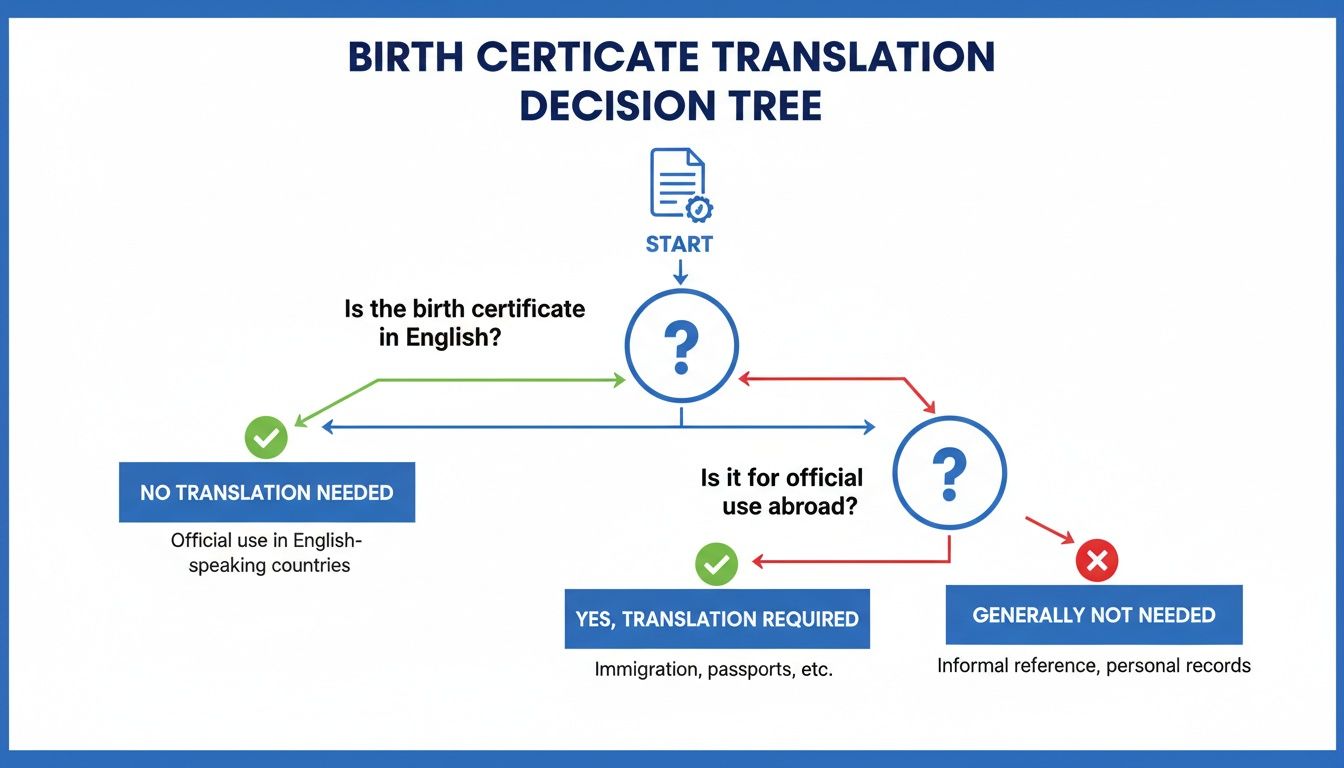
The single most important takeaway? Always check the requirements of the receiving agency. They have the final say on what level of verification your translated birth certificate needs.
Certified Translation: The Gold Standard
A certified translation is what you’ll encounter most often. It’s the standard requirement for major U.S. government bodies, including U.S. Citizenship and Immigration Services (USCIS).
This doesn't mean a special government entity has "certified" the translator. It’s actually a much simpler concept. The translation comes with a signed statement from the translator or the translation company. This letter, often called a "Certificate of Accuracy," formally states that the translation is a complete and accurate reflection of the original document, to the best of their professional ability.
A certified translation is all about vouching for the accuracy and completeness of the translation itself. The focus is purely on the linguistic quality of the work.
It's essentially a declaration of professional confidence. For instance, if you're submitting a birth certificate from Mexico for a U.S. green card application, USCIS requires the translation to be certified. No other level of verification is typically needed for them.
Notarized Translation: Adding Identity Verification
A notarized translation adds another layer to the process. This involves the translator signing their Certificate of Accuracy in front of a licensed Notary Public.
It's critical to understand what the notary is actually doing here. They are not checking the quality of the translation or the authenticity of the original birth certificate. The notary's only job is to confirm the identity of the person signing the certification statement. They watch the signature happen and then add their official stamp or seal.
This extra step isn't usually required for domestic use in the U.S. but might be requested by certain foreign institutions, like courts or universities, that need that extra formal verification on the translator’s signature. You can explore this service in more detail with our guide to notarized document translation services.
Apostilled Documents: Verifying the Original
This is where things can get confusing. An Apostille has absolutely nothing to do with the quality of the translation or the identity of the translator. Instead, an Apostille authenticates the origin of the public document itself—in this case, your original birth certificate.
It’s an international certification created by the Hague Convention of 1961. Think of it as a standardized way for one country to recognize the official documents of another. If you need to present your U.S. birth certificate to an official body in Spain (a member of the convention), you would first get an Apostille for the original certificate. Only then would you have both the certificate and the Apostille translated.
Translation Levels Explained: Certified vs. Notarized vs. Apostilled
To make this crystal clear, let's break down these three levels of verification side-by-side. Each serves a distinct function, and knowing the difference will save you time and headaches.
| Requirement Level | What It Means | Commonly Used For | Who Provides It |
|---|---|---|---|
| Certified | The translation is a true and accurate copy of the original, vouched for by the translator or agency. | U.S. immigration (USCIS), college admissions, most domestic legal and official uses. | The professional translator or translation company. |
| Notarized | A Notary Public has verified the identity of the person who signed the Certificate of Translation Accuracy. | Some foreign universities, courts, or government agencies that require an extra layer of formality. | A licensed Notary Public. The translator signs the certificate in the notary's presence. |
| Apostilled | An official seal that authenticates the original document (not the translation) for use in foreign countries. | Submitting official documents (like birth certificates) to countries that are part of the Hague Convention. | The government entity that issued the original document (e.g., Secretary of State). |
Ultimately, choosing the right level comes down to one thing: following the specific instructions of the person or organization requesting your documents. When in doubt, always ask them directly for their requirements.
Getting Your Document Ready for a Flawless Translation
The final quality of your birth certificate translation really comes down to the quality of the document you start with. A translator can only work with what's in front of them, so giving them a perfect source file is the single most important thing you can do to sidestep frustrating delays and rejections.
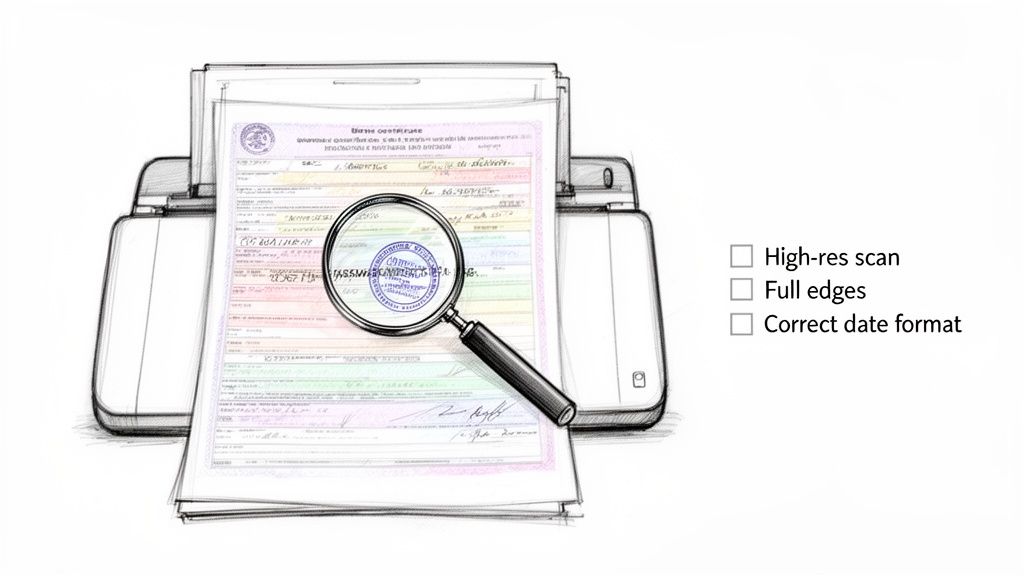
Your first job is to get a high-resolution scan. Every last detail has to be perfectly clear and easy to read. I'm talking about all the printed text, the official stamps, any of those fancy embossed seals, and every handwritten signature or note. I’ve seen immigration applications get held up for weeks just because a faint, circular stamp in the corner of a certificate was too blurry to read on the scan.
The Little Details That Matter Most
Once you've got that crisp scan, it's time to put on your detective hat. A few minutes of checking now can save you a massive headache later.
- Check Every Name: Go through the spelling of all names—yours, your parents', and any officials listed. A single typo can create a real mess.
- Clarify Date Formats: Is that date DD/MM/YYYY or MM/DD/YYYY? This is a classic mix-up. A good translator will usually ask, but it's smart to confirm it yourself.
- Inspect Stamps and Seals: Can you actually read the text inside every official marking? If it's a blur to you, it will be a blur to the translator, and they'll have to make a note of it.
- Watch for Cropped Edges: Make sure the scan captures the entire document, edge to edge. Sometimes vital info like a document number or a tiny signature hides near the border.
This need for precision isn't just a suggestion; it's a requirement. The global market for immigration document translation is expected to hit about $1.5 billion by 2025, and birth certificates are a huge piece of that pie. This is all driven by strict government policies where even a small formatting error can get your submission thrown out. Agencies insist the translation mirrors the original layout perfectly. You can read more about these market trends in immigration document translation.
Picking the Best File Format
The file type you save your scan as makes a difference, too. While a high-quality JPEG can sometimes do the trick, PDF is almost always the better way to go for official documents.
A PDF locks in the layout, fonts, and images of your original document. It ensures that what you send is exactly what the translator or agency sees on their end. It’s the digital equivalent of handing them the actual piece of paper.
PDFs are the universal standard. They look the same on any computer or phone, which is vital for official applications where maintaining the document's original structure is non-negotiable. If you're working with a different file type, our guide on how to translate a PDF document has some helpful tips. Taking these few extra steps up front will set you up for a smooth, accurate translation process.
Choosing Your Translation Method: Human vs. AI
When you need to get a birth certificate translated, you’re basically standing at a fork in the road. One path leads to a traditional human translator, and the other leads to a modern, AI-powered service. Neither one is universally "better"—the right choice really comes down to what you need in terms of speed, cost, and the specific quirks of your document.
Hiring a person brings a certain level of expertise to the table. This can be a lifesaver if you're dealing with a really complex document—maybe it has tricky legal jargon or a bunch of handwritten notes that are hard to read. But that human touch comes at a price. You're usually looking at higher costs and a much longer wait, sometimes stretching from a few days to several weeks.
The AI Advantage: Speed and Precision
This is where AI-powered tools have really stepped up. They can turn around a translation almost instantly and for a fraction of the cost. For a standard birth certificate, where the language is pretty formal and the layout is predictable, an AI solution is often the most practical way to go. The technology has evolved way beyond basic word-for-word translations; it now gets the context and official terminology right with surprising accuracy.
But the real game-changer with top-tier AI platforms is their ability to perfectly preserve the original document's formatting. This is a detail that people often miss, but it's absolutely critical. I've seen plenty of official applications get rejected not because of a translation mistake, but because the translated document's layout—the placement of seals, signatures, and tables—didn't perfectly match the original.
A translation that fails to replicate the original format can be just as problematic as one with incorrect wording. For agencies like USCIS, a document that looks different raises red flags and can lead to immediate rejection, forcing you to start the process all over again.
Making the Right Call for Your Document
For most modern, standard birth certificates, an AI service is an incredibly smart choice, especially when your top priorities are speed, cost, and an exact format match. If your document is from the last few decades and has a clear, typed layout, AI is almost certainly your most efficient option. Getting a submission-ready document back in minutes is a huge plus.
Here’s an example of an AI service built specifically to preserve formatting. You can upload your document, and it delivers a translated version that keeps the layout perfectly intact.
This completely cuts out the painstaking and error-prone job of trying to manually recreate the document's structure after it's been translated.
What if your birth certificate is very old, filled with handwritten notes, or has unusual legal stamps on it? In that case, you might want to try a hybrid approach. Start with a high-quality AI translation to do the heavy lifting and lock in the formatting. Then, have a human translator give it a quick review to double-check any of the tricky or ambiguous parts. This gives you the best of both worlds: the speed of AI combined with the nuanced eye of a human expert.
You can learn more about how modern platforms are changing the game in our guide to the power of AI translation. In the end, taking a moment to understand what your specific document needs will help you pick the most reliable and efficient path forward.
Your Final Review Checklist Before Submission
You’ve got the translated document back. The finish line is in sight, and it’s incredibly tempting to just fire it off and move on. Before you do, take ten minutes—just ten—for one last look. This final quality check is your best defense against a rejection that could set you back weeks or even months.
Think of it this way: you wouldn't head out on a long road trip without a quick check of the tires and gas. This is the same principle. A small typo or a missing detail is easy to fix now but can become a massive headache once your application is in the system.
Core Details Accuracy Check
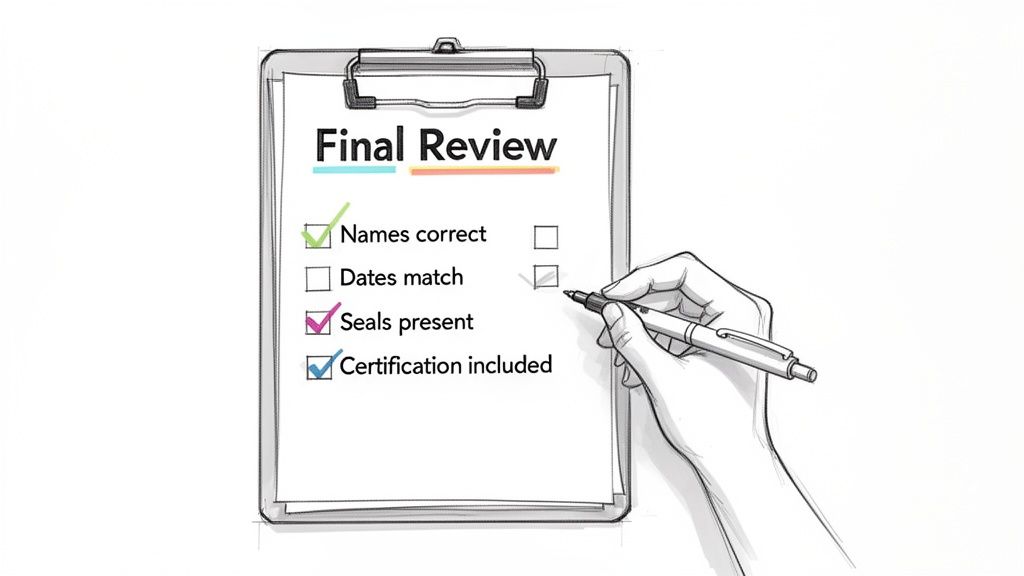
Start with the absolute non-negotiables: the names, dates, and places. These are the first things any official—or automated system—will look at.
- Names: Is every single name spelled perfectly? Check your name, your parents' names, and any official names listed. One wrong letter can flag a mismatch in the system and bring everything to a halt.
- Dates: Go through every date on the page. Birth dates, registration dates, issue dates—confirm they all match the original document. Be extra careful about the format (e.g., DD/MM/YYYY vs. MM/DD/YYYY) to avoid any ambiguity.
- Places: Make sure all cities, provinces, states, and countries are translated correctly and consistently.
Completeness and Formatting Review
Now, broaden your focus. The translated document should be a perfect mirror of the original. Nothing should be added, and absolutely nothing should be left out.
This isn't just a matter of preference; it's a requirement. To give you some perspective, in 2023 alone, over 800,000 students from China applied to study abroad. The universities and immigration bodies they deal with demand exact replicas of official documents, right down to the layout of seals and parental information. This global standard for precision is a big reason why the birth certificate translation market is growing so rapidly.
Expert Tip: Your final check needs to account for every single marking on the original. This includes stamps, seals, signatures, and even those little handwritten notes in the margins. If a seal is blurry or unreadable, the translation should still acknowledge it, often with a note like,
"[Illegible circular stamp in the bottom left corner]".
Finally, do you have the complete package ready to go? Most official submissions require a specific bundle of documents. Make sure you have:
- The Certified Translation: This is the main document you just reviewed.
- The Certificate of Accuracy: The signed statement from the translator or translation company vouching for its correctness.
- A Copy of the Original Document: Nearly every agency will want to see the translation alongside a clear copy of the source birth certificate.
This careful, methodical final review is what separates a smooth application process from a stressful one. It's the last step to ensuring your document is ready for success.
Untangling Birth Certificate Translation: Your Questions Answered
Diving into the world of official document translation can feel a bit overwhelming. You've got this critical piece of paper, a birth certificate, and a long list of questions. Let's clear up the confusion and tackle the most common concerns people have when they need one translated.
One of the very first things that comes to mind is often, "Can't I just translate this myself to save a few bucks?" It's a logical thought, but for any official use, the answer is a hard no. Government bodies like USCIS, for instance, strictly forbid it. They see it as a conflict of interest and require an objective, professional third party to vouch for the translation's accuracy.
The same rule applies to that bilingual friend or family member who offers to help. Even if their language skills are perfect, they aren't a recognized professional and can't provide the Certificate of Accuracy that institutions demand. It’s all about impartiality.
Who Is Actually Allowed to Translate a Birth Certificate?
So, if you can't do it yourself, who can? You'll need to turn to a professional translator or a well-regarded translation agency. In the United States, translators don't need a specific federal license, but they absolutely must be proficient in both languages and be able to provide a signed statement certifying the translation is complete and correct.
This brings up another classic question: "Does it have to be notarized?"
For most situations in the U.S., like immigration filings, a certified translation is all you need. Notarization is usually an extra, unnecessary step. However, if you're sending the document abroad—to a foreign university, consulate, or court—they might have different rules and specifically ask for it. The golden rule is to always check the requirements of the person or place you're sending it to.
A key thing to remember is that a notary public doesn't check the translation itself. They only verify the identity of the person who signed the certification statement. It's a simple stamp that confirms the signer is who they say they are, not that the Spanish-to-English translation is flawless.
The Nuts and Bolts of the Process
Let's get into the practical side of things. What if your original birth certificate is old, with a faded stamp or some scribbled handwriting that's hard to read?
A good translator has a standard way of handling this. They'll make a note right in the translated text, usually in brackets, saying something like [illegible] or [stamp unclear]. This shows the receiving agency that they didn't just skip over it; they accounted for every mark on the page, which is crucial for a "complete" translation.
People also worry about timing and logistics. How long does this all take, and what do you get back in the end?
- Turnaround Time: This has gotten much faster. Traditional agencies might take a few business days, but many modern services, especially those using smart technology, can turn around a certified translation in just a few hours—sometimes even minutes.
- Receiving Your Document: You'll almost always get a digital PDF copy delivered by email. This file will include the translated document and the separate certification page. This is standard and accepted by most places, but it's always smart to ask if they need a physical copy with a "wet ink" signature sent by mail.
Finally, what's the damage? "How much should I expect to pay?" Thankfully, translating a single-page document like a birth certificate is usually very affordable. Most services have a straightforward flat fee per page, so you'll know the exact cost before you even start.
For a hassle-free, quick, and accurate birth certificate translation that keeps its original formatting, DocuGlot offers certified translations you can rely on. Get an instant quote and receive your completed document in minutes at https://docuglot.com.
Tags
Ready to translate your documents?
DocuGlot uses advanced AI to translate your documents while preserving formatting perfectly.
Start Translating