How to Choose the Right Translation Service for Your Business
When you hear "translation service," you might just think of swapping words from one language to another. But that's only scratching the surface. A professional translation service is really about bridging communication gaps, allowing businesses and individuals to connect with a global audience clearly and effectively. It’s less about word-for-word conversion and more about making sure the final text is accurate, culturally appropriate, and reads naturally.
What a Modern Translation Service Actually Does
Let's get past the outdated idea of just replacing words. A modern translation service acts more like a strategic partner, building a sturdy bridge between your message and a whole new audience. It's the engine that drives global communication, making sure your ideas land with the same punch in Tokyo as they do in Toronto.
This isn't something a simple dictionary can do. It requires a deep understanding of context, the original intent behind the words, and the subtle cultural nuances that make a translated document feel like it was written by a native speaker.
Core Components of a Translation Service
At its core, a solid translation service rests on two pillars. First, there's precise language conversion—this is the technical side, getting the grammar, syntax, and specific terminology exactly right. The second, which is arguably even more important, is cultural adaptation, often called localization.
Localization is what makes your message truly connect. It involves adapting things like:
- Idioms and Expressions: Directly translating "it's raining cats and dogs" would sound bizarre in most languages. Localization finds the local equivalent that captures the same meaning.
- Cultural References: A mention of a local TV show or a national holiday that works in one country would fall flat in another. These need to be swapped for something the new audience will recognize.
- Formatting: This covers the nuts and bolts, like changing date formats (MM/DD/YY vs. DD/MM/YY), currencies, and units of measurement to match local standards.
This combination of precision and cultural savvy is what separates a professional service from a free online tool. You can dive deeper into this in our guide on choosing an https://docuglot.com/blog/online-document-translation-service.
The Key Players in the Industry
The translation world is surprisingly diverse. You've got traditional agencies coordinating projects with teams of human translators, highly specialized freelance linguists who are experts in niche fields, and powerful AI platforms that deliver translations at incredible speeds. It's not just about static documents, either. Today's services also include things like AI-powered conversation translation tools for real-time customer support chats.
A great translation service doesn't just change the language; it preserves the original document's purpose, tone, and power, making it an indispensable tool for international business.
This industry has exploded, thanks largely to global e-commerce and the rise of remote work. In fact, the language services industry hit USD 71.7 billion and is still on an upward trend, showing just how vital these services have become. Making the right choice between a human, AI, or hybrid provider is the first crucial step toward expanding your reach and making a real connection with a global audience.
Choosing Your Model: Human, AI, or Hybrid?
Picking a translation service is a bit like choosing a vehicle. You wouldn't take a sports car on a family camping trip, and you wouldn't enter a minivan in a Grand Prix. The engine powering your translation—whether it's a human expert, a powerful AI, or a combination of the two—needs to be the right fit for your specific content, audience, and goals.
Getting a handle on the core differences between these models is the first real step toward making a smart decision. Each one strikes a different balance between speed, cost, and nuance, making them better suited for some jobs over others.
The Artistry of Human Translation
Human translation is the classic, artisan approach. It's all about a professional linguist's deep, ingrained knowledge of not just two languages, but two cultures. This is where you turn when subtlety, emotion, and creativity are non-negotiable.
Think about a clever marketing slogan. A direct, word-for-word translation would almost certainly kill the joke or fall completely flat, losing all its original charm and cultural punch. A human translator doesn't just swap words; they act as a cultural bridge, "transcreating" the intended feeling and impact for a new audience. This makes it the undisputed gold standard for your most important, high-stakes content.
- Best For: Marketing campaigns, literary works, brand messaging, and anything where a real emotional connection is the end goal.
- Key Advantage: Unmatched ability to capture creative language, humor, idioms, and deep cultural context.
Of course, this level of precision takes more time and comes with a higher price tag. But for the public-facing materials that define your brand, that investment is almost always worth it.
The Power and Speed of AI Translation
AI and Machine Translation (MT) are the high-octane engines of the modern translation world. Fueled by sophisticated neural networks, these AI models can chew through millions of words in minutes—a job that would take a human translator months to complete.
This makes AI the go-to solution when speed and sheer volume are your top priorities. Imagine needing to translate thousands of pages of internal technical manuals or a massive backlog of customer support articles. The goal is simple: get clear, accurate information into the hands of users quickly, not to write a beautiful piece of prose. Platforms like DocuGlot harness these powerful models to translate complex documents while perfectly preserving the original formatting, which saves teams countless hours of tedious rework.
To get a better sense of how it all works under the hood, check out our deep dive into AI translation. When looking into these tools, it's also helpful to understand what's possible with related technologies like AI powered transcription software, as it provides a good barometer for the state of automated language processing.
This decision tree can help you visualize which path makes the most sense based on what you're trying to achieve.
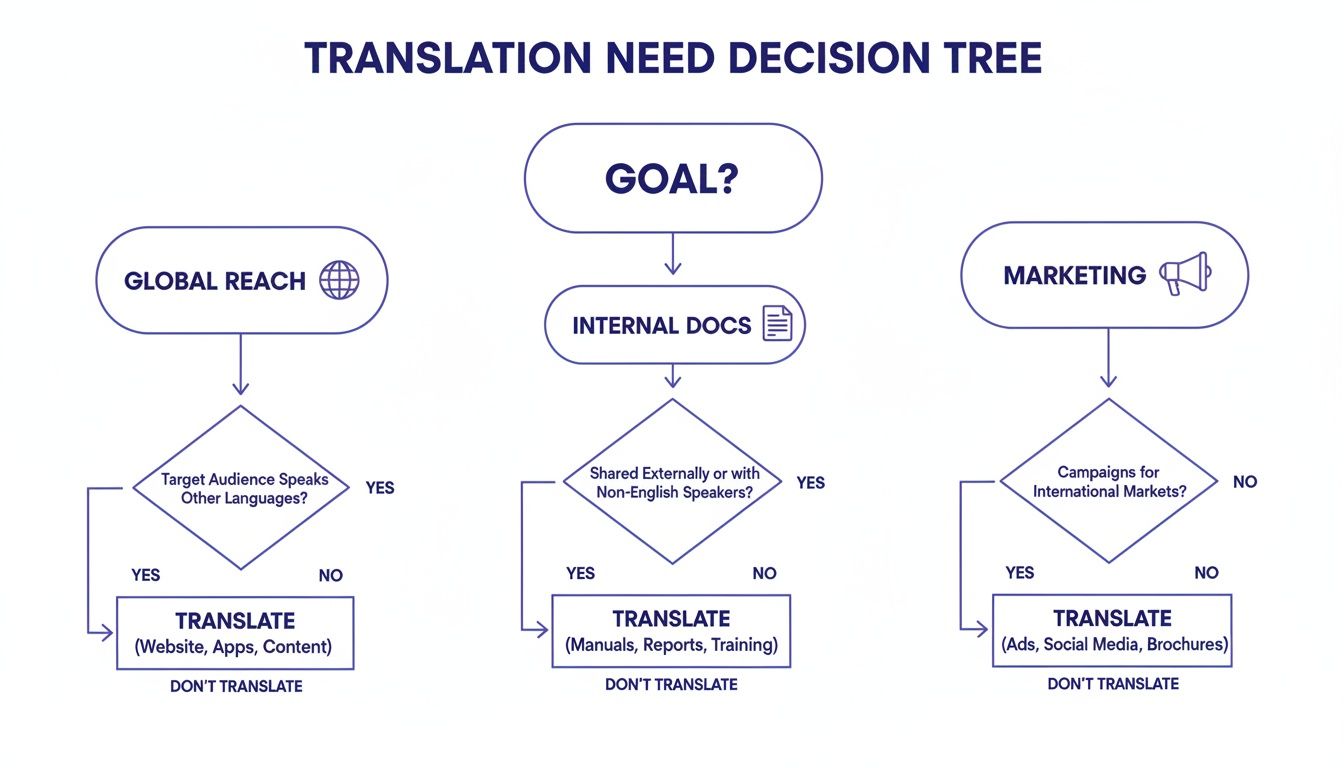
As you can see, your main objective—whether it's blistering speed for internal docs or delicate nuance for marketing—is the biggest factor in choosing your model.
The Balanced Hybrid Approach
The hybrid model is that perfect middle ground, blending the best of both worlds. The process starts with AI, which does the initial heavy lifting to create a solid, accurate first draft at incredible speed. From there, a human expert steps in to review, edit, and polish the output.
This "AI-first, human-polished" workflow gives you the efficiency of machine translation but adds that crucial layer of human quality assurance. It ensures the final text is not just technically correct but also reads smoothly and sounds completely natural.
This balanced approach is ideal for business-critical documents that need to be both fast and flawless. Think client-facing reports, important legal agreements, or website content where both accuracy and readability are paramount. It minimizes the risk of awkward or subtle AI errors while still being much faster and more affordable than a fully human workflow.
Comparing Translation Service Models
To make the choice even clearer, here's a side-by-side look at how the three models stack up across the most important factors.
| Feature | Human Translation | AI Translation | Hybrid (AI + Human Review) |
|---|---|---|---|
| Best For | Creative, nuanced, or high-impact content. | High-volume, internal, or non-critical content. | Business-critical documents needing speed and quality. |
| Quality/Nuance | Highest. Captures cultural context, tone, and idioms. | Variable. Good for literal text, struggles with subtlety. | High. AI accuracy enhanced by human polish and review. |
| Speed | Slowest. A human can translate ~2,000 words per day. | Fastest. Can translate millions of words in hours. | Fast. Much quicker than human-only, with a review step. |
| Cost | Highest. Priced per word, reflecting expert time. | Lowest. Often a low monthly fee or per-word rate. | Moderate. A balance between the cost of AI and human expertise. |
| Consistency | Can vary between translators. | Extremely High. Uses the same logic every time. | High. AI ensures base consistency, human review refines it. |
Ultimately, there's no single "best" model—only the best model for your specific project. By choosing the right approach, you ensure your message connects perfectly, no matter the language.
Critical Factors for Selecting a Translation Service
Picking the right translation service is about more than just swapping words from one language to another. It’s really about finding a partner you can trust with your global communication. With so many options out there, it’s easy to get overwhelmed. The key is to cut through the marketing fluff and focus on what actually matters for your project.
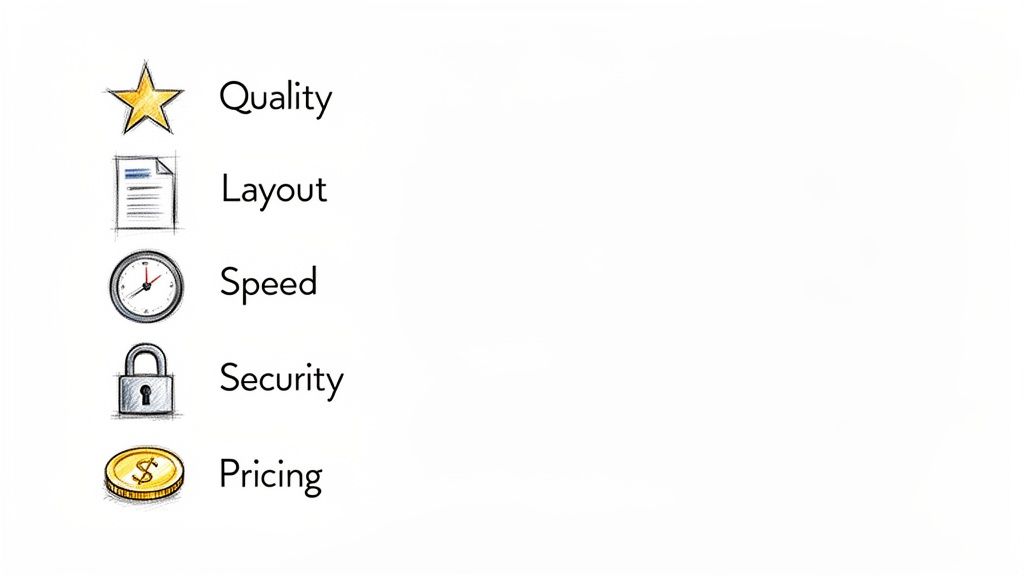
Let's walk through the five make-or-break factors that will help you confidently choose a service that hits all your targets for quality, speed, security, and cost.
Quality and Accuracy
First things first: not all translations need to be perfect. Your initial step is to define what "quality" really means for the task at hand. Is this for an internal memo where you just need the gist, or is it for your public website where every word reflects on your brand?
For instance, a translation of an internal training manual might be fine with 95% accuracy, as long as the main instructions are clear. But for a marketing campaign or a legal contract, you need near-perfection. A single mistake there could tarnish your brand's reputation or introduce a serious legal risk.
Here’s a simple way to think about it:
- "Good Enough" Quality: This works well for internal documents, quick email summaries, or sifting through large amounts of data where you just need to understand the content quickly.
- "Flawless" Quality: This is non-negotiable for any public-facing content—websites, marketing materials, legal agreements, and anything that represents you to the world.
Knowing this distinction is crucial because it helps you pick the right tool for the job, whether that’s a quick pass with AI or a more thorough hybrid approach with a human in the loop.
Document Integrity and Format Preservation
One of the biggest headaches with translation is getting back a plain text file that’s been stripped of all your careful formatting. You send over a beautifully designed PDF with charts, tables, and branded headers, and what you get back is a wall of text. Now your team has to waste hours rebuilding the entire document from scratch.
This is a massive pain point, and it’s exactly what specialized platforms like DocuGlot were designed to eliminate. A top-tier service must offer robust format preservation, making sure the final document is a mirror image of the original, including:
- Headers, footers, and page numbers
- Tables and charts
- Font styles and text hierarchy
- Images and their placement
Honestly, keeping the layout intact isn't a "nice-to-have" feature; it's a fundamental requirement that saves an incredible amount of time and effort. For any serious business or academic work, this should be a deal-breaker.
Speed and Turnaround Time
We all want things done yesterday. The demand for instant results has completely changed the game. Traditional translation agencies, which rely entirely on human translators, can take days or even weeks to turn around a project. That might be fine for some things, but it’s a huge bottleneck for any business trying to stay competitive.
Modern AI-powered services have shrunk that timeline from weeks down to minutes. You can get a multi-page report translated in the time it takes to grab a coffee. This kind of speed lets your team act faster, communicate across borders without friction, and keep your projects on track.
When you're comparing services, look closely at their turnaround times. Do they talk in terms of minutes and hours, or are they still measuring in days and weeks? For most modern business needs, fast delivery is a serious competitive advantage.
Security and Confidentiality
Handing over your documents to a third party requires a leap of faith. Whether it’s a sensitive business contract, a private medical record, or proprietary research, you have to know that information is safe. Any translation service worth its salt will have crystal-clear security protocols.
Here's what you should be looking for as a bare minimum:
- Data Encryption: Files must be encrypted both in transit (as you upload and download) and at rest (while stored on their servers).
- Strict Privacy Policies: The service needs to state, in no uncertain terms, that they won't share your data with anyone else. Period.
- Automatic File Deletion: A clear retention policy is vital. The best services will permanently delete your files from their systems after a short, defined period—like 24 hours—to minimize your data's exposure.
Don't ever cut corners on security. Always read the privacy policy before you upload a single sensitive file.
Pricing Models and Transparency
Translation costs can be all over the map. To avoid sticker shock and get real value, you need to understand how different services charge. The three most common models are per-word, per-page, and subscription-based.
- Per-Word: This is the traditional model you’ll find with most agencies and freelancers. It’s simple but can get pricey with large documents.
- Per-Page: Sometimes used for standard documents, but it can be a bit of a black box if the amount of text per page varies.
- Subscription: AI platforms often use this model. You pay a recurring fee for a certain volume of translations, which is great if you have ongoing needs.
No matter the model, the single most important thing is transparency. A good service will give you a clear, upfront quote before you commit. That way, you know exactly what you're paying and can decide if it's the right value for your budget, with no nasty surprises later.
Real-World Scenarios for Document Translation
It’s one thing to talk about translation models in theory, but where the rubber really meets the road is in how they perform in the real world. The best translation service isn’t a one-size-fits-all tool; it’s about picking the right solution for a specific problem.
Different fields come with their own unique headaches, from wrestling with dense technical jargon to the absolute necessity of keeping a document’s layout intact. Let's walk through a few practical scenarios to see why the right service is so critical.
Corporate and Business Operations
In the corporate world, everything moves fast, and consistency is everything. Companies are constantly translating huge volumes of internal documents—think employee handbooks, training materials, quarterly financial reports, and marketing plans. The main goal here is simple: make sure everyone across every regional office is on the same page.
This is where an AI-powered translation service often becomes the hero. It can chew through thousands of pages in the time it would take a human team to get started, ensuring the entire organization gets the same message at the same time. If a company is rolling out a new global policy, they can't afford to wait weeks for translations. AI gives them that speed.
A major hurdle, though, is keeping the structure of complex files like financial spreadsheets or slide decks. A service that preserves formatting is a lifesaver, preventing teams from wasting hours manually rebuilding documents from scratch.
Legal and Compliance Documents
When you're dealing with legal documents, there is absolutely no margin for error. Contracts, patents, court filings, and compliance forms demand pinpoint accuracy. But it’s not just about the words; the exact layout—from the placement of clauses to signature lines and appendices—is part of the document's legal DNA.
For this reason, keeping the original format is non-negotiable. Just imagine a translated contract where a key clause gets buried or a signature line disappears. The fallout could be catastrophic. This is precisely where a specialized translation service that guarantees document integrity is essential.
For legal and compliance professionals, a translation that breaks the document's original structure is fundamentally unusable. The service must deliver a file that is not only linguistically accurate but also visually identical to the source.
While a hybrid approach—using AI for the initial pass and having a legal expert review it—is often the gold standard, that first translation must flawlessly maintain the document's structure. That makes platforms built for format preservation an indispensable part of any legal workflow.
Academia and Research
The academic world is built on the precise sharing of information. Researchers need to translate dense, technical papers loaded with specialized terms, and universities need to make course materials accessible to students from around the globe. The challenge is a double-whammy: you need extreme accuracy with terminology and the ability to handle the complex layouts of academic journals and textbooks.
Take a typical research paper, for instance. It’s often filled with intricate diagrams, data tables, and footnotes. A basic translation tool could easily scramble these elements, making the entire paper a jumbled mess. A more sophisticated AI platform can navigate this complexity, making sure charts and citations stay perfectly aligned with their text.
This capability helps researchers share their work with the world and allows universities to support a diverse student body. It's all about bridging language gaps to speed up global innovation and collaboration.
Expanding into Global Markets
The demand for translation is exploding worldwide. While Europe and North America have historically been the biggest players, accounting for about 85% of the industry's spending, things are changing. The Asia-Pacific region is now the fastest-growing market, driven by rapid economic growth and digitization. This shift means any truly effective translation service must be able to cater to both established Western markets and emerging Asian ones, as you can see in these global translation trends online.
This global pivot highlights just how important it is to choose a versatile service that can handle a wide range of languages and cultural nuances, a topic we cover more deeply in our guide to document translation services.
Taking the Plunge: How to Get Started
So, where do you go from here? We’ve covered a lot of ground, but the main idea is simple: a modern translation service is less of a simple utility and more of a strategic business tool. AI has completely changed the game, delivering speed and efficiency that was unthinkable just a few years ago. The right partner isn't just about a good translation; it's about finding a service that syncs with your needs for quality, security, and especially, keeping your document's formatting intact.
If you're someone who just needs to get things done, you'll find that jumping in is refreshingly easy. The old days of back-and-forth emails, confusing quotes, and long waits are gone. Today's process is built around you, designed to take a document from its original language to a new one in minutes.
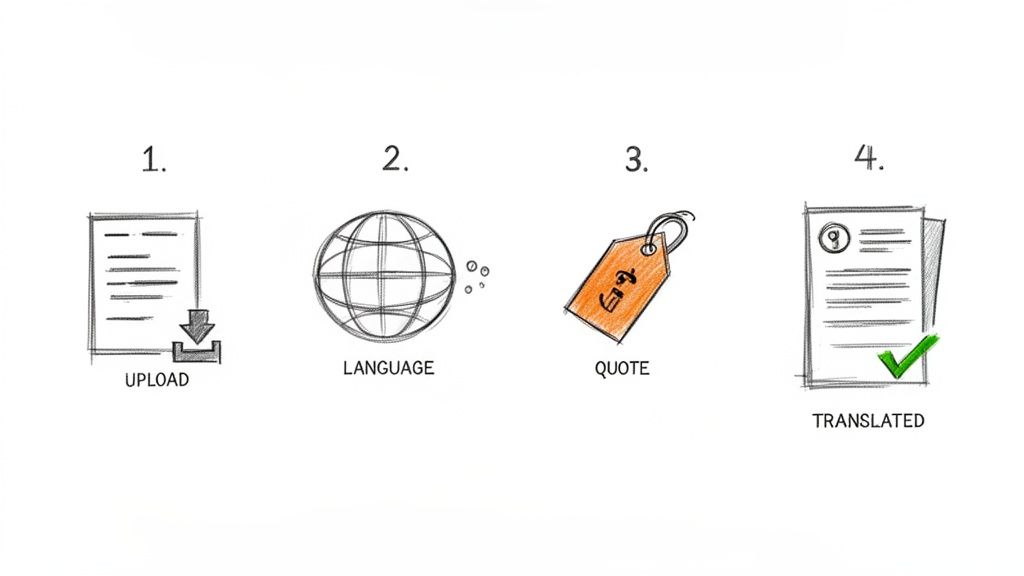
Your First Translation in Four Simple Steps
The best technology removes friction. Platforms like DocuGlot have boiled the entire translation workflow down to a few intuitive clicks, so you don't need a degree in linguistics to get started.
Here’s a look at how straightforward it is:
- Upload Your Document: Just drag and drop your file. Modern services are built to handle pretty much any common format—PDFs, Word docs, you name it. No need to mess around with converting files first.
- Select Your Languages: Tell the system what the original language is and which one you need it translated into. Good services offer a massive list of over 100 languages, often including regional dialects for that extra layer of accuracy.
- Review the Instant Quote: This is a big one. No more waiting for a sales rep to call you back. The platform scans your document and gives you a clear, upfront price on the spot. You know exactly what it costs before you click "go."
- Start the Translation: With a final click, the AI takes over. You can grab a coffee or work on something else, and you'll get an email as soon as your translated—and perfectly formatted—document is ready to download.
That’s it. What used to be a complicated, drawn-out affair is now a quick, hands-off process.
The big takeaway here is that you no longer need to be a localization expert to get world-class translation. The technology handles the heavy lifting, from the actual words to preserving the layout, freeing you up to focus on your business.
Making a Confident Choice
Picking a translation service is a big decision that directly affects how well you can communicate with the world. By understanding the different options out there and zeroing in on what truly matters—like format integrity and data security—you can make a smart choice that saves you time, cuts down on costs, and makes your message resonate.
It's not an intimidating process anymore. Now that you know what to look for and how simple the steps are, you're ready to use today's technology to your advantage. Go ahead and start breaking down those language barriers and connecting with new audiences.
Frequently Asked Questions About Translation Services
Jumping into the world of translation can feel like learning a new language itself. With so many options out there, from pure AI to traditional human services, it’s easy to get tangled up in questions about accuracy, security, and what really works. This section is here to clear the air.
We'll tackle the most common questions head-on, giving you straightforward answers so you can make decisions with confidence. Think of this as your personal cheat sheet for navigating modern translation services.
How Accurate Is an AI Translation Service?
The accuracy of today's AI translation has come an incredibly long way. For technical, legal, and business documents, modern neural machine translation (NMT) models are remarkably precise and can often go toe-to-toe with human translators, especially when the main goal is conveying facts clearly.
But the real line in the sand appears when you get into creative or highly nuanced content. A human translator is still the master of capturing deep cultural context, humor, and the specific idioms that make marketing copy truly connect with people. It all boils down to what you need.
Here’s a quick way to think about it:
- For technical manuals or internal reports: AI is lightning-fast, consistent, and extremely effective.
- For a public-facing ad campaign: A human or hybrid approach is far better suited to handle the creative and cultural finessing required.
Will a Translation Service Keep My Document Formatting?
This is a huge one, and honestly, the answer varies wildly. Many basic online tools or even some traditional agencies will send you back a plain wall of text. That leaves your team with the soul-crushing job of manually rebuilding every table, header, and image placement.
Losing your document's layout is a massive productivity killer. A simple translation job can quickly spiral into hours of frustrating rework.
This is exactly why platforms built specifically for format preservation are a game-changer. A service like DocuGlot is engineered to solve this problem from the ground up. You upload a perfectly formatted DOCX or PDF, and you get back a translated version that looks just like the original, saving you a ton of time and headaches.
Are My Documents Safe with an Online Service?
When you’re dealing with sensitive information, security should be front and center. Any reputable online translation service will treat your data protection as a top priority. Before you upload anything, it’s smart to quickly check their security policies.
Look for a few key indicators of a solid security setup:
- End-to-end encryption: This is non-negotiable. It protects your files while they’re being uploaded and downloaded, so no one can intercept them.
- Strict data privacy policies: The service should state clearly that your documents are your documents and will never be shared.
- Automatic file deletion: The best services permanently delete your files from their systems after a short, set period (like 24 hours) to minimize any risk.
These measures are essential for making sure your confidential business, legal, or personal information stays private from start to finish.
What Is the Difference Between Translation and Localization?
People often use these terms interchangeably, but they’re two very different things. Getting this distinction right is key to making sure your project actually succeeds.
Translation is the straightforward act of converting words from one language to another. It’s all about linguistic accuracy—turning the English word "Hello" into the French "Bonjour." The focus is on getting the literal meaning right.
Localization, on the other hand, goes much deeper. It’s the process of adapting a whole product or piece of content so it feels like it was made specifically for another culture.
Think of localization as cultural translation. It goes beyond just words to adjust imagery, color schemes, date formats, currencies—anything needed to make the entire experience feel natural and right for the local audience.
A great translation service partner gets this. They can help you figure out if a simple translation will do the trick or if you need to invest in localization to truly connect with a new market. Choosing the right path is what separates a message that’s just understood from one that’s actually felt.
Ready to see fast, accurate, and format-preserving document translation in action? DocuGlot uses advanced AI to deliver high-quality translations in over 100 languages, all while keeping your original layout perfectly intact. Try DocuGlot today and get your translated documents back in minutes, not days.
Tags
Ready to translate your documents?
DocuGlot uses advanced AI to translate your documents while preserving formatting perfectly.
Start Translating