Document translation services: Compare AI vs Human Experts
Document translation services are tools designed to take a written file, like a PDF or Word document, from one language and convert it into another. The real challenge, and what separates the best services from the rest, is finding the right balance between speed, accuracy, and cost—all while keeping the original formatting intact.
Why Choosing the Right Translation Service Matters
In a world this connected, you can't afford miscommunication. But getting it right is about more than just swapping words. We're seeing a huge spike in demand for high-quality translation as more businesses need to reach international audiences.
The language services industry is already valued at $71.7 billion in 2024 and is expected to hit $75.7 billion by 2025. Those numbers, which you can read more about in Nimdzi's industry growth report, show just how critical translation has become for global business.
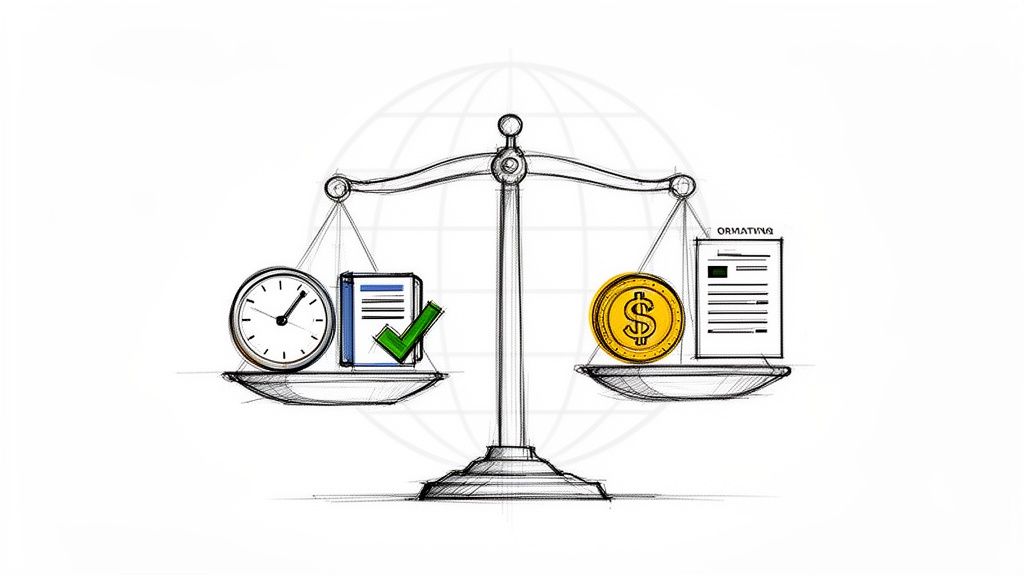
This guide is designed to give you a clear framework for making sense of the crowded translation market. We'll go beyond the basic feature lists to help you pick a solution that actually fits what you need to accomplish.
Key Decision Points at a Glance
When you start looking at different services, a few key factors will bubble to the surface. There’s no single "best" service for everyone; your final choice will come down to your priorities. After all, a law firm translating sensitive contracts has vastly different needs than a marketing team localizing creative brochures.
Think of the table below as your starting point. It lays out the core considerations that will guide your decision and help you figure out what truly matters for your projects.
| Decision Factor | What It Means for You | Example Scenario |
|---|---|---|
| Technology Used | This is all about the trade-offs between speed, cost, and nuance. You'll find everything from fully automated AI to expert human translators. | AI is great for getting the gist of an internal report quickly, but you'd want a human expert for a public-facing legal notice where every word counts. |
| Formatting | Do layouts, tables, images, and fonts need to look identical in the translated version? This is a surprisingly complex, and crucial, detail. | A company translating a technical PDF manual needs a service that maintains the exact visual layout to avoid confusion. |
| Operational Factors | This covers the practical stuff: data security, clear pricing, and how fast you can get your project turned around. | A healthcare provider absolutely must choose a service with solid security and compliance to protect sensitive patient data. |
Understanding Different Translation Service Models
Before we get into a feature-by-feature breakdown, it’s important to get a handle on the basic ways translation services operate. Once you understand the three main approaches, picking the right tool becomes a lot easier. Each model is built to solve a different puzzle of speed, cost, and quality.
You’ll generally run into three types: traditional human translation agencies, pure AI platforms, and hybrid services that mix tech with a human touch. Knowing how they differ will give you a solid framework for judging specific vendors later on. The thinking here is similar to what you'd find when comparing different service models for converting audio to text.
To help you see the differences at a glance, let's start with a high-level comparison. This table breaks down the three core models to help you quickly match your needs to the right approach.
Comparing Document Translation Service Models
| Service Model | Ideal Use Case | Expected Turnaround | Typical Cost | Primary Strength |
|---|---|---|---|---|
| Human Agency | Legal contracts, marketing creative, literary works | Days to Weeks | High | Nuance & Context |
| Automated AI | Internal docs, large-scale data analysis | Seconds to Minutes | Low | Speed & Scale |
| Hybrid | Business reports, technical manuals, website content | Hours to Days | Medium | Balance of Speed & Quality |
Now, let's dig a little deeper into what each of these models really means for your projects.
Traditional Human Translation Agencies
This is the classic, time-tested model. It’s all about people. A project manager takes your document, finds a professional translator who knows your industry, and then has a second linguist review the work to catch any errors. Think of it as a craft approach to translation.
This method is king when it comes to capturing cultural nuances, creative wordplay, or complex jargon. If you're translating a novel, a clever ad campaign, or a legally binding contract, you need the deep contextual understanding that only a human expert can provide. The trade-off? This level of care costs more and takes longer, making it a tough fit for high-volume projects or anyone on a tight deadline.
Fully Automated AI Platforms
On the complete other side, you have fully automated AI platforms. These services use powerful neural machine translation (NMT) engines to translate entire documents almost instantly. You upload a file, and minutes later, you have it back in another language.
The big wins here are unmatched speed and affordability. It’s the perfect solution for internal communications, sifting through massive amounts of information for research, or any scenario where getting the gist of a document right now is the top priority.
Key Takeaway: AI translation has gotten impressively fluent, but it’s not perfect. It can easily miss subtle context, misinterpret brand-specific terms, or produce slightly awkward phrasing. For anything your customers or legal team will see, it's a risk without a final human check.
Hybrid Translation Services
Hybrid models try to give you the best of both worlds. The process usually starts with an AI-powered translation that does the heavy lifting quickly and cheaply. Then, a professional human translator steps in to review and polish the machine’s output. This is often called Post-Editing Machine Translation (PEMT).
This balanced approach cuts down the time and cost dramatically compared to a fully manual job, but it boosts the quality far beyond what AI can do alone. It’s a fantastic middle ground for things like business documents, technical manuals, and website localization, where you need both accuracy and efficiency. For most businesses, this is the sweet spot that delivers quality at a practical pace.
A Practical Feature Comparison for Decision Makers
Choosing the right document translation service isn't about finding the "best" one, but the right one for your specific job. You have to look past the flashy marketing claims and dig into the features that will actually make or break your project. A service that’s perfect for one task can be a terrible fit for another.
This guide breaks down the critical capabilities you need to compare. We'll look at everything from how a service handles complex layouts to the actual technology doing the translating. Getting these details right is the key to saving yourself headaches, keeping costs in check, and getting a final product you can actually use.
1. Formatting and Layout Preservation
One of the first and most frustrating hurdles you'll hit with document translation is keeping the original look and feel. What good is a perfectly translated contract if the tables are a jumbled mess? A marketing brochure loses all its punch when the design falls apart. This is where you see a huge gap between different services.
- Basic Services: A lot of platforms do just fine with plain text files (.txt) but fall apart with anything more complicated. You upload a polished PDF or Word doc, and what you get back is a wall of translated text. That leaves you with the tedious job of rebuilding the entire document from scratch.
- Advanced Services: The better solutions are built for end-to-end formatting preservation. They're smart enough to analyze the source file’s entire structure—headers, footers, tables, fonts, even where the images go—and replicate it in the translated version. This one feature can turn a multi-hour manual formatting nightmare into a non-issue.
My Recommendation: If you're just translating simple text for internal use where formatting doesn't matter, a basic service might be all you need. But for any document where the visual presentation is part of the message—think legal agreements, user manuals, or marketing materials—a service with strong formatting preservation is non-negotiable.
2. Translation Technology and Quality Tiers
The engine under the hood has a massive impact on the final output. It's important to remember that not all "AI translation" is the same, and knowing the difference between the models—and when a human touch is needed—is crucial.
Here’s a look at the main models you'll come across.
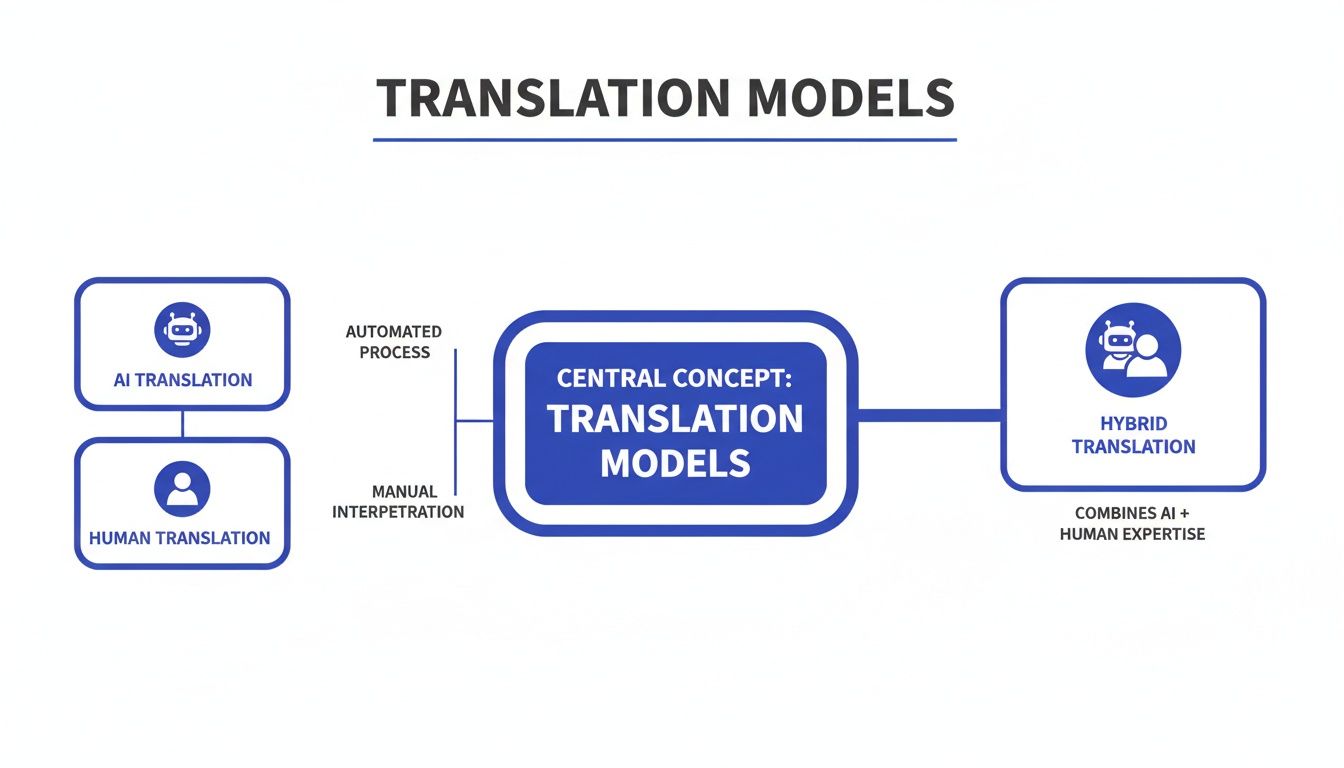
Your choice between AI, human, or a hybrid approach really comes down to balancing speed, cost, and the level of accuracy you need for a given project.
- Standard AI (The "Good Enough" Tier): This is typically a general-purpose Neural Machine Translation (NMT) model. It’s lightning-fast and cheap, making it perfect for getting the gist of a document for internal review or when you just need to understand something quickly.
- Advanced AI (The Professional Tier): Premium AI tiers use more sophisticated NMT models, often trained on specialized data for specific industries. These engines are much better at handling technical jargon, keeping the tone consistent, and navigating complex sentences. The result is a far more natural and professional-sounding translation that’s ready for many business uses. To get a better sense of the different types, you can explore our guide to document translation software.
- Human Translation (The "Perfect" Tier): At the very top, you have a professional linguist doing the work. This is still the gold standard for capturing cultural nuance, creative flair, and the precise legal language needed for high-stakes documents. Of course, this level of quality comes with a much higher price tag and a longer wait.
3. Language and Dialect Support
The number of languages a service offers is another key thing to check. Almost everyone covers the major world languages like Spanish, French, and Mandarin, but what if your needs are more specific? For quick, on-the-fly text conversion, especially when testing new markets, it's also worth looking into AI-powered auto translate devices.
When you’re evaluating a service, don't just glance at the total language count. Dig deeper and see if they support regional dialects. This is a huge deal for true localization. For instance, the Spanish you’d use for a customer in Mexico is quite different from the Spanish for someone in Spain. A service that gets these distinctions right shows a real commitment to accuracy.
4. Turnaround Speed and Pricing Models
Technology has completely changed the game when it comes to the speed and cost of translation. The machine translation market nearly doubled from USD 650 million in 2020 to over USD 1.1 billion by 2022, and that growth is all about delivering faster results at a lower cost. This has led to some much-needed variety in how services are priced.
Here’s a quick breakdown of the pricing structures you’ll usually find:
| Pricing Model | How It Works | Best For | Potential Downside |
|---|---|---|---|
| Per-Word | The classic agency model. You pay a set rate for every single word translated. | High-quality, human-led projects where nuance is everything. | Can get incredibly expensive for large documents; you often don't know the final cost upfront. |
| Per-Page/Document | A flat fee for each page or for the whole document, often with different quality tiers. | Predictable budgeting. Great for projects with high volume where word count isn't the only cost factor. | Might not be the most economical choice for very short documents with little text. |
| Subscription | A monthly or annual fee that gives you a set amount of translation credits. | Businesses that have consistent, ongoing translation needs. | Watch out for expiring credits and high fees if you go over your allotment. |
Frankly, transparent and upfront pricing is a sign of a modern, customer-focused service. Platforms that show you the exact cost before you hit "translate" take all the guesswork and financial risk out of the equation.
5. Security and Compliance Protocols
Last but certainly not least: never, ever overlook security. When you upload a document, you're handing your data over to a third party. This is a massive deal when you’re working with sensitive information like legal contracts, financial reports, or private customer data.
Here’s what to look for in a service’s security policy:
- Encryption: Your data should be encrypted both in transit (as it's uploading and downloading) and at rest (when it's stored on their servers). This is non-negotiable.
- File Deletion Policies: A trustworthy service will be crystal clear about how long they keep your files. Automatic deletion after a short period, like 24 hours, is a great sign of good data hygiene.
- Confidentiality Agreements: Make sure the service explicitly guarantees they won’t share your documents or the data within them with anyone else.
By carefully weighing these core features, you can move beyond the marketing noise and make a smart decision that truly fits your project's needs for quality, speed, cost, and security.
Matching Translation Services to Your Use Case
Picking the right document translation service isn't about finding the one with the longest feature list. It’s about matching the tool to the job. The perfect solution for a law firm handling sensitive contracts is almost never the right fit for a marketing team trying to launch a global campaign.
Let's walk through a few real-world scenarios. By looking at what different teams actually need—whether it's airtight precision, lightning-fast speed, or cost-efficiency—you can see how to make the right call.
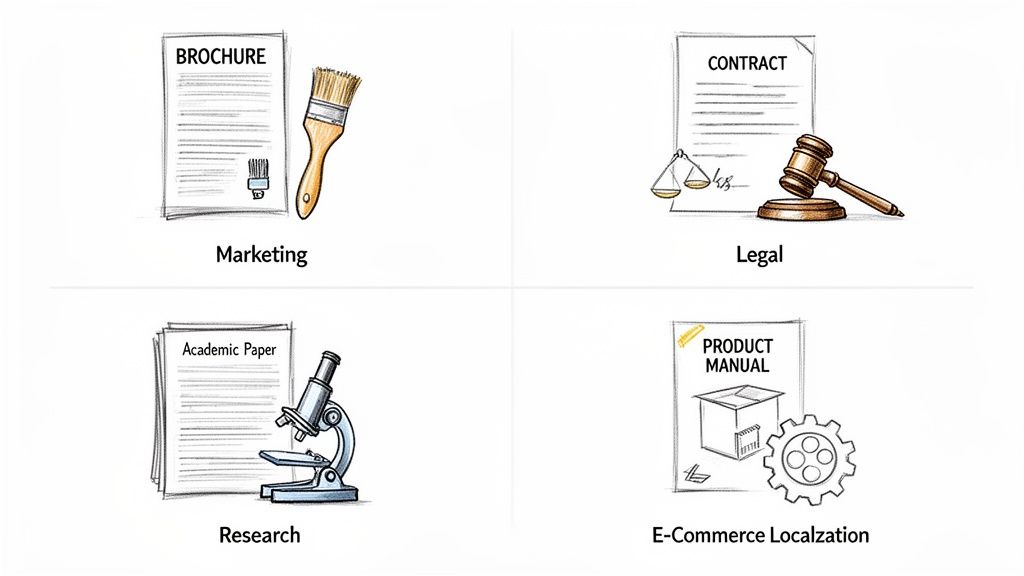
Use Case 1: The Marketing Team Localizing Brochures
Imagine a marketing team ready to translate a beautiful, visually complex product brochure into Japanese and German. The file is a layered PDF loaded with custom fonts, specific branding colors, and perfectly placed images.
Top Priorities:
- Layout Preservation: This is non-negotiable. The translated brochure has to look exactly like the original to protect the brand's image.
- Brand Voice & Nuance: The translation can't just be literal. It needs to be persuasive, culturally sharp, and capture the brand’s unique tone.
- Speed: These brochures are for an international trade show next month. Time is tight.
Here, a service that specializes in end-to-end formatting preservation is mission-critical. The team needs a platform that won't butcher the design when processing a complex PDF. If you want a deep dive into how that works, our guide on how to translate a PDF breaks it down. A premium AI tier is the perfect starting point for a fast, fluent draft, followed by a quick review from a native-speaking marketer to nail the cultural nuances.
Use Case 2: The Legal Firm Handling Sensitive Contracts
A law firm is in the middle of a cross-border merger and has to translate stacks of contracts and due diligence files. These documents are packed with sensitive financial data and dense legal jargon.
Top Priorities:
- Unerring Accuracy: There is zero room for mistakes. One mistranslated clause could trigger a cascade of legal and financial problems.
- Ironclad Security: Confidentiality is everything. The service must offer robust data encryption and have a clear, trustworthy file deletion policy.
- Terminology Consistency: Legal phrases must mean the same thing across every single document.
A hybrid workflow is the only sensible approach here. Kicking things off with an advanced AI model trained on legal terminology can produce a highly accurate first draft in a fraction of the time. But the final step is absolutely essential: a certified legal translator must review and verify every word. Security is just as crucial, so you'd look for a service that guarantees end-to-end encryption and automatic file deletion after processing.
Expert Insight: For high-stakes legal or medical content, think of AI as an accelerator, not a replacement. It’s a powerful tool to get you 95% of the way there, but a human expert must close that final 5% gap where liability lives. The risk is simply too great.
Use Case 3: The Academic Researcher Translating Papers
A researcher needs to translate several technical papers for an international journal. The documents are dense with field-specific terminology, complex charts, and long bibliographies.
Top Priorities:
- Technical Jargon: The service has to get the niche vocabulary right.
- Formatting of Data: All tables, graphs, and citations must remain perfectly intact.
- Budget-Friendly: Most researchers are working with a limited grant budget.
In this situation, a premium AI tier trained on academic and technical glossaries is a fantastic fit. It can handle the specialized language and preserve the document's structure without the high cost of a specialized human translator. A platform that offers transparent, per-document pricing is a huge plus for managing a tight budget. The researcher is the subject matter expert, so they can perform the final review to ensure every term is spot-on.
Use Case 4: The E-Commerce Business Localizing Manuals
An e-commerce company is launching in several new European markets. The task? Translate hundreds of product user manuals—fast.
Top Priorities:
- Scale and Speed: They have a massive volume of documents and a fixed launch date.
- Cost Control: Translating hundreds of files into multiple languages gets expensive, fast. The budget needs to be predictable.
- Good-Enough Quality: The translations don't need to be poetic. They just need to be clear, accurate, and easy for a customer to understand.
This is the ideal job for a high-quality, AI-powered document translation service. The ability to batch-process huge volumes of documents at a low cost is exactly what’s needed to localize at scale. A platform with simple, predictable pricing allows the business to budget the entire project upfront. For instructional content like manuals, the focus is on clarity and utility—something modern AI handles exceptionally well.
When to Invest in Human Review
Modern AI delivers impressive speed and fluency, but even the best document translation services aren't infallible. Knowing when to bring in a human expert isn’t about doubting the technology; it’s about smart risk management and making sure your final document hits the mark.
Think of AI as a fantastic tool for generating a solid first draft. For low-stakes internal documents or initial research where you just need to understand the gist, that's often good enough. But when your content is customer-facing or carries real-world consequences, that AI draft is just the starting point. It needs a professional linguist to provide the final polish.
High-Stakes Legal and Financial Documents
Nowhere is the need for a human expert more critical than in legal and financial matters. In these domains, one wrong word or a misplaced comma can lead to disaster—voided contracts, compliance failures, or serious financial losses. Ambiguity is your worst enemy, and AI can sometimes miss the hyper-specific terminology that these fields demand.
A human translator specializing in legal or financial language does more than just translate words; they understand the intricate concepts and different legal systems at play. They ensure that terms like "indemnity" or "fiduciary duty" carry their full legal weight in the target language—a level of nuance an AI model might get close to, but can't guarantee.
Your human reviewer is the last line of defense against liability. For any document where a mistake could spark legal action or financial penalties, professional human oversight isn't a luxury—it's essential.
Creative and Persuasive Content
Marketing materials, brand messaging, and ad campaigns are all about cultural nuance, tone, and emotional connection. A direct, word-for-word translation, even if technically accurate, will almost always sound clunky and unnatural. It can come off as robotic, miss local idioms, or, in the worst cases, be unintentionally offensive.
This is where human translators shine. They perform transcreation, which is the art of adapting a message from one language to another while preserving its original intent, style, and emotional impact. It’s absolutely vital for any content meant to persuade or connect with an audience.
Human review is a must for content like:
- Ad Slogans: You need a human to capture the clever wordplay or cultural resonance of a great tagline.
- Website Copy: A translator ensures your brand's voice feels authentic and native to the local market.
- Sales Materials: They can adapt persuasive language to fit local buying habits and cultural norms.
Any Document for Public Distribution
When in doubt, follow this simple rule: if the document is going public, have a human review it. This covers everything from press releases and annual reports to website content and user manuals. Every piece of public-facing material is a direct reflection of your brand’s professionalism.
A clean, polished translation shows that you are competent and that you respect your audience. On the flip side, a document with awkward phrasing or small errors can quickly damage your reputation and erode trust. Investing in a quick human check is a small price to pay to protect your brand's image on the world stage.
Your Decision-Making Checklist
Picking the right document translation service comes down to knowing exactly what your project needs. To make it easier, walk through this checklist. Answering these questions will help you zero in on a provider that can actually deliver what you need.
I’ve broken this down into four key areas, taking you from the big picture all the way down to the nitty-gritty details of budget and security.
Document and Formatting Needs
First things first, let's talk about your files. The type and complexity of your documents will immediately rule out some services, especially those that can't handle anything more than a simple text file.
- What are your primary file types? Are we talking basic text documents, or are you dealing with heavily formatted PDFs, DOCX files, or even InDesign layouts?
- Is keeping the original layout a deal-breaker? For marketing brochures, technical manuals, or legal contracts, the translated version needs to look identical to the original—tables, fonts, and all.
- Do your documents have more than just text? Think about how a service will manage embedded images, charts, graphs, and even headers and footers. These elements often get overlooked.
Project Scope and Scale
Next, get a handle on the sheer volume and linguistic variety you're working with. This will tell you whether you need a powerhouse service built for enterprise-level work or something simpler for occasional projects.
- What's your typical document volume? Are you translating a one-off document, or are you managing a steady stream of hundreds of files?
- How many languages do you need? Don't just think about the big ones. Do you need specific regional dialects, like the difference between Brazilian Portuguese and European Portuguese?
- What’s your turnaround time? Do you need translations back in minutes or hours, or are your timelines more flexible, measured in days or weeks?
A Word on Scalability: This is huge. A service that’s great for a single-page memo might completely fall apart when faced with a 500-page technical manual, struggling to maintain quality and consistency across the board.
Quality and Accuracy Standards
What's the document for? An internal draft for your team has a much lower quality bar than a public-facing legal agreement where every word counts.
- Is machine translation good enough? For getting the gist of an internal email or document, AI is often perfectly fine—and incredibly fast.
- Does your content demand human-level nuance? When it comes to marketing materials, legal contracts, or anything else where precision is non-negotiable, you absolutely need a professional human translator to review the final output.
- Is your content full of specialized jargon? If you're in a technical, medical, or legal field, you have to be sure the service can correctly translate industry-specific terminology without losing meaning.
Budget, Speed, and Security
Finally, let's talk about the practical constraints that will shape your decision. It's almost always a balancing act between cost, speed, and how your data is handled.
- What’s your budget? Look for a provider with a clear, transparent pricing model. To get a better sense of industry rates, check out our guide on document translation cost.
- How is your data protected? Make sure the service uses end-to-end encryption and has a straightforward data policy, like automatically deleting your files after a set period.
- What are your compliance requirements? If you're working with sensitive information, you need a provider that can meet industry standards for data confidentiality.
Common Questions About Document Translation
When you start digging into document translation services, a few questions always seem to pop up. Whether you're translating a quick internal memo or a critical legal contract, getting the right answers upfront makes all the difference. Let's tackle some of the most common ones.
How Can I Stop Translations from Wrecking My Formatting?
This is a huge, and valid, concern. The key is to find a service that explicitly promises end-to-end layout preservation, especially for tricky file types like PDF or DOCX. The best platforms don't just translate the text; they use sophisticated tech to analyze the entire document's structure—every table, image, and font choice.
They then painstakingly rebuild that same layout in the translated version. This is what saves you from the nightmare of manually fixing a document that’s been completely scrambled.
What's the Real Difference Between AI Translation Tiers?
It all boils down to the power of the AI model and how polished you need the final text to be.
- Standard Tier: Think of this as the workhorse. It uses a solid, general-purpose AI model that's perfect for internal documents or when you just need to understand the core message. It gets the job done quickly.
- Premium Tier: This is where things get more refined. These tiers typically run on more advanced neural models, which have been trained on specialized industry data. The output is noticeably more fluent, handles nuance and idioms much better, and is far more accurate for important, client-facing materials.
Key Insight: A standard tier gives you a functional first draft. A premium tier delivers a translation that sounds professional and is nearly ready for prime time.
What’s a Fair Price for Document Translation?
Pricing is all over the map. Traditional translation agencies have historically charged by the word, which can lead to unpredictable and often high costs, especially for larger documents.
Thankfully, modern AI-driven platforms have brought much-needed clarity to pricing. Many now offer a simple flat fee per document or per page. For the sake of your budget, always look for a service that gives you a clear, upfront quote before you hit "translate." No one likes surprise fees.
Ready to translate your documents without the formatting headaches? DocuGlot provides end-to-end preservation for PDFs, DOCX files, and more, with clear pricing and ironclad security. Get your instant quote today.
Tags
Ready to translate your documents?
DocuGlot uses advanced AI to translate your documents while preserving formatting perfectly.
Start Translating