Choosing the Best Online Document Translation Service
Ever had to translate a document, only to watch the formatting completely fall apart? You get the words back, but the tables are a mess, the images are all over the place, and the layout is completely destroyed. It's a frustrating, time-consuming nightmare to fix.
This is exactly the problem that online document translation services solve. They’re built to translate the text in your files—like PDFs, Word docs, or presentations—while keeping every bit of the original formatting perfectly in place.
What Exactly Is an Online Document Translation Service?
Think of it this way: a simple text translator is like getting a script for a play. You have the words, but you have no idea about the stage directions, the set design, or how the actors should deliver their lines. An online document translation service, on the other hand, gives you the full, ready-to-perform production in a new language.
These platforms are sophisticated enough to recognize and preserve the entire structure of your document. We're talking about headers, footers, complex charts, and even the exact placement of your company logo. The real magic is that you get back a document that's instantly usable, saving you from the headache of manually rebuilding it from scratch.
Powering Modern Global Communication
In a world where business is global, the need to translate everything from legal contracts to technical manuals and marketing materials has exploded. Companies are expanding faster than ever, and clear, professional communication is non-negotiable. The market numbers tell the story loud and clear.
The global document translation services market shot up from $34.5 billion in 2021 and is on track to hit $44.6 billion by 2025. This massive growth is a direct result of globalization, as more and more companies find themselves needing to translate huge volumes of content. You can read more about this market growth to see the full picture.
This isn't just a trend; it's a fundamental business need. Companies can't afford to waste time and money on slow, clunky translation processes that compromise quality. A good online document translation service steps in to fix this, offering a few key advantages:
- Serious Speed: What used to take days now takes minutes or hours.
- Smart Savings: It dramatically cuts down on the costs of manual DTP (desktop publishing) and reformatting work.
- Rock-Solid Consistency: Your branding and professional look are maintained perfectly across every language.
- Translate from Anywhere: Just upload your file from your browser, and you’re good to go.
At the end of the day, these services make it possible for businesses, researchers, and legal experts to break through language barriers. They take the friction out of multilingual communication, letting you share high-quality, professionally formatted documents with anyone, anywhere.
How Modern AI Translation Preserves Your Layout
Have you ever spent hours perfecting a document, only to run it through a free online translator and watch the layout completely fall apart? Tables get scrambled, images end up on the wrong page, and all your careful formatting vanishes. It’s a common frustration. This happens because most basic tools are built to see only one thing: the words. They ignore the entire structure that gives your document its professional look.
A true online document translation service takes a fundamentally different approach. Think of it less like a simple word-swapper and more like a skilled digital artisan. It doesn't just rip the text out and jam a translation back in. Instead, it carefully disassembles your file, translates the content with precision, and then meticulously reconstructs everything, ensuring the final version is a perfect mirror of the original.
This is the key difference between a quick-fix tool and a real business solution. The magic behind this is a multi-step process designed from the ground up to respect and replicate your document’s design.
This simple workflow shows how a modern platform handles your files from start to finish.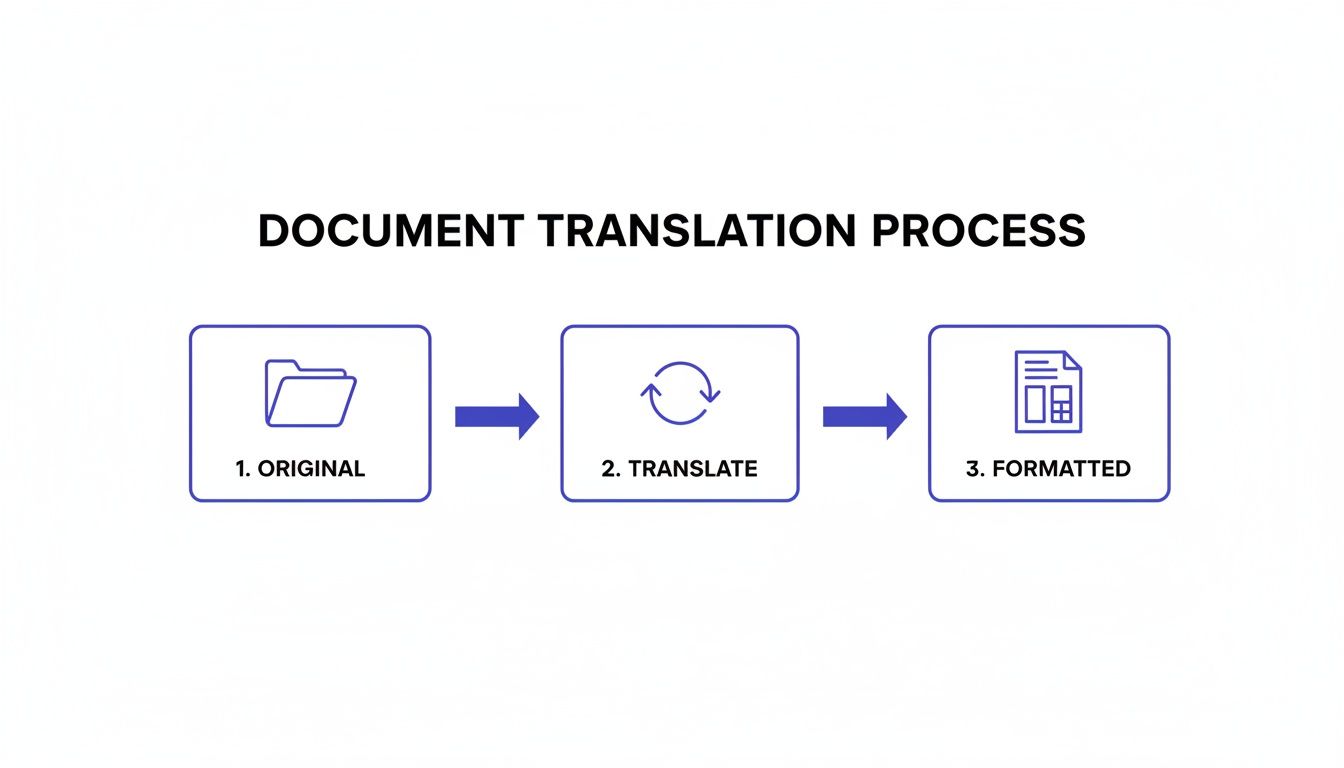
The main thing to remember is that formatting isn't an afterthought; it’s an integral part of the process from the moment you hit "upload."
The Deconstruction and Analysis Phase
As soon as your file arrives, the system gets to work on the most critical first step: deconstruction. It acts like a digital architect, meticulously mapping every single element in your document.
This goes far beyond just grabbing the text. The AI identifies and logs everything that makes your document look the way it does:
- Structural Components: Headers, footers, footnotes, and page numbers are all tagged and their positions noted.
- Visual Elements: The exact location of images, charts, and graphs is carefully recorded.
- Formatting Styles: It catalogs all font types, sizes, colors, bolding, and italics.
- Complex Layouts: Tables with specific column widths and row heights are mapped out with precision.
By creating this detailed blueprint first, the service knows exactly how to put the puzzle back together later. This is especially vital for tricky file types. For a closer look at how this works with a common format, you can read our guide on how to translate a PDF while keeping its layout.
AI Translation with Contextual Awareness
With the document’s structure fully mapped, the text is handed over to the AI translation engine. This is where the language conversion happens, but it’s a world away from simple word-for-word replacement.
Today's AI doesn't just see words; it understands context. It analyzes sentences and entire paragraphs to grasp the true meaning, which helps it select more natural and accurate phrasing. This is how it knows the difference between "book" a flight and read a "book." This contextual understanding is what elevates the quality from robotic to readable.
The technology is advancing at an incredible pace.
The machine translation market is exploding, growing from $1.88 billion in 2023 and projected to hit $2.34 billion in 2024. This growth is driven by massive daily demand—services like Google Translate alone field requests from over 500 million people every day.
The Meticulous Reconstruction Process
This final step is where the magic really happens, and it’s what protects your document's professional polish. With the translated text ready and the original layout blueprint in hand, the system begins putting everything back together.
It carefully places each translated sentence and paragraph into its designated spot. It then re-applies the original font styles, sizes, and colors. Images and tables are re-inserted into their precise locations, while headers and footers are rebuilt with the new text. The system is also smart enough to adjust for text expansion or contraction—a common issue when, for example, translating from English to German—to prevent awkward line breaks and keep the layout clean.
This meticulous reassembly is what ensures your translated document is ready for immediate use, saving you hours of frustrating manual reformatting.
What to Look for When Comparing Translation Services
Choosing an online document translation service can feel overwhelming. A quick search brings up dozens of options, and they all seem to promise the same things: speed, accuracy, and ease of use. But how do you find the one that actually works for your professional needs?
The secret is to look past the flashy marketing and focus on a few core features that separate the basic tools from a truly reliable business partner. It’s a bit like buying a car—you wouldn’t choose one based on its color alone. You'd dig into the engine specs, safety ratings, and how it feels to drive. Let's do the same for translation services.
Comprehensive File Format Support
First things first: can the service even handle your files? In the real world, we're not just translating plain text. Our work lives in complex documents—meticulously formatted Word files, multi-layered PDFs, and polished presentation decks.
A truly professional-grade service needs to support the formats you use every day, including:
- DOCX and DOC: For all your reports, contracts, and internal documents.
- PDF: The go-to for everything from invoices to research papers.
- PPTX: Essential for taking your presentations to a global audience.
- XLSX: For spreadsheets packed with financial data, project timelines, or inventory lists.
If a platform can't open your primary file types, it’s a dead end. This isn't a nice-to-have feature; it's the absolute baseline.
Guaranteed Layout Preservation
This is where the best services really shine. A great tool doesn't just swap out words; it maintains the entire visual structure of your document. Think about it—all your tables, images, headers, footers, and even font choices should stay exactly where you put them.
Without guaranteed layout preservation, you’re only getting half the job done. The time you supposedly saved on translation gets eaten up by tedious hours of manual reformatting. It completely defeats the purpose.
Imagine translating a 50-page technical manual where all the charts and diagrams are suddenly jumbled. The document becomes confusing and unprofessional, if not completely useless. This is why services like DocuGlot are built from the ground up to preserve formatting, giving you a translated file that's a perfect mirror of the original.
Breadth of Language Coverage
Your business's global reach is limited by your translation service's language library. Sure, most platforms can handle common pairs like English to Spanish. But what about when you need to reach a market in Southeast Asia, or when you need to distinguish between different dialects?
Look for a provider that offers an extensive language catalog that covers both your current and future needs. It’s not just about the number of languages, but the depth. For example, does it offer both European and Brazilian Portuguese? A deep and nuanced language list is a strong signal of a serious, globally-focused platform. For a closer look at what separates the good from the great, check out our guide on what to look for in good translation software.
Robust Security and Data Privacy
When you upload a sensitive document to an online platform, you’re placing a massive amount of trust in that company. This is absolutely non-negotiable for legal contracts, private medical records, or confidential business plans.
You have to be sure the service has ironclad security protocols. Here’s what to demand:
- End-to-End Encryption: Your file needs to be protected from the second it leaves your computer to the moment you download the translated version.
- Strict Data Privacy Policies: The provider must give you a rock-solid guarantee that they won't share your data or use your content to train their AI models.
- Automatic File Deletion: Look for a clear policy stating your files will be permanently wiped from their servers after a short window, usually 24 to 48 hours, to minimize any risk of exposure.
Transparent and Upfront Pricing
Hidden fees, confusing credit systems, and vague pricing models are huge red flags. A trustworthy service will give you a clear, upfront quote before you hit "translate." You should know the exact cost based on the document's word count and the quality level you've selected.
Steer clear of services that force you to "contact us for a quote" for standard document translations. Transparent, per-word pricing or a simple calculator shows that a company is confident in the value it provides and respects your time. It makes budgeting predictable, whether you're translating a one-page memo or a massive report.
When you're comparing different platforms, it can be helpful to see these features side-by-side.
Key Feature Comparison for Online Document Translation Services
This table breaks down what to look for in each critical area, helping you evaluate potential services and ensure they meet professional standards.
| Feature | What to Look For (Ideal) | Why It Matters |
|---|---|---|
| File Format Support | Native support for DOCX, PDF, PPTX, XLSX, and other common business formats without requiring conversion. | You need a tool that works seamlessly with your existing files, eliminating extra steps and potential conversion errors. |
| Layout Preservation | A guarantee that all visual elements (images, tables, headers, fonts, columns) will be retained in the final document. | It saves you from hours of manual reformatting and ensures the translated document is professional and ready to use instantly. |
| Language Coverage | A wide range of languages, including specific dialects and regional variations. | A deep language library supports true global communication and allows your business to scale into new markets. |
| Security & Privacy | End-to-end encryption, a strict no-data-sharing policy, and automatic file deletion within 48 hours. | This protects your sensitive information, maintains client confidentiality, and ensures compliance with data protection laws. |
| Pricing Model | Clear, upfront, per-word pricing with a cost calculator displayed before you commit. | It provides budget predictability and eliminates the risk of hidden fees, building trust between you and the provider. |
| Translation Quality | Options for both instant AI translation and human-reviewed translation to match different needs and budgets. | It gives you the flexibility to choose between speed for internal drafts and high accuracy for public-facing content. |
Ultimately, the goal is to find a service that feels less like a tool and more like a reliable extension of your team. By carefully weighing these key features, you can confidently choose a platform that not only translates words accurately but also protects your workflow, your data, and your brand's professional image.
How Professionals Actually Use Document Translation
The true test of any tool isn't its list of features, but how it solves real-world problems. For professionals in countless fields, an online document translation service is much more than a convenience—it's a critical engine for growth, compliance, and global communication. Let's step into the shoes of four different professionals to see how these services solve complex challenges and turn them into simple successes.
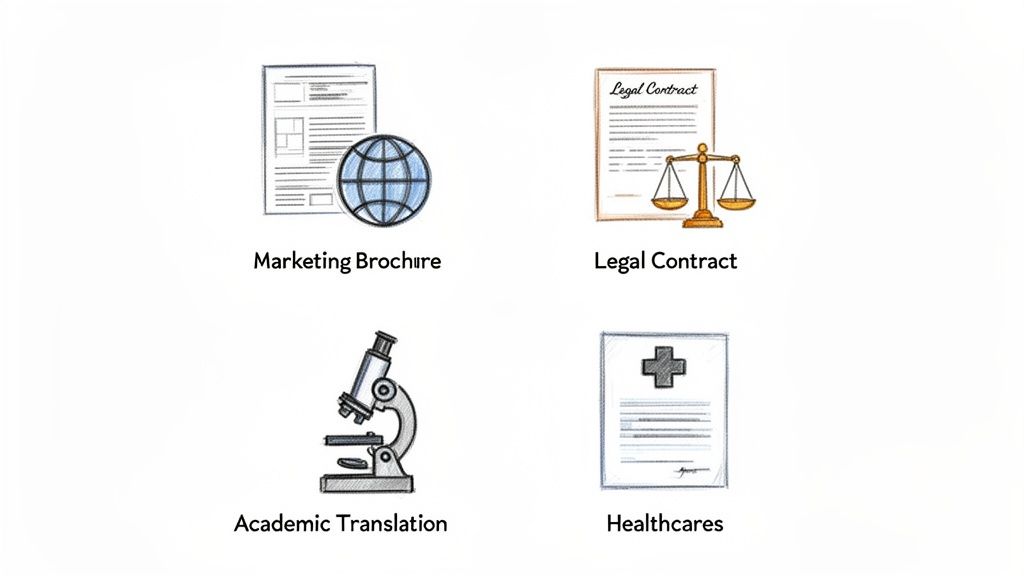
Each of these stories shines a light on how specific capabilities like speed, accuracy, and format preservation give professionals the power to operate far more effectively on a global stage.
The Small Business Expanding into Europe
Picture a small US-based e-commerce shop selling beautiful, artisanal home goods. They've built a loyal following at home and are ready to take on the German market. The problem? Their primary sales tools are stunning PDF brochures and catalogs, all in English.
Trying to translate these visually rich documents manually would be a disaster. German text is often longer, which would shatter the layout of their carefully designed brochures. The alternative—hiring a freelance translator and then a separate graphic designer to rebuild every file—is incredibly slow and expensive. We're talking weeks of back-and-forth and a bill running into the thousands.
This is where a modern online document translation service flips the script.
- The Action: The business owner simply uploads their entire collection of PDF brochures to a service like DocuGlot.
- The Outcome: A few hours later, they have perfectly translated German versions in hand. The platform’s AI didn't just translate the words; it intelligently adjusted the layout to fit the longer German phrases, keeping every image, font, and design element exactly where it should be.
- The Impact: The company can launch its German marketing campaign almost overnight, at a tiny fraction of the traditional cost. They look professional and localized from day one, which is key to building trust with a brand-new audience.
The Legal Team Managing International Contracts
A corporate law firm is navigating a merger between a Canadian tech company and a Japanese conglomerate. The deal hinges on hundreds of legal documents—dense contracts, financial reports, and compliance paperwork in both English and Japanese. In this world, precision is everything. The formatting, down to the last table, clause number, and paragraph break, must be identical in both languages to be legally binding.
A simple copy-paste translation would create a jumbled mess of text, making it impossible to compare versions. The legal team needs a solution that guarantees the structural integrity of every single page.
For legal and immigration purposes, the accuracy of translation is paramount. A poorly translated document can lead to serious misunderstandings, legal challenges, or outright rejection by authorities like U.S. Citizenship and Immigration Services (USCIS).
The firm turns to a secure online document translation service. They upload the English DOCX contracts, and the system delivers professionally formatted Japanese versions almost instantly. Side-by-side reviews become a breeze because the paragraph numbers and table structures align perfectly. This incredible speed helps them hit tight deadlines without ever compromising the meticulous detail that international law demands.
The Academic Sharing Groundbreaking Research
An environmental scientist has just finished a game-changing study on climate change. It’s a dense, 100-page paper packed with complex charts, data tables, and scientific notation. For her work to have a real global impact, she needs to get it into the hands of researchers in China and Brazil. But it's only in English.
She faces two major hurdles: translating highly technical jargon accurately and, just as importantly, preserving the complex data visualizations that are the heart of her research. The university's internal translation department is buried in work, with a backlog stretching for months.
Using an advanced online document translation platform, she can:
- Choose a Premium AI Model: She selects a translation model specifically trained on academic and technical texts to ensure it understands the specialized terminology.
- Preserve Complex Data: The service processes her document, keeping every chart, graph, and table perfectly intact in the translated output.
- Spark Global Collaboration: In a single day, she has the paper ready in both Mandarin and Portuguese. She can now share her findings with international colleagues immediately, fueling the global conversation around her work.
For authors trying to grow their audience, finding smart ways to translate their work is key. This includes looking into strategies for publishing in Spanish and other languages to connect with millions of potential new readers.
The Healthcare Provider Ensuring Patient Safety
A large city hospital serves a diverse community, including a large Spanish-speaking population. To guarantee patient safety and informed consent, every patient-facing document—intake forms, medical histories, post-op instructions—must be available in both English and Spanish.
These documents are full of complex medical terms and formatted tables for things like dosage instructions. A small mistake in translation or formatting could have serious, even dangerous, consequences. The hospital's compliance department is crystal clear: all translated materials have to be accurate, clear, and professionally presented.
The hospital’s administrative team uses an online translation service to handle this critical job with confidence. They upload their standard English PDF forms and get print-ready Spanish versions back the same day. Because the layout is perfectly preserved, the Spanish forms are instantly familiar to staff and easy for patients to navigate. This simple, efficient process helps the hospital meet its compliance duties and, more importantly, deliver safer, more equitable care to every patient who walks through its doors.
Understanding Security and Data Privacy
Uploading sensitive information to any online platform can feel like a leap of faith. This is especially true when you're dealing with confidential business plans, private medical records, or proprietary legal contracts. When you use an online document translation service, you’re not just translating words—you’re entrusting that provider with critical data. That makes security a non-negotiable part of the deal.
A truly professional platform moves beyond vague promises of being "secure" and provides multiple, transparent layers of protection. The first and most critical layer is end-to-end encryption. Think of it as a digital armored truck for your file. From the moment you hit "upload" until you download the finished translation, your document is sealed in a protective cryptographic layer, making it completely unreadable to anyone who might try to intercept it.
Core Pillars of Data Protection
Solid security isn't just about the tech; it's also about clear, enforceable policies that put your privacy first. A service's commitment to protecting your data should be easy to find and even easier to understand.
Here are a few key policies to look for:
- A Strict No-Sharing Guarantee: The provider must state, in no uncertain terms, that your documents and their contents will never be shared with third parties or used to train public AI models.
- Automatic File Deletion: Your files shouldn't live on a server forever. A reputable service will permanently wipe your original and translated documents from their systems after a short, defined period, usually 24 to 48 hours.
These policies are your assurance that the service is designed to handle your data temporarily and with the utmost care, minimizing its exposure. You can often find these commitments detailed in a company's privacy policy. It’s always worth taking a moment to review DocuGlot’s clear data handling commitments to see what a transparent policy looks like.
Verifying a Service’s Security Claims
In a world full of digital threats, you have to verify a provider's security practices. The consequences of a data breach are just too high to take a company at its word. Uploading immigration forms, financial statements, or patient records to an unsecured website creates massive privacy risks.
A professional service will have clear, confident answers to your security questions. If their responses about encryption, access controls, or data deletion are vague or dismissive, consider it a major warning sign.
If you want to dive deeper into how digital information is protected from unauthorized access, modification, or theft, this practical guide on data security management offers some great insights that can help you evaluate any online service you use.
Ultimately, choosing an online document translation service is a decision built on trust. That trust isn't earned with flashy marketing claims, but with provable security measures and transparent privacy policies. By prioritizing providers who treat your data with the same seriousness you do, you can get instant, accurate translations without ever compromising the confidentiality your work demands.
A Practical Guide to Getting the Best Results
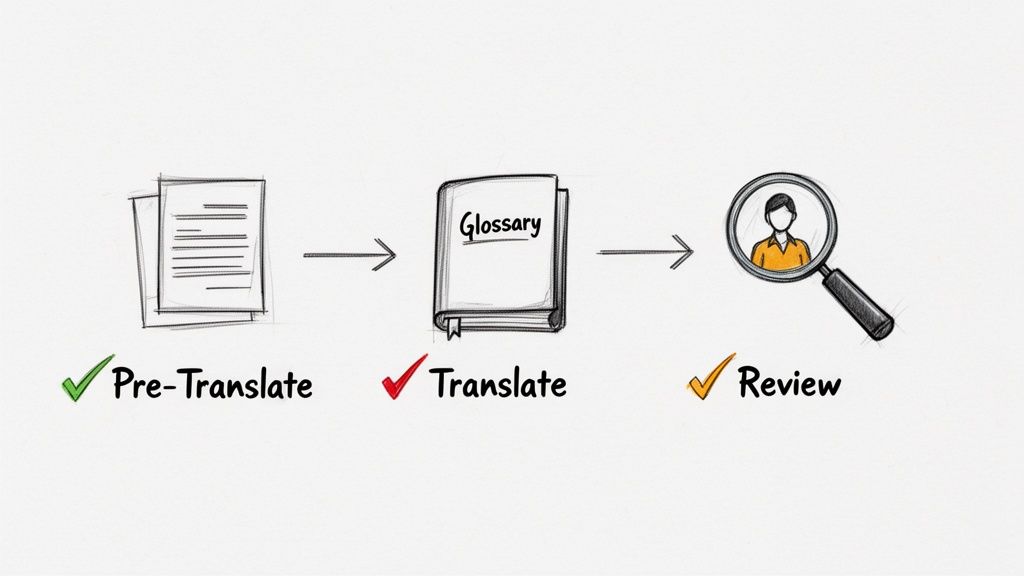
Even the most powerful online document translation service is ultimately a partnership. The technology does the heavy lifting, sure, but how you prepare your files and what you do afterward can be the difference between a good translation and a great one. Getting it right starts before you even click "upload."
Think of the AI as an incredibly smart assistant that takes everything you give it literally. To set it up for success, your first job is to prep the source document. While top-tier services like DocuGlot are built to handle tricky layouts, simplifying overly complex designs or floating text boxes can help avoid any formatting surprises.
And here’s a pro tip: consistency is everything. If your documents are full of specific technical terms, brand names, or inside-baseball jargon, creating a simple glossary is a game-changer. When you define these terms upfront, you’re telling the AI exactly how to handle them every single time, which keeps your documents looking professional and clear.
Preparing Your Document for Translation
Before you hand over your file, a quick check can make a world of difference. The idea is to give the AI a clean, unambiguous source to work from.
- Proofread for Clarity: Hunt down any typos, grammatical mistakes, or clunky sentences in the original text. The AI translates what it sees, so a clean source document naturally leads to a cleaner translation.
- Simplify Complex Layouts: If you have text buried inside complex graphics, try to pull it out into standard text boxes. This makes it much easier for the platform to find and translate every last word.
- Create a Glossary for Key Terms: For recurring technical language, just list the English term and its preferred translation. This small step pays huge dividends in consistency, especially for your most critical terminology.
By prepping your document and creating a glossary, you're not just a user—you're the director of the translation. You're actively guiding the process toward a more precise and polished outcome.
Taking these steps beforehand sets the stage for a smoother, more accurate translation and cuts down on the revision work you'll have to do later.
The Critical Post-Translation Review
After the translation is complete and your document comes back, it's time for the final quality check. The AI has done its part, preserving the layout and converting the words, but a human eye is still the best tool for catching subtle nuances.
So, what should you look for? Read through the translated file and check for context and tone. Does it feel right? Does it match the original's intent? Are there any phrases that might land awkwardly or be misinterpreted in the target culture? For anything important, like legal contracts or medical instructions, this step is absolutely essential.
If the document is heading to a crucial external audience, it's often worth having a native speaker or professional translator give it a final polish. A high-quality AI translation gets you 95% of the way there, almost instantly and for a fraction of the cost. That final human review adds the last 5%, ensuring your message isn't just accurate but truly connects with your audience.
Document Translation FAQs
When you're looking into online document translation, a few questions always pop up. It's totally normal to wonder about everything from how AI handles complex charts to whether your confidential files are actually safe. Let's walk through the most common questions so you can feel confident you're making the right choice.
Can AI Really Handle Complex Documents With Tables and Charts?
Yes, but there's a huge catch: you have to use a service specifically built for it. Your average text translator just sees a wall of words and will absolutely wreck your formatting. A true online document translation service is different because it’s designed to see the entire document, not just the text.
Here’s how it works behind the scenes. Advanced platforms first scan and map out the document's structure—every header, footer, table, image, and font style. Only then is the text translated. Finally, the service meticulously reassembles the document, slotting the translated text back into its original spot. This "format preservation" technology is the secret sauce that makes the final document look just like the original.
How Secure Is It to Upload Sensitive Business or Legal Files?
This is a big one, and the answer varies wildly from one provider to the next. Security should be at the top of your checklist. A reputable service will be completely transparent about how they protect your data.
When you're evaluating options, look for these non-negotiable security features:
- End-to-End Encryption: This is a must-have. It means your file is scrambled from the moment you upload it to the moment you download it, making it unreadable to anyone trying to intercept it.
- Clear Privacy Policies: The service should state, in no uncertain terms, that they won’t share your data or use your documents to train their public AI models.
- Automatic File Deletion: For ultimate peace of mind, the best services permanently delete your files from their servers after a set period, like 24 hours.
If a service doesn't offer these, it's not the right choice for confidential information.
When Should I Choose AI-Only Translation Over Human Review?
It all comes down to what the document is for and who will be reading it. AI-only translation is fantastic for internal communications, digging through research, or just getting the basic meaning of a document in a hurry. You can't beat its speed and cost-effectiveness.
But when the stakes are high—when every word matters—adding a final pass by a professional human translator is a smart move.
A good way to think about it is this: let the AI do 95% of the heavy lifting. It's incredibly fast and keeps your formatting intact. Then, bring in a human expert to add that final 5% of polish for critical documents like legal contracts, patient records, or customer-facing marketing materials.
What Is the Difference Between Standard and Premium AI Translation?
The main difference is the brainpower of the AI model doing the work. A "Standard" or "Basic" option generally uses a very capable, high-quality model that works perfectly for most day-to-day documents. It’s fast, accurate, and cost-effective.
A "Premium" option, on the other hand, uses a more sophisticated, context-aware AI. These models are much better at navigating tricky sentences, industry-specific jargon, and the subtle nuances of language. You'd want to go with a premium translation for more complex content like technical manuals, academic papers, or detailed financial reports where capturing the precise meaning is crucial.
Ready to translate your documents with perfect formatting and complete peace of mind? DocuGlot offers an AI-powered service that preserves your layout, supports over 100 languages, and protects your data with end-to-end encryption. Get your instant, transparent quote today.
Tags
Ready to translate your documents?
DocuGlot uses advanced AI to translate your documents while preserving formatting perfectly.
Start Translating