A Guide to Modern Tech Translation Services
If you've ever dealt with technical content—think software documentation, engineering schematics, or detailed user manuals—you know it's a world of its own. Tech translation services are built specifically for this world, focusing on converting that complex information from one language to another with absolute precision.
This isn't your average translation job. It’s less about creative flair and more about ensuring that the technical integrity, function, and meaning are perfectly preserved.
Why Tech Translation Is More Than Just Words
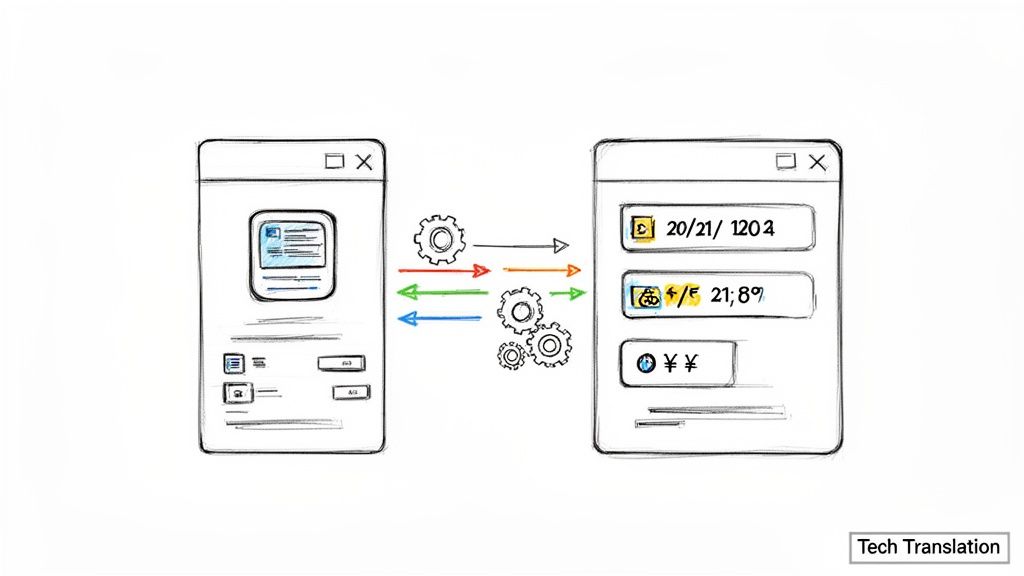
Think of it this way: you wouldn't ask a poet to rewrite an engineering blueprint. While literary translation focuses on capturing tone and cultural nuance, tech translation is all about accuracy. A single misplaced decimal or a mistranslated command in a medical device manual could lead to product failure or even pose a safety risk.
This field is built on a foundation of precision. It demands a unique combination of deep linguistic skill and genuine subject-matter expertise. You need someone who not only speaks the language but also understands the technology behind the words.
The Core Pillars of Effective Tech Translation
The real goal here isn't just to make the content understandable in another language. It has to be 100% usable and technically sound for a global audience.
Any truly effective tech translation service nails these three principles:
- Contextual Accuracy: The translators have to know the lingo. For instance, the word "string" means something completely different to a software developer than it does to a musician. They need to understand the specific industry jargon and acronyms to get it right.
- Functional Integrity: When you're translating software, the text has to work. UI elements, error messages, and system commands must not only be translated correctly but also fit within the design constraints and trigger the right actions in the application.
- Format Preservation: Technical documents are rarely just text. They’re filled with complex layouts, tables, diagrams, and code snippets. A critical part of the job is ensuring the translated document looks and feels exactly like the original. You can dive deeper into the challenges and solutions for technical document translation to see how modern platforms handle this.
At its heart, tech translation is about enabling seamless knowledge transfer across linguistic and cultural barriers. It ensures that an engineer in Germany can understand a schematic from Japan just as clearly as its original author.
Ultimately, this kind of service is non-negotiable for any tech company with global ambitions. It’s the critical step that turns a local product into a global solution, making sure your complex information stays clear, accurate, and functional, no matter who your audience is or where they are.
The Three Flavors of Tech Translation
When people talk about tech translation services, they're not talking about one single thing. It’s really an umbrella term for a few different solutions, each built for a specific job. Getting a handle on these categories is the first step to picking the right approach for your project.
Think of it like this: you wouldn't use a sledgehammer to hang a picture frame. The same logic applies here. Each type of translation tackles a unique challenge, from one-off documents to software that's updated every single day. Let's break down the three main types you'll encounter.
1. Technical Document Translation
This is the most straightforward and often the first kind of translation companies need. We're talking about translating self-contained, static files. Got a 200-page user manual in a DOCX file? A batch of engineering specs locked in a PDF? Or maybe your knowledge base is all written in Markdown. This is the service you'd use.
The real trick here isn’t just getting the words right—it's about preserving the formatting. A translated manual is pretty useless if the tables are a jumbled mess, the diagrams are all over the place, and the chapter headings have lost their styling. The whole point is to get back a translated document that looks and feels exactly like the original.
Here's what defines it:
- A File-In, File-Out Process: You upload a file (like a PDF, DOCX, or TXT), and you get a translated version of that same file back. Simple.
- Structure is Everything: The tech has to be smart enough to deconstruct and then perfectly reconstruct complex layouts—headers, footers, tables, you name it.
- Best for Static Content: This is the perfect fit for things that don't change often, like final product guides, research papers, or legal contracts.
2. Software Localization
While document translation is for static files, software localization dives headfirst into the dynamic world of apps. This is a much deeper process than just swapping out words. It’s all about making your software feel like it was built from the ground up for someone in a completely different part of the world.
Just think about any app you use. It's more than the text on the buttons. Localization means adapting the entire user interface (UI), from the text strings to the subtle cultural cues that build trust and make the software feel intuitive. It's a big deal—some apps have seen a 92% jump in downloads in new markets after getting localization right.
Localization is the art of making a product feel like it was built specifically for the end-user, no matter where they are. It involves adapting everything from currency symbols and date formats to colors and imagery to align with local expectations.
The process involves much more than translation:
- Adapting the UI/UX: Making sure translated text fits neatly into buttons and menus without breaking the entire design.
- Cultural and Regional Tweaks: Switching out currencies ($ vs. €), date formats (MM/DD/YYYY vs. DD/MM/YYYY), and even images that might not land well culturally.
- Wrestling with Plurals: Correctly handling language rules for singular and plural forms, which can get surprisingly complex from one language to another.
3. Continuous Localization and APIs
The third and most advanced approach is continuous localization. This is built for the fast-paced, agile world of modern software development, where teams push updates daily or even multiple times a day. Instead of translating big batches of text every few months, this method plugs translation directly into the development workflow.
How? Usually through an Application Programming Interface (API). Developers can hook their code repository or content management system straight into the translation service. As new lines of text are written, they're automatically sent for translation. Once translated, they’re sent right back and merged into the next software build.
This kind of pipeline is a must-have for:
- Agile Teams: It runs in the background, keeping pace with CI/CD (continuous integration and continuous deployment) cycles without slowing anyone down.
- Dynamic Platforms: It's the only way to manage translation for websites, SaaS products, and mobile apps where new content is always being added.
- Total Automation: It cuts out the mind-numbing manual work of exporting and importing files, which saves a massive amount of time and gets your product to market faster.
Ultimately, the right choice depends entirely on what you’re trying to do—whether it's a one-and-done document translation, a full-scale app launch in a new country, or managing a global platform that never stops evolving.
How Modern Translation Workflows Actually Function
Remember the old days of translation? You'd email a file to an agency, cross your fingers, and wait weeks for a quote, let alone the final product. That whole song and dance is pretty much over. Modern tech translation services have completely flipped the script, turning a slow, manual chore into a slick, cloud-based workflow. It’s less like sending a letter and more like using a real-time collaboration tool.
This shift has made top-tier translation accessible to businesses of all sizes. The magic starts the second you upload a document to a platform. Instead of a human project manager manually assigning tasks, automated systems kick into gear instantly.
Here’s a look at how these workflows progress, from handling a simple document to powering a continuous, real-time pipeline for software.
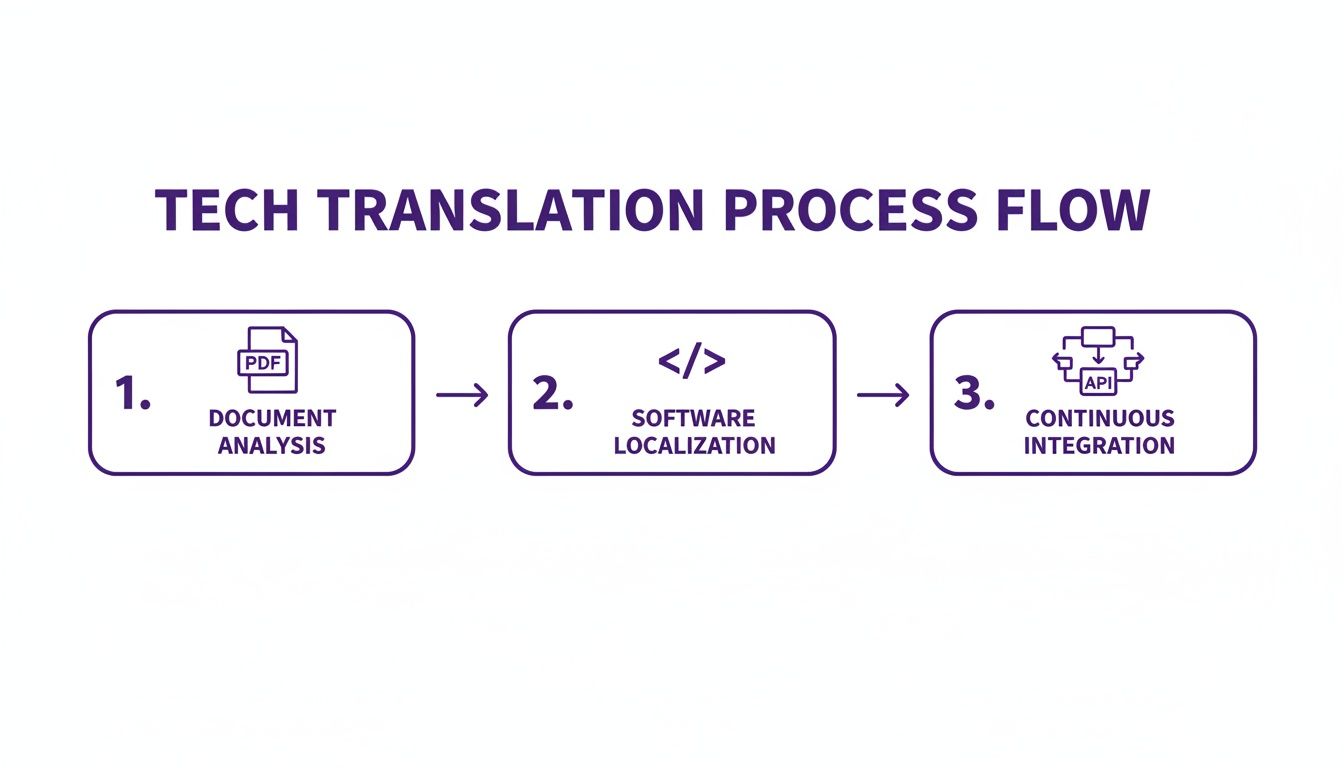
This flow shows just how versatile modern platforms are, adapting from straightforward jobs to deeply integrated localization efforts.
The Initial Analysis and Breakdown
Once your file is in the system, two key technologies immediately go to work. The first is intelligent chunking, which breaks your document into smaller, digestible segments—think sentences or short paragraphs. This allows the system to process everything in parallel, meaning a 500-page manual gets handled with the same efficiency as a one-page memo.
At the same time, a format preservation engine meticulously scans the document’s layout. It maps out every single header, table, image caption, and font style. This step is the secret sauce that ensures the translated version is a perfect mirror of the original, keeping its professional look and feel completely intact. To see how this works under the hood, check out our guide to AI for translation in modern workflows.
The Power of Cloud-Native Architecture
This entire process lives in the cloud, and that has massive implications for the industry. In fact, cloud deployment is expected to grab over 71.9% of the translation services market by 2035. A cloud-native setup allows these tools to plug directly into your other business systems through APIs. Suddenly, translation isn't a one-off project; it's a continuous, automated process humming along in the background.
The financial upside is huge. Some studies show that the right software can slash translation costs by as much as 90% simply by eliminating manual admin tasks and human error.
The real game-changer in a modern workflow is predictability. You get transparent pricing, consistent quality, and reliable turnaround times, which takes all the guesswork out of the equation.
The difference between the old and new ways of doing things is night and day. Let's put them side-by-side to make it crystal clear.
Comparing Traditional vs Modern Translation Workflows
This table breaks down the fundamental differences between the clunky, human-centric processes of the past and the agile, AI-first systems we use today. You'll see dramatic improvements across the board, from how a project kicks off to how it scales.
| Feature | Traditional Translation Workflow | Modern AI-First Workflow |
|---|---|---|
| Process Start | Manual project setup, quotes, and emails with a project manager. | Instant file upload and automated project initiation on a cloud platform. |
| Turnaround Time | Days or weeks, dependent on human translator availability. | Minutes to hours, with processing happening 24/7 via AI models. |
| Cost Structure | Often opaque, with high per-word rates and project management fees. | Transparent, per-word pricing calculated instantly before you commit. |
| Scalability | Limited by the number of available human translators and their capacity. | Virtually unlimited; capable of processing millions of words simultaneously. |
| Consistency | Varies between translators, leading to potential inconsistencies across projects. | High, with AI models applying consistent terminology and style every time. |
| Integration | Manual file transfers; difficult to integrate into other business systems. | Seamless API integration with CMS, CRM, and code repositories. |
Ultimately, the modern translation workflow is built for the speed and scale of today's business. By swapping manual hand-offs for automated, intelligent systems, it delivers faster, cheaper, and more consistent results. This allows companies to connect with global audiences far more effectively than ever before.
Choosing Between AI and Human Translation
When you're looking at tech translation services, the first question people ask is often, "Is AI better than a human?" That's the wrong way to think about it. The real question is, "Which one is the right tool for this specific job?"
Framing it that way changes everything. It’s no longer a competition but a strategic choice. Each approach has its place, and knowing when to use which is the key to an efficient, affordable, and high-quality translation workflow.
When to Use AI-Powered Translation
AI translation is all about speed and scale. Modern Neural Machine Translation (NMT) engines can tear through massive volumes of text in a fraction of the time it would take a human team. This makes AI an absolute powerhouse for certain types of technical content.
An AI-first approach is a great fit for:
- Internal Documentation: Think knowledge bases, wikis, and employee handbooks. The goal is to get information out quickly and clearly to your internal teams.
- Technical Manuals: For user guides and support articles, AI can produce accurate, format-perfect translations almost instantly, helping you launch products worldwide without delay.
- High-Volume Content: If you're staring down a mountain of thousands of pages of research data or product specs, AI is really the only feasible way to get it done on a reasonable budget.
The huge win here is efficiency. AI does the heavy lifting, handling the bulk of the work with incredible consistency and speed. This frees up your human experts for the tasks that really need their attention. The rise of tools like an auto translate device shows just how central AI has become to modern translation.
The secret to a smart translation strategy is using AI to handle 80% of your content needs quickly and accurately. This saves your budget and your best people for the critical 20% where human nuance is everything.
This hybrid model is the way forward. You let automation handle the scale and save your human talent for where it truly counts.
When Human Expertise is Non-Negotiable
While AI is a workhorse, human translation is still the gold standard for high-stakes content. When you absolutely cannot afford an error in nuance, cultural context, or legal precision, you need a person. A machine translates words; an expert understands intent. For a deeper dive, check out our comparison of AI versus human translation capabilities.
Human oversight is a must in these situations, whether they're doing the full translation or reviewing an AI-generated draft:
- Legally Binding Contracts: For agreements, terms of service, or compliance paperwork, a single wrong word can create massive legal and financial risk.
- High-Impact Marketing Copy: Creative campaigns and brand slogans depend on connecting with people emotionally. This requires a deep understanding of culture and persuasive language that AI can't replicate.
- Patient-Facing Medical Information: When it comes to medical device instructions or clinical trial documents, accuracy isn't just important—it's a matter of patient safety.
In these cases, the potential cost of a mistake is far greater than any savings you’d get from cutting corners with pure automation. A human translator is your quality control, catching the subtle mistakes in tone and meaning that an algorithm would miss. They make sure the final translation isn't just correct, but effective.
6. Security, Compliance, and Pricing: The Make-or-Break Factors
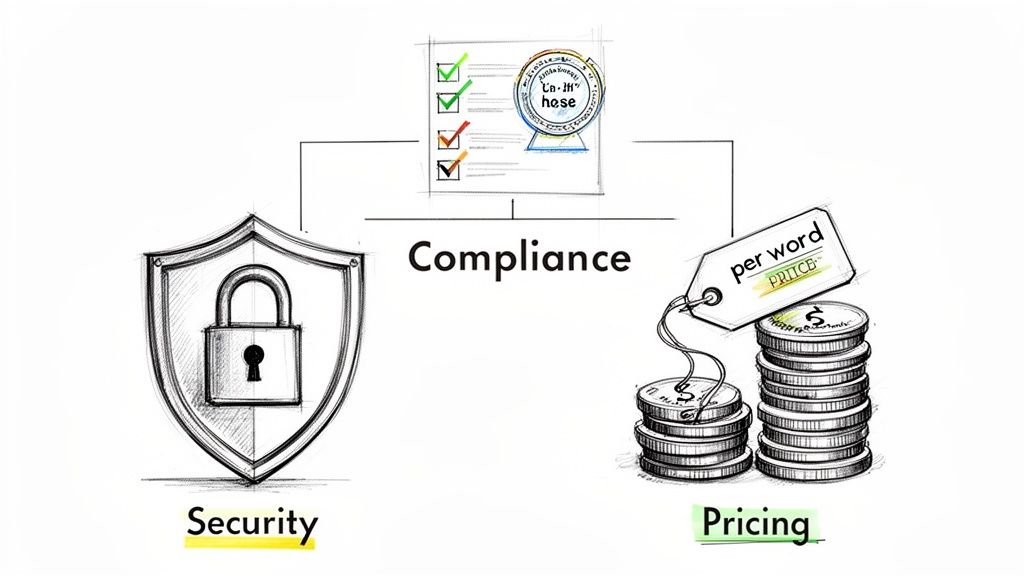
Picking the right tech translation service goes far beyond just getting the words right. A flawless translation is useless if the process exposes your company’s trade secrets or violates industry regulations. You have to look under the hood at the provider's operational guts—its security, compliance, and pricing structure. These aren't just details; they're as critical as the translation quality itself.
Think of these factors as the foundation of your partnership. A shaky foundation puts everything at risk. Let's break down what you need to scrutinize to make sure your translated content stays safe, compliant, and on budget.
Safeguarding Your Intellectual Property
Every time you upload a document for translation, you're handing over sensitive data. It could be anything from schematics for an unreleased product to proprietary source code or confidential financial documents. In this context, strong security isn't a nice-to-have; it's the absolute baseline.
Don't settle for vague promises. Look for a partner with concrete, non-negotiable security measures. Here’s what should be standard:
- End-to-End Encryption: Your data needs to be locked down from the moment it leaves your computer until it returns. That means encryption during upload/download (in transit) and while it's stored on their servers (at rest).
- Clear Data Handling Policies: How long are your files kept? A trustworthy service should have a strict, automatic deletion policy. A 24-hour retention window, for example, dramatically reduces the risk of exposure.
- No Third-Party Sharing: This is a big one. The provider must guarantee they won't share your documents with anyone else or use your proprietary content to train their AI models.
A provider’s approach to security says everything about how much they respect your business. If their policies are fuzzy, that’s a massive red flag. Demand total clarity on how your data is protected from start to finish.
Navigating Regulatory Compliance
If you're in a regulated field like healthcare, finance, or law, translation gets even more complicated. Your content isn't just text; it's subject to strict rules like HIPAA for patient data or GDPR for personal information. A single slip-up—a translation error or a data breach—can result in huge fines and reputational damage.
Your translation partner must be equipped to handle this. Their systems need to be secure and audited to meet these industry standards. Ask about certifications like SOC 2 or ISO 27001, as these demonstrate a serious commitment to security and process control. Understanding how much a SOC 2 audit costs can also give you insight into the level of investment a vendor has made in its security posture.
Demystifying The Pricing Models
Finally, let's talk money. How a translation service charges you speaks volumes about its efficiency and transparency. The industry is moving away from the old, confusing pricing methods toward something much more straightforward.
The Traditional Agency Model
This is the old-school "call for a quote" method. You send your files, wait for a project manager to review them, and eventually get a custom price. It’s slow, unpredictable, and often bundles in project management fees, making it tough to budget for.
The Modern AI-First Model
Newer platforms like DocuGlot have flipped the script with a simple, per-word pricing model. You upload your file, and the system gives you an exact cost instantly, before you spend a dime. This transparent approach kills hidden fees and turns translation from a murky, unpredictable expense into a scalable, operational line item. You know exactly what you’re paying for, every single time.
How To Choose The Right Translation Partner
Alright, let's put everything we've covered into practice. The final step is finding a translation partner who can actually deliver on all these fronts. And honestly, it can feel a little daunting. The translation market is booming—it was worth over USD 76.23 billion in 2025 and is on track to nearly double to USD 147.48 billion by 2034.
What’s driving that explosive growth? Software. Software-based translation now makes up a massive 72.88% of the market, largely because AI platforms can cut project timelines by as much as 80%. You can dig into the numbers yourself over at Fortune Business Insights.
This huge market gives you plenty of options, but it also makes it harder to separate the real experts from the slick marketers. To help you cut through the noise, I’ve put together a checklist of essential questions to ask every potential vendor. It's a simple way to compare providers and find the one that truly aligns with your technical, security, and business needs.
Technical Capabilities and Workflow Integration
First things first: can they handle the job? A perfectly translated document is worthless if the formatting is a mess or it requires your team to jump through hoops. You need to get straight to the point and ask about their technical chops.
Here’s what I’d ask:
- File Format Support: What file formats can you really handle? I’m talking about our specific PDF, DOCX, Markdown, or InDesign files. Can you prove it with a test translation of one of our most complex documents?
- AI Model Tiers: Do you have different AI quality tiers? What’s the difference—is it a trade-off between speed and deep contextual understanding? When would we use one over the other?
- API Availability: Do you offer a solid, well-documented API? We’d want to know if we can automate translations directly within our CI/CD pipeline or content management system.
These questions force them to move beyond vague promises and show you if their service can actually fit into your world.
A partner’s ability to flawlessly handle your specific file types and integrate with your existing tools is non-negotiable. It's the difference between a seamless workflow and a constant source of frustration and manual rework.
Security Protocols and Data Guarantees
Next up is security. When you’re handing over sensitive schematics, source code, or internal documentation, you need absolute confidence that your intellectual property is safe. That trust has to be earned with transparent, rock-solid security policies.
Don't be shy about digging into their security posture. Ask them directly:
- Data Encryption: How is our data protected? Is it encrypted both while it’s being sent to you and while it’s sitting on your servers?
- Data Retention Policy: What happens to our files after the translation is done? Do you have an automatic and permanent deletion policy, say, after 24 hours?
- Data Privacy: Can you give us an ironclad guarantee that our documents will never be shared with anyone or used to train your AI models?
A vendor who has clear, confident answers to these questions is one that takes your security seriously. That’s the kind of partner you can trust with your most critical assets.
A Few Common Questions About Tech Translation
Diving into tech translation services for the first time? You're not alone. Let's tackle some of the most common questions that pop up when businesses start translating their technical content for a global audience.
How Can I Make Sure My Document Formatting Stays Intact?
This is a big one. The last thing you want is for your perfectly formatted user manual or technical datasheet to turn into a jumbled mess after translation. The secret is using a service that was built from the ground up to preserve formatting.
Simply copying and pasting text into a generic translation tool is a recipe for disaster. It’s almost guaranteed to break your tables, mess with your fonts, and misplace your images.
Instead, look for a platform that can actually read the structure of your original file—whether it's a PDF, DOCX, or another complex format. These specialized tools are designed to identify every element, translate the text, and then carefully put everything back together in the new language. Before you commit to a big project, always run a small test with one of your more complex documents to see the results for yourself.
Is AI Translation Really Good Enough For Technical Content?
For most technical documents, the answer is a resounding yes. Today's neural AI models have been trained on enormous libraries of scientific papers, engineering specs, and academic journals. This means they've learned the specific vocabulary and contextual nuances that are crucial for high-fidelity technical translation.
This makes AI a fantastic choice for things like internal knowledge bases, user guides, and research papers where you need accuracy, consistency, and speed.
That said, for content where there is absolutely zero room for error—think legal contracts or instructions for a life-saving medical device—the gold standard is a hybrid approach. Use AI for the heavy lifting, then have a human expert in that specific field review and sign off on the final version.
What's The Real Difference Between Translation And Localization?
It’s easy to get these two mixed up, but they're fundamentally different things. Knowing which one you need is key to getting the right result.
Let's break it down simply:
- Translation is all about the words. It's the process of converting text from one language to another, focusing purely on getting the meaning right. You translate a sentence.
- Localization is about the entire experience. It adapts a whole product or piece of content to feel completely natural in a specific culture. This includes translation, but it also means adjusting things like date formats (DD/MM vs. MM/DD), currencies, units of measurement, cultural inside jokes, and even colors. You localize a software application.
Think of it this way: translation helps people understand your content. Localization makes them feel like it was created just for them.
Ready to translate your technical documents without the formatting headaches? DocuGlot uses advanced AI to deliver fast, accurate, and structure-preserving translations in over 100 languages. Try it now and see how easy it can be.
Tags
Ready to translate your documents?
DocuGlot uses advanced AI to translate your documents while preserving formatting perfectly.
Start Translating