Master translate spanish to portuguese: A Quick Guide to Accurate Translations
On the surface, translating from Spanish to Portuguese seems like a simple task. They're sister languages, right? But this assumption is a trap many businesses fall into, and it's where miscommunications are born. The truth is, a successful translation relies on a smart workflow—one that uses technology for the heavy lifting and a human touch for the critical nuances.
This approach is the only way to nail the right regional dialect and, just as importantly, keep your original document formatting intact. We’ve all been there, spending hours fixing a translated file that looks nothing like the original.
From Madrid to São Paulo: A Practical Guide
When you're translating Spanish to Portuguese, you’re doing more than just swapping words. You're bridging two massive, influential cultures. Their shared roots on the Iberian Peninsula give them a familiar feel, but treating them as interchangeable is a classic, and often expensive, blunder.
The similarities are what make it so tricky. Both languages share a huge amount of vocabulary, meaning many words look and sound almost the same. This is where you run into trouble with "false friends"—words that look identical but have completely different meanings. It's a recipe for confusion.
More Than Just Language, It's Global Business
Getting this right matters because Spanish and Portuguese are economic giants. Spanish is spoken by over 575 million people in more than 20 countries. Meanwhile, Portuguese connects you to around 215 million speakers, dominated by the huge markets of Brazil and Portugal. For any company looking to grow, accurate translation is the key to unlocking these enormous economies. If you're expanding, it's worth understanding the strategic importance of Spanish content localization for global markets.
This guide will walk you through a process that gets professional results by tackling the common mistakes from the start. We’ll cover the big stuff, like picking the right dialect, and the nitty-gritty, like making sure your final PDF or Word doc looks just like the original.
Your goal shouldn't be a word-for-word translation. It needs to be a culturally sharp adaptation that connects with your audience, whether they're in Lisbon or São Paulo.
Ultimately, mastering this process protects your brand's credibility. It ensures your message lands exactly as you intended. By combining the right tools with a clear strategy, you can bridge the linguistic gap with confidence.
Choosing Your Translation Approach: AI vs. Human Expertise
When you're facing a Spanish document that needs to be in Portuguese, your first big decision is how to get it there. This isn't just a simple choice between a machine and a person. It’s about picking the right tool for the job, and that depends entirely on your document’s purpose, who will read it, and how much subtlety matters.
AI-powered tools are fantastic for internal jobs where speed is everything. Say you need to get the gist of a dozen Spanish customer support emails or scan a competitor's market report from Portugal. In those cases, a machine translation gives you what you need almost instantly, at little to no cost. It’s all about efficiency.
But when the stakes are higher—think public-facing content or legally binding agreements—the game changes. A marketing campaign aimed at a Brazilian audience needs to hit all the right cultural notes, something AI often fumbles. A business contract demands absolute precision; there's no room for ambiguity. For these critical projects, the smart move is a hybrid approach: let AI do the initial heavy lifting, then have a professional human translator refine and perfect it.
Finding the Right Balance for Your Project
So, how do you decide? It really boils down to risk. Think about the potential cost of an error. A small typo in an internal memo is no big deal. But a mistake in a product’s user manual could be dangerous, and a poorly translated legal document could cost you a fortune.
This decision tree can help you map out the best path forward based on your document's complexity.
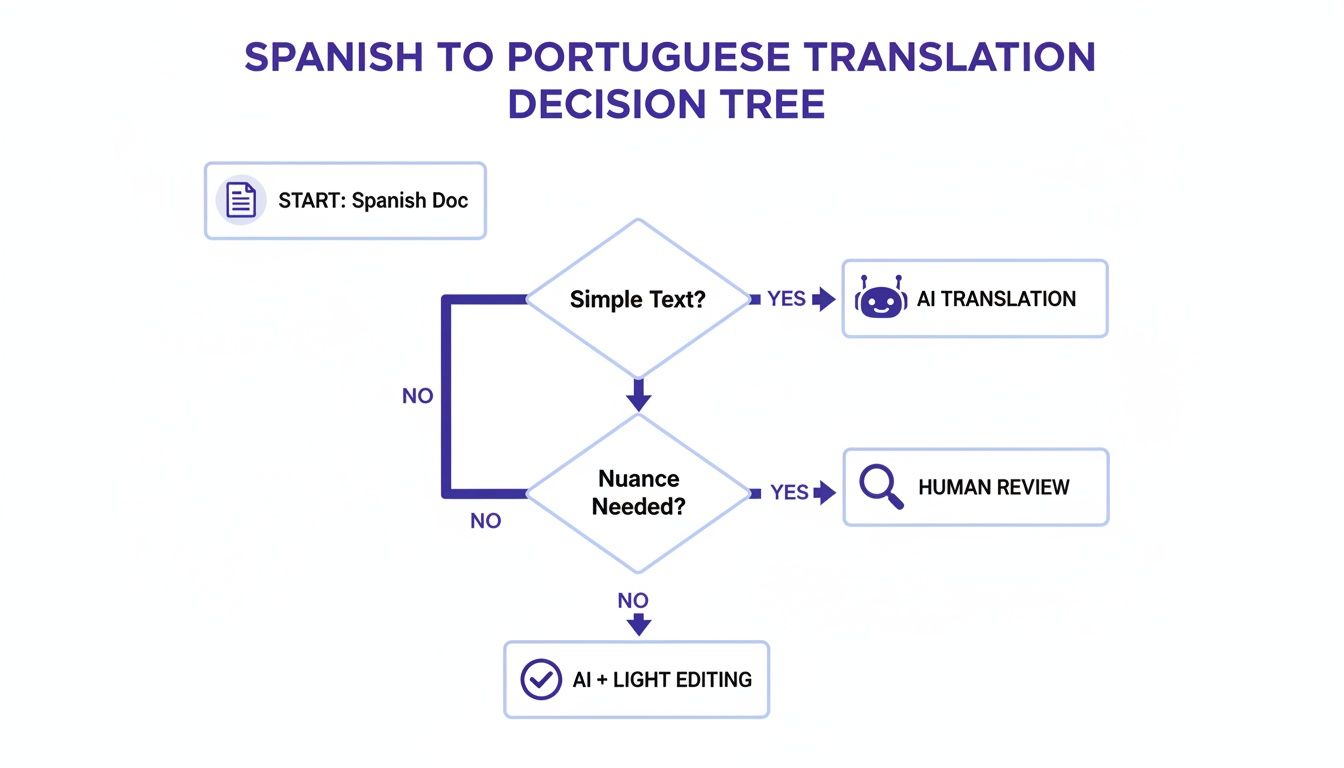
As you can see, the workflow is pretty clear. Simple, low-risk texts are a perfect fit for a quick AI pass. But once you get into content that requires cultural nuance or legal precision, bringing a human expert into the review process is essential.
To make this even clearer, let's look at a few common scenarios. When does a raw AI translation suffice, and when is professional oversight a non-negotiable?
AI Translation vs. Human Review: A Scenario-Based Comparison
| Scenario / Document Type | Recommended Approach (AI vs. Human Review) | Key Consideration | Example Use Case |
|---|---|---|---|
| Internal Communications | Pure AI Translation | Speed and general understanding are the goals. | Translating an informal company-wide email from the Madrid office for the team in Lisbon. |
| Marketing & Advertising Copy | AI + Mandatory Human Review | Cultural nuance, brand voice, and persuasive language are critical. | Adapting a product slogan and website copy for a new launch in the Brazilian market. |
| Legal Contracts & Agreements | AI + Expert Human Review | Absolute precision is non-negotiable. Mistranslations have legal and financial consequences. | Translating a partnership agreement between a Spanish and a Portuguese company. |
| Technical Manuals | AI + Human Review | Technical accuracy and clarity are paramount for user safety and product function. | A user guide for a piece of machinery where incorrect operation could be hazardous. |
| Customer Support Tickets | Pure AI Translation | Volume and speed are key. The goal is to quickly understand the customer's issue. | A support team processing hundreds of Spanish-language help requests to categorize them. |
Ultimately, your choice should be a practical one based on how the final document will be used. For a more in-depth analysis, you can explore a detailed comparison of AI versus human document translation services to see the strengths of each.
A good rule of thumb: If the document influences a customer's decision, defines a legal obligation, or represents your brand's voice, always invest in a human review of the AI-generated translation.
This isn't an "either/or" situation anymore. The best translation workflows blend the speed of AI with the irreplaceable intelligence of a human expert. By knowing when to lean on automation and when to call in a professional, you can tackle any Spanish-to-Portuguese translation with confidence.
Getting Your Documents Ready for a Flawless Translation
The single biggest factor influencing the quality of your final Portuguese translation isn't the tool or the translator—it's the quality of your original Spanish document. A clean, well-prepared source file is the secret to a smooth process, yet it's the one step most people tend to rush through.
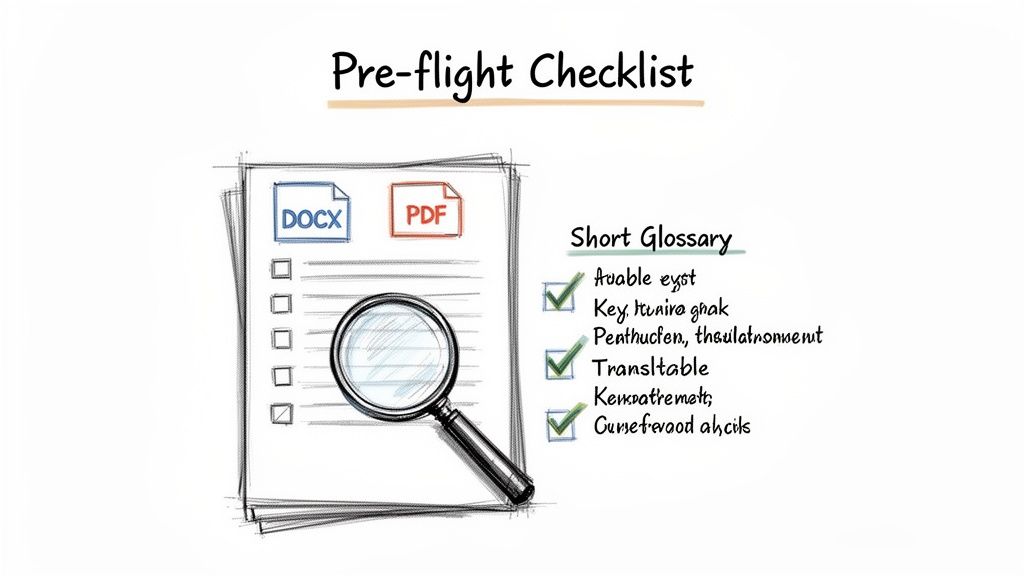
Think of it as a pre-flight check. Spending just a few minutes tidying up your file now can save you from major headaches and messy revisions down the road. This groundwork is essential whether you're using an AI tool or a human translator; it ensures the technology can parse your content correctly and allows a human reviewer to focus on nuance instead of fixing basic errors.
Your Pre-Flight Checklist for Common File Types
Every file format has its own quirks. Running through a quick check before you upload will dramatically improve your results when you translate Spanish to Portuguese.
For Microsoft Word (DOCX) files, here's what to look for:
- Accept All Tracked Changes: Make sure you're working with the final, approved version of your document. Lingering comments and tracked changes can easily confuse translation software, leading to fragmented or just plain wrong outputs.
- Clear Out Hidden Text and Comments: Just like tracked changes, these elements can get picked up and translated by mistake. You don't want irrelevant notes popping up in your final Portuguese version.
- Use Consistent Formatting: Don't just make text bold or larger to create headings. Use proper heading styles (H1, H2, etc.). This gives the document a clear structure that translation tools use to understand its hierarchy.
And for Adobe PDF documents:
- Confirm the Text is Selectable: This is a big one. Open your PDF and try to highlight a sentence with your cursor. If you can't, you're dealing with an image-based PDF, not a text document. Scanned documents need to be run through Optical Character Recognition (OCR) first. For a deep dive, check out our guide on how to translate a PDF file.
- Remove Security Restrictions: Some PDFs are locked down to prevent copying and pasting. These protections will also block any translation tool from accessing the content. Be sure to remove any passwords or restrictions before you upload.
This quick cleanup helps the technology read your file correctly, preserving the layout and preventing garbled text from ruining your translation.
Fine-Tuning Your Spanish Source Text
Beyond just the file itself, the language you use matters immensely. Ambiguity is the sworn enemy of accurate translation. A sentence that's just a little bit vague in Spanish can become complete nonsense once it's been run through an AI into Portuguese.
Take the time to simplify overly complex sentences. If a sentence in Spanish has multiple clauses and makes you pause to understand it, it's a magnet for translation errors. Break it down into two or three shorter, more direct sentences.
Another pro tip, especially for business or technical documents, is to create a simple glossary. This is just a list of key terms and how they must be translated into Portuguese to maintain consistency.
- Brand Names: Make sure your company and product names are never translated.
- Technical Jargon: Decide on the exact Portuguese equivalent for industry-specific terms. For example, should "almacenamiento en la nube" always be "armazenamento em nuvem"? Lock it in.
- Key Phrases: Identify brand taglines or important phrases that need a very specific translation to preserve your brand's voice and meaning.
Running this 'pre-flight check' gets your document ready for a successful translation, sidestepping common pitfalls and paving the way for a polished final product.
Choosing the Right Portuguese: More Than Just Words
Simply swapping Spanish words for Portuguese ones might get your basic message across, but it won’t connect. Real connection, the kind that builds trust and drives action, comes from understanding that language is regional. The Spanish spoken in Madrid is a world away from what you’ll hear in Mexico City, and the same goes for Portuguese in Lisbon versus São Paulo.
Picking the wrong dialect is a dead giveaway that you're an outsider. It can make a marketing campaign feel tone-deaf, a technical manual confusing, or a legal contract imprecise. We're not just talking about a few spelling changes here; this is about vocabulary, grammar, and cultural references that can flip the meaning of your content on its head.
This is especially true online. The internet has a way of magnifying these small missteps. While English still dominates 52.6% of websites, Spanish and Portuguese are used on just 5.4% and 3% of sites, respectively. But here's the kicker: Spanish speakers alone make up 8% of all internet users. That gap signals a huge, underserved audience waiting for content that actually speaks their language. If you want to dig deeper, you can find more global translation statistics that really drive home this point.
European vs. Brazilian Portuguese: A Tale of Two Languages
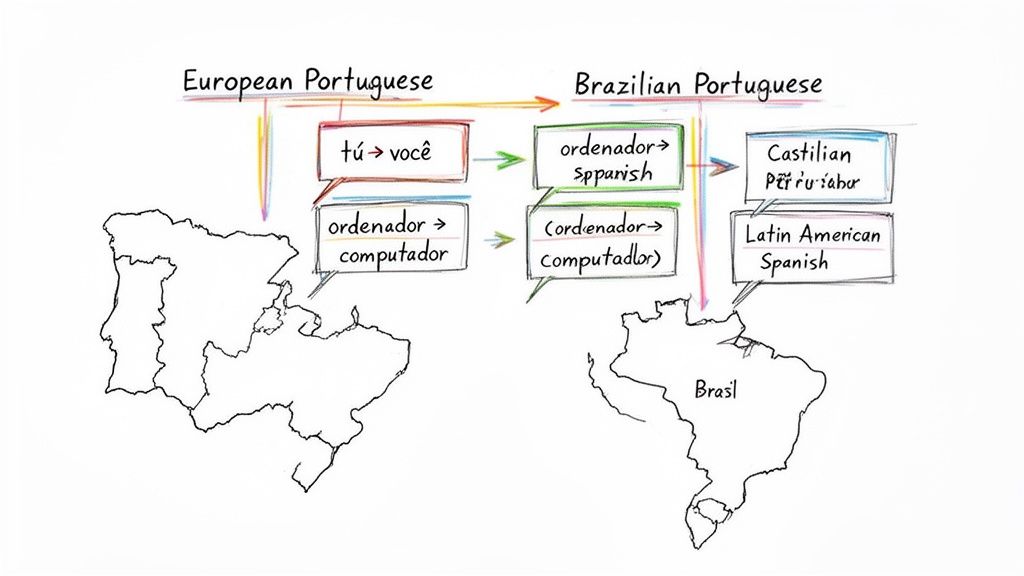
When you're ready to translate Spanish to Portuguese, your first big decision is between European Portuguese (PT-PT) and Brazilian Portuguese (PT-BR). The differences are significant and go way beyond accent.
You, Me, and Us: How you address someone is a major tell. Brazilian Portuguese almost always uses "você" for "you," whether you're talking to a friend or a CEO. But in Portugal, "você" is more formal, and "tu" is the go-to for casual chats. Get this wrong, and you'll either sound stuffy or way too familiar.
Same Thing, Different Name: Everyday vocabulary can be a minefield. What’s an "autobús" in Spain becomes an "ônibus" in Brazil but an "autocarro" in Portugal. A refrigerator ("frigorífico" in Spanish) is also a "frigorífico" in Portugal, but in Brazil, it's a "geladeira."
Think of it this way: choosing the right dialect isn't just a tiny detail to check off a list. It's a core strategic decision. A brilliant marketing campaign can fall flat simply because the language feels "off" or foreign to the very people you're trying to reach.
How to Get Your Dialect Right
To make sure your translation truly resonates, you need to be deliberate about your dialect choice right from the start. Here are a few things I always consider.
First, pinpoint your primary audience. Where do most of them live? If your target is the massive Brazilian market, the choice is simple: go with PT-BR. If you’re focused on Portugal or Portuguese-speaking countries in Africa, then PT-PT is your best bet.
Next, think about your source material. Are you translating from Castilian Spanish (from Spain) or a Latin American dialect? While it’s not a perfect match, your source can offer some clues. Some Latin American Spanish vocabulary, for instance, has more in common with Brazilian Portuguese because of shared history and regional influences.
Finally, use tools that let you be specific. Don’t just hit a button that says "Translate to Portuguese." Modern platforms like DocuGlot give you the power to choose. Make an active selection for "Brazilian Portuguese" or "European Portuguese." This tells the translation engine exactly what you need, leading to a much more accurate and relevant result.
When you nail these details, you’re doing more than just a word-for-word swap. You’re crafting a document that speaks the authentic language of your audience, ensuring your message lands with the clarity and impact it deserves.
Fine-Tuning Your Translation: The Post-Review Process
Once your Spanish text has been run through the initial translation, the real work begins. This is where you polish the raw output, transforming a technically correct translation into one that truly resonates with a native Portuguese speaker.
Think of this step as quality control. Skipping it is a surefire way to let subtle (and sometimes not-so-subtle) errors slip through, which can undermine your credibility. This final pass is your chance to catch what automated tools almost always miss and ensure your message lands perfectly.
Your Final Review Checklist
A haphazard review won't cut it. You need a system. I always work from a checklist to make sure I don't overlook common mistakes that pop up when translating between Spanish and Portuguese.
Here are the non-negotiables to scrutinize:
- Hunt for "False Friends": This is a big one. Spanish and Portuguese share a lot of words that look identical but mean completely different things. For instance, the Spanish word "exquisito" means delicious, but in Portuguese, "esquisito" means strange. A human eye is essential to catch these classic blunders.
- Check the Tone and Voice: Read passages out loud. Does it sound clunky or natural? The goal is to make sure the Portuguese version mirrors the original's personality, whether it’s a formal legal document or a friendly marketing email.
- Ensure Consistency: Are key terms translated the same way every time they appear? If you defined "cliente" as "cliente" on page one, it shouldn't suddenly become "freguês" on page ten. This is where having a glossary from the start pays off big time.
A rigorous review is the secret sauce for professional-grade accuracy. It's not just about the words; it's about the final quality. The principles are remarkably similar to other detail-oriented work, like those found in guides on mastering proofreading in transcription, which also stress a meticulous final check.
Localizing the Details: Formats and Culture
Great translation goes beyond just words. Localization means adapting all the little things that native speakers expect to see. Getting these wrong is an instant red flag that screams "this was translated by a machine."
Pay very close attention to these small but critical elements:
- Dates and Times: A date written as 31/12/2024 is standard in Spain and Brazil. But in Portugal, you're more likely to see 31-12-2024. It’s a small detail that shows you’ve done your homework.
- Currency and Numbers: When dealing with money, make sure your symbols (€, R$) and separators are right. In Spanish, you might see a number formatted as 1.234,56. In Brazilian Portuguese, that formatting is actually the same, but it's a critical point to verify for your specific audience.
- Cultural References: Did a mention of a Spanish public figure or a local festival sneak into the Portuguese version? Swap it out. Find an equivalent that makes sense for your Brazilian or Portuguese audience, or choose a more universal example.
This final, detail-oriented review is what separates a passable translation from a professional one. It’s how you build trust and make sure your message is understood exactly as you intended.
Handling Complex Legal and Technical Documents
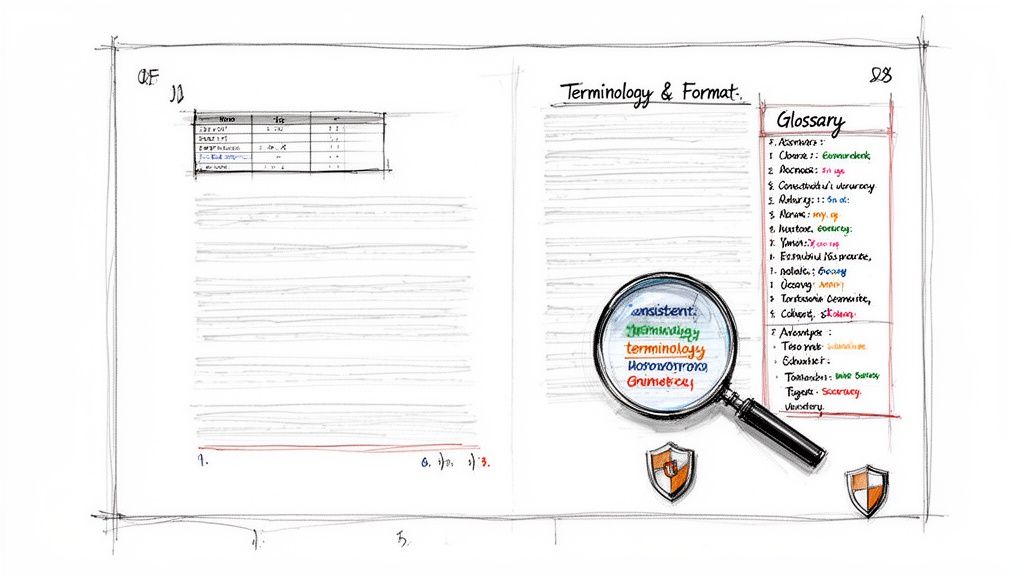
When you’re translating documents for specialized fields like law, engineering, or academia, the stakes are incredibly high. A small mistake in a blog post might be a little embarrassing, but the same error in a legal contract or a technical manual can create serious financial or safety problems. There's simply no room for error.
These kinds of documents are built on a foundation of very specific, standardized language. The real challenge isn't just swapping out words. It's about protecting the precise legal or technical meaning, which often hinges on terminology that doesn't have a simple, one-to-one equivalent. Ambiguity is the enemy here.
Maintaining Terminological Consistency
The single most important part of any technical translation is consistency. If your Spanish legal document uses the term "contrato de arrendamiento," you have to pick the right Portuguese equivalent—like "contrato de arrendamento" or "contrato de locação"—and stick with it. Every single time.
To pull this off, creating a project-specific glossary is essential. It's not a "nice-to-have"; it's a necessity.
- Find Your Core Terms: Before you even begin translating, go through the Spanish document and identify all the recurring legal, technical, or company-specific terms.
- Define the Portuguese Equivalents: This is where a subject matter expert is worth their weight in gold. Work with them to lock in the official Portuguese translation for every term on your list.
- Make it Your Bible: This glossary becomes the definitive guide for the project. It ensures every key phrase is translated exactly the same way, every time it shows up.
Following this process helps you avoid the kind of "terminological drift" that can create legal loopholes or make technical instructions dangerously confusing. For really complex legal work, a specialized tool like a legal chatbot can be a useful assistant for analysis or a first-pass review.
Think about translating a compliance manual for a company moving into Brazil. The term "datos personales" must always become "dados pessoais" to align with Brazil's General Data Protection Law (LGPD). Get that wrong, and the company could be looking at serious fines.
Preserving Critical Document Formatting
In legal and technical documents, the format is often just as important as the words. The exact placement of a footnote, the layout of a table, or even the page numbering in a contract can have real legal significance. A translation that messes up the structure isn't just sloppy—it could be legally invalid.
Protecting this structural integrity is a core part of the job. You need to make absolutely sure that after the translation is done, all the original formatting elements are perfectly preserved.
- Tables and Charts: All data must stay in the right cells, and the headers and labels need to be accurately translated.
- Footnotes and Endnotes: Every citation and note has to remain tied to its original reference point in the text.
- Page and Paragraph Numbering: Legal documents constantly refer to specific clauses by number. That system has to stay intact, period.
This is exactly why a careful human review is non-negotiable for these types of documents. When you’re dealing with sensitive information, you need to be sure every single detail is correct. To dive deeper into this, you can learn more about how to translate legal documents with precision and ensure you're covering all your bases.
Got Questions About Spanish to Portuguese Translation? We've Got Answers.
When you're translating between two languages as closely related as Spanish and Portuguese, it's easy to run into some unique quirks. Let's tackle some of the most common questions people have when starting these projects.
How Long Does This Actually Take?
This really boils down to two things: the length of your document and its complexity.
If you're just translating a simple, one-page memo, an AI tool could have it ready for you in less than an hour. But if you’re dealing with something like a 50-page technical manual, you'll need a human in the loop to get it right, and that could easily take several days. They'll need time to nail the terminology and make sure every table and chart is perfect.
A piece of advice I always give: don't sacrifice quality for speed. Rushing a legal contract or a technical guide can create huge problems and costly mistakes that take way more time to unravel down the road.
Can't I Just Use a Free Online Tool?
Look, for quick, casual stuff—like getting the general idea of an email from a colleague—sure, a free tool can work in a pinch.
But for anything that matters to your business, your academics, or your legal standing, I'd strongly advise against it. Free services just don't have the muscle to handle tricky grammar or maintain your document's formatting. More importantly, they often don't provide the security you need for confidential information. A professional service keeps your data private and delivers a final product you can actually use.
Brazilian or European Portuguese? Which One Do I Pick?
This is probably one of the most important decisions you'll make, and the answer is simple: it all comes down to your audience.
- Targeting Brazil? You absolutely need to choose Brazilian Portuguese (PT-BR). Brazil is the largest Portuguese-speaking market by a huge margin, and using the right dialect is non-negotiable if you want to connect.
- Targeting Portugal or Africa? Stick with European Portuguese (PT-PT). Using the Brazilian variant here can come across as unprofessional or just plain wrong.
Getting this wrong can instantly make your content feel like it's from another world, pushing away the very people you're trying to attract.
What's the Single Biggest Mistake I Should Avoid?
The most common trap people fall into is thinking the languages are basically the same. This false sense of security leads them to skip a proper review process.
This is how "false friends"—words that look alike but mean completely different things—end up in the final text. A classic example is the Spanish word "apellido" (which means surname) and the Portuguese "apelido" (which means nickname). You can imagine the confusion! Always, always have someone do a final quality check to catch these subtle but critical errors.
Ready to get a flawless translation that keeps your formatting perfectly intact? DocuGlot uses advanced AI to translate your documents accurately while preserving layouts, tables, and styles. Try DocuGlot today and see the difference.
Tags
Ready to translate your documents?
DocuGlot uses advanced AI to translate your documents while preserving formatting perfectly.
Start Translating