A Guide to Translation of Legal Document Accuracy
Translating a legal document isn't just about swapping words from one language to another. It's a highly specialized field focused on converting legal texts while keeping their original legal meaning, intent, and—most importantly—their enforceability perfectly intact.
This goes far beyond simple fluency. It demands a deep understanding of the legal systems in both the source and target countries. Ultimately, the goal is to make sure critical documents like contracts, patents, and court filings are legally sound and hold up across international borders.
Why Legal Translation Is in a Class of Its Own
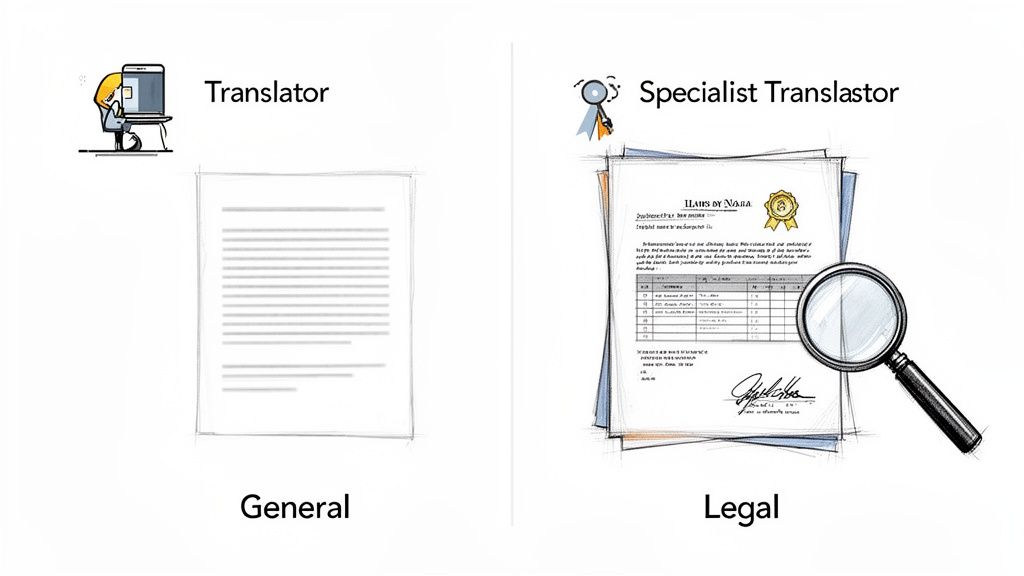
Think of it this way: you wouldn't ask your family doctor to perform brain surgery. Both are medical experts, but the neurosurgeon operates with a level of precision where the tiniest mistake could have devastating consequences. Legal translation works under the same kind of pressure. The stakes are incredibly high.
A single mistranslated phrase in a business contract can void the entire agreement, opening the door to massive financial losses and drawn-out legal battles. Similarly, a small error in an immigration filing could lead to a denial, changing the course of someone's life. This work isn't just about language; it’s about upholding the law across different cultures and jurisdictions.
This absolute need for accuracy is why the market is growing so quickly. Valued at around USD 5.2 billion in 2023, the global market for legal translation services is expected to hit USD 9.3 billion by 2032, according to a report from DataIntelo. That’s a clear sign of just how vital this work is in our connected world.
To get a clearer picture, let's break down the key differences between general and specialized legal translation.
Key Differences Between General and Legal Translation
| Aspect | General Translation | Legal Document Translation |
|---|---|---|
| Primary Goal | Convey the general meaning and tone. | Preserve the exact legal meaning and enforceability. |
| Margin for Error | Low to moderate. A minor mistake is usually not critical. | Extremely low. A single error can have severe legal or financial consequences. |
| Required Expertise | Strong command of source and target languages. | Linguistic fluency plus deep knowledge of both legal systems. |
| Terminology | Everyday language, industry-specific but flexible. | Precise, standardized legal terms with no room for creative interpretation. |
| Formatting | Often secondary; can be adapted for readability. | Critical. The original structure, clauses, and layout must be perfectly mirrored. |
This table shows that while both require skill, legal translation operates on an entirely different level of precision and consequence.
The Three Pillars of Accurate Legal Translation
To deliver a document that is both linguistically perfect and legally sound, every translation must be built on three non-negotiable pillars.
Absolute Linguistic Precision: There's zero room for creative license. Legal terms carry specific, binding weight. A term like "force majeure" or "indemnify" can't be swapped for a "close enough" phrase; it must map to the exact legal concept in the target language.
Jurisdictional Expertise: Laws and legal frameworks can be worlds apart. A concept from a common law system (like the U.S.) might not have a direct counterpart in a civil law system (like Germany). A true legal translation expert knows these differences and can navigate them accurately.
Cultural and Contextual Adaptation: Beyond the black-and-white letter of the law, legal documents are shaped by cultural norms. The translator has to understand these subtleties to ensure the final document is not only legally valid but also culturally appropriate.
Why Preserving the Format is Preserving Validity
Another thing that makes legal translation unique is the strict need to maintain the original document’s formatting. The structure of a legal text is anything but arbitrary.
A translated contract that scrambles the order of clauses or misplaces a signature block could be challenged and deemed unenforceable in court. The visual integrity of the document is directly tied to its legal integrity.
Elements like clause numbering, tables, footnotes, and signature lines are integral to the document's authority. This is why modern AI-powered legal document translation solutions work so hard to preserve formatting, ensuring the translated version is a perfect mirror of the original. Whether it’s a patent filing with complex diagrams or a court document with strict margin rules, the layout is everything.
You might need a legal document translated for all sorts of reasons, from personal life events to massive corporate deals. These aren't just ordinary texts; they're official records that carry real weight, defining rights, responsibilities, and ownership across different countries. Knowing what kind of document you're dealing with helps you understand why getting the translation right is so critical.
The legal translation field is a huge piece of the USD 41.78 billion translation services market. As business and law become more global, this area is just getting bigger. North America makes up a whopping 40% of all document translation revenue, and to give you an idea of the scale, U.S. firms filed over 1.2 million international patents in 2023 alone—each one a candidate for certified translation. You can dig into more market data over at straitsresearch.com.
Corporate and Commercial Law Documents
This is the bread and butter of international business. When a company decides to expand, acquire another firm, or just trade overseas, its legal paperwork has to keep up and be perfectly adapted to local regulations.
Think about a Silicon Valley startup buying a software company in Germany. The whole deal depends on getting the translation of crucial documents exactly right.
- Merger and Acquisition Agreements: These lay out the fine print of the sale, from liabilities to warranties. One tiny mistake in a translated clause could derail the entire agreement or lead to millions in losses.
- Compliance Filings: Every country has its own regulatory bodies, like the SEC in the U.S. Any documents filed with them must be translated with impeccable accuracy to be accepted.
- Shareholder Resolutions and Bylaws: These are the internal rulebooks of a company. They have to be legally solid and clearly understood in every country the company operates in.
Personal and Immigration Documents
For people whose lives cross borders, accurate translations are non-negotiable. Immigration offices and government agencies are incredibly strict and have no patience for mistakes or vague language.
These documents are often deeply personal, yet they're put under a microscope by officials. Some of the most common personal documents needing translation are birth certificates, marriage licenses, and even a divorce certificate, particularly when someone is navigating family law matters in a new country.
Here are a few more examples:
- Birth and Marriage Certificates: These are fundamental for visa applications, claiming dual citizenship, or establishing residency abroad.
- Wills and Testaments: If you have assets in more than one country, a professionally translated will is the only way to make sure your final wishes are honored without legal challenges.
- Academic Transcripts and Diplomas: Applying to a foreign university or getting a professional license overseas? You'll need certified translations of your academic records.
Without a certified and accurate translation, these critical life documents are often considered invalid by foreign authorities, leading to significant delays and rejections.
Intellectual Property and Litigation Materials
When you're protecting an invention or fighting a legal battle on the world stage, you enter a whole new level of specialized translation.
Intellectual Property (IP) documents are notoriously technical and packed with legal jargon. If a biotech company wants to patent a new drug in the European Union, its application has to be translated into several languages. The translation must nail the scientific terms and legal phrasing perfectly to ensure the patent is enforceable. This applies to everything from trademark registrations to complex patent filings and licensing agreements.
When it comes to litigation, any piece of evidence has to be admissible in a foreign court. This means translating witness statements, court records, and all discovery materials with certified accuracy. In these cases, the translation itself becomes an official part of the legal record, and its integrity has to be beyond question.
The Legal Translation Process from Start to Finish
It’s easy to think of document translation as just a simple upload-and-download process. But when it comes to legal documents, that’s a risky oversimplification. A professional workflow is a multi-step journey, with each stage carefully designed to protect your document’s accuracy, security, and, most importantly, its legal weight.
Let's walk through what that process actually looks like, from the moment you hit "send" to the final delivery.
Step 1: Secure Submission and Initial Analysis
Everything starts with a secure upload. This isn’t like attaching a file to an email; it’s the beginning of a secure chain of custody. Professional platforms use end-to-end encryption, which means your sensitive document is shielded from prying eyes from the very first click.
Once your file is safely on the server, an initial analysis kicks in. The system quickly assesses the document's length, complexity, and unique formatting. This allows for an accurate quote and a realistic timeline right from the start, so there are no surprises down the road.
Step 2: Format Preservation and Translation
Here’s where the magic happens, but it's far more than just swapping words from one language to another. In the legal world, formatting isn't just about making a document look good—it's part of its structural integrity. Think about a contract’s numbered clauses or a patent filing's detailed diagrams. If that structure is lost, the document’s meaning and legal standing can be compromised.
This is why advanced translation tools are built to recognize and perfectly replicate these elements:
- Tables and Charts: Financial data in an acquisition agreement needs to stay in its table format to be understood.
- Numbered and Bulleted Lists: The specific order and hierarchy of clauses are meticulously maintained.
- Headers, Footers, and Footnotes: Critical details like case numbers or citations must remain exactly where they belong.
Getting the formatting right is non-negotiable. A document with a sloppy layout can be flat-out rejected by a court or government agency. You can learn more about how professionals handle these critical details in our complete guide on how to translate legal documents.
The image below shows just a few of the common document types that rely on this meticulous process.
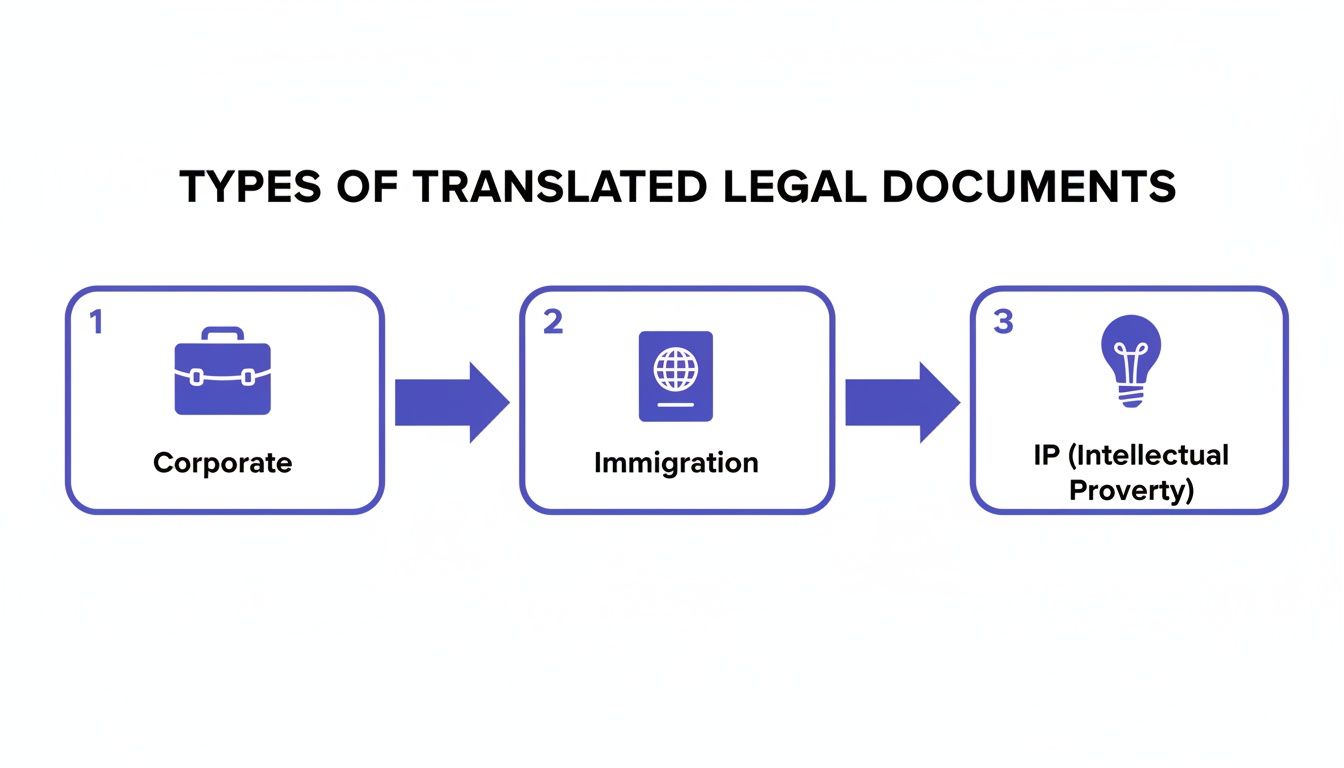
Whether it’s a corporate merger, an immigration application, or an intellectual property dispute, the need for precise, format-perfect translation is universal.
Step 3: Certification and Notarization
Once the translation is complete, some documents need an extra stamp of official approval. This is where certification and notarization come into play. They sound similar, but they serve distinct purposes.
A Certificate of Translation Accuracy is a signed statement from the translator or agency. It formally declares that the translation is a complete and accurate reflection of the original document. This is a standard requirement for things like immigration papers, foreign academic transcripts, and official records.
Notarization takes it a step further. A Notary Public doesn’t check the translation itself; they verify the identity of the person who signed the certificate of accuracy. This adds another layer of authentication, often required for documents used in serious legal battles or international court proceedings.
Step 4: Rigorous Review and Secure Delivery
Before the document comes back to you, it undergoes one last, crucial check. A second human linguist or an advanced quality control system reviews the entire translation. They're hunting for any subtle errors in legal terminology, grammar, or cultural nuance that could alter the document's meaning.
After passing this final quality gate, the finished document is delivered back to you through a secure, encrypted channel. Top-tier services also prioritize your privacy by automatically deleting your files from their servers after a short period, often within 24 hours. This final step ensures your confidential information was protected from start to finish.
Choosing Between AI and Human Translators
Deciding how to handle a legal translation feels a lot like choosing the right vehicle for a trip. Are you just zipping down a familiar, paved highway, or are you navigating a treacherous, unmarked mountain pass? Your choice of tool—whether it's a powerful AI platform or a seasoned human expert—really needs to match the terrain ahead. Both have their place, and knowing when to use each is key.
There's no denying that AI has exploded onto the scene. The market for AI language services is rocketing, growing from USD 1.88 billion in 2023 to an estimated USD 2.34 billion in 2024. A huge part of that growth comes from AI’s ability to slash translation costs by 60-70% compared to traditional human services. For businesses trying to go global without a massive budget, that’s a big deal. You can find more details on these automated translation statistics on Sonix.ai.
But raw numbers don't tell the whole story, especially when legal validity is on the line.
When to Use AI for Legal Translation
Think of AI translation as a high-performance electric car: it's incredibly fast, efficient, and cost-effective for predictable journeys. It absolutely shines when speed and volume are the main goals and the stakes are relatively low.
AI is the perfect choice for internal document reviews, whipping up initial drafts, or just getting the gist of a huge pile of discovery materials quickly. Its real strengths are its blistering speed and consistency. It can tear through millions of words in the time it takes a human to finish a few pages, and it applies terminology the same way every time across massive documents.
This makes it ideal for:
- Internal Reviews: Getting a quick understanding of foreign-language documents for your team's eyes only.
- Initial Drafts: Creating a solid first pass that a legal professional can then polish and refine.
- Large-Volume Discovery: Sifting through thousands of pages of evidence to flag the important stuff.
- Low-Risk Communications: Translating non-binding emails or internal memos where precision isn't paramount.
While AI is a powerful assistant, it’s not meant for every job. For a closer look at what it can do, check out our guide on leveraging AI for translation tasks.
The Case for Human Expertise
A human legal translator, on the other hand, is the rugged, all-terrain vehicle you need for the most challenging and high-stakes journeys. They become essential when the path is complicated and a wrong turn could have serious consequences. This is where nuance, cultural context, and a deep understanding of legal intent are everything.
Human experts don't just swap words; they interpret meaning within the framework of two different legal systems. They're the ones who can spot deliberate ambiguity in a contract, understand the cultural weight of a legal phrase, and ensure the final document carries the exact same legal force as the original.
For example, a human translator knows that the German term "Gesellschaft" should be translated as "company" in a business contract, not its literal meaning, "society." That single distinction can fundamentally change corporate obligations and liabilities.
This level of precision is absolutely non-negotiable for:
- Court Filings and Evidence: Any document that will become part of the official legal record.
- Binding Contracts and Agreements: Think international M&A deals, employment contracts, and partnership agreements.
- Immigration and Official Documents: Birth certificates, visa applications, and academic records headed for a government agency.
- Certified Translations: Any document that requires a formal Certificate of Translation Accuracy for official use.
A Hybrid Approach: The Best of Both Worlds
Often, the smartest strategy isn't an "either/or" choice but a "both/and" approach. The hybrid model, known in the industry as Machine Translation Post-Editing (MTPE), uses AI to generate a fast initial draft. That draft is then handed over to a human legal expert who meticulously reviews, corrects, and refines it.
This process gives you the speed and cost-efficiency of AI combined with the precision and legal insight of a professional translator. It’s a great way to streamline the workflow without ever sacrificing the accuracy required for critical legal documents.
To help you figure out the best path forward, we've put together a quick decision-making guide.
Choosing Your Legal Translation Approach
This table breaks down common scenarios to help you select the most effective translation method based on your document's purpose, urgency, and required level of accuracy.
| Scenario | Recommended Approach | Why It Works Best |
|---|---|---|
| Internal review of a competitor's terms of service | AI-Only | Speed is the priority, and you just need the general meaning, not 100% accuracy. |
| Translating a binding international sales contract | Human Translator or Hybrid (MTPE) | The document's legal enforceability depends on perfect accuracy and jurisdictional nuance. |
| Submitting a birth certificate for a visa application | Certified Human Translator | Government agencies require a formal certification of accuracy that only a human can provide. |
| Analyzing 10,000 pages of discovery documents | AI, followed by Human Review of Key Files | AI can quickly sift through the volume, letting a human focus only on the most relevant materials. |
Ultimately, picking the right tool for the job ensures you get the results you need—whether that's a quick, low-cost overview or a legally sound, certified document ready for court.
How to Ensure Security and Confidentiality
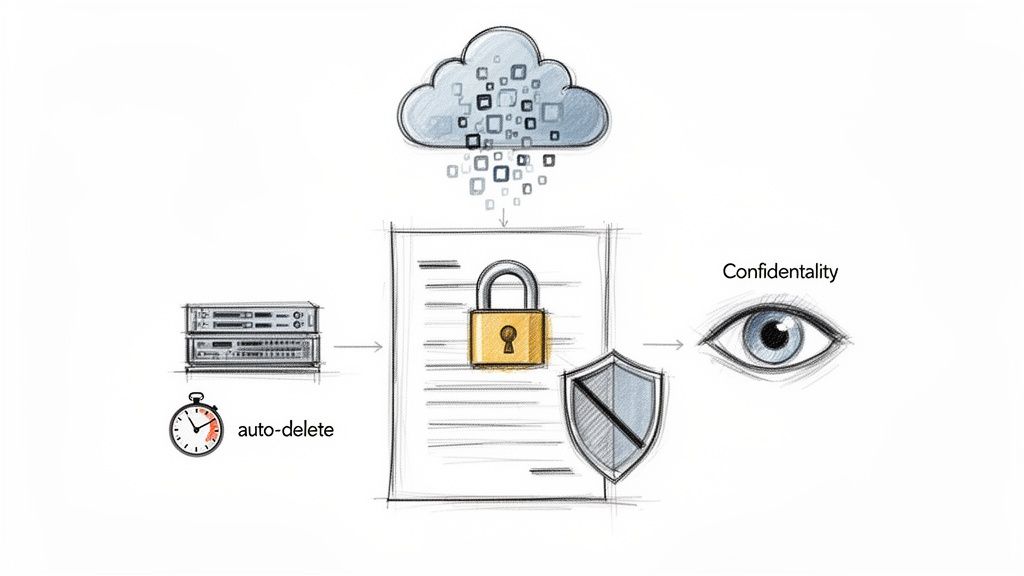
Legal documents are packed with sensitive information. Think about it—merger agreements hold trade secrets, and immigration filings contain deeply personal data. This makes security an absolute, non-negotiable priority.
Using a free online translator for these documents is like discussing a confidential case in a packed coffee shop. You have no idea who’s listening, and the risk of a leak is sky-high. Public AI platforms often use your data to train their models, which means your private information could easily be exposed, violating the strict duty of confidentiality you’re bound to uphold.
The Gold Standard for Data Protection
Protecting your information during the translation of legal document files isn’t about a single lock; it’s about a multi-layered security strategy. The best professional services build a secure digital fortress around your data, from the moment you upload it to the second it’s back in your hands.
This fortress is built on a few key pillars:
- End-to-End Encryption: This is the digital equivalent of an unbreakable lockbox. It scrambles your data as it travels online and while it’s stored, making it completely unreadable to anyone without the key.
- Secure Server Infrastructure: Reputable providers house your data in fortified, access-controlled data centers. This protects your files from both hackers and physical break-ins.
- Transparent Privacy Policies: A trustworthy service will be crystal clear about its data handling. Look for an explicit promise that they will never share your documents or use them to train AI models.
Confidentiality is the bedrock of legal practice. A data breach doesn't just leak information—it shatters client trust, invites regulatory fines, and can completely derail the outcome of a case.
As an extra precaution, always use tools like email encryption when sharing translated documents internally or with outside counsel. It adds another critical layer of defense to your workflow.
Reducing Exposure with Automatic Deletion
Even with the best security, the longer data sits on a server, the longer the window of opportunity for a breach. That’s why top-tier services have a strict automatic file deletion policy.
By permanently wiping your files from their systems—often within 24 hours of completing the translation—they shrink the risk profile dramatically. This isn't just a feature; it's a commitment to data minimization. It proves they take your confidentiality seriously.
Your Security Evaluation Checklist
When vetting a translation provider, don't stop at accuracy and speed. You need to grill them on their security protocols. Use this checklist to make sure they can be trusted with your most sensitive materials.
- Is end-to-end encryption used for all data? (This includes data in transit and at rest.)
- Does the provider have a clear, public privacy policy? (Find the "no data sharing" or "no model training" clause.)
- Are files automatically deleted from their servers? (And what’s the timeframe? 24 hours is a good benchmark.)
- Are they compliant with regulations like GDPR? (This is crucial if your documents contain personal data of EU citizens.)
- Do they offer non-disclosure agreements (NDAs)? (This gives you an extra layer of legal protection for mission-critical projects.)
By making these security measures a priority, you can confidently manage the translation of legal document files while upholding your professional and ethical duty to protect client information.
Your Quality Checklist for Legal Translation
When you're dealing with legal documents, there's no room for error. A successful translation isn't just about swapping words; it’s about getting every detail right. Think of this checklist like a pilot’s pre-flight inspection—it’s a straightforward but essential routine to prevent common mistakes and ensure every critical step is covered.
Running through these points before, during, and after your translation project will give you the confidence that the final document is accurate, compliant, and ready for use. I’ve broken it down into three phases that follow the natural arc of any translation job.
Phase 1: Pre-Translation Preparation
Before a single word gets translated, a little prep work goes a long way. Getting these details sorted out upfront can save you from major headaches, costly revisions, and serious legal issues down the road.
Is the source document final and complete? This is non-negotiable. Always, always work from the absolute final version of your document. Translating a draft that gets updated later is a recipe for disaster—it wastes time, blows up your budget, and introduces a huge risk of version control errors slipping into the final legal text.
Have you identified the precise legal jurisdiction? Knowing the target country isn't specific enough. You need to pinpoint the exact state, province, or legal system. For example, a contract for Canada needs to distinguish between Quebec's Civil Code and the common law used in other provinces. This detail is what determines the correct legal terminology and ensures the document will actually hold up.
Phase 2: During the Translation Process
Once the project is in motion, your attention should shift to the technical execution. Keeping an eye on these elements ensures the final product meets your exact requirements.
Does your chosen tool or service preserve formatting? The structure of a legal document—clause numbers, tables, signature blocks—is part of its legal integrity. You must confirm that your translation method will replicate the original layout perfectly. A poorly formatted document can be flat-out rejected by courts or government agencies.
Is a human review required for this document’s purpose? You need to decide this early. Is an AI-only translation good enough for an internal review, or is this a court submission that absolutely requires a human expert for nuance and certification? Making this call at the beginning prevents you from having to do the work all over again.
Phase 3: Post-Translation Review and Finalization
After the translation is delivered, a final verification step is crucial. This is where you confirm the document is legally sound and fit for its intended purpose.
A translated document is not truly "finished" until it has been verified for both linguistic accuracy and legal nuance. This final review is your last line of defense against potentially critical errors.
Is certification or notarization needed? Find out exactly what the receiving institution requires. Many government bodies, courts, and universities demand a formal Certificate of Translation Accuracy or even a notarized signature to accept a translated document as official.
Has a qualified party reviewed the final document? This should be your last step, every time. Have someone with legal expertise in the target jurisdiction review the translated document. They are the only ones who can spot the subtle issues a direct translation might miss, ensuring the document's legal intent remains perfectly intact.
Frequently Asked Questions
When you're dealing with legal document translation, a lot of questions can pop up. Let's walk through some of the most common ones we hear, giving you the clear, straightforward answers you need to move forward confidently.
How Much Does Legal Translation Cost?
The price for a translation of legal document files isn't one-size-fits-all. A few key things will move the needle on the final cost.
Here’s what typically influences the price:
- Language Pair: Translating between common languages, like English and Spanish, is usually more budget-friendly than working with a less common pair.
- Document Complexity: A simple birth certificate is a world away from a dense, multi-page business contract. The more specialized the legal language, the more it will cost to get it right.
- Turnaround Time: Need it yesterday? Rush jobs almost always come with a premium to prioritize your project.
- Certification Requirements: If the document needs an official Certificate of Translation Accuracy or has to be notarized, expect those services to add to the final invoice.
What Is a Certified Translation?
Think of a certified translation as more than just the translated text. It's a package deal: the translated document comes with a formal, signed statement from the translator or their company.
This signed statement, often called a "Certificate of Accuracy," is a professional guarantee. It confirms that the translation is a true and accurate reflection of the original document. This isn't just a nice-to-have; it's a must for most official uses, like submitting immigration paperwork, foreign academic transcripts, or evidence in court.
How Long Does a Legal Translation Take?
The timeline really comes down to the document's length and how technical it is. A standard one-page document can often be turned around and certified within 24 hours.
But if you have a massive contract or a complicated court filing, it could easily take several days or even a week. A good process isn't just about translating the words; it includes a thorough review by a second linguist to catch any errors. It's always smart to ask about the delivery timeline upfront, especially when you're up against a deadline.
A common myth is that translation happens in an instant. While technology has made things much faster, high-stakes legal work still needs a human expert to ensure every detail is perfect, and that takes time.
Ready to handle your document translation with speed, security, and precision? DocuGlot offers an AI-powered solution that preserves your original formatting, supports over 100 languages, and ensures your confidential data is protected with automatic file deletion. Get an instant quote and start your translation in minutes at https://docuglot.com.
Tags
Ready to translate your documents?
DocuGlot uses advanced AI to translate your documents while preserving formatting perfectly.
Start Translating