A Guide to AI for Translation in Modern Workflows
AI translation isn't just swapping words anymore. It's about using sophisticated neural networks to understand and convert text from one language to another, capturing the kind of context and nuance that used to get lost in translation. Think of it as a strategic tool that helps businesses, academics, and individuals instantly break down language barriers for better efficiency and global reach.
The New Era of Global Communication
Forget the clunky, literal machine translations of the past that gave us awkward and often nonsensical results. Today's AI is a far more capable partner, one that can grasp idiomatic expressions, technical jargon, and subtle cultural cues. It’s less like a digital dictionary and more like a skilled multilingual assistant who has learned from billions of texts, understanding not just the words but the complex relationships between them.
This evolution is fundamentally changing how we work. It’s a game-changer for anyone needing to translate complex documents while keeping the original layout and design perfectly intact. Imagine a legal contract with precise formatting, a technical manual packed with diagrams, or a research paper filled with citations—modern AI ensures the translated version is a mirror image of the original.
Unlocking Global Potential and Efficiency
The real power of using AI for translation is its blend of speed and scale, delivering high-quality results for a vast range of needs. This allows organizations and individuals to:
- Accelerate Global Expansion: Businesses can take marketing materials, user guides, and support content into dozens of languages almost overnight, opening up new markets faster than ever before.
- Improve Operational Workflows: Global teams can share reports, training manuals, and internal updates without the usual delays, creating a more unified and productive workforce.
- Democratize Access to Information: Researchers and students can finally read and understand scholarly articles and publications from anywhere in the world, dismantling knowledge barriers that have long slowed down progress.
For professionals dealing with sensitive information, the security of these platforms is non-negotiable. Features like end-to-end encryption and automatic file deletion are critical for ensuring confidential data in legal, medical, or corporate documents stays protected.
Ultimately, this technology is about so much more than just converting words—it's about preserving meaning, intent, and structure. By making large-scale projects affordable and secure, AI translation has become an indispensable tool for thriving in our interconnected world. For a closer look at specific use cases, you can learn more about AI-driven document translation in our detailed guide.
How AI Translation Actually Works
At its heart, AI for translation doesn't learn like a student cramming grammar rules. Instead, imagine it as an apprentice poring over millions of documents already translated by expert humans. This modern method, called Neural Machine Translation (NMT), is a world away from the old, rigid, word-for-word systems.
Older translation tools were like a pocket phrasebook. They could swap "hello" for "hola" just fine, but they'd stumble over sentences where context and word order are everything. NMT, on the other hand, learns the intricate patterns and relationships between words across entire sentences, grasping the underlying meaning instead of just swapping words.
This leap in capability is precisely why AI translation has become so dependable for complex documents. It's reshaping how we communicate across business, academics, and even personal interactions.
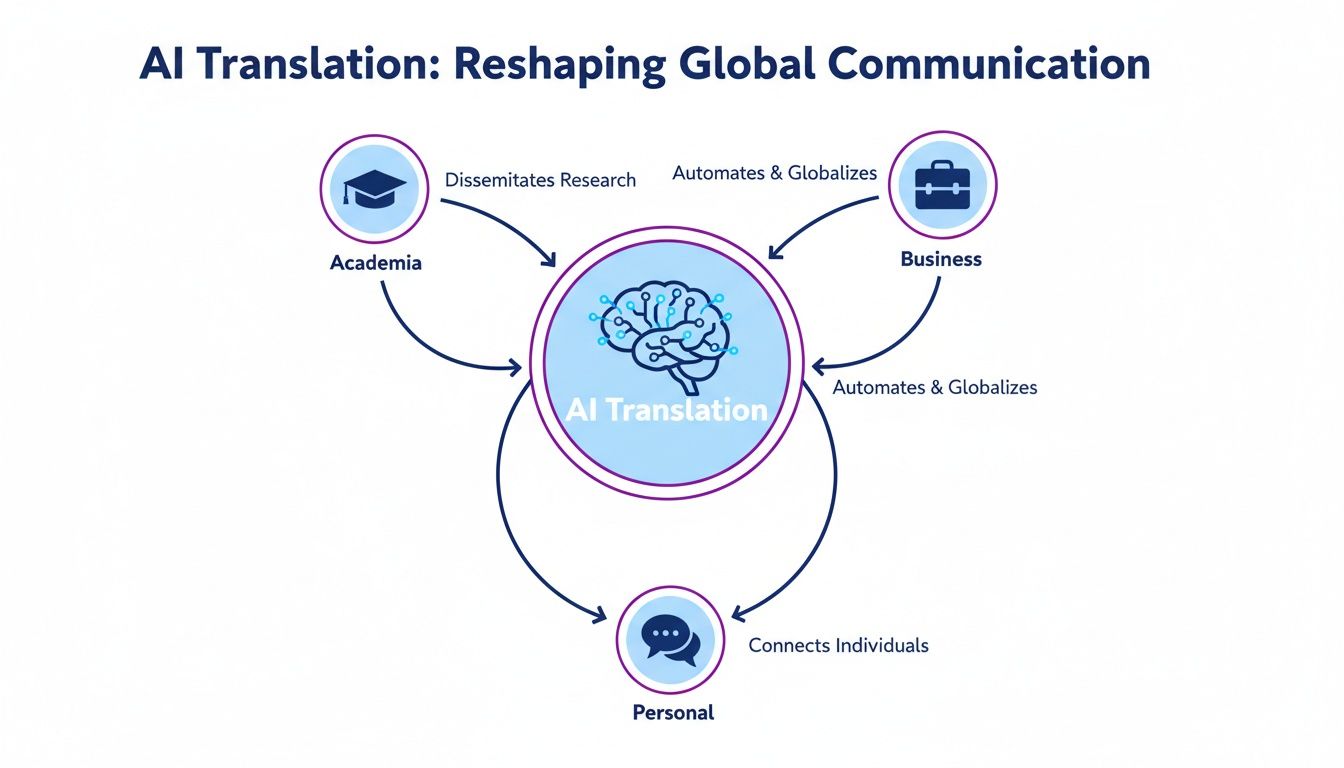
This diagram really shows AI translation as the central link, breaking down language barriers and letting information flow freely between different fields.
The Power Of Transformer Models
The engine driving today’s NMT is a technology called a transformer model. First introduced in 2017, this architecture was a genuine breakthrough, giving AI an almost human-like ability to process language. Its secret weapon? The power to weigh the importance of different words in a sentence when generating a translation.
This is all thanks to a concept known as an attention mechanism. Think about translating the sentence, "The bank is on the left bank of the river." An attention mechanism lets the AI figure out that the first "bank" (a financial building) is entirely different from the second "bank" (the side of a river). It pays more "attention" to the words around it to nail down the correct meaning.
This ability to parse grammar and context is also critical for tricky linguistic challenges, like accurately handling irregular verb conjugations that don't follow standard rules.
From Statistical Guesses To Contextual Understanding
To truly get why NMT is such a big deal, it helps to look at what came before it: Statistical Machine Translation (SMT). SMT worked by analyzing huge volumes of text to calculate probabilities—basically, it made an educated guess about the most likely word or phrase translation. It was an improvement, but the results often felt clunky and disconnected.
NMT, powered by those transformer models, completely changed the game.
To see just how far we've come, here’s a look at how NMT stacks up against the older methods that paved the way.
Comparing AI Translation Technologies
| Feature | Neural Machine Translation (NMT) | Statistical Machine Translation (SMT) | Rule-Based Machine Translation (RBMT) |
|---|---|---|---|
| Methodology | Deep learning networks analyze full sentences for context and meaning. | Translates based on statistical models from bilingual text corpora. | Relies on hand-coded grammatical rules and bilingual dictionaries. |
| Accuracy | High. Captures nuance, tone, and complex grammar. | Moderate. Often struggles with grammar and natural flow. | Low. Very rigid and frequently produces literal, awkward translations. |
| Context | Excellent. Understands entire sentences and paragraphs. | Poor. Focuses on phrases, losing broader context. | Very poor. No contextual understanding, just word-for-word swaps. |
| Fluency | Sounds natural and human-like. | Can be clunky and disjointed. | Robotic and unnatural. |
The takeaway is clear: NMT's ability to see the bigger picture results in translations that are not just technically correct, but also read like they were written by a person.
Different Models For Different Needs
Of course, not every translation job is the same. You don't need the same level of precision for a quick internal memo as you do for a published user manual. That’s why a platform like DocuGlot gives you options. A Basic model can handle everyday tasks quickly and affordably, while a Premium model brings in more powerful AI for technical or sensitive material where every detail matters.
This lets you fit the tool to the task, getting work done efficiently without compromising on quality when it counts. It's no surprise that NMT now holds a 48.21% share of the translation market, a testament to its superior performance. With the machine translation market expected to jump from USD 1.25 billion in 2026 to USD 2.17 billion by 2031, its role is only getting bigger.
For a closer look at how businesses are putting this technology to work, check out our guide on AI translation.
What Separates a Good AI Translation Tool from a Great One?
Not all AI translation platforms are built the same. Raw translation accuracy is the starting point, of course, but that’s just table stakes. What really separates a functional tool from an indispensable one are the features that solve real-world problems.
Think about it. When you're translating a legal contract, the formatting isn't just decoration—it's part of the document's integrity. When you're localizing a massive research paper, the tables and charts are just as critical as the text. The best tools get this. They're designed for the messy reality of professional work, handling the entire process from upload to final download with precision.
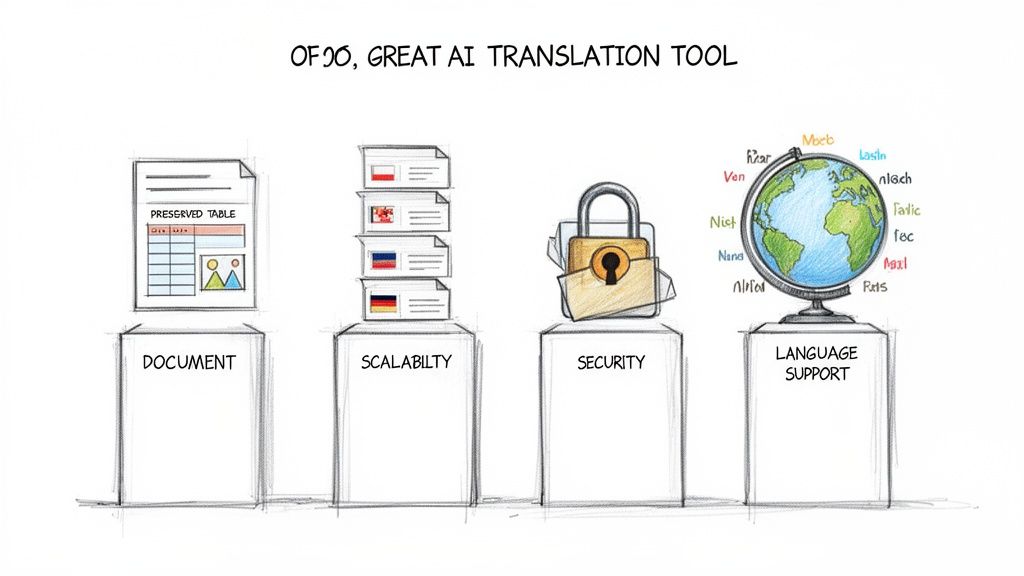
Let's break down the four pillars that truly define a top-tier AI for translation experience.
Flawless Format Preservation
You’ve spent hours meticulously laying out a technical manual in a DOCX file. You send it for translation, and what comes back is a giant, unformatted wall of text. It's a nightmare scenario, and a common one.
This is where flawless format preservation comes in. It’s the tool's ability to maintain the entire structure of your original document. We’re talking headers, footers, tables, images, and even font styles, all perfectly replicated in the new language. For file types like PDFs, where the layout is everything, this isn't just a nice-to-have; it's a dealbreaker. Platforms like DocuGlot are built from the ground up to ensure the translated file is a perfect mirror of the source, saving you from the soul-crushing task of reformatting.
Scalability and Robust File Handling
Your translation needs probably aren't limited to one-page memos. Professionals deal with monsters: book-length manuscripts, exhaustive legal discovery files, or dense quarterly financial reports. A great AI tool has to be ready for that.
Look for these signs of true scalability:
- No Size or Page Limits: The platform should chew through massive files without crashing or timing out. The smart ones do this by breaking documents into manageable chunks behind the scenes, so you can translate hundreds of pages with confidence.
- Batch Processing: The power to upload and translate a whole folder of documents at once is a massive time-saver, especially for large-scale localization projects.
- Broad File Type Support: You need a tool that speaks your language—and your file formats. Compatibility with professional standards like PDF, DOCX, TXT, and Markdown is essential.
This kind of scalability means the tool can keep up with you, whether you’re translating a quick email or an entire library of corporate documents.
Ironclad Security and Confidentiality
When you upload a document for translation, you're placing your data in someone else's hands. For business, legal, or academic work, that data is often highly sensitive. Security isn't an add-on; it's the foundation of trust.
An AI translation service must treat your data with the utmost care. This means your documents should never be used to train third-party models or be left sitting on a server indefinitely.
A truly secure platform will always deliver:
- End-to-End Encryption: Your files must be protected both in transit (as they upload and download) and at rest (while being processed).
- Strict Data Privacy Policies: Look for a provider with a crystal-clear policy on data handling. For example, DocuGlot has a strict commitment to never share your documents with anyone.
- Automatic File Deletion: To minimize exposure, your files should be automatically and permanently wiped from the system after a short, defined period—typically 24 hours.
Comprehensive Language and Dialect Support
Finally, the sheer scope of language support matters immensely. The world doesn't just speak a handful of major languages; it communicates in a rich tapestry of regional variations and dialects. Translating a marketing campaign for Mexico requires a completely different flavor of Spanish than one for Spain.
A premier tool gives you access to a vast library of languages so you can connect with a truly global audience. This goes beyond just the big names to include crucial regional dialects. It's this nuanced support that allows you to create authentic, resonant communication that actually speaks to local audiences on their own terms.
Real-World Applications of AI Translation
It's one thing to talk about the technical side of AI translation, but it's another to see it solve real, everyday problems. That's when the value really clicks. Abstract ideas like format preservation, security, and scalability suddenly become very real when you see them in action, solving headaches for professionals in their day-to-day work. These aren't just bullet points on a feature list; they are genuine solutions that save time, cut costs, and unlock new opportunities.
And the demand for these solutions is absolutely surging. The AI-powered translation market has seen explosive growth, jumping from USD 1.88 billion in 2023 to USD 2.34 billion in 2024. That's a massive 24.9% compound annual growth rate. This isn't just a niche trend; it shows businesses everywhere are scrambling to break down language barriers. You can dive deeper into this shift by exploring more insights about automated translation statistics.
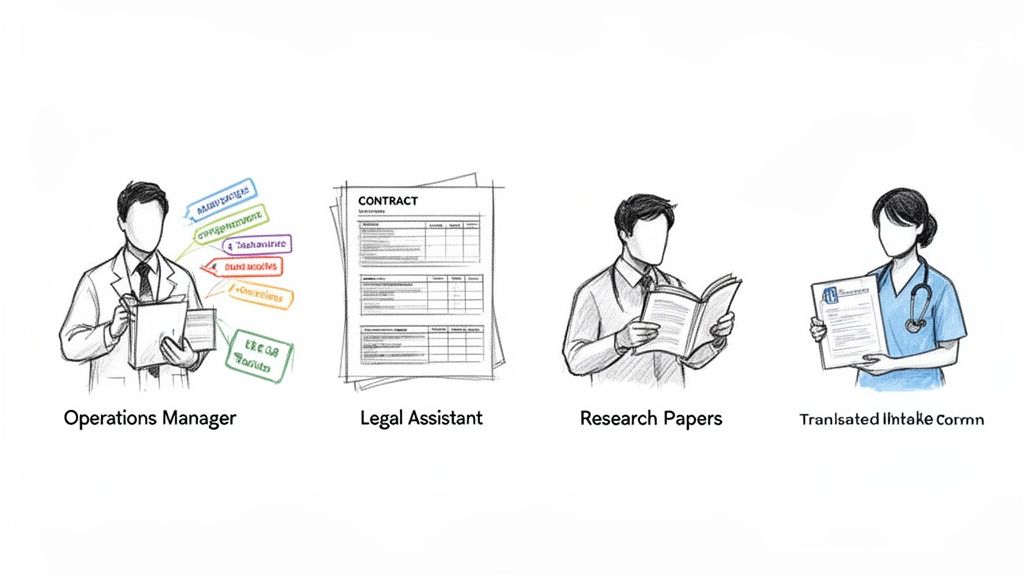
So, let's step into the shoes of four different professionals to see just how a powerful AI for translation tool can completely change their workday.
The Global Operations Manager
Meet Sarah. She’s an operations manager at a fast-growing tech company, and she's staring down a huge project: launching a new product in five international markets at the same time. This means localizing hundreds of pages of user manuals and training materials—all complex DOCX files packed with screenshots, diagrams, and tables.
In the past, this would have been a logistical nightmare. Imagine trying to coordinate with a half-dozen freelance translators, getting back files with messed-up formatting, and then spending weeks manually piecing the layouts back together. Not anymore.
Now, Sarah uses DocuGlot. She uploads the entire batch of manuals in one go. The AI gets to work, translating the text into Spanish, German, French, Japanese, and Korean while—and this is the magic part—keeping every single image and table perfectly in place. A few hours later, an email lands in her inbox. The translated documents are ready, each one a perfect mirror of the original. A month-long ordeal is now a single afternoon's task.
The Diligent Legal Assistant
Next up is David, a legal assistant at a corporate law firm. A 150-page contract from a potential partner in Brazil just landed on his desk. It’s a PDF, it's in Portuguese, and his team needs to review it ASAP. The challenge here is two-fold: language and layout. The contract's structure, with its specific clauses, tables, and formatting, is legally binding and can't be altered.
His biggest worry? Confidentiality. Uploading such a sensitive agreement to a random online tool is out of the question. He opts for a service with end-to-end encryption and a strict automatic file deletion policy, like DocuGlot's. He uploads the PDF, knowing the firm’s data is safe.
The AI doesn't just translate the dense legal jargon; it preserves the exact formatting of the original PDF. This is critical. It means the partners can review the English version side-by-side with the original, confident that Clause 4.1 in their version corresponds exactly to Clause 4.1 in the Portuguese document. What used to be a costly, week-long process is now done securely in under an hour.
By maintaining the document’s structural integrity, AI for translation empowers legal teams to act faster and more confidently in international dealings, where every detail and delay can have major financial consequences.
The Dedicated PhD Student
Let's look at Maria, a PhD student knee-deep in environmental science research. She’s found a treasure trove of groundbreaking papers from a German institute, but they're only available as heavily formatted PDFs in their native language. These documents are dense with charts, graphs, and highly specific scientific terms.
For Maria, getting access to this information is make-or-break for her thesis. She uses an AI tool to translate the entire collection. The platform handles the large, complex files without breaking a sweat, delivering English versions where the data visualizations and citations are perfectly aligned with the translated text.
This simple act completely democratizes access to global knowledge. Maria can now weave cutting-edge international research into her work without language standing in her way, allowing her to engage with the global academic community on a whole new level.
The Compassionate Healthcare Provider
Finally, there’s Dr. Chen. He works at a community clinic that serves a very diverse population. A new family who speaks only Ukrainian has just come in. To give them proper care, he needs them to fill out several detailed patient intake and medical history forms.
Using a secure AI translation tool, Dr. Chen instantly translates the clinic’s standard forms into Ukrainian. Because the format is preserved, the documents are clear and easy for the family to understand. They can provide their information accurately, and Dr. Chen can then translate their responses back into English for the clinic's records.
This quick, simple use of AI for translation ensures clear communication, cuts down on the risk of dangerous misunderstandings, and helps him provide better, more equitable care. It’s a perfect example of how this technology has a direct and incredibly positive human impact.
Best Practices for High-Quality Results
Getting the most out of AI for translation is about more than just hitting the "translate" button. While today's tools are incredibly powerful, the old saying "garbage in, garbage out" still holds true. The quality of what you get out is directly tied to the quality of what you put in.
Think of the AI as a brilliant but very literal assistant. It works best with clear, precise instructions. By making a few smart adjustments to your source documents and your process, you can steer the AI toward producing translations that are not just good, but genuinely great.
Prepare Your Source Document for Success
Before you even start the translation, take a close look at your original file. A clean, well-structured document is the bedrock of a high-quality translation. Ambiguity is machine translation's worst enemy, so your main job here is to stamp it out.
Start with your language. Try to simplify complex sentences and steer clear of idioms or regional slang that won't have a direct equivalent in another language. While the latest AI models are getting much better at handling nuance, clear and direct language always wins. For instance, instead of "We need to hit a home run on this project," something like "We need this project to be a major success" is much safer.
Here are a few practical steps you can take:
- Write Clearly and Concisely: Stick to shorter, direct sentences. This drastically cuts down the chances of the AI misinterpreting the grammar.
- Keep Terminology Consistent: If you call a feature the "user dashboard," stick with that exact term every single time. Switching between "dashboard," "user portal," and "client interface" will only confuse the AI.
- Simplify Formatting: Tools like DocuGlot are built to handle complex layouts, but using standard fonts and avoiding overly complicated tables or text boxes can help ensure a smoother process. If you're dealing with a difficult file, our guide on how to translate a PDF has some great tips for preserving the original structure.
Choose the Right Quality for the Job
Not all translations carry the same weight. An internal team memo is a world away from a legal contract you're sending to an international partner. A good AI for translation service understands this and provides different quality tiers to match the task at hand.
For quick, low-stakes needs, a Basic model is usually more than enough. It's fast, affordable, and nails the general meaning. But when you're working with technical manuals, academic papers, or critical business documents, investing in a Premium model is the smart move. These models are trained on vast, specialized datasets, which gives them a much stronger grasp of complex context and industry-specific terminology.
Embrace the Role of Human Oversight
This might be the most important practice of all: view AI as a powerful tool that assists human experts, not one that replaces them. For any document where accuracy is absolutely critical—think medical records, financial reports, or legal agreements—a final review by a human is non-negotiable. This process is called post-editing.
The "human-in-the-loop" approach is the gold standard. It marries the incredible speed and scale of AI with the nuanced judgment and cultural awareness of a professional translator. This hybrid model is how you achieve the highest possible quality.
A human post-editor catches the subtle cultural shades of meaning that an AI might miss, ensures the tone is right for the audience, and verifies that every critical piece of information is 100% accurate. It’s the final quality check that transforms a great machine translation into a perfect one.
Making the Smart Choice for Your Needs
Picking the right AI translation service is all about matching what's on offer with what you actually need. It’s not just about getting words from one language to another. The best tool is one that fits right into your workflow, whether you’re a student with a research paper, a lawyer with a contract, or a business manager handling global communications.
You have to start by looking at the trade-offs. Sure, free tools are tempting because they're instant, but that speed often comes at a steep price: your document's formatting and your data's security. For any kind of professional work, those compromises are a deal-breaker. You'll waste more time rebuilding a document's layout or worrying about a data leak than you saved on the translation itself.
The goal is to find that sweet spot—a service that gives you professional-grade features without a punishing price tag.
Key Decision-Making Criteria
When you start comparing services, it's easy to get lost in the marketing noise. To cut through it, focus on these five core pillars. They'll tell you if a tool is truly built for the job.
- Format Preservation: Will your PDFs and Word docs come back looking exactly as they went in, with tables, images, and layouts intact? For professional documents, this is absolutely essential.
- Security: Where does your data go? You need to see clear, ironclad policies on end-to-end encryption and automatic file deletion. Anything less is a risk.
- Scalability: Can the platform handle a 100-page report as easily as a one-page memo? Can you upload a whole batch of files at once? Your needs will inevitably grow, so your tool needs to keep up.
- Turnaround Time: How fast can you get a quality translation back? When a deadline is looming, you need a service that delivers both speed and accuracy without compromise.
- Cost-Effectiveness: Is the price fair for the value you're getting? Look for transparent, pay-as-you-go pricing that lets you control your budget without any nasty surprises.
To really get under the hood and make a confident choice, it helps to understand what makes these tools tick. If you want to dive deeper into the technology, this a founder's guide on how to compare AI models is a fantastic resource that breaks down the critical differences in cost, speed, and accuracy.
In the end, choosing the right tool is an investment. When you prioritize features that protect the integrity of your documents and the security of your data, you’re not just buying a translation—you’re investing in a solution that makes your global communications seamless, professional, and secure.
Common Questions About AI Translation
When you're thinking about using AI for translation, a few key questions always come up. It's only natural to wonder about accuracy, the safety of your files, and whether the tech can handle tricky document layouts. Let's get straight to the answers.
How Accurate Is It, Really?
Modern AI translation is impressively accurate, especially for widely spoken language pairs like English to Spanish or German to French. For most business communications or general academic papers, the technology does a fantastic job of understanding context and creating text that flows naturally.
But accuracy isn't a simple yes or no. When the stakes are high—think legal contracts, medical reports, or critical safety manuals—you still need a human expert in the loop. The smartest approach is to let the AI do the heavy lifting first, then have a subject matter expert perform a final review, a process we call "post-editing," to catch any subtle errors and guarantee every last detail is spot-on.
Is It Safe to Upload Confidential Documents?
This is a huge concern, and rightly so. The answer comes down to which service you use. You should absolutely never upload sensitive information to a free, public translation website, as they might use your data to train their systems.
A professional-grade service, on the other hand, puts security front and center. Look for a platform that makes security a core part of its offering, not an afterthought. Key features to demand include:
- End-to-end encryption: This ensures your files are protected from the moment you upload them to the moment you download the translation.
- A rock-solid privacy policy: It should explicitly state that your documents are yours alone and will never be shared or used for any other purpose.
- Automatic file deletion: Your data should be permanently wiped from their servers after a short, defined period, often just 24 hours.
Security isn't a luxury add-on; it's the price of entry for any professional translation workflow. Always confirm a provider's security practices before you upload anything.
Can AI Handle Complex Documents Like PDFs?
Yes, but this is where you really see the difference between a basic tool and a professional solution. Keeping the layout of a complex PDF—with its intricate tables, images, and columns—is a major technical hurdle. Most simple translators will just strip out the text, leaving you with a messy, unformatted document that takes hours to fix.
This is exactly the problem that advanced platforms like DocuGlot are built to solve. They use sophisticated document analysis to deconstruct the file, translate the text, and then perfectly rebuild it with the original formatting intact. That ability to preserve the layout is what makes it a true document translation solution, not just a text translator.
Ready to see how fast and secure document translation can be, without sacrificing formatting? DocuGlot is built for professionals who need reliable results. Get your perfectly formatted translation in minutes and experience the difference for yourself.
Tags
Ready to translate your documents?
DocuGlot uses advanced AI to translate your documents while preserving formatting perfectly.
Start Translating