A Practical Guide to Technical Translations Services
Technical translation is all about precision. It’s the highly specialized craft of converting complex, industry-specific documents from one language to another while keeping every technical detail perfectly intact.
Think of it this way: you’re not just swapping words. You're making sure a German engineering schematic is crystal clear to a Japanese production team. Get one term wrong, and you could be looking at equipment failure, a serious safety hazard, or even a legal nightmare.
Why Technical Translation Matters
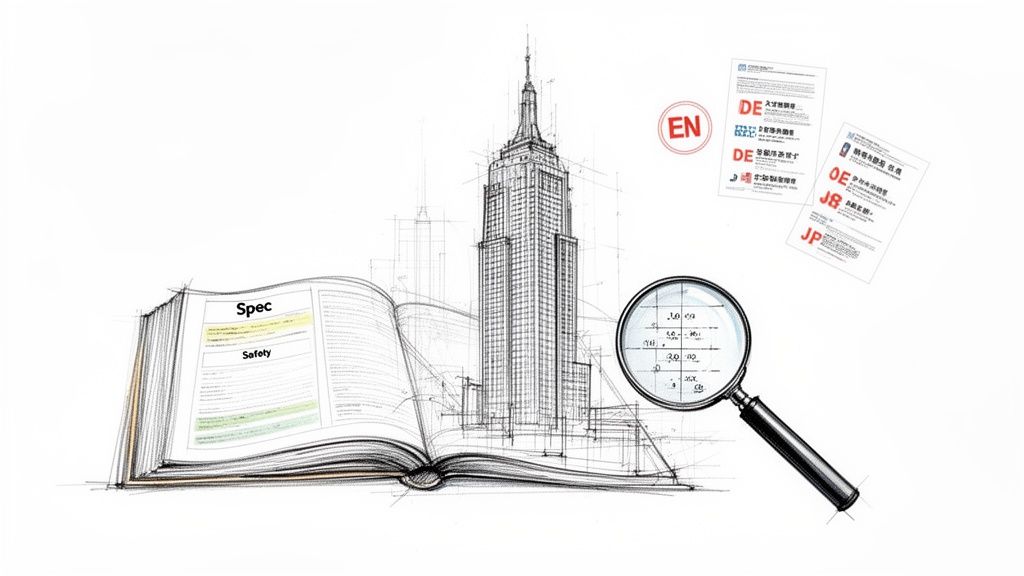
Picture the blueprint for a skyscraper. Every line, measurement, and note has to be exact. A tiny miscalculation could lead to disaster. Technical translation works on that very same high-stakes principle, but with language instead of lines. It’s the art and science of ensuring a user manual, a patent filing, or a clinical trial report means the exact same thing in every language, with zero room for ambiguity.
This is where it parts ways with general translation. While a marketing translator might focus on capturing a certain style or emotion, a technical translator is obsessed with precision, accuracy, and consistency. The vocabulary is dense with jargon, acronyms, and industry-specific terms that would send a generalist translator running for the dictionary—and they’d probably still get it wrong.
The Real-World Cost of Getting It Wrong
A single mistranslated word in a technical document isn’t just an awkward mistake; it can have massive real-world consequences. For any business operating globally, these errors can pop up in some pretty damaging ways:
- Safety Hazards: An incorrectly translated safety data sheet (SDS) or machinery manual can put workers directly in harm's way.
- Product Malfunctions: Faulty assembly instructions can lead to product failures, which quickly tanks your brand’s reputation.
- Legal & Compliance Headaches: A poorly translated patent application can get flat-out rejected, and non-compliant regulatory documents can lead to massive fines.
- Financial Losses: Think about it—product launch delays, wasted materials, and legal battles all drain your budget, and many of them trace back to a preventable translation error.
At its core, professional technical translation is about managing risk. It's what keeps your complex information reliable and actionable across languages and cultures, protecting your operations, your reputation, and your bottom line.
A Market Fueled by Global Interconnection
This absolute need for precision is what’s driving huge growth in the industry. The global translation services market, where technical accuracy is a massive component, was valued at USD 41.78 billion in 2024. It’s on track to hit USD 50.02 billion by 2033.
This isn't just a random number; it reflects the real-world demand for clear communication in today's interconnected supply chains. Companies have to translate everything from software interfaces to user guides just to compete and stay compliant on the world stage.
Ultimately, investing in professional technical document translation isn't an expense—it's a critical part of a smart global strategy. This commitment to clarity protects your brand and makes seamless international work possible.
What Kinds of Documents Get a Technical Translation?
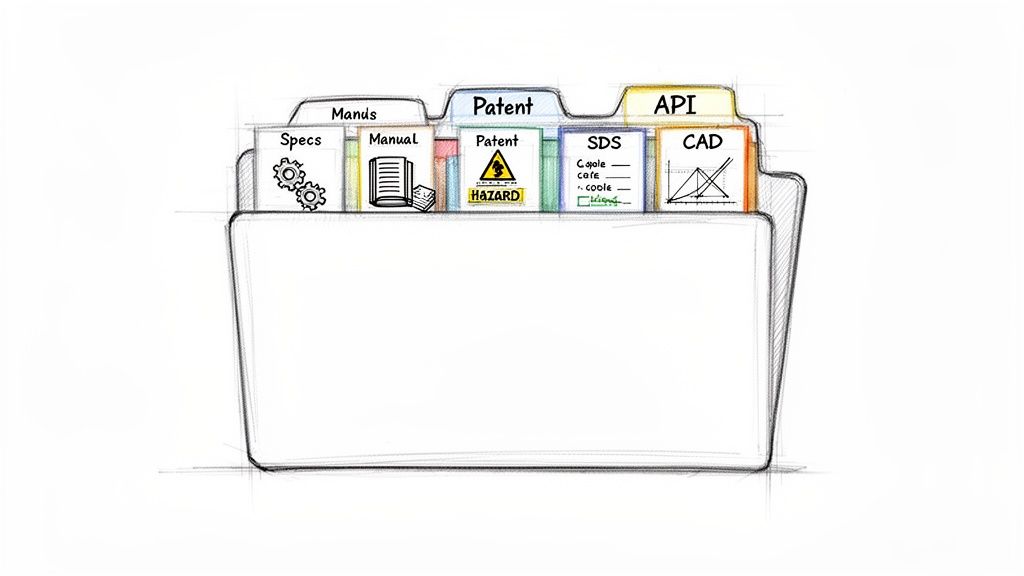
Technical translation isn't about swapping words in a simple text file. It's about meticulously preserving complex, highly structured information across all sorts of formats where every single detail—from a decimal point to a diagram label—is critical.
Different industries run on entirely different types of documentation, each with its own set of rules, jargon, and challenges.
Understanding these categories is the first step toward choosing the right technical translations services. The team that excels at translating snappy software strings probably isn't the same one you'd trust with the dense, rigid formatting of a patent application. Let's look at the most common documents that cross a technical translator's desk.
For Engineering and Manufacturing Teams
In engineering and manufacturing, precision is everything. One tiny mistake in a document can snowball into production delays, costly rework, or even serious safety incidents. Every schematic, guide, and spec sheet has to be perfect.
Think about a German auto parts manufacturer sending detailed schematics to a new factory in Mexico. Every label on a CAD drawing and every step in the assembly guide must be translated flawlessly. If not, the parts won't fit, and the whole production line could grind to a halt.
Here’s what these teams typically need translated:
- User Manuals and Installation Guides: These have to be crystal clear so that end-users and technicians can operate and maintain expensive machinery safely and correctly.
- Product Specifications and Schematics: This is the nitty-gritty—the core data like dimensions, materials, and tolerances. A single misplaced decimal can make the entire document worthless.
- Technical Data Sheets (TDS): These documents pack in detailed performance specs, which are absolutely crucial for engineers trying to integrate a component into a larger system.
For Legal and Compliance Departments
When legal and compliance are involved, the stakes are sky-high. A single mistranslated phrase can invalidate a patent, get a medical device rejected by regulators, or open a company up to massive legal liability. The language here is intentionally dense, hyper-specific, and tied to strict jurisdictional rules.
The real challenge isn't just linguistic accuracy; it's achieving legal equivalency. A translated term has to carry the exact same legal weight and implication as the original. That takes more than a good translator—it takes a subject matter expert.
Documents that demand this specialized touch include:
- Patent Applications: Patents are a unique beast, blending complex technical descriptions with ironclad legal formatting. Getting the translation right is non-negotiable for protecting intellectual property worldwide.
- Regulatory Submissions: Any document sent to a body like the FDA or EMA has to follow their guidelines to the letter. Small errors can lead to long, expensive delays in getting a product to market.
- Safety Data Sheets (SDS): Governed by global standards, these documents require precise translation of chemical properties and safety protocols to keep people safe and stay compliant.
For the Software and IT World
Software localization is so much more than translation. It's about adapting an entire application—every button, menu, and error message—so it feels like it was built specifically for that local market. This work is a true blend of technical know-how and cultural intuition.
Picture a project management app expanding into the Middle East. It’s not enough to just translate the user interface (UI) into Arabic. The service must also handle right-to-left (RTL) text alignment, reconfiguring the entire layout to make it usable and professional.
Commonly translated software assets include:
- UI/UX Strings: These are all the little bits of text inside an app—button labels, menu items, tooltips—that guide the user experience.
- API Documentation: Developers need clear, accurate API guides to build on your platform. Precise technical translation here isn't a nice-to-have; it's a business necessity.
- Help Files and Knowledge Bases: Well-translated support docs empower global users to find their own answers, which can dramatically reduce the strain on your support teams.
Across all these fields, handling different file formats is a huge piece of the puzzle. A professional technical translations service has to be comfortable with everything from standard DOCX and PDF files to more specialized formats like XML and JSON for software, or even complex CAD files for engineering. The goal is always the same: deliver a translated document that is just as functional and easy to use as the original.
5. Navigating AI and Human Translation Quality
Deciding between AI and human expertise in technical translation isn't about picking a winner. It's about strategy—choosing the right tool for the job to balance your project's speed, budget, and quality.
Think of it like building custom cabinetry. You'd use a computer-guided CNC machine to cut the main pieces. It’s incredibly fast and perfectly consistent every single time. That’s your AI translation, fantastic for processing huge volumes of text and keeping repetitive terms uniform.
But for the fine details—the intricate joinery, the final sanding, and the perfect finish—you need a master craftsperson. That’s your human translator. They step in to handle cultural nuances, clarify ambiguous phrasing, and add the final polish that makes the work truly professional.
When to Go with Pure AI Translation
Pure AI, often called raw machine translation (MT), is your fastest and cheapest option. It's the perfect choice when speed is everything and you just need a "good enough" grasp of the content.
It’s the right call for scenarios like these:
- Internal Drafts: You need to quickly see what a competitor's technical docs from another market are about.
- High-Volume, Low-Risk Content: Analyzing thousands of internal support tickets or user comments to spot recurring issues.
- Initial Research: Scanning foreign-language patents or academic papers to see if they're relevant before paying for a full translation.
In these cases, AI delivers immediate insight without a big investment. It gets the main idea across, even if the wording is a little clunky.
The Power of the Hybrid Approach
For most modern technical translation needs, the best workflow is a hybrid model: Machine Translation Post-Editing (MTPE). This approach uses AI for the initial heavy lifting and then brings in a human expert for a strategic review.
The goal here isn't to fix every single word the AI generates. Instead, a human subject matter expert scans the translation for critical errors, checks key terminology, and ensures the context is right. It’s a targeted quality check that makes sure the final document is both technically accurate and professionally polished.
This combination of speed and quality is driving huge growth. The machine translation market exploded from $650 million in 2020 to over $1.1 billion in 2022 and is on track to hit $3 billion by 2027, thanks to major AI breakthroughs. For a deeper dive, our friends at Redokun have some great insights on this growth.
When Full Human Translation is Non-Negotiable
While AI is a powerful tool, some documents are simply too important to leave to a machine. For high-stakes, customer-facing, or legally binding content, you absolutely need the deep understanding and nuanced judgment of a professional human translator.
A human expert doesn't just translate words; they translate meaning, intent, and implication. This is a level of understanding that even the most advanced AI models are still working to achieve consistently, especially in complex technical fields.
Full human translation (or at least a very thorough human edit) is critical for:
- Patient-Facing Medical Documents: Think instructions for a medical device or drug dosages, where even slight ambiguity could be dangerous.
- Legally Binding Contracts: Agreements, patents, or compliance paperwork where every single clause must have the precise legal weight as the original.
- Flagship User Manuals: The primary guide for your most important product, where clarity and brand voice are everything.
If you want to dig deeper into this comparison, check out our detailed guide on AI vs. human translation services for documents: https://docuglot.com/de/blog/dokumentubersetzungsdienste-vergleich-ki-vs.-menschliche-experten.
For those curious about the technology itself, understanding how to use Python for NLP and semantic SEO offers a fascinating look under the hood. It helps clarify both the incredible power and the current limits of translation AI.
Choosing Your Translation Method
So, how do you decide? It all comes down to your content's purpose, your audience, and how much is at stake. This table breaks down the decision-making process.
| Factor | Best for AI Translation | Best for Human Review (Post-AI) | Best for Full Human Translation |
|---|---|---|---|
| Content Type | Internal drafts, user comments, competitor analysis, initial research. | User guides, knowledge bases, technical support articles, product descriptions. | Legal contracts, medical device instructions, patents, flagship marketing materials. |
| Goal | Gist/understanding only. Speed is the top priority. | Accurate and readable content for a broad audience. A balance of speed and quality. | Perfect accuracy, nuance, and brand voice. Quality is the top priority. |
| Risk | Low risk. Errors are acceptable and have no serious consequences. | Medium risk. Errors could cause confusion but are unlikely to be dangerous or costly. | High risk. Any error could lead to legal issues, safety concerns, or brand damage. |
| Budget | $ (Lowest Cost) | $$ (Moderate Cost) | $$$ (Highest Cost) |
| Speed | Fastest (minutes to hours) | Fast (hours to days) | Slowest (days to weeks) |
Ultimately, picking the right method isn't just a technical choice—it's a business decision. By matching the translation approach to the content's value and risk, you ensure you get the quality you need without overspending.
How to Choose the Right Translation Provider
Picking the right partner for your technical translations is a make-or-break decision. It’s not just about getting words from one language to another; it's about finding a provider who gets your world and can handle the complexity, budget, and deadlines of your project.
Think of it as hiring a specialist, not just a service. The best fit comes down to evaluating four key areas: their actual expertise, the tech they use, how they handle security, and whether they can keep up with your needs. Let’s walk through what to look for in each.
Evaluate Their Subject Matter Expertise
First things first: do they speak your language? I don’t mean French or Japanese; I mean the language of your industry. Translating a patent application is a completely different ballgame from localizing a software manual. A generic translator, human or AI, will stumble over the nuances and get the critical details wrong.
When you’re talking to potential providers, get specific. Ask them directly about their experience in your field. Do they have translators with engineering backgrounds? Is their AI trained on medical or legal terminology?
The easiest way to cut through the marketing fluff is to request a sample translation. Give them a short, jargon-heavy snippet of your own content. You’ll see in minutes whether they can actually deliver the precision you need.
Analyze Their Technology and Workflow
Great technology should make your life easier, not add another frustrating step to your process. A modern translation platform should feel intuitive, letting you upload, manage, and download documents without a headache.
One of the most critical, yet often overlooked, features is format preservation. Your technical documents are more than just text—they’re filled with tables, diagrams, and specific layouts. What good is a translation if it comes back as a jumbled wall of text you have to spend hours fixing? Make sure any service you consider guarantees that your PDFs, DOCX files, and other formats will keep their original structure.
It's also a good idea to see if they're up-to-date with broader industry tech. For instance, researching the best audio translation tools can give you a benchmark for their overall technical capabilities, even if you don't need audio services right now.
Scrutinize Security and Confidentiality
Let’s be honest: your technical documents are probably full of sensitive information. Whether it’s proprietary product designs, patient data, or confidential legal arguments, you can’t afford for that information to fall into the wrong hands.
Start with their data privacy policy. Don’t just skim it; look for concrete answers to these questions:
- Encryption: Are your files protected with encryption both when you upload them and while they’re stored on the server?
- Data Handling: Do they share your data with anyone else? You’re looking for a clear, unambiguous "no."
- Retention Policies: How long do they keep your files? A provider that automatically deletes your documents after a short period, like 24 hours, is showing a real commitment to your privacy.
Don’t just take their word for it. A trustworthy provider will be transparent and upfront about their security measures, documenting them clearly on their website. If you have to dig for it, that's a red flag.
This focus on security is a massive deal in the industry. Technical translation is the backbone of high-stakes sectors, which is why localization strategies gave translation services a 51.2% share of the market value in 2025. This market is set to grow from USD 62.7 million to USD 137.3 million by 2032. The big driver? Cloud deployment, which holds a 71.9% share because it offers secure, instant access for professionals who can’t compromise on confidentiality. You can dive deeper into these trends by exploring the latest findings on localization strategies.
Confirm Their Scalability and Speed
Finally, you need a partner who can grow with you and hit your deadlines. Can they handle a one-page memo with the same care and speed as a 500-page technical manual?
Look for clear, upfront information on their turnaround times. A modern, AI-powered service should be delivering translations in minutes or hours, not making you wait for days. That speed is what lets you build translation right into your workflow, instead of it being a slow, final hurdle. By choosing a partner that scales, you ensure your technical translations services can keep pace with your ambitions.
Building an Efficient Translation Workflow
Getting professional technical translation shouldn't feel like a bottleneck. The goal is to weave it seamlessly into your existing operations, not tack it on as a chaotic final step. A well-thought-out workflow saves you time, keeps costs predictable, and delivers consistent quality across all your global documents.
The whole process really boils down to a few key stages. You start by prepping your content, then pick the right translation approach, make sure the tech handles your formatting, and finally, set up a smart review cycle. Each step logically flows into the next, creating a smooth system from start to finish.
Prepare Your Content for Translation
Here's a secret from the trenches: the quality of your final translation is almost entirely dictated by the quality of your source document. If you start writing with "translation in mind," you'll sidestep a ton of problems later on. This just means making your original text as clear and unambiguous as humanly possible.
Before you even think about sending a file off, run through this quick checklist:
- Standardize Terminology: Get a glossary together. Decide if it's an "actuator assembly" or an "actuator mechanism" and stick to it. This single step eliminates a massive amount of guesswork for both AI and human translators.
- Write Simply and Clearly: Ditch the complex sentences, cultural idioms, and corporate jargon that isn't in your official glossary. The simpler and more direct the language, the more accurately it translates.
- Use a Consistent Style: When your documents all have a similar tone and structure, translation models get much better at learning and mimicking your company's unique voice.
This upfront work pays off big time, making the entire process faster and far more accurate, no matter which tools you end up using.
This diagram breaks down the key decision points when choosing a provider to plug into your workflow, focusing on their expertise, technology, and security measures.
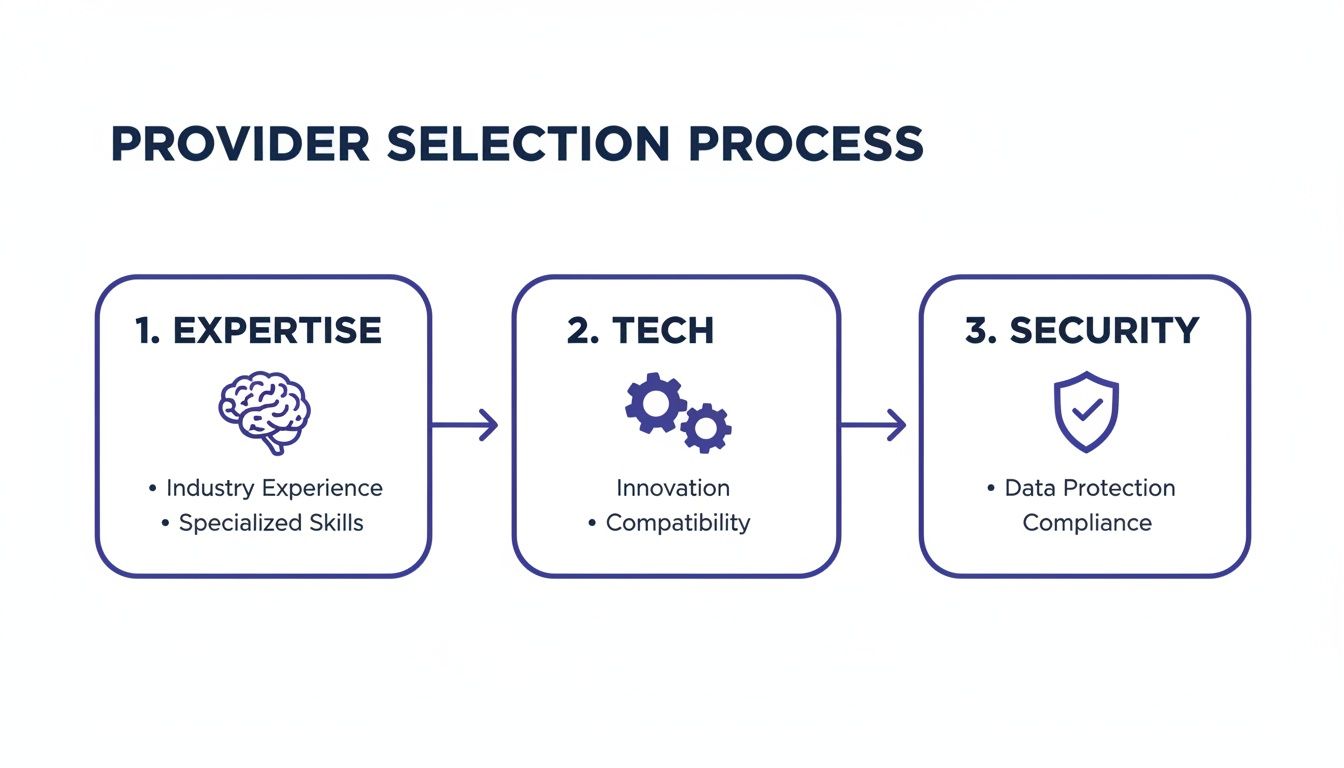
As you can see, a solid workflow isn't just about the tech; it's an equal partnership between human skill, powerful tools, and robust security.
Choose Your Tools and Quality Tier
Once your document is prepped and ready, it's time to choose your translation method. This is a strategic call—are you going with raw AI, AI with a human review (MTPE), or a full human translation? For an efficient workflow, this decision should be based entirely on the document's purpose.
A simple decision matrix can work wonders here. For instance, internal drafts might be zapped through an AI-only process for speed. But customer-facing installation guides? Those are automatically flagged for a human post-editing step. This removes any ambiguity and makes sure every document gets the right level of attention without blowing your budget.
The most efficient workflows aren't about finding one tool that does everything. They're about building a flexible system that matches the right level of investment—in both time and money—to the value and risk of the content.
Understand Layout Preservation
One of the biggest headaches in old-school translation workflows was formatting. You’d get a plain text file back from the translator, and then a designer would have to spend hours painstakingly recreating the original layout. It was slow, expensive, and a recipe for errors.
Modern technical translations services have completely changed the game by preserving the document's structure automatically. You can upload a complex PDF or Word file packed with tables, images, and specific fonts, and the technology translates the text inside that layout. The file you download at the end looks just like the one you started with, only in a new language. If you want to dive deeper into this, our guide on what is desktop publishing (DTP) explains how this critical piece of the puzzle works.
Establish a Smart Review Process
The final piece is review and approval. Let's be practical: not every translated document needs a full, line-by-line review from your top subject matter expert (SME). A truly efficient workflow defines when a quick check is good enough and when you absolutely need an expert to sign off.
Try setting up a tiered review system:
- Spot Check: For low-risk internal documents, a quick scan by a native-speaking team member to catch any glaring errors is often plenty.
- Key Terminology Review: For more important content, have an SME just review a list of the critical technical terms. This confirms accuracy where it matters most, without them having to read the whole thing.
- Full SME Review: For your high-stakes content—think legal contracts, patient safety information, or operator manuals for heavy machinery—a comprehensive review by an expert is non-negotiable.
By defining these tiers ahead of time, you ensure mission-critical quality while keeping everything else moving along at a brisk pace.
Common Questions About Technical Translations
Even with a solid plan, jumping into technical translation can bring up some very real-world questions about cost, quality, and how it all works day-to-day. Getting straight answers is the only way to make a smart choice and build a process that actually helps your team.
Here are the most common questions we get from businesses, researchers, and professionals trying to get a handle on technical document translation.
How Much Do Technical Translation Services Cost?
This is the big one, and the honest answer is: it varies wildly. A traditional, fully human translation for technical content usually runs somewhere between $0.15 to $0.30 per word. If you're translating a hefty manual, you can see how that adds up fast.
The good news is that modern AI-powered services have completely changed the game. Many of these platforms charge per document or even per page, slashing the cost to a tiny fraction of the old-school rates. This makes professional-grade translation a real possibility for everything from a one-page memo to a 500-page compliance binder.
The trick is to match your spending to the document's purpose. For internal drafts where you just need to get the gist, a low-cost, pure AI translation is perfect. But for something like a public-facing safety manual, adding a quick human review gives you that ideal blend of affordability and peace of mind.
Can AI Really Handle Complex Technical Terms?
Yes, and it's surprisingly good at it. Today's AI models are trained on gigantic datasets filled with millions of technical documents from every field imaginable—engineering, medicine, software, you name it. This training gives them the context to understand jargon that would completely stump a generalist human translator.
For example, an AI trained on engineering texts knows the difference between "stress" on a steel beam and the "stress" of a deadline. That kind of built-in awareness makes it highly accurate for most standard technical content.
Where does it stumble? Brand-new terminology, highly nuanced phrasing, or your company’s internal acronyms can sometimes trip it up. This is where a hybrid approach really shines. Let the AI handle 95% of the document with its incredible speed and consistency, then have a subject matter expert do a final pass to polish those last few critical terms.
What’s the Single Biggest Mistake to Avoid?
By far, the most common and costly mistake is treating translation as a last-minute chore. Too many teams finalize their documents and then just "throw them over the wall" to be translated. This is a recipe for disaster—it leads to delays, blown budgets, and a weak final product.
When you rush it at the end, you almost always discover problems in the original text, like idioms or unclear sentences that are a nightmare to translate accurately. The last-minute scramble to fix these issues almost guarantees the quality will suffer.
The smartest move is to build translation into your content workflow from day one. This practice is often called internationalization, and it just means writing your source documents with an eye toward future translation. Using clear language, avoiding cultural inside jokes, and keeping a glossary of key terms makes the entire process smoother, faster, and far more reliable for every language you add.
How Important Is It to Keep the Original Document Format?
It’s not just important; it's everything. The layout of a technical document—the tables, diagrams, headers, and callouts—is part of the information. When that formatting breaks, the document can become unprofessional, confusing, or even flat-out useless.
Think about a user manual where the pictures no longer line up with the instructions, or a contract where page numbers and clauses are all jumbled. It instantly loses credibility and value. An engineering schematic with misaligned labels isn't just messy; it's a safety hazard.
Many older or simpler translation tools really struggle with this, forcing your team to waste hours manually rebuilding files. Modern technical translations services are built specifically to solve this problem. They are designed to analyze a document's structure, translate the text inside that layout, and produce a final file that’s a perfect mirror of the original. This capability saves an incredible amount of time and ensures your documents are ready to go, right away.
Ready to see how fast and accurate your technical document translations can be? With DocuGlot, you can translate your complex PDF, DOCX, and other files in minutes while preserving every last detail of your original formatting. Get a transparent quote and start your first translation.
Tags
Ready to translate your documents?
DocuGlot uses advanced AI to translate your documents while preserving formatting perfectly.
Start Translating