A Guide to Understanding Prices for Translations
Trying to pin down the cost of a translation can feel a bit like asking, "how long is a piece of string?" But in reality, it almost always comes down to one of three common pricing models. The one you'll see most often is a per-word rate, which has become the industry standard for its simplicity and transparency.
Decoding How Translation Pricing Actually Works
Getting a handle on translation costs starts with understanding how providers bill for their work. It's not as mysterious as it seems. Just like hiring any professional, the price is tied to the scope of the job. Some projects are straightforward and can be priced by volume, while others require a more flexible approach.
The key is to match your project's needs to the right pricing structure. A simple document translation has very different requirements than a creative marketing campaign, and the pricing reflects that.
The Three Core Pricing Models
When you request a quote, you'll almost certainly encounter one of these three methods. Knowing how they work is your first step toward getting a fair price and managing your budget effectively.
- Per-Word Rate: This is the bread and butter of the translation world. It’s incredibly straightforward: you take the total number of words in your document and multiply it by the rate. This works perfectly for text-heavy content like reports, articles, and user manuals where the word count is fixed.
- Per-Hour Rate: Sometimes, the work isn't just about translating words. Projects like creative copywriting (often called transcreation), localizing a website, or wrestling with tricky document formatting are best billed by the hour. It accounts for the time spent on tasks that go beyond simple word replacement.
- Flat-Rate or Per-Project Fee: For small, predictable jobs, a flat fee is often the simplest solution. Think translating a one-page birth certificate or a standard business card. Everyone agrees on a fixed price upfront, so there are no surprises when the invoice arrives.
This infographic lays out the core models to give you a clearer picture.

As you can see, the best fit really depends on the job at hand.
The demand for these services isn't just steady; it's booming. The global translation market was valued at roughly £60 billion ($75 billion) in 2025, a massive leap from about £43 billion in 2020. This explosion is driven by businesses going global online, which makes finding the right translation partner more important than ever.
Choosing the right pricing model is all about aligning the payment structure with the project's nature. A per-word rate offers predictability for a 10,000-word manual, while an hourly rate makes sense for adapting a creative ad campaign where nuance is everything.
Quick Guide to Translation Pricing Models
To make things even clearer, here's a simple breakdown of the main pricing models and when you'd typically use them.
| Pricing Model | How It Works | Best For |
|---|---|---|
| Per-Word | Total word count is multiplied by a set rate (e.g., 5,000 words x £0.10/word). | Standard documents, articles, reports, books, and website content. |
| Per-Hour | You are billed for the total time spent on the project. | Creative transcreation, editing, proofreading, and complex formatting tasks. |
| Flat-Rate | A single, fixed price is agreed upon for the entire project. | Small, well-defined jobs like certificates, diplomas, or short brochures. |
This table should help you quickly identify which model is likely the best fit for your next project, giving you a solid starting point for discussions with any translation provider.
For a wider look at understanding various pricing models in other professional fields, you might find some interesting parallels. At the end of the day, knowing how these structures work empowers you to ask smarter questions and choose a partner whose pricing truly matches the value you need.
How AI Is Changing the Cost of Translation
Let's be honest, artificial intelligence has completely shaken up the world of translation pricing. It's not just about a simple word-for-word swap anymore. Today’s AI tools are smart enough to understand context, keep your original document's layout intact, and even maintain a consistent brand voice across dozens of files.
This is a world away from the old-school translation process. Instead of relying entirely on human linguists—which is slow and expensive—AI does the initial heavy lifting. It can tear through massive amounts of text in just minutes, producing a surprisingly accurate draft that often only needs a light touch-up, if any at all.
The New Economics of Translation
So, what does this mean for your wallet? Three things: speed, scale, and serious cost savings. A human translator might take a few days to get through a big project. An AI service can often deliver it in a matter of minutes. That efficiency has a direct impact on the final bill, opening up high-quality translation to everyone from scrappy startups to university researchers.
One of the biggest hidden costs in translation has always been reformatting. AI is changing that game, too.
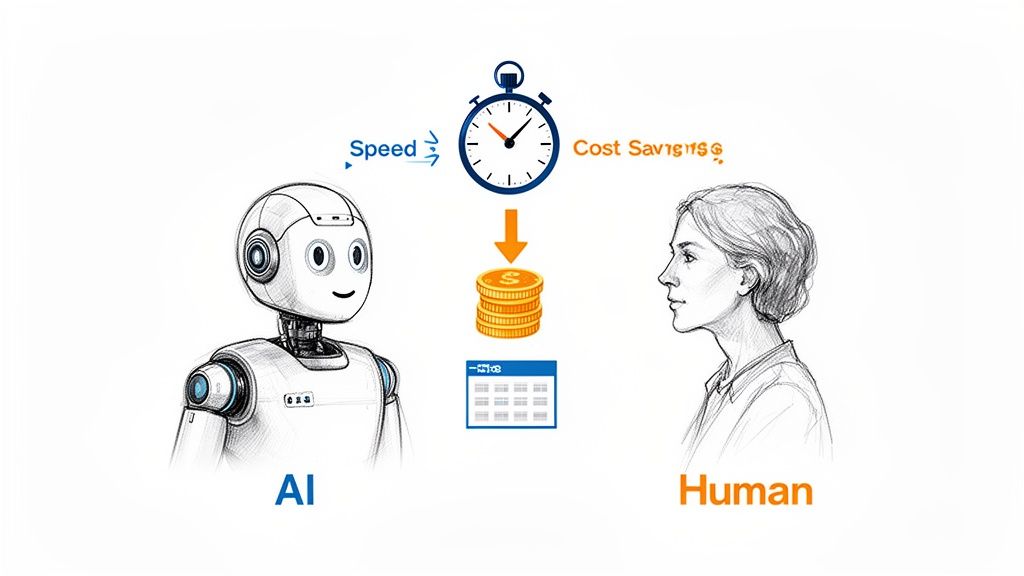
Platforms that automatically preserve complex layouts—like tables, charts, and columns—save a ton of money. You're no longer paying for someone to manually piece your document back together after it's been translated.
The market is taking notice. The machine translation industry was valued at USD 1.1 billion in 2022 and is expected to rocket to USD 3 billion by 2027. For any business dealing with a steady stream of documents, the right AI tool can slash translation costs by up to 90% simply by cutting out the manual busywork.
AI vs Human vs MTPE: A Quick Comparison
It helps to know your options. Each approach has its place and its own price tag.
- Pure AI Translation: This is your fastest and cheapest route. It's perfect for internal documents, research, and any large-volume project where preserving the original format is just as important as speed.
- Human Translation: The premium choice. It's the most expensive and takes the longest, but it’s the right call for highly creative or sensitive content, like marketing campaigns or legal contracts.
- Machine Translation Post-Editing (MTPE): The middle ground. A human expert polishes an AI-generated draft. It strikes a balance—cheaper than a full human translation but more expensive than pure AI.
The real takeaway here is that it's no longer a simple "human or machine" decision. The smart move is to build a workflow that uses AI as the default, bringing in human review only when the content absolutely demands it. This gives you the best mix of quality, speed, and cost-efficiency.
This new way of thinking lets you be far more strategic with your translation budget. Seeing how AI-powered translation tools in Excel are being used gives a great, practical view of this shift. If you want to dive deeper into the pros and cons, check out our guide comparing AI and human translation services.
Key Factors That Influence Your Final Quote
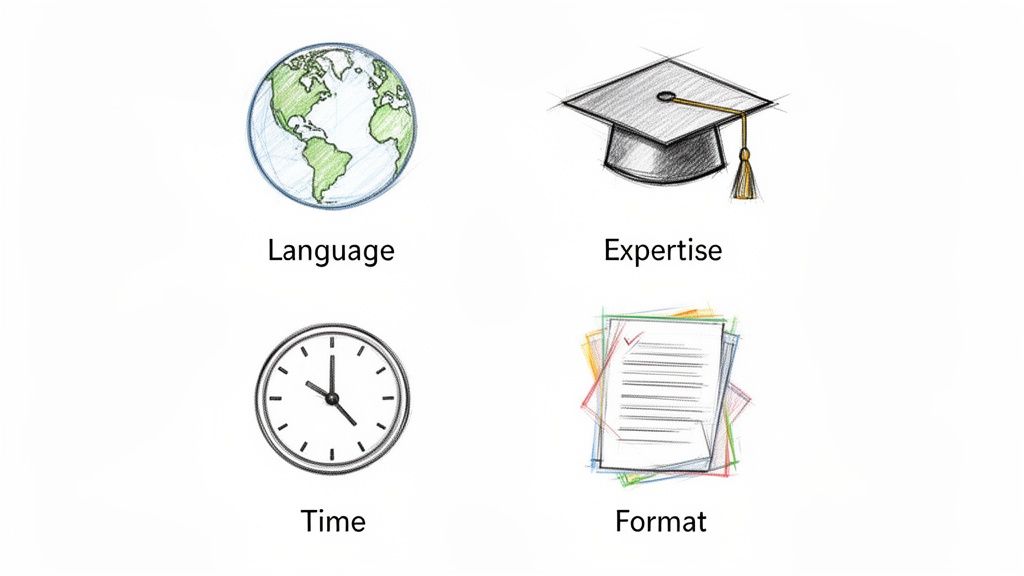
Ever get two different quotes for the same translation project and wonder why they're worlds apart? It’s because the final price tag is rarely about the word count alone. Several key variables are working behind the scenes, and understanding them is the first step to budgeting accurately and avoiding surprise costs down the road.
Think of it like cooking. The rarity of an ingredient can dramatically change the price of a dish. The same is true for languages. A simple translation from English to Spanish is a well-traveled path with plenty of qualified translators available, which naturally keeps the price competitive.
But what about translating Japanese to Swahili? That’s a far less common request. The pool of linguists with that specific expertise is much smaller, and that scarcity drives the cost up. The more exotic or complex the language pair, the more you can expect to invest.
Subject Matter and Expertise
Not all words are created equal. Translating a casual business memo is one thing; translating a complex legal contract or a detailed clinical trial report is another beast entirely. The latter requires a specialist with years of hands-on experience in that specific field, and that expertise directly impacts the quote.
Here’s a quick breakdown of how content complexity shifts the cost:
- General Content: This is your everyday stuff—internal emails, simple blog posts, or general business letters. It doesn't require deep, specialized knowledge, so it sits at the lowest price tier.
- Technical or Business Content: Think user manuals, financial reports, or software documentation. This material is full of specific industry jargon, so you'll need a translator who knows the lingo, which bumps the price up a bit.
- Highly Specialized Content: We're talking legal patents, medical research papers, or intricate engineering specs. This requires a true subject matter expert, not just a linguist. The pool of people qualified to do this work is tiny, making it the most expensive category.
A mistake in a marketing slogan is embarrassing. A mistake in a legal patent document can cost millions. The price reflects this level of risk and the expertise required to avoid it.
Turnaround Time and Urgency
Need it yesterday? It's going to cost you. Time is one of the biggest levers on translation pricing. A standard delivery timeline allows translators and agencies to schedule their work efficiently. But if you need a document turned around overnight or on a weekend, get ready for a rush fee.
These urgency fees can easily add 25% to 100% to the total cost, depending on just how tight the deadline is. That extra charge is to compensate the translator for dropping everything else, reshuffling their schedule, and often working late into the night to hit your deadline. Simply planning ahead is one of the easiest ways to keep your budget in check.
Document Formatting and File Type
Finally, the file itself matters—a lot. A clean, simple Word document is a translator's best friend. It’s easy to work with and usually won't add any extra costs to your project.
The real headache begins with more complex formats. Scanned (non-editable) PDFs, elaborate PowerPoint presentations, or layered Adobe InDesign files require a ton of extra work. A translator can't just type over the text; they often have to rebuild the entire document's layout from scratch after the translation is done. This process, known as Desktop Publishing (DTP), is almost always billed by the hour and can significantly inflate your final bill.
Putting It All Together: Real-World Translation Costs
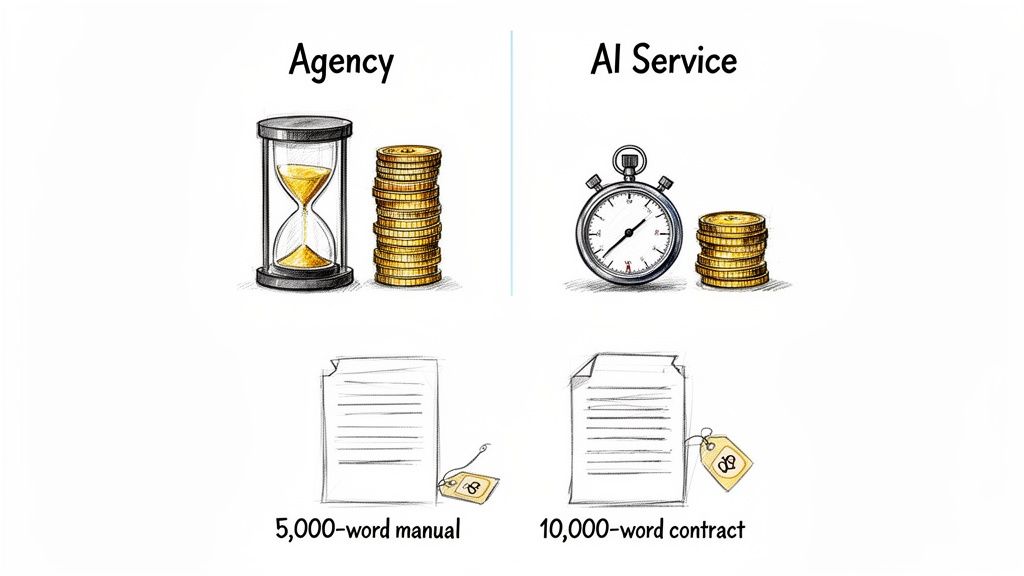
Theory is one thing, but seeing the numbers in action is what really counts. To help you get a feel for what you might actually pay, let's walk through a couple of common scenarios. We’ll compare the old-school route—a traditional translation agency—with a modern AI-powered service like DocuGlot.
You'll see pretty quickly that the differences aren't just about the final price tag; they're about speed, effort, and keeping your original formatting intact.
Scenario 1: The Startup User Manual
Picture a startup on the move. They’ve just polished their 5,000-word user manual in English and now need to crack into new markets by translating it into Spanish, French, and German. The document is a standard DOCX file, but it has a few tables and images that need to stay put.
Here’s how the two approaches stack up:
With a Traditional Agency: A professional human translator usually charges anywhere from $0.15 to $0.30 per word. If we take a middle-of-the-road average of $0.20, one language costs $1,000 (5,000 words x $0.20). For all three, you're looking at a $3,000 bill and a wait time of several days, if not a full week.
With an AI Translation Service: The cost plummets. AI services often charge less than a penny per word. That same 5,000-word manual would likely cost between $10 and $20 per language. The grand total for all three? Somewhere around $30 to $60. The best part is the turnaround—the translated documents are ready in minutes, with every table and image perfectly preserved.
The difference is night and day. The startup saves over 98% and gets what it needs almost instantly.
Scenario 2: The Urgent Legal Contract
Now, let's raise the stakes. A legal team has a 10,000-word contract that needs to go from English to Japanese. It's a complex PDF, and the specific legal formatting is non-negotiable. Oh, and they need it back within 24 hours.
This is where traditional costs can really spiral:
With a Traditional Agency: This is a perfect storm for a high price tag. English to Japanese is a difficult language pair, it demands a specialized legal translator, and it’s a rush job. The base rate could easily hit $0.25 per word, starting the quote at $2,500. Tack on a 50% rush fee, and you’re at $3,750. Because it's a PDF, they'll also add a hefty Desktop Publishing (DTP) fee to recreate the layout, which could add hundreds more to the final invoice.
With an AI Translation Service: An AI-powered platform handles this without breaking a sweat. The word count and language will determine the price, but it will be a tiny fraction of the agency's quote. The entire 10,000-word contract might cost between $20 and $40. It’ll be ready in under an hour, with the original PDF formatting completely intact. That alone saves a small fortune in DTP fees.
The key takeaway here is simple: for the vast majority of business, academic, and technical documents, an AI-first approach delivers impressive accuracy at a dramatically lower cost and at a speed that traditional methods just can't match.
Sample Translation Cost Comparison
To make this even clearer, here’s a table showing estimated costs and turnaround times for a few common document translation scenarios.
| Scenario | Word Count | AI Translation (e.g., DocuGlot) | Traditional Agency (Human) |
|---|---|---|---|
| Business Proposal (PDF) | 2,500 | $5 - $10 (minutes) | $500 - $750 + DTP fees (2-3 days) |
| User Manual (DOCX) | 5,000 | $10 - $20 (minutes) | $1,000 - $1,500 (3-5 days) |
| Legal Contract (PDF) | 10,000 | $20 - $40 (under an hour) | $2,500 - $4,000+ (2-4 days, rush fees extra) |
| Academic Paper (DOCX) | 7,500 | $15 - $30 (minutes) | $1,125 - $2,250 (4-6 days) |
As you can see, the value proposition for AI translation, especially for standard business and technical documents, is incredibly strong.
If you want to get a precise estimate for your own files, our guide on document translation cost can help you budget accurately for any project on your plate.
How to Reduce Costs Without Sacrificing Quality
Getting a high-quality translation is an investment, but that doesn't mean it has to break the bank. By thinking ahead and making a few smart moves, you can bring down the prices for translations quite a bit without compromising on the final result. It all starts before you even send the first document.
One of the easiest wins is to prep your source content. Plain, clear language is always faster and cheaper to translate, whether by a machine or a person. This means cutting out the jargon, simplifying long, rambling sentences, and sticking to editable formats like DOCX when you can. A clean source file sidesteps a lot of the complexity and formatting nightmares that drive up costs.
Adopt a Hybrid Workflow
By far, the best way to get that perfect balance of cost, speed, and quality is to use a hybrid approach. This strategy lets AI do what it’s great at—plowing through the bulk of the work quickly—while saving your budget for human expertise where it counts the most.
Here’s a simple breakdown of how it works:
- AI First Pass: Start by running your document through a solid AI translation service. This initial step handles the heavy lifting, translating the majority of your text in just a few minutes for a tiny fraction of what a human translator would charge.
- Targeted Human Review: Now, instead of paying someone to translate the entire thing from scratch, you bring in a professional linguist for a final review. They can focus their time on what really matters: polishing nuanced phrases, ensuring cultural accuracy, and verifying critical terms.
This workflow, known in the industry as Machine Translation Post-Editing (MTPE), can easily slash your final bill by 30-50% compared to a fully human process. You get the speed of a machine with the final, reliable touch of a human expert. To see which tools make this possible, check out our guide to the best document translation software on the market.
Use Translation Memory and Glossaries
If you find yourself translating content regularly, there are two tools that deliver amazing long-term savings: translation memory (TM) and glossaries.
Think of Translation Memory as a smart database that saves every sentence you've ever had translated. The next time that exact sentence—or a very similar one—pops up, the system instantly pulls the approved translation. You never pay to translate the same thing twice.
A glossary, sometimes called a termbase, does something similar for specific words. It’s your company’s custom dictionary, storing key terminology like product names or branded slogans along with their official translations. This ensures perfect consistency across all your documents and saves your reviewer from having to look up the same term over and over again.
Your Top Questions About Translation Prices, Answered
Alright, we've covered the models and the factors that influence cost. But you probably still have some specific questions buzzing around. Let's get right to them and clear up the most common queries we hear from clients.
Think of this as the practical, no-nonsense part of the guide.
What Is the Average Price Per Word for Translation?
If you're hiring a traditional human translator, you can expect to pay somewhere between $0.10 and $0.30 per word. That's a pretty big window, right? The final price really hinges on the language pair, how technical the material is, and the translator's own experience.
For example, a common pairing like English to Spanish will land on the lower end of that scale. But if you need a complex legal contract translated into a less common language, you'll be looking at the higher end.
AI translation flips this on its head. The cost is often just a tiny fraction of a cent per word, making it an incredibly accessible choice for most business documents, reports, or academic papers where budget is a major consideration.
When Should I Choose AI Translation Over a Human Translator?
This is the big one, and the answer comes down to what you truly need for a specific project. It’s all about priorities.
Go with AI translation when: Your top concerns are speed, cost, and keeping your document's original formatting intact. It’s a fantastic solution for user manuals, internal reports, academic research, and any large project where you're up against a tight deadline or a strict budget.
Stick with a human translator when: The content is highly creative, emotionally charged, or legally binding. Think punchy marketing slogans, sensitive public announcements, or contracts where a single misplaced word could have serious consequences. This is where cultural nuance and a perfect brand voice are non-negotiable.
A smart strategy many people use is a hybrid approach. Start with a powerful AI service like DocuGlot to do the heavy lifting quickly and affordably. Then, have a human expert come in to review and polish the most critical parts.
This gives you the best of both worlds: the raw efficiency of AI and the refined, expert touch of a human.
How Does Document Formatting Affect the Translation Price?
This is one of the biggest "hidden costs" in the traditional translation world. If your document has complex tables, charts, graphics, or a very specific layout, a human translator has to manually recreate all of it.
That extra work is called Desktop Publishing (DTP), and it's almost always billed by the hour. Depending on the complexity, DTP can easily add hundreds, or even thousands, of dollars to your final invoice. It's often a nasty surprise for first-time buyers.
This is where modern AI-powered services really shine. They're built to automatically recognize and preserve your original formatting. The translated document you get back looks just like the original, completely eliminating those expensive DTP fees. It's one of the single biggest ways AI makes professional translation more affordable.
Ready to see how affordable your next project can be? At DocuGlot, we provide instant, transparent quotes for high-quality AI translations that preserve your document's original formatting. Translate your document now and get your results in minutes.
Tags
Ready to translate your documents?
DocuGlot uses advanced AI to translate your documents while preserving formatting perfectly.
Start Translating