Technical translation service: Unlock precise, reliable documents
When you hear the word "translation," you probably think of converting a simple sentence from one language to another. But what happens when the document isn't a simple sentence? What if it's a 300-page engineering manual, a complex patent filing, or a clinical trial report?
That's where a technical translation service comes in. This isn't your everyday translation; it's a highly specialized field focused on converting complex, industry-specific documents with absolute precision. It demands translators who are not just language experts, but also have deep subject-matter expertise in fields like engineering, medicine, or law.
More Than Just Words: The Real Job of a Technical Translator
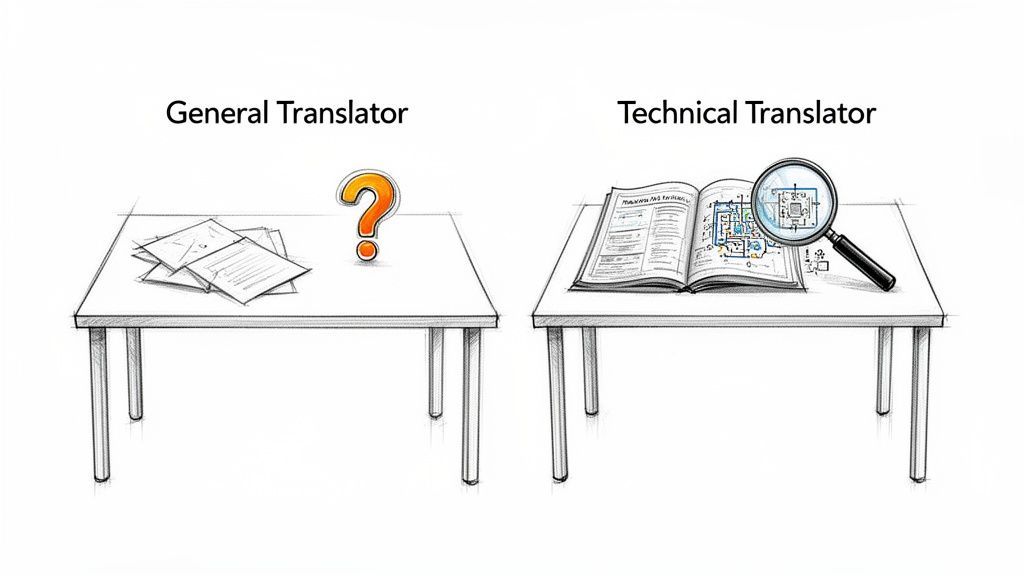
Think of it this way: you wouldn't ask a general family doctor to perform open-heart surgery. Both are brilliant medical professionals, but for a high-stakes, specialized procedure, you need a specialist. A technical translator is that specialist for your documents. Their job goes far beyond just swapping words; they ensure the core meaning, function, and safety of the information remain intact.
Consider the user manual for a piece of heavy industrial machinery or the instructions for a medical device. A single mistranslated measurement could lead to catastrophic equipment failure. An ambiguous phrase in a legal contract could cost a company millions. General translation tools or non-specialist translators can easily miss these critical nuances, resulting in confusing instructions, safety hazards, and significant financial risk.
To give you a clearer picture, let's break down the key differences.
Technical Vs General Translation at a Glance
This table shows a side-by-side comparison to highlight just how different these two disciplines are.
| Feature | Technical Translation | General Translation |
|---|---|---|
| Content Type | Manuals, patents, medical reports, software strings, legal contracts. | Emails, marketing copy, blog posts, general correspondence. |
| Translator's Skillset | Dual expertise: language proficiency + subject matter knowledge. | Strong linguistic skills and cultural understanding. |
| Terminology | Highly specialized, industry-specific jargon and acronyms. | Everyday language, common idioms, and conversational tone. |
| Consequence of Error | High: Can lead to safety risks, legal liability, or financial loss. | Low: Usually results in miscommunication or brand embarrassment. |
| Focus | Precision, accuracy, and consistency above all else. | Readability, cultural adaptation, and capturing the right tone. |
As you can see, the stakes are simply much higher in the technical realm. It's less about creative flair and more about uncompromising accuracy.
Preserving Meaning, Structure, and Functionality
The biggest challenge in this field is maintaining the document's original integrity—both in its meaning and its physical layout. Technical documents often rely on a specific structure, like complex tables, diagrams, and schematics, to communicate information clearly.
A professional technical translation service makes sure that:
- Terminology is flawlessly consistent: They build and use industry-specific glossaries to ensure a term like "tensile strength" or "API endpoint" is translated the same correct way every single time it appears.
- Context is deeply understood: The translator is familiar with the subject, preventing dangerous misinterpretations that a generalist might make.
- Formatting is perfectly retained: The final translated document looks and functions exactly like the original. This is a hallmark of high-quality document translation services.
This need for precision is why the global translation services market, which includes a huge technical component, hit USD 41.78 billion in 2024 and continues to expand. For a deeper dive into this market trend, a report from Straits Research offers some great insights.
At its core, technical translation is really about risk management. It's a critical process that protects your company, your customers, and your intellectual property by ensuring complex information is communicated perfectly, no matter the language or the file format.
The Four Pillars of a Great Technical Translation
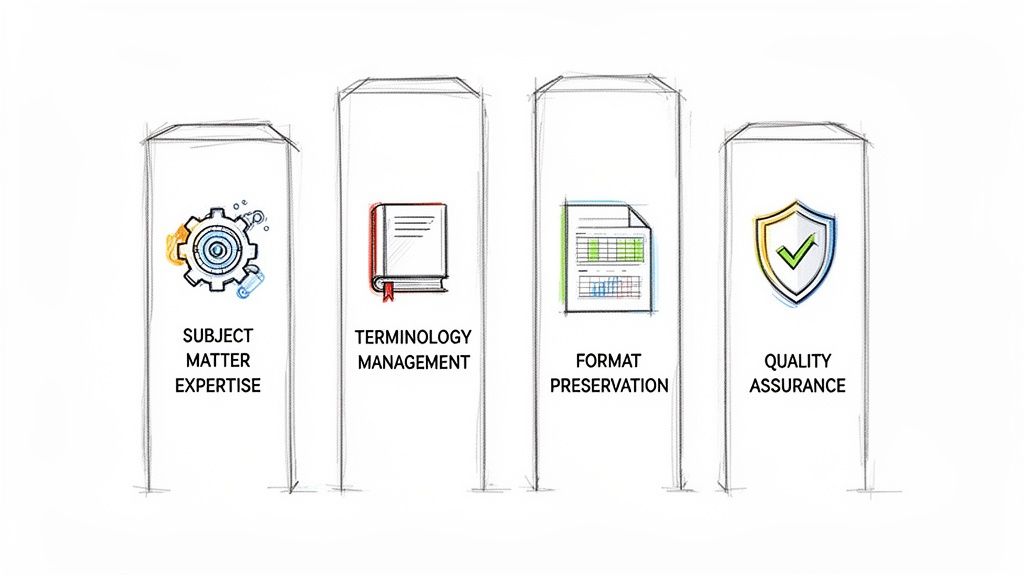
So, what separates a truly professional technical translation service from a generic tool? It all comes down to a foundation built on four essential pillars. These aren't just nice-to-haves; they are the non-negotiable elements that ensure your complex information is accurately communicated, not just converted from one language to another.
Think of these pillars as the legs of a sturdy table. If even one is wobbly, the entire structure is compromised, and your project is at risk. Let's dig into each one to see why they're so critical.
Subject Matter Expertise
You wouldn't ask a novelist to translate a patent application for a new medical device. It just wouldn't work. True technical translation demands a deep, practical understanding of the subject at hand. This means the translator is often an engineer, a scientist, or a legal professional first, and a linguist second.
This dual expertise is the absolute cornerstone. A subject matter expert (SME) knows the industry jargon, grasps the underlying concepts, and catches the subtle nuances a general translator would easily miss. This is what prevents catastrophic errors, like misinterpreting a crucial safety warning in a manufacturing manual or botching a key claim in a legal filing.
A translator without technical expertise is like a musician who can read notes but has never heard the music. They can reproduce the symbols, but they miss the melody—the true meaning and context—that makes the information valuable.
Terminology Management and Consistency
Technical documents are often loaded with specialized terms that have to be used the exact same way every single time. Imagine reading a 500-page user guide where the term "actuator" is translated three different ways. The confusion would be immense, and the credibility of the entire document would go right out the window.
A reliable technical translation service prevents this with disciplined terminology management. The process involves building and maintaining a centralized glossary, or “termbase,” that’s unique to your company and its projects.
This simple but powerful step ensures that:
- Key terms are defined and agreed upon before the translation even starts.
- Consistency is locked in across every document, now and in the future.
- Brand-specific language and acronyms are handled correctly every time.
It’s a proactive strategy that stamps out ambiguity before it has a chance to create problems.
Meticulous Format Preservation
Let’s be honest, technical documents are rarely just plain text. They’re full of complex layouts—tables, diagrams, charts, and even snippets of code—that are vital to understanding the content. A quick copy-and-paste translation can completely shatter this structure, making the document a useless mess.
This is where format preservation becomes a non-negotiable pillar. An expert service uses specialized tools and workflows to make the translated document a perfect mirror of the original. Headers, footers, font styles, and image placements are all painstakingly preserved. This is especially true for tricky file types like PDFs or intricate DOCX files, where the layout is just as important as the words.
Robust Quality Assurance Workflows
The final pillar is a rigorous Quality Assurance (QA) process. When accuracy is paramount, a single pass just isn't enough. Professional services rely on multi-step reviews to catch any and all errors before the final files land in your inbox.
This usually involves a TEP (Translation, Editing, Proofreading) workflow, where a different linguist handles each stage. Having fresh eyes at every step is crucial for verifying everything from grammatical precision to technical correctness and formatting integrity. This built-in redundancy is what stops a minor oversight from turning into a major operational headache.
Where Technical Translation Makes a Critical Difference
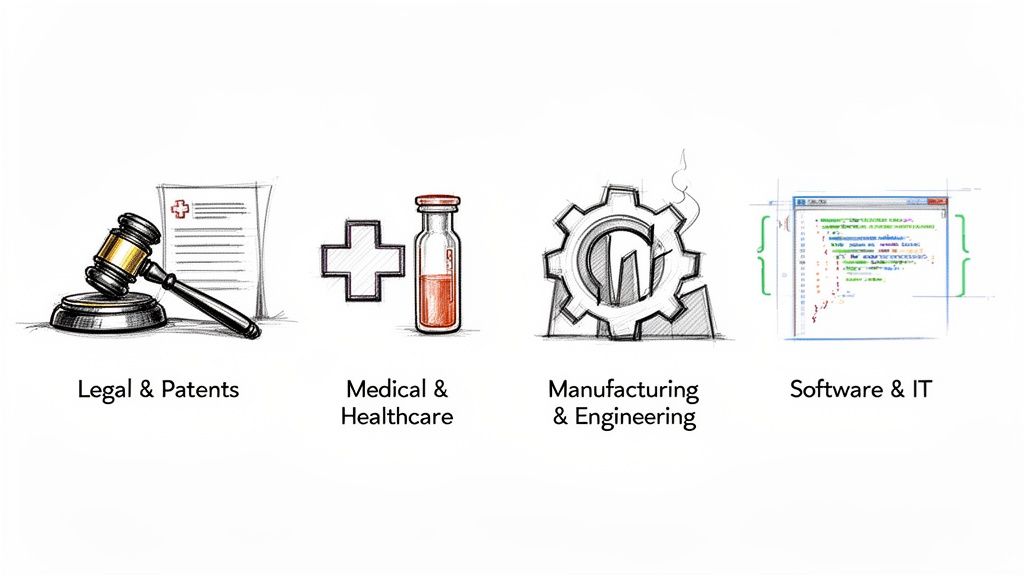
The real value of a specialized technical translation service snaps into focus when you look at high-stakes industries. In some fields, getting it "mostly right" is the same as getting it completely wrong. Precision isn’t just a nice-to-have; it's the bedrock of safety, compliance, and basic operational success. A single mistake can have massive ripple effects.
This is exactly why demand is surging. The global translation services market is on track to hit USD 27.78 billion in 2025 and is expected to climb to USD 34.24 billion by 2029. A huge part of that growth comes from the complex needs of global industries that can't afford errors. You can dig into the numbers and trends yourself in this detailed report from Research and Markets.
So, where is this level of accuracy an absolute non-negotiable? Let's walk through a few key areas.
Legal And Compliance Documents
In the legal field, words have power and immense financial consequence. The exact phrasing in a patent application, an international contract, or a regulatory filing can make or break a multi-million dollar deal. Ambiguity isn't just a nuisance; it's a liability.
A proper technical translation service ensures legal documents maintain their precise meaning and are fully enforceable, no matter the jurisdiction. It’s about more than swapping words; it’s about translating complex legal concepts without losing a shred of the original intent. This is how you protect intellectual property and avoid costly legal battles down the road.
Medical And Healthcare Materials
Nowhere are the stakes higher than in medicine and healthcare. Here, accuracy can literally be a matter of life and death. Whether we're talking about clinical trial results, the instructions inside a box of medication, or the user manual for a sophisticated MRI machine, every single detail must be flawless.
An improperly translated dosage instruction or a misunderstood step in a surgical device's operating guide can lead to catastrophic patient harm. This is why expert medical translators aren't just linguists; they have deep medical knowledge, ensuring patient safety and compliance with regulatory bodies like the FDA or EMA.
Manufacturing And Engineering Schematics
For any company manufacturing products on a global scale, clear and accurate technical documents are the foundation of a safe and efficient operation. This covers everything from:
- Safety Manuals: Making sure a worker in Germany understands how to operate heavy machinery just as clearly as a worker in Mexico.
- Technical Specifications: Providing crystal-clear instructions for product assembly, preventing expensive production mistakes.
- CAD Drawings and Schematics: Translating the fine-print notes and measurements on complex engineering diagrams without compromising their technical integrity.
A single mistranslation here can easily lead to equipment failure, workplace accidents, or entire batches of defective products, all of which come with huge financial and reputational costs.
Software And IT Localization
In the world of tech, launching a product globally means localizing the very core of the software, not just the marketing website. This is where a technical translation service is indispensable.
The work involves translating everything from user interface (UI) text and developer API documentation to obscure error messages and help guides. The ultimate goal is to create a user experience that feels completely natural and intuitive in every single market. It’s a critical step for winning over users and achieving real global growth.
3. Navigating AI, Human, and Hybrid Translation Models
When you're looking for a technical translation service, one of the biggest decisions you'll make is what's "under the hood." Are you going with pure artificial intelligence, the seasoned eye of a human expert, or a smart combination of both? There's no single right answer—the best choice really comes down to what your project demands in terms of speed, accuracy, and nuance.
Let's start with AI. Modern machine translation (MT) isn't what it used to be. Today's engines are trained on vast libraries of scientific, legal, and engineering documents. This makes them incredibly good at handling specialized jargon with remarkable consistency.
The growth here has been explosive. The MT market shot up from USD 650 million in 2020 to over USD 1.1 billion in 2022, and it's expected to clear USD 3 billion by 2027. This isn't just hype; it reflects how essential AI has become for translating huge volumes of technical content quickly and without breaking the bank. For more insights into these trends, check out the translation industry statistics on Redokun.com.
The Irreplaceable Human Element
But for some documents, you absolutely need a human touch. AI is a machine, and it can miss the subtle art of cultural adaptation, the creativity in phrasing, or the unspoken intent behind a sentence.
Think about a high-stakes legal contract where one poorly worded phrase could open up a massive loophole. Or consider medical device instructions where a slight misunderstanding could have serious consequences. In these cases, a human expert isn't just a good idea—it's essential.
A human translator is unmatched when it comes to:
- Capturing Nuance: They understand the cultural idioms, tone, and context that an algorithm might completely overlook.
- Creative Adaptation: They make sure technical content with a marketing spin actually connects with the people reading it.
- High-Stakes Verification: They provide that critical final check for legally binding or life-or-death information.
The Hybrid Model: The Best of Both Worlds
This is where the hybrid model comes in, and it's quickly become the gold standard for getting top-tier quality without sacrificing efficiency. The process is straightforward: a powerful AI engine does the initial translation, tackling the bulk of the terminology and sentence structure in seconds. Then, a human subject matter expert steps in to perform a post-editing review.
This two-step workflow plays to everyone's strengths. The AI provides the speed and consistency needed for large-scale projects, while the human editor refines the output, catches any subtle mistakes, and ensures the final text is polished and perfectly suited to its purpose. It's a pragmatic approach that hits the sweet spot between cost, speed, and quality. We dive deeper into this in our guide on AI versus human document translation services.
The hybrid model is like building a house with modern power tools and having a master craftsperson handle the intricate finishing touches. You get the speed of automation with the precision of expert skill.
Some of the most sophisticated hybrid workflows now integrate advanced large language models like GPT-4 to improve the initial AI draft even further. This balanced approach lets you pick the right tool for the job, whether you need a quick-and-dirty translation of an internal memo or a flawless version of a public-facing safety manual.
Choosing Your Translation Workflow: AI Vs. Human
To make the decision clearer, let's break down how these models stack up against each other based on what matters most for your project.
| Factor | AI Translation (e.g., DocuGlot Basic) | Human Translation | Hybrid Model (e.g., DocuGlot + Human Review) |
|---|---|---|---|
| Speed | Fastest. Near-instantaneous, ideal for high-volume, urgent needs. | Slowest. A professional translates around 2,000-3,000 words per day. | Fast. Faster than human-only, with a review step that adds some time. |
| Cost | Lowest. The most budget-friendly option for bulk translation. | Highest. Priced per word, reflecting deep expertise and time. | Balanced. More affordable than human-only, offering a great value. |
| Accuracy | High for technical terms, but can miss nuance and context. | Highest. Unmatched for contextual accuracy, cultural nuance, and tone. | Very High. Combines AI consistency with human verification for polish. |
| Best For... | Internal documents, knowledge bases, initial drafts, and low-risk content. | Legal contracts, marketing materials, medical documents, user-facing content. | Manuals, compliance docs, high-value reports, and most business needs. |
Ultimately, the right workflow depends on your priorities. By understanding the strengths of each model, you can make a strategic choice that delivers the quality you need on a timeline and budget that works for you.
How to Choose the Right Technical Translation Partner
Picking a technical translation service can feel like a make-or-break decision, and frankly, it is. The right partner acts as an extension of your own team, safeguarding your intellectual property and making sure your global communications are spot-on. On the flip side, the wrong one can open the door to expensive errors, security vulnerabilities, and frustrating project delays.
The key to getting it right is asking the right questions—the kind that cut through the marketing fluff. This approach shifts you from being just another buyer to an informed stakeholder who knows exactly what to look for.
Your Vetting Checklist
Before you sign on the dotted line, run through this practical checklist. A partner worth their salt will have solid, transparent answers for every single one of these points.
How do you guarantee my formatting stays intact? Ask them point-blank what file types they can handle, whether it's PDF, DOCX, or even complex InDesign layouts. A professional service should deliver a translated document that’s a perfect mirror of the original, right down to the tables, diagrams, and page breaks. Don't be afraid to ask for samples.
What are your data security protocols? This one is a dealbreaker. You need to know about their end-to-end encryption (both for data on the move and sitting on their servers). Ask about their policy on sharing information with third parties and if they offer automatic file deletion after a certain time.
What does your quality assurance process actually look like? A simple one-and-done translation just doesn't cut it for technical content. Find out if they use a multi-stage review, like a Translation, Editing, and Proofreading (TEP) workflow, to catch every potential error.
How do you keep our terminology consistent? A top-tier provider will use tools like translation memories and termbases (think of them as company-specific dictionaries). This ensures that your unique industry jargon is translated the same way across every document, every single time.
This decision tree helps visualize how the nature of your content should guide your choice of translation model—a critical piece of the puzzle when selecting a partner.

As you can see, while human expertise is essential for creative and nuanced text, AI-powered models are often the most effective route for purely technical documents where precision and speed are paramount.
Uncovering the True Cost and Scalability
Finally, look for transparency. A reliable partner won't hide their pricing or operational limits. You need to know what you’re paying for and whether they can grow with you.
Pricing Transparency: Is their pricing model clear and simple? Or are you going to get hit with surprise fees for certain file types, project management, or revisions? Look for a service that gives you an exact, all-inclusive quote before you commit. To get a feel for the market, it helps to understand the typical document translation cost structures.
Scalability: How do they handle a sudden influx of work? Can their system process a 500-page manual with the same efficiency and quality as a five-page memo? You need a partner who can handle your volume, whether it's big or small, without skipping a beat.
Choosing a partner is really about finding a strategic fit. The right technical translation service aligns with your specific needs for security, accuracy, and scale, ensuring your global projects succeed without a hitch. By asking these targeted questions, you can identify a provider who offers not just translation, but peace of mind.
Your Top Questions About Technical Translation, Answered
Even after getting the basics down, you probably have a few practical questions about how technical translation actually works. Let’s dive into some of the most common ones that come up.
What’s the Real Cost of Technical Translation?
There’s no single price tag for a technical translation project. The final cost really boils down to a few key factors: the language pair (common pairs like English-to-Spanish usually cost less than more obscure ones), the total word count, and the translation workflow you need—whether that's pure AI, a human expert, or a mix of both.
Thankfully, most modern services have ditched complicated quotes for a straightforward, per-word pricing model. This is a game-changer because you get an exact, upfront cost before committing to anything. It takes all the guesswork out of budgeting and ensures you won't get hit with surprise fees later.
The Bottom Line: Look for transparent, per-word pricing. It's become the industry standard for a good reason—it lets you plan your budget accurately and avoids hidden costs for things like file formatting or project management.
Can I Trust AI Translation for My Technical Documents?
For a huge amount of technical content, the answer is a firm yes. The AI models we have today are trained on vast libraries of scientific papers, engineering schematics, and other specialized texts, so they’re surprisingly good at handling complex jargon with impressive consistency.
However, the right tool always depends on the job. If you're dealing with a legally binding contract, patient-critical medical records, or any document where even a tiny mistake could have serious consequences, the gold standard is a hybrid approach. This means an AI does the initial heavy lifting, and then a human subject matter expert reviews and refines the output. This gives you the best of both worlds: the speed of AI and the critical eye of a seasoned professional.
How Do I Know My Data Is Safe with Online Tools?
When you’re uploading proprietary designs, sensitive legal agreements, or confidential research, data security isn't just a feature—it's everything. You need total confidence that your information is locked down.
A trustworthy service will always have a multi-layered security framework in place. Here’s what to look for:
- End-to-End Encryption: This keeps your files secure from the moment you upload them (in transit) to when they’re stored on a server (at rest).
- Strict Data Policies: The provider should have a crystal-clear policy stating they will never share your documents or use your data for anything else.
- Automatic File Deletion: To minimize exposure, top-tier services will automatically and permanently delete your files from their servers after a set period, like 24 hours.
These measures work together to create a secure bubble around your work, guaranteeing your intellectual property stays yours and yours alone.
Ready to translate your technical documents with precision and security? DocuGlot offers an AI-powered solution that preserves your original formatting perfectly. Get an instant, transparent quote and see how easy it is to translate complex files at https://docuglot.com.
Tags
Ready to translate your documents?
DocuGlot uses advanced AI to translate your documents while preserving formatting perfectly.
Start Translating