Choosing a Spanish Document Translation Service
So, what exactly is a Spanish document translation service? Put simply, it’s a professional service that takes a written document—like a business contract or a technical manual—and converts it from Spanish to another language, or the other way around.
But it's so much more than just swapping words. The real goal is to make sure the final document is spot-on accurate, captures the original meaning and tone, and even keeps the visual formatting perfectly intact. It’s the difference between a clunky, literal translation and a polished, professional file that’s ready to use right away.
What a Spanish Document Translation Service Actually Does
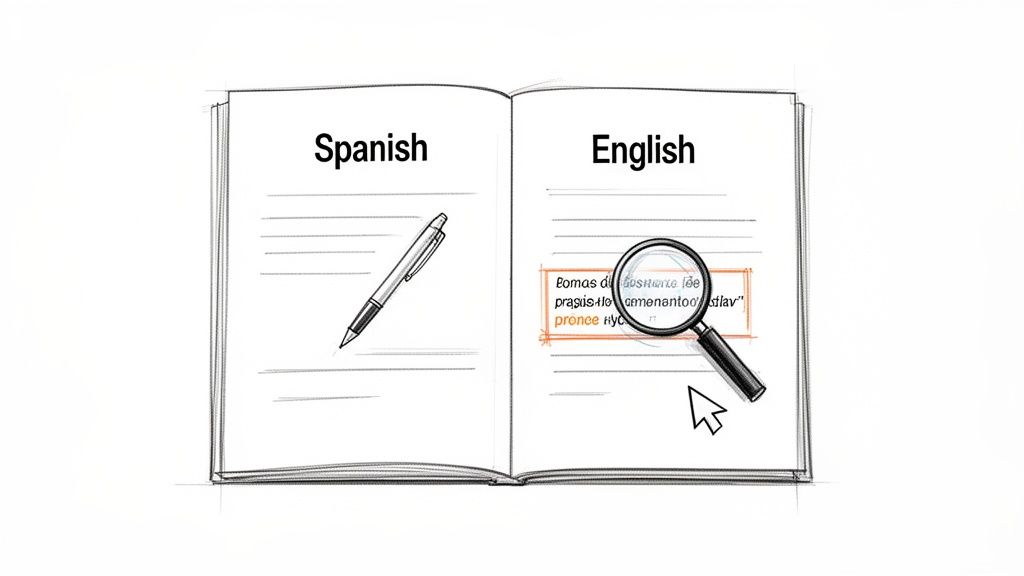
Think of a good translation service as a communication bridge. It’s there to make sure your message lands just right, no matter the language or cultural gap. Whether you're a company launching a product in Spain or an academic sharing your latest research, you need your words to resonate. The service takes your source document and delivers a target document that reads like it was written by a native speaker.
This isn’t a one-step process. While the core is obviously language conversion, a professional service handles all the tricky stuff that free online tools just can't manage.
Beyond Basic Word Swapping
A real Spanish document translation service gets into the weeds of what your words actually mean in context. It's not just about finding the Spanish equivalent for an English word.
For example, a punchy, casual marketing slogan that works in the U.S. might need a total rework to connect with an audience in Madrid, let alone one in Buenos Aires. They're both Spanish-speaking, but the culture is completely different.
This is where true expertise shines. A quality service understands:
- Cultural Nuances: Idioms, slang, and cultural jokes don't translate literally. A phrase that’s clever and persuasive in one language can easily become confusing—or worse, offensive—in another.
- Technical Terminology: Every field has its own jargon. In legal, medical, or engineering documents, using the wrong term isn't just awkward; it can be a serious liability. A professional service ensures every term is precise and industry-correct.
- Formatting Integrity: Think about how much information is conveyed through a document's layout—tables, charts, headers, and even bold text. A crucial part of modern translation is making sure all of that is perfectly preserved.
A professional translation is a careful blend of art and science. It demands linguistic precision for accuracy, deep cultural fluency for the right tone, and technical skill to deliver a document you can use immediately, no cleanup required.
Two Primary Approaches to Translation
When you start looking for a Spanish document translation service, you’ll quickly see there are two main ways to get the job done.
First, you have the traditional, human-powered agencies. These services use professional linguists who bring a ton of cultural insight to the table. This is often the go-to for certified translations needed for things like immigration paperwork or court proceedings.
The second model is the modern, AI-powered platform. These tools are built for speed and efficiency, translating huge amounts of text in minutes while keeping complex formatting in one piece. This is a game-changer for businesses and researchers who need to get through large documents fast and affordably.
It’s also helpful to know about related services, like remote interpretation tools for legal nonprofits, which solve similar language barriers but for live conversations. Knowing the different options out there helps you pick the right tool for the job.
AI Translators vs. Human Experts: Which Is Right for You?
Deciding between an AI-powered platform and a traditional human translator is a pivotal moment when you need a Spanish document translation service. The question isn’t which one is "better" overall, but which tool is the right fit for the job at hand. Each has its own distinct strengths, making one or the other the perfect choice for different situations.
Think of it like choosing how to get around. If you need to haul a massive load of cargo across the country quickly and on a budget, you’d go for a freight train—it’s powerful, efficient, and built for scale. That’s AI translation. But if you’re navigating the narrow, winding streets of an old European city, you’d want a smaller car with a local driver who knows every shortcut. That’s a human translator.
The Powerhouse of Speed and Scale: AI Translation
Artificial intelligence is the engine driving modern translation, built for speed, consistency, and cost savings. When you're up against a mountain of documents or a tight deadline, AI is almost always the answer. It can chew through thousands of pages in the time it takes a person to translate just a few.
AI really comes into its own in scenarios like these:
- Internal Business Documents: Imagine translating hundreds of employee handbooks, internal reports, or training modules. AI ensures that key terms are translated the same way every single time, maintaining consistency across the board.
- Academic Research: For converting lengthy research papers, dissertations, or reference materials, technical accuracy is paramount. AI excels at handling this kind of dense, specific language without getting bogged down.
- User Manuals: When translating a technical guide, clarity and user safety depend on every instruction being identical. AI locks in that consistency.
The global demand for language services is booming, and advancements in machine translation are a huge part of that story. The market is already worth over $70 billion, and the machine translation slice of that pie is expected to jump from $9 billion to over $23.53 billion by 2032. This isn’t just hype; it shows how AI is making translation faster and more accessible for everyone. Discover more insights about these industry trends on future-trans.com.
The Artisan of Nuance and Certification: Human Experts
While AI is the master of scale, human experts are the artisans. They handle nuance, culture, and high-stakes precision like no machine can. A professional human translator does more than just swap words; they convey intent, emotion, and cultural context. This is absolutely critical for documents where how something is said is just as important as what is said.
For certain jobs, relying on a human-led service is non-negotiable:
- Certified Legal Documents: Anything for official use—immigration papers for USCIS, court filings, or government applications—demands a "certified translation." This is a formal guarantee of accuracy from a human translator, and it’s something an AI simply cannot provide.
- High-Impact Marketing Copy: You can't just translate a creative ad campaign or a persuasive sales pitch. It needs to capture the brand's voice and resonate with the local culture. That requires a human touch.
- Sensitive Medical Records: AI can process medical terms, but a human expert provides an essential final review for patient records or clinical trial documents where even a tiny mistake could have serious consequences.
A human translator excels at what we call transcreation—a mix of translation and creation. They don't just translate the words; they adapt the core message to connect emotionally and culturally with the new audience.
To help you visualize the trade-offs, here’s a direct comparison of what you get with each approach.
AI vs. Human Translation: A Feature-by-Feature Comparison
This table breaks down the core strengths and weaknesses of both AI-powered and human-led translation services, helping you see which is better suited for your specific needs.
| Feature | AI Translation (e.g., DocuGlot) | Human Translation (Traditional Agency) |
|---|---|---|
| Speed | Extremely Fast. Can translate millions of words per hour, ideal for large volumes and tight deadlines. | Slow. A professional typically translates around 2,000-3,000 words per day. |
| Cost | Highly Affordable. Significantly lower cost per word, making it accessible for any budget. | Expensive. Premium pricing reflects the intensive manual labor involved. |
| Consistency | Perfect. A specific term is translated the same way every time it appears, across all documents. | Variable. Consistency depends on the individual translator and any style guides provided. |
| Nuance & Culture | Limited. Struggles with idioms, sarcasm, and deep cultural context. The translation is literal. | Excellent. An expert understands cultural subtleties and adapts the message to resonate with the target audience. |
| Certification | Not Available. Cannot provide the formal attestation required for legal or official documents. | Standard Offering. Certified translations for legal, immigration, and academic use are a core service. |
| Ideal Use Cases | Internal reports, technical manuals, research papers, first-draft translations, personal documents. | Legal contracts, marketing campaigns, medical records, literary works, anything requiring certification. |
As you can see, the choice depends entirely on what you value most for a particular project: speed and scale, or nuance and certification.
The Best of Both Worlds: A Hybrid Approach
Increasingly, the smartest strategy isn't choosing one over the other but combining their strengths. A hybrid model uses AI for the initial heavy lifting, generating a fast and surprisingly accurate first draft. Then, a human expert steps in to review and refine it, polishing the language, catching subtle errors, and ensuring it’s culturally spot-on.
This "best of both worlds" method gives you the speed and cost-effectiveness of AI backed by the quality assurance of a human professional. For many businesses, this strikes the perfect balance, delivering high-quality translations at a fraction of the time and cost of a fully human process.
To dig deeper, you can explore a detailed comparison between these approaches to see which one is the right match for your project. Learn more about comparing AI vs. human experts in our detailed guide.
Why Formatting and File Types Are So Important
Getting the words right is only half the battle. If the translation process completely wrecks your document's layout—the structure, branding, and visual flow—you're left with a useless wall of text. It's the difference between a professional tool and a deeply frustrating one.
Think about it. Imagine a legal contract where the translated text throws a critical table's columns out of alignment, making it impossible to read. Or picture a carefully designed marketing brochure where your company’s logo, charts, and colors vanish, completely undermining your professional image. This is why keeping the original format isn't just a nice perk; it's absolutely essential.
This is especially true in the business and academic worlds. There's a reason document translation is the powerhouse of the language translation software market, a sector that grew from $10.72 billion to $11.37 billion in just a year and is projected to hit $18.26 billion by 2033. Documents are the currency of business, and their layouts—headers, footers, tables, and all—are non-negotiable for them to be usable. You can dig deeper into these numbers in a comprehensive report on the language translation software market.
This decision tree gives you a simple way to think about choosing between AI and human services based on what you need most.
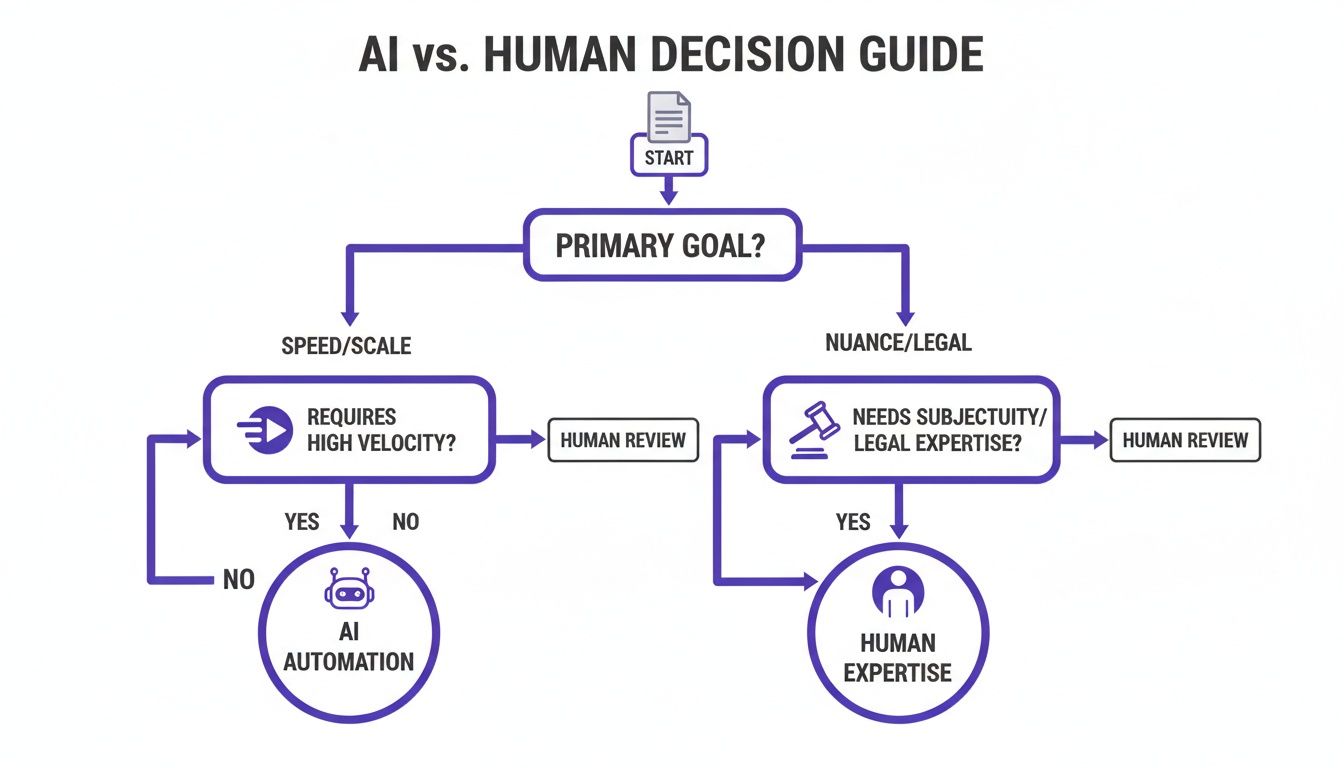
The takeaway is pretty clear: if you need to process a huge volume of documents quickly, AI is your best bet. But if you need a translation that will hold up in court or one that truly captures cultural nuance, you’ll want a human expert.
Common File Types and Their Headaches
Every document format brings its own set of technical challenges to the table. A professional Spanish document translation service has to be built to handle a wide range of them, each with its own quirks.
- PDF (.pdf): Often called the "final" format for a reason, PDFs are notoriously tricky. They essentially lock text and images into a fixed design, making it a real challenge to pull the content out and put it back in without shattering the whole structure.
- Word Documents (.docx): While they seem more flexible, DOCX files can be surprisingly complex. They often contain tables of contents, tracked changes, comments, and intricate table layouts that have to be replicated perfectly.
- Markdown (.md): A favorite among developers and technical writers, Markdown relies on simple syntax for formatting. The trick here is translating the actual words while leaving the code-like syntax (like
#for headers or[]()for links) completely untouched.
A top-tier translation service doesn't just see the words on the page; it sees the entire architecture of the document. It's engineered to carefully deconstruct the original file, translate the text, and then meticulously put it all back together in the new language, with every element in its rightful place.
The Modern Solution for Keeping Your Format Intact
This is exactly the problem that modern AI-powered services are built to solve. They don't just crudely copy and paste text. Instead, they use advanced parsing technology to identify and map every single formatting element in your original document.
The system essentially creates a blueprint, recognizing things like:
- Structural Elements: Headers, footers, page numbers, and footnotes.
- Text Styling: Font types, sizes, colors, bolding, and italics.
- Visuals: Embedded images, charts, and graphs.
- Layout Features: Multi-column designs, text boxes, and tables.
Once the blueprint is set, the system translates the text and then carefully re-inserts it into the preserved layout. The result is a final translated document that’s a mirror image of the original.
This is what a good, modern translation platform should look like—simple, clean, and designed to handle the complexity for you.
You shouldn't have to worry about the technical gymnastics happening behind the scenes. This kind of drag-and-drop approach saves countless hours of manual clean-up, which is a common nightmare when using less sophisticated tools. If you're dealing with a particularly stubborn file, we've got some tips that can help. Check out our guide on how to successfully translate a PDF while keeping its format.
Security, Privacy, and Keeping Your Documents Safe
Handing over a sensitive document for translation can be nerve-wracking. Whether it's a confidential business plan, a private legal contract, or personal records, you need to know your information is protected. It’s not a leap of faith; it’s about understanding what a professional Spanish document translation service does to earn your trust.
The first and most critical layer of defense is encryption. The best way to think about it is like putting your document inside a digital armored truck for its entire journey. For this to work, encryption has to happen at two key points.
The Security Measures That Actually Matter
First, you need end-to-end encryption. This protects your files while they’re on the move—from the moment you hit "upload" to the moment you download the finished translation. It stops anyone from snooping on your data while it's traveling over the internet.
Just as important is encryption at rest. This is what keeps your files safe while they’re sitting on the service’s servers. Even if someone physically broke into the data center, all they’d find is scrambled, unreadable code. Your documents remain completely locked down.
But technology is only half the story. The service's policies on what they do with your documents are just as critical. A trustworthy platform will be upfront and crystal clear about how your files are handled after the job is done.
The gold standard is a simple, non-negotiable promise: Your data is used only for your translation. Nothing else. This means no using your documents to train AI models and, crucially, a commitment to automatically and permanently delete your files from their servers after a short, defined period.
Professional Services vs. Free Online Tools
This is where you see the night-and-day difference between a paid, professional service and a free online tool. Those free translation websites often have fuzzy privacy policies that might allow them to store, analyze, or even share what you upload. You could be giving up control of your information without even realizing it.
A dedicated document translation platform, on the other hand, is built from the ground up with security in mind. They know their clients are dealing with proprietary and confidential material, so they design their entire system to protect it. This usually includes:
- Strict Access Controls: Only the necessary automated systems ever touch your files. No human eyes, unless absolutely required for a support issue you initiate.
- Secure Infrastructure: Using data centers and servers that meet tough industry security standards.
- Clear Deletion Policies: Your files are automatically and permanently erased, typically within 24 to 48 hours, to ensure they aren't sitting around any longer than needed.
A privacy policy isn't just legal boilerplate; it’s a direct statement of a company's commitment to you. Before uploading anything sensitive, it’s always smart to spend a few minutes reviewing their policies. You can see what a strong, user-focused policy looks like by reading about our own approach to privacy and data protection. A little due diligence here gives you the confidence to translate any document without worrying about its security.
Real-World Scenarios for Spanish Document Translation
It's one thing to talk about features and workflows, but it’s another to see how they play out in the real world. Understanding when and why you'd reach for a Spanish document translation service becomes much clearer when you look at actual situations professionals face every day.
Let's walk through a few common stories. Each one highlights a different challenge where things like speed, formatting, security, or cost become the deciding factor.
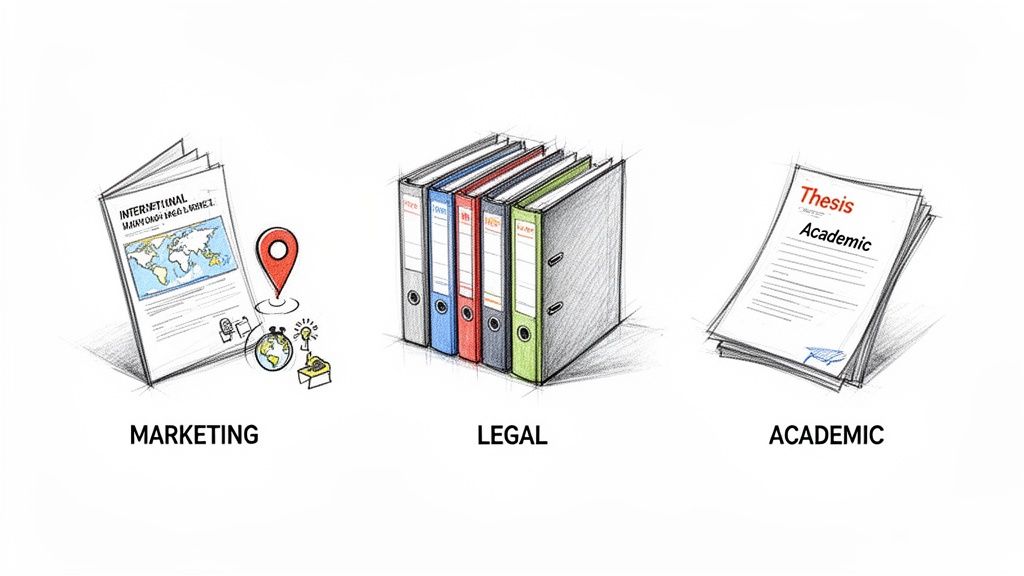
The Startup Founder Expanding into New Markets
Picture a startup founder on a shoestring budget. She’s ready to launch in Latin America, which means translating dozens of marketing brochures, user guides, and technical spec sheets from English into Spanish. For her, the two biggest hurdles are cost and speed.
She simply doesn't have weeks to wait on a traditional agency, and her budget won't stretch to cover high per-word rates for thousands of pages of content. This is a classic case where an AI-powered document translation platform shines.
She can upload all her files—a mix of DOCX and PDF documents—and get back accurate, well-formatted translations in a few hours. The cost is just a fraction of what a human agency would charge, freeing up her budget for the actual marketing campaigns. The AI also keeps technical terms consistent across every document, which is vital for building a clear and trustworthy brand.
The Paralegal Facing a Mountain of Evidence
Now, think about a paralegal buried in a complex international litigation case. He needs to translate thousands of pages of legal evidence—contracts, depositions, and emails—from Spanish to English. The files are a messy collection of scanned PDFs and Word documents.
For him, the one thing that is absolutely non-negotiable is preserving the original document structure. The translated files have to be a perfect mirror of the originals. Every table, timestamp, and paragraph break must line up exactly for the documents to be admissible and easy for the legal team to review.
For legal and compliance work, formatting isn't just about looks; it's about integrity. A misaligned table or a wonky page layout can make a document confusing or, even worse, get it thrown out in a legal proceeding.
An advanced AI service built specifically for format preservation is the answer here. It can chew through the massive volume of documents quickly while meticulously rebuilding the original layout in the translated files. This saves the legal team hundreds of hours of painstaking manual reformatting and makes sure the evidence is clear, credible, and ready for court.
The global demand for these services is exploding. The document translation market swelled from $34.5 billion in 2021 to a projected $44.6 billion by 2025, a direct result of the globalization that creates these cross-border legal and business challenges. You can learn more about the rapid growth in the document translation market in recent industry analysis.
The Researcher Aiming for Global Recognition
Finally, imagine a university researcher in Colombia who has just poured her heart into a groundbreaking thesis, written in Spanish. To get published in a top-tier English-language journal and gain international recognition, she needs a flawless English version. Her biggest worries are accuracy with technical terminology and keeping all citations and footnotes perfectly intact.
Her thesis is a dense, 200-page document packed with specialized scientific language. While she could hire a human translator specializing in her field, the cost is way out of her budget, and it could take weeks to get it back.
Instead, she takes a hybrid approach. First, she runs the document through a premium AI translation service to generate a highly accurate draft in just a few hours. The AI handles the heavy lifting, translating the complex terminology and preserving the academic structure. Then, she invests a much smaller sum to have a subject-matter expert review and polish the AI-generated text, ensuring it meets the journal's exacting standards. This smart strategy gives her the perfect blend of speed, affordability, and expert-level quality.
Your Checklist for Choosing the Right Service
Picking the right Spanish document translation service can feel like a shot in the dark, but it doesn't have to be. By asking a few key questions, you can cut through the marketing fluff and find the provider that truly fits what you need. Think of this as your final buyer's checklist—a simple framework to help you make a smart, confident decision.
Before you pull the trigger, take a minute to think about what your project actually demands. There’s no single "best" service out there; the right choice for you depends entirely on what you value most. Is it speed? Pinpoint accuracy? Watertight security? Let’s walk through it.
Define Your Technical Needs
First things first, let's talk about the files themselves. The types of documents you're working with will immediately tell you which services are a good fit and which ones to skip.
File Types: What are you translating? Simple DOCX files are one thing, but what about complex PDFs loaded with tables and images? Or maybe you have technical documentation written in Markdown. Double-check that the service you're considering explicitly supports your formats.
Formatting Preservation: How critical is it that the translated document looks exactly like the original? If it's a legal contract or a polished marketing brochure, maintaining the layout is everything. If it's just a block of plain text for internal use, maybe not so much.
Clarify Your Project Goals
Next, zoom out and look at the big picture. Your timeline and budget are two of the biggest factors that will steer you toward one type of service over another.
Your project's purpose should be the driving force behind your decision. A rush job for an internal memo has completely different needs than a certified document for a government agency. Define the "why" before you choose the "who."
Timeline: How fast do you need this done? If you need a translation back in a couple of hours, an AI-powered platform is probably your only realistic choice. But if you have a few days or weeks to spare, a human translation service becomes a viable option.
Budget: What can you realistically spend? AI translation services usually have clear, upfront pricing and are much easier on the wallet. Traditional agencies, on the other hand, charge a premium for their hands-on work. Know your numbers before you start shopping.
Assess Your Security and Compliance Requirements
Finally, and this is a big one, consider how sensitive your information is. When you're dealing with confidential business data or personal records, this is the one area where you absolutely cannot cut corners.
Data Sensitivity: Are you translating a top-secret business plan, private employee records, or a legally sensitive contract? The more confidential the information, the more rigorous the security needs to be.
Security Protocols: Dig into the details. Does the service use end-to-end encryption? Is your data encrypted while it's stored on their servers? Read their privacy policy—you need a clear guarantee that your documents won't be used to train their AI models.
Deletion Policy: Look for a service with a clear, automatic deletion policy. A great provider will permanently delete your files after a set period, like 24 hours, ensuring your sensitive information isn't just sitting on a server somewhere.
By running through these questions, you'll be able to size up any Spanish document translation service and confidently pick the one that gets the job done right for you.
Frequently Asked Questions
When you're looking for a Spanish document translation service, a few common questions always seem to pop up. Let's tackle them head-on with some straight-to-the-point answers to clear up any confusion about costs, timing, and what kind of translation is right for you.
How Much Does It Cost to Translate a Document into Spanish?
This is where you'll see the biggest difference between the old way and the new way. The cost really depends on whether you go with a machine or a human.
AI-powered translation platforms are incredibly budget-friendly. They usually charge by the word, and we're talking fractions of a cent. A typical 10-page business report might only set you back a few dollars, and you'll see the exact price before you even click "translate."
Traditional human translation agencies, on the other hand, are a premium service. You can expect to pay anywhere from $0.10 to $0.25 per word. That same 10-page report could suddenly cost you several hundred dollars. Watch out for added fees, too—things like complex formatting or a tight deadline can push the price even higher.
Can I Get a Certified Translation from an AI Service?
The short answer is no. While AI services deliver incredibly accurate translations for most business, academic, and personal needs, they can't provide a certified translation. That's a specific legal requirement for documents you're submitting to official bodies like the USCIS.
A certified translation isn't just about accuracy; it's a legal declaration. It requires a signed statement from a real person—a human translator—who vouches for the translation's completeness and correctness. An automated system simply can't provide that human signature. If you're dealing with immigration papers, court filings, or official transcripts, you'll need to work with a human service that specializes in certified documents.
How Long Does It Take to Get a Document Translated?
If you need it done yesterday, AI is your best friend. The speed difference is night and day.
- AI Translation: You can translate a multi-page document in literally a few minutes. Got a massive file, like a whole book? You could still have it back in under an hour. You just upload it, and the system lets you know when it’s ready.
- Human Translation: This is a much more manual, and therefore slower, process. A simple one-page document often takes 24-48 hours. For larger projects, you could be looking at days or even weeks, all depending on the translator's schedule and how complex your document is.
What Is the Most Accurate Way to Translate a Spanish Document?
"Accuracy" means different things for different documents. The best method really hinges on what you're translating.
For things like technical manuals, internal reports, or legal contracts, you need literal, precise accuracy. Modern AI models are fantastic at this and often perform at a human level. They're especially good at keeping specialized terms consistent across thousands of pages.
But if your content is meant to persuade or connect with someone—think marketing copy, a novel, or a sales pitch—a professional human translator is still the way to go. They can pick up on cultural humor, subtle emotions, and the kind of nuance that an algorithm might miss. A great middle-ground for many projects is a hybrid approach: get a fast, affordable first draft from an AI, then have a human expert review and polish it to perfection.
Ready to translate your documents with speed, accuracy, and perfect formatting? DocuGlot offers an AI-powered solution that preserves your original layout, from tables to headers, across more than 100 languages. Get your instant quote and start your translation in minutes at https://docuglot.com.
Tags
Ready to translate your documents?
DocuGlot uses advanced AI to translate your documents while preserving formatting perfectly.
Start Translating