A Guide to Online Document Translation Services
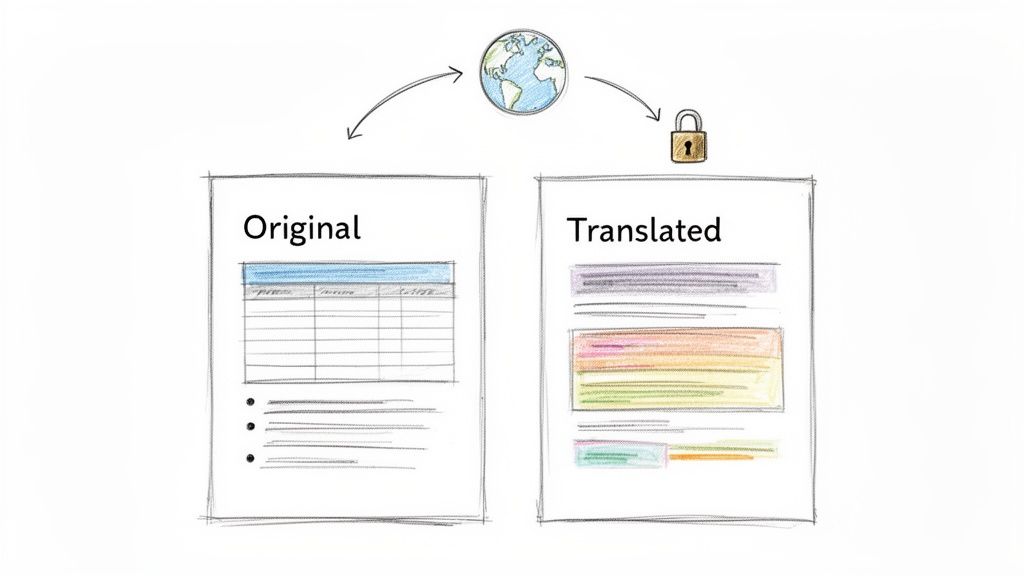
Picture this: you have a perfectly formatted contract, complete with tables and specific branding, that needs to get to an overseas partner today. The catch? It has to be in their native language. This is exactly where online document translation services come in. They act as a digital bridge, doing far more than just swapping words—they meticulously preserve the original layout.
What Exactly Are Online Document Translation Services?
At its heart, an online document translation service is a platform built to convert the text inside a file from one language to another, all while keeping the original structure and formatting exactly as you designed it. Forget copying and pasting text into a simple box. These are end-to-end solutions designed to tackle the real-world complexities of entire documents, whether it’s a one-page memo or a dense technical manual.
This leap from basic text converters to sophisticated platforms isn't just a gimmick; it’s a response to a real-world problem. As more businesses, law firms, and universities operate on a global scale, the need for fast, reliable, and scalable translation has shot through the roof.
What Modern Platforms Can Actually Do
Today’s leading services blend powerful technology with user-friendly interfaces to solve some of the most common translation headaches. Here’s what you can generally expect:
- Format Preservation: This is the big one. You can upload a DOCX, PDF, or even a PowerPoint file and get it back with the same layout, fonts, and images perfectly in place.
- AI-Powered Speed: Advanced AI models provide translations in seconds or minutes, a game-changer for handling large volumes of content or working against a tight deadline.
- Serious Scalability: Whether you’re translating a single birth certificate or a 500-page engineering guide, these platforms are built to process files of virtually any size.
- Solid Security: Reputable services don't mess around with your data. They use encryption and have strict privacy policies, often including automatic file deletion, to keep sensitive information safe.
The true value here is the blend of speed and fidelity. Not long ago, translating a formatted document was a painful, multi-step ordeal. You’d have to extract the text, send it off for translation, and then manually reformat everything back into the original design—a process that could easily take days, if not weeks.
This shift is clearly reflected in market trends. The document translation sector is expected to grow at a compound annual growth rate of 9% between 2025 and 2032, outpacing the broader translation market. This boom, detailed in a comprehensive market analysis of translation services, highlights a crucial point: businesses don't just need translated words anymore. They need fully intact, ready-to-use documents for a global audience.
Understanding the Technology Behind Modern Translation
To really get why today’s online document translation services are so powerful, you have to look under the hood. We've come a long way from the clunky, word-for-word substitutions of the past. Think of it as the difference between a tourist awkwardly pointing at a phrasebook versus a skilled diplomat who understands the context, culture, and intent behind the words.
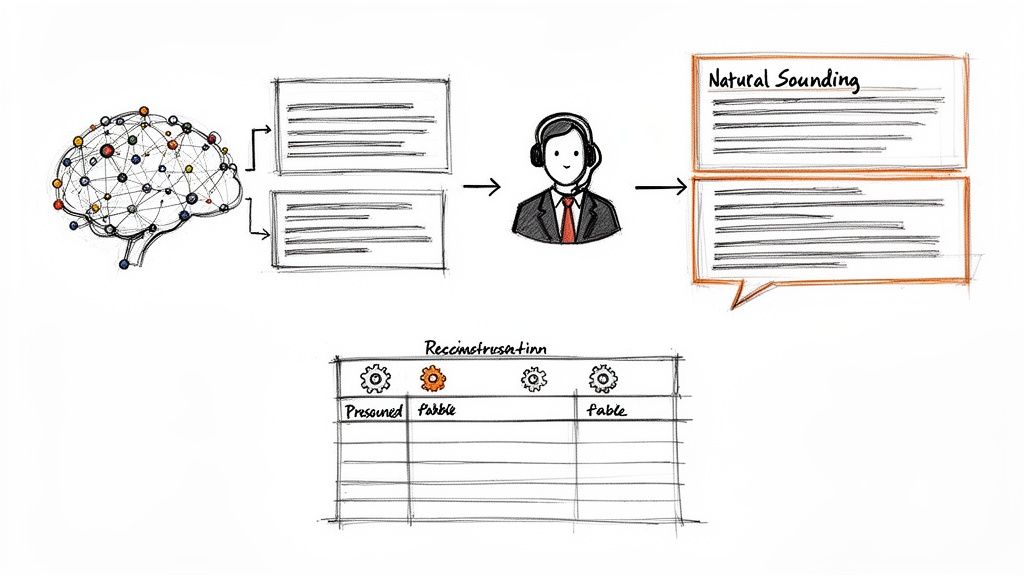
The engine driving these modern services is a sophisticated form of Artificial Intelligence (AI) called Neural Machine Translation (NMT). Instead of just swapping out individual words, NMT models look at entire sentences—even whole paragraphs—to grasp the relationships between words. This is how they can correctly interpret idioms, technical jargon, and subtle nuances that a literal translation would completely butcher.
This deep contextual understanding is the secret sauce that makes the final translation sound natural and human, not robotic. The AI is trained on massive libraries of multilingual text, letting it learn the same patterns and structures a professional human translator would use. The result? A more accurate, fluid, and trustworthy translation for all kinds of documents. If you're curious, we've gone deeper into how AI is shaping the future of translation.
The Leap from Words to Meaning
The real game-changer is that AI now processes meaning, not just language. This shift has had a huge economic impact, completely changing how businesses handle document workflows. The machine translation market, valued at $650 million back in 2020, is on track to hit $3 billion by 2027. That kind of growth tells you just how effective this technology has become.
Behind the scenes, you’ll also find technologies like Automatic Speech Recognition (ASR) technology, which helps process audio and video files before the translation even begins. All these systems work in harmony to deliver a seamless experience.
For your documents, this technological leap means:
- Greater Accuracy: The AI can pick the right definition of a word based on the words around it. No more confusing mistranslations.
- Improved Fluency: The translated text reads smoothly, matching the tone and style of your original document.
- Consistent Terminology: The system keeps key terms consistent throughout a long document, which is absolutely vital for legal or technical papers.
The Unsung Hero: Format Preservation Technology
While the AI is busy translating the words, another critical piece of tech is working quietly in the background: format preservation. This is the unsung hero that saves you from hours of frustrating manual clean-up. It’s the reason the translated document you download looks just like the original you uploaded.
Think of it like a skilled art restorer. The AI carefully removes the original text (the old paint) and replaces it with the translated text (the new paint) without ever disturbing the underlying canvas—your document's layout, structure, and design.
This is much more than a simple copy-and-paste job. The system has to intelligently break down every component of your document, including:
- Headers and footers
- Tables and charts
- Font styles and sizes
- Image placements and captions
- Column layouts and bullet points
Once the text is translated, the technology meticulously puts the document back together in the new language. It even accounts for things like differences in word length. A German phrase, for example, is often much longer than its English equivalent. Format preservation tech automatically adjusts the layout to prevent broken tables or text spilling onto the next page. This intelligent reconstruction gives you a final document that’s ready to use right away.
How to Choose the Right Online Translation Service
Picking an online document translation service isn't just about finding one that supports the language you need. It's about finding a partner you can trust with your documents. To make a smart choice, you have to look under the hood at the features that really matter: quality, security, and whether the final file is actually usable.
Think of it like buying a new car. The paint color is nice, but what you really care about is the engine's reliability, the safety ratings, and if it's practical for your day-to-day life. The same logic applies here. The real value of a translation service is in its technical guts and its commitment to protecting your data.
Let's walk through a simple checklist of what to look for.
H3: File Format Support and Layout Fidelity
First things first: can the service even handle your file? This is the most basic, practical test. Most platforms can translate a simple Word document, but the real test is how they manage complex files filled with images, tables, and specific formatting.
Look for a service that can handle a wide range of common file types:
- PDFs: This is a big one. A top-tier service can process both text-based (native) PDFs and image-based (scanned) ones. Translating a PDF while keeping the original layout perfectly intact is incredibly difficult, so strong PDF support is a great sign of a robust platform.
- Microsoft Office Suite: Your Word documents (DOCX), PowerPoint presentations (PPTX), and even Excel spreadsheets (XLSX) should come back looking exactly as they did before. A good service will preserve everything down to the slide transitions and table cell formatting.
- Plain Text and Markdown: If you're a developer or a writer working on technical documentation, you need a service that can handle TXT and MD files without messing up the syntax or adding weird formatting.
The ultimate goal is end-to-end format preservation. This means you upload a file, and the translated version you download is in the exact same format, with every table, header, and image right where it should be. This feature alone can save you hours of frustrating manual clean-up.
Security Protocols and Data Privacy
When you upload a document, you're handing over your data. If that document contains a sensitive legal contract, a confidential financial report, or unpublished research, security isn't just a feature—it's everything. You have to be confident your information is safe.
Here are the non-negotiable security features to look for:
- Data Encryption: Your files should be protected with strong encryption both "in transit" (as they upload and download) and "at rest" (while stored on the service's servers). This is your first line of defense against unauthorized access.
- Automatic File Deletion: Look for a clear, firm policy on data retention. A trustworthy service will automatically and permanently delete your files from their servers within a short window, like 24 hours, to minimize any risk of exposure.
- Privacy Policy: Read the fine print. Does the provider guarantee they won't use your data to train their AI models? This is a critical promise that ensures your proprietary information stays yours, period.
Translation Quality and Customization
Not all AI is the same, and not every project needs the same level of polish. A great service gives you options, letting you dial the quality—and the cost—up or down depending on what you're translating. For a closer look at how these factors affect pricing, our guide on understanding document translation costs breaks it all down.
Think of it in tiers:
- Standard AI: This is your workhorse for internal documents or competitor research. It's fast, affordable, and perfect when you just need to get the gist of the content.
- Advanced AI: This tier uses more powerful, context-aware AI models. It’s the right choice for more important materials like technical manuals or business proposals, where getting the flow and precision right is crucial.
- Human Review: For high-stakes, public-facing content, nothing beats a final check by a human expert. Adding a human review ensures that cultural nuances, idioms, and industry-specific jargon are translated perfectly.
Feature Comparison for Online Translation Services
To help you see how these features stack up, here’s a quick side-by-side comparison. It shows what you can typically expect from a basic service versus a more advanced one.
| Feature | Basic Service (Typical) | Advanced Service (e.g., DocuGlot) | Why It Matters |
|---|---|---|---|
| File Format Support | Limited to DOCX, TXT. Poor PDF/PPTX handling. | Broad support for PDF, Office Suite, Markdown, and more. | Saves you from having to convert files or manually fix broken layouts after translation. |
| Layout Preservation | Text is translated, but formatting is often lost. | Layout, images, and tables are kept perfectly intact. | Eliminates hours of rework, ensuring your document is ready to use immediately. |
| Data Encryption | Basic encryption during transit. | End-to-end encryption (in transit and at rest). | Provides comprehensive protection against unauthorized access to your sensitive data. |
| File Deletion Policy | Unclear or long retention periods. | Automatic file deletion within 24 hours. | Minimizes the risk of your data being exposed by ensuring it's not stored long-term. |
| Use of Data for AI Training | Often uses customer data to train models. | Strict policy: Never uses your data for AI training. | Guarantees your confidential information remains private and is not fed into public models. |
| Quality Tiers | One-size-fits-all standard AI translation. | Multiple AI tiers (Standard, Advanced) plus Human Review. | Gives you control over quality and cost, so you can match the service to the project. |
By focusing on these core areas—file handling, security, and quality options—you can move beyond the marketing hype. You'll be able to confidently pick an online document translation service that truly fits your needs and gives you peace of mind.
Choosing Between AI and Human Translation
One of the biggest calls you'll make when using online document translation services is deciding between pure AI and a version polished by a human. This isn't a simple "good vs. bad" debate. It’s more like choosing between sending a quick text message and drafting a formal, hand-signed letter—it’s all about matching the right tool to the job.
Think of pure AI translation as your go-to for raw speed and efficiency. It’s brilliant when your main goal is just to get the gist of something, not to achieve perfection. Need to quickly understand what a competitor's research paper says? Or translate a 100-page internal manual for your team? AI is your best friend here. It can chew through massive volumes of text in minutes, giving you the core message without the time or cost of a human translator.
But when the stakes are higher, that human touch is non-negotiable. Human-reviewed translation is the gold standard for anything public-facing, legally binding, or culturally sensitive. It's the only real choice for documents where every single word matters.
When AI Translation Is the Smart Choice
AI shines when speed and budget are your top concerns. The trick is to use it for content where the audience is internal or the purpose is purely informational. You're not trying to persuade anyone; you just need to understand.
Here are a few scenarios where relying on pure AI makes perfect sense:
- Internal Communications: Think company-wide memos, drafts of reports, or updates to an internal knowledge base. Your team just needs the main points.
- Initial Research: Translating competitor websites, news articles from foreign markets, or academic papers for background info is an ideal task for AI.
- High-Volume, Low-Risk Content: Got thousands of user reviews or support tickets you need to analyze for trends? AI can process that data in a flash.
The rule of thumb is pretty simple: if a small mistake won't cause a big problem, AI is an incredibly efficient tool. It delivers a solid "good enough" translation that gets the job done without draining your budget or schedule.
This flowchart lays out a simple decision-making process to help you see which path to take.
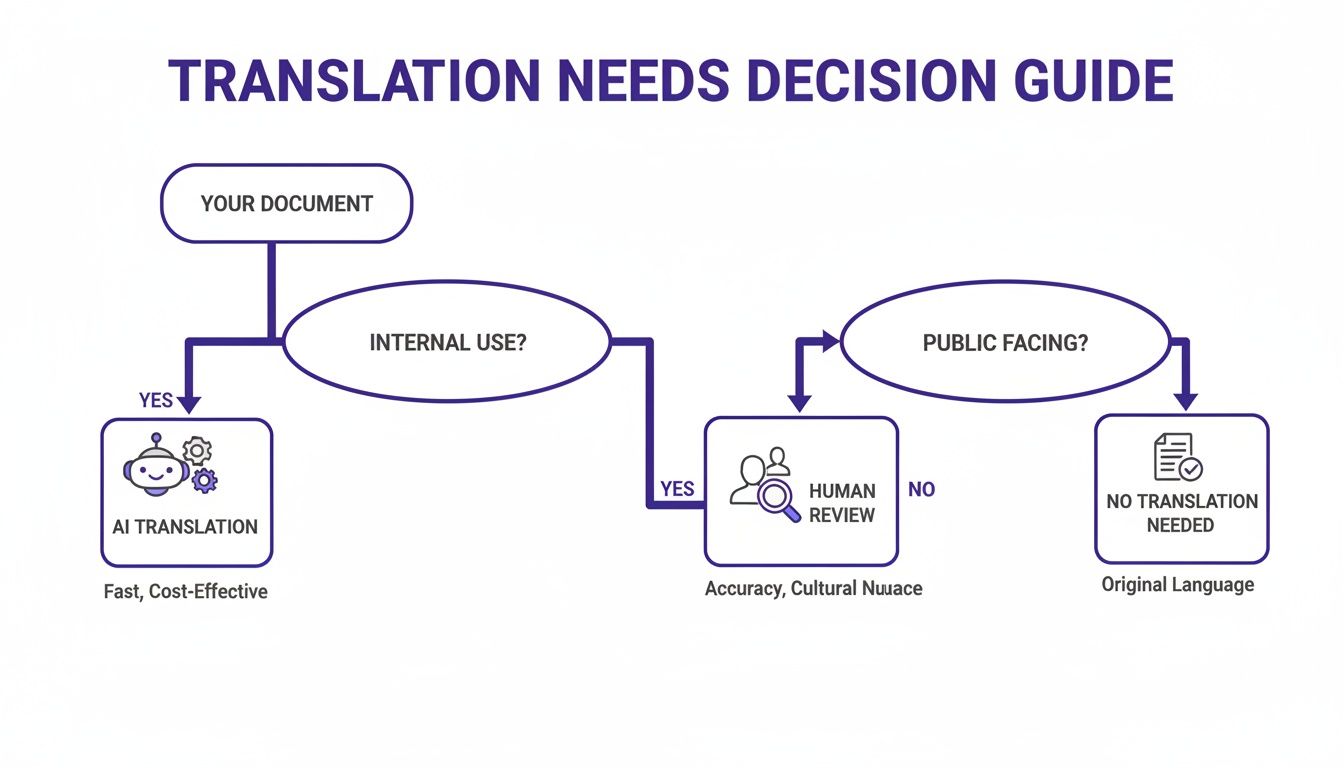
As you can see, the most important question is who will be reading the final document. That alone will point you in the right direction.
When to Invest in Human Review
For your most important documents, you need a human. The subtle nuances of language, cultural context, and specific industry jargon are things that only a person can truly get right. A human reviewer does more than just fix grammar; they ensure the tone is spot-on, the idioms land correctly, and the message truly connects with the intended audience.
You should absolutely plan for a human review for these types of documents:
- Legal Contracts and Agreements: A single misplaced word in a legal document can have massive financial or legal fallout. Don't risk it.
- Marketing and Advertising Materials: Slogans, product descriptions, and ad campaigns have to be carefully adapted—or "localized"—to avoid embarrassing and costly blunders.
- Medical and Patient-Facing Documents: When it comes to medical records, clinical trial data, or patient instructions, accuracy is a matter of safety and compliance.
- Official Documents for Submission: Any paperwork heading to a government agency, like immigration forms or business licenses, requires certified accuracy that only a human can provide. You can dig deeper into our comparison of AI versus human expertise in document translation services.
This whole balancing act reminds me of the broader challenge of automating customer service without losing the human touch. The principle is the same: technology is a powerful tool, but you have to know when human expertise is irreplaceable. The best online document translation services understand this and give you the flexibility to choose the right level of quality for every single project.
Where Document Translation Makes a Real-World Impact
The real value of an online document translation service isn't just about changing words from one language to another. It's about what that translation unlocks. These tools are the unsung heroes behind global sales campaigns, high-stakes legal filings, and even academic breakthroughs.
Let’s step away from the technical side for a moment and look at a few common scenarios where these services aren't just a nice-to-have, but an absolute necessity. You'll see how format-aware, instant translation solves very real, very frustrating problems for people every day.
Pushing into New Markets: Business and E-commerce
For any company trying to grow internationally, language is the first and biggest wall you hit. You can have the best product in the world, but if your marketing materials, product manuals, and sales decks don't speak the local language, you're invisible. And waiting weeks for a traditional translation agency can mean a missed opportunity.
Picture a marketing team ready to launch a new product across Europe. They have a whole arsenal of materials ready to go: slick sales brochures, detailed PDF spec sheets, and a compelling PowerPoint deck for distributors.
- The Challenge: Getting all of this translated and reformatted for French, German, and Spanish markets is a massive headache. The traditional route means weeks of back-and-forth with translators and designers, costing a small fortune to get the layout just right again.
- The Solution: Using an online document translation service, the team can simply upload everything. In minutes, they get back perfectly translated versions that look identical to the originals—the branding, the charts in the presentation, all of it. They can now hit the ground running in new markets almost overnight.
This kind of speed is a game-changer in e-commerce. As we all know, online shopping is a global phenomenon. But did you know that a staggering 76% of online shoppers will simply leave a site if the product descriptions aren't in their native language? To tap into 80% of the world's online spending power, you need to cater to at least eight major languages. Efficient, accurate translation isn't a luxury anymore; it's the engine for international e-commerce. You can dig deeper into the impact of language on global e-commerce to see just how critical this is.
Keeping It Air-Tight: Legal and Compliance
In the legal field, there is zero room for error. One poorly translated word in a contract, a patent filing, or a piece of evidence can have disastrous consequences. On top of that, legal documents often have incredibly rigid formatting rules that absolutely must be preserved.
Imagine a law firm working on an international patent application. The source documents are dense, packed with highly specific terminology and intricate diagrams.
- The Challenge: The firm has to submit these documents to patent offices in several countries. Each submission must be a perfect translation and a perfect structural replica of the original. Any deviation could get it rejected.
- The Solution: A high-quality document translation platform handles both problems at once. It ensures specialized legal and technical terms are translated with precision and consistency. More importantly, it preserves the exact formatting—a non-negotiable for most government and legal bodies. This sidesteps the risk of human error in manual reformatting and dramatically cuts down the time to file.
For legal professionals, getting both accuracy and format preservation in one step is a huge win. It delivers the confidence that the translated document is not just linguistically correct but also structurally sound and ready for official submission.
Spreading Knowledge: Academia and Research
Great ideas shouldn't be trapped by language. When researchers and academics discover something new, they want to share it with the entire world to push their field forward. But language barriers can slow that process to a crawl.
Take a university researcher who has just finished a landmark study. To make a real impact, they need to get it in front of colleagues everywhere and publish it in top international journals.
- The Challenge: Manually translating a heavy academic paper—with all its specific jargon, data tables, and citations—is slow and tedious work. A single mistake could damage the credibility of the entire study.
- The Solution: By running the paper through a service with a sophisticated AI model, the researcher gets a high-quality draft translation in minutes, not weeks. This lets them quickly circulate their findings for peer feedback or submit to journals in different languages, accelerating the global conversation around their work.
From the boardroom to the courtroom to the research lab, the story is the same. Online document translation services are the crucial piece of infrastructure that helps us work together in a deeply interconnected world, turning what used to be a barrier into a bridge for growth and collaboration.
Your Step-By-Step Translation Workflow
Using an online document translation service for the first time shouldn't feel like you're trying to launch a rocket. The best platforms are designed to be incredibly straightforward, walking you through a simple process that takes just a few clicks. It’s less like operating complex software and more like using a self-service kiosk at the airport—clear, logical, and built to get the job done fast.
The entire workflow really boils down to four key moments: you upload your file, pick your languages, choose your quality level, and download the finished product. Let’s walk through exactly what that looks like.
Step 1: Upload Your Document
It all starts when you hand your file over to the system. Most services today have a simple drag-and-drop box where you can drop a file right from your desktop. This is the first real test of the platform’s muscle.
A good service will instantly scan the file, making sure it can handle the format—whether it's a tricky PDF with lots of images, an Excel spreadsheet with multiple tabs, or just a plain Word document. This is also when the system will usually give you an instant quote by counting the words to figure out the cost.
Step 2: Select Your Languages
Next, you tell the platform what you want it to do. This part is simple and involves two key pieces of information:
- Source Language: This is the original language of your document. Most tools can figure this out on their own, but it never hurts to double-check their guess.
- Target Language(s): Here you pick the language (or languages) you need the document translated into. Many platforms let you select several at once, which is a huge time-saver.
Getting this right is important because it tells the AI which specific language model to use, and that has a direct effect on how good the final translation will be.
Step 3: Choose a Quality Tier and Confirm
This is where you match the translation to your actual needs. As we covered earlier, you'll see options ranging from a basic AI translation (perfect for internal documents) to a more polished, human-reviewed option for client-facing materials.
Think of this as your control dial for balancing cost, speed, and accuracy. Picking the right tier means you aren't overspending on a quick internal memo or, worse, cheaping out on a critical legal contract.
Once you’ve picked your tier and reviewed the final price, you give it the green light. The platform's AI engine then kicks into gear, translating the text while working to keep your document's original formatting perfectly intact. Depending on the size of your file, this can take anywhere from a few minutes to a couple of hours.
Step 4: Download Your Translated File
And now for the easy part. You'll get an email as soon as the translation is ready. Just log back in, and your new document will be waiting for you to download.
The magic here is that the file you download should be in the exact same format as the one you uploaded. A DOCX file goes in, a DOCX file comes out. A PDF goes in, a PDF comes out. This seamless format preservation is what separates a truly great online document translation service from the rest, saving you hours of frustrating manual cleanup.
Frequently Asked Questions
When you're diving into the world of online document translation, it's natural to have a few questions. Let's tackle some of the most common ones so you can move forward with confidence.
How Secure Is My Data with an Online Service?
This is a big one, and rightly so. Reputable services take data security incredibly seriously. The best platforms use end-to-end encryption, which is just a technical way of saying your files are scrambled and protected from the moment you upload them until they're back in your hands.
The real proof is in their privacy policy. Look for a clear promise to automatically delete your files after a short window, often just 24 hours. You also want to see a firm commitment that they won't use your confidential data to train their AI models. It's always a smart move to spend a minute on a service's security page before uploading anything sensitive.
Can I Translate a Scanned PDF or a File with Images?
It really comes down to the file itself. Most AI translators are superstars with text-based files like native PDFs (the kind you can copy and paste from) or Microsoft Word documents. A scanned PDF, though, is basically just a picture of words. To work with it, the service first needs to use something called Optical Character Recognition (OCR) to "read" the image and turn it into actual text.
As for files that have images embedded in them, most platforms will translate the text around the images, but they'll leave the pictures—and any text baked into them—as they are.
Key Takeaway: Translation is the direct conversion of text from one language to another. Localization goes deeper, adapting content to feel native to a target audience by adjusting cultural nuances, idioms, currencies, and date formats. While online services provide excellent translation, true localization often requires a human expert's touch to ensure cultural relevance and impact.
Ready to translate your documents with speed, accuracy, and full format preservation? Trust DocuGlot to deliver high-quality, secure translations in minutes. Try DocuGlot today and see how easy it is.
Tags
Ready to translate your documents?
DocuGlot uses advanced AI to translate your documents while preserving formatting perfectly.
Start Translating