A Practical Guide to Legal Document Translation Service
When you need a legal document translated, you're not just swapping words from one language to another. You're entering a highly specialized field where precision isn't just a goal—it's a requirement. A legal document translation service is dedicated to this exact task: converting complex legal materials into another language while keeping their precise legal meaning and authority intact.
This goes far beyond what a standard translation service can offer. It demands a deep understanding of the legal systems in both the original and target countries to guarantee accuracy and compliance. This is critical for everything from international business contracts and intellectual property filings to personal immigration documents.
Why Legal Translation Is A Unique Skill
Think of a legal document like a precision-engineered key, designed to fit a very specific legal lock. Every term, clause, and even the placement of a comma acts as a groove on that key. A standard translation might create a key that looks right, but if a single legal term is off—one groove is misaligned—the key simply won't work. The contract could be voided, the immigration petition rejected, or the patent filing invalidated.
A professional legal document translation service essentially re-engineers that key to fit an entirely new lock in a different legal system. It's a craft that blends linguistic mastery with a lawyer's understanding of the law.
To put it in perspective, let's look at the key differences between standard and legal translation.
Key Differences Between Standard and Legal Translation
| Feature | Standard Translation | Legal Document Translation |
|---|---|---|
| Primary Goal | Convey general meaning and intent. | Preserve legal accuracy and enforceability. |
| Translator's Skills | Fluency in two languages. | Fluency plus expertise in source and target legal systems. |
| Terminology | General or industry-specific vocabulary. | Precise, jurisdiction-specific legal terminology. |
| Consequences of Error | Misunderstanding or communication issues. | Lawsuits, financial loss, rejection of legal filings. |
| Certification | Often not required. | Frequently requires certification or notarization to be valid. |
As you can see, the stakes are dramatically higher in legal translation. You're not just translating words; you're translating legal consequences.
The Human Element in a Tech-Driven World
Modern tools and AI-powered platforms like DocuGlot have certainly made translation faster and more accessible. They're fantastic for getting a quick draft or for internal, low-stakes reviews. But when it comes to high-stakes legal documents, they can't replace the critical judgment of an experienced human translator.
Why? Because legal language is loaded with traps for the unwary (and for machines):
- Jurisdictional Nuances: A term like "consideration" in U.S. contract law doesn't have a direct one-to-one equivalent in many civil law systems. A machine might give you a literal translation that's legally meaningless. A human expert knows to find the correct local legal concept that achieves the same effect.
- Ambiguity and Intent: Lawyers sometimes use deliberate ambiguity or rely on implied context. A human translator can read between the lines and interpret this intent, while a machine is likely to produce a literal—and legally incorrect—translation.
- Cultural Context: Laws don't exist in a vacuum; they're woven into a country's culture. Translators must navigate these subtleties to make sure the document carries the same legal weight in its new environment.
With global commerce expanding, the demand for this highly specialized skill is surging. The market for legal translation services was valued at around USD 5.2 billion in 2023 and is on track to hit nearly USD 9.3 billion by 2032, all driven by our interconnected world. You can learn more about the growth of the legal translation market and its driving factors.
A general translator sees words and converts them. A legal translator sees concepts, obligations, and rights, then reconstructs them within an entirely new legal framework. The difference isn't just vocabulary; it's a fundamental understanding of the law itself.
At the end of the day, a legal document translation service does more than just give you a document in another language. It delivers a legally binding instrument, ensuring your rights, obligations, and agreements are protected across borders. It gives you the confidence that your carefully crafted legal key will work, no matter which country's lock it needs to open.
Decoding The Different Types Of Legal Translation
Stepping into the world of legal document translation can feel a bit like learning a new language itself. You'll quickly run into terms like "certified," "notarized," and "apostilled," and each one represents a specific level of official validation. Getting this right from the start is absolutely crucial—it's the difference between your documents being accepted or facing expensive, frustrating delays.
Before diving in, this flowchart can help you figure out that very first step: does your document need a specialist legal translator, or will a standard translation do the trick?
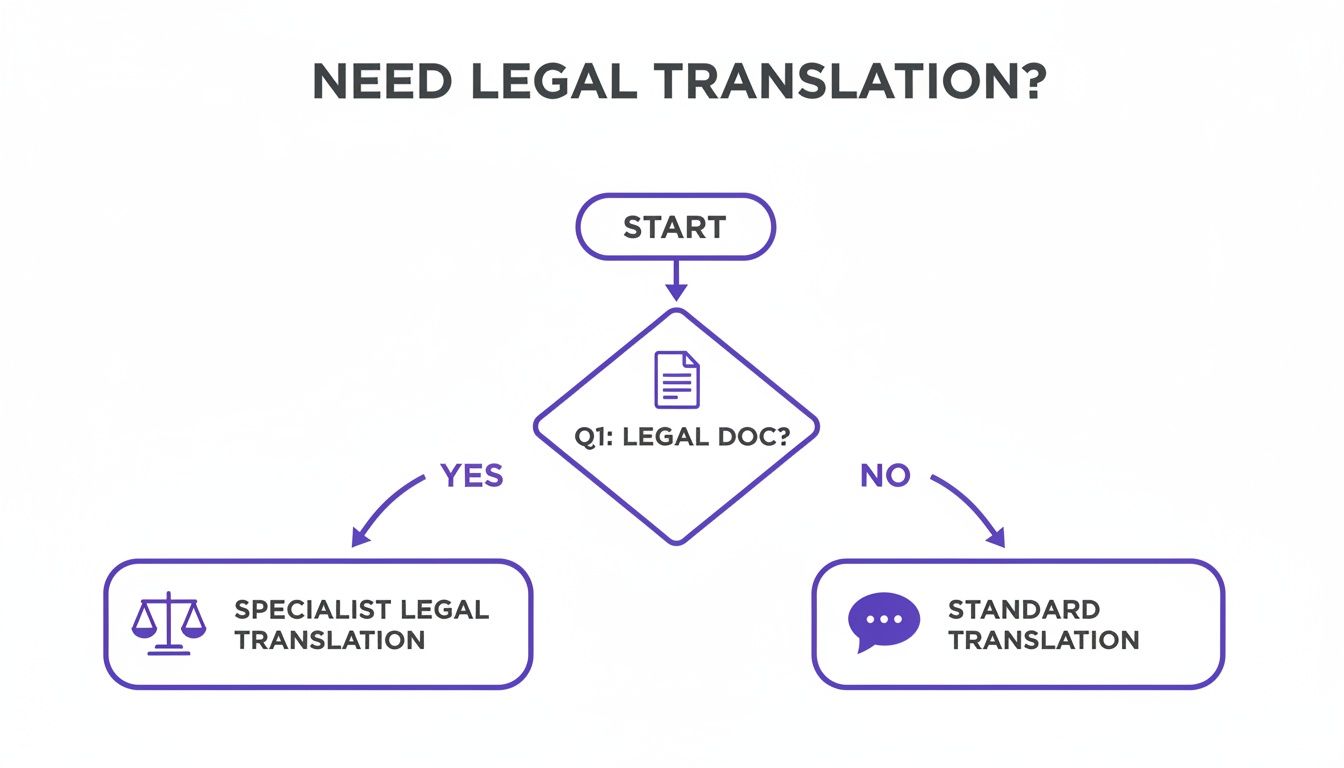
The main takeaway here is simple. If a document carries any kind of legal weight or has real-world legal consequences, a standard translation just won't cut it. It’s a risk you don’t want to take.
Understanding Certified Translation
A certified translation is probably the most common type you'll need for official matters. It’s not as complicated as it sounds. It simply means the translated document comes with a signed statement from the translator or translation company. This statement, often called a "Certificate of Accuracy," confirms that the translation is a complete and faithful version of the original document.
Think of it as the translator’s professional guarantee—their seal of approval on their own work. No outside authority is involved; it's a direct promise of quality from the provider.
This formal assurance is a non-negotiable for many government agencies and legal bodies. You’ll almost certainly need one for:
- Immigration Filings: U.S. Citizenship and Immigration Services (USCIS) is very strict about this. They require certified translations for all foreign-language documents, including birth certificates, marriage licenses, and academic records.
- Court Proceedings: If you're submitting evidence like a foreign contract or a witness statement, it will need to be certified to be considered valid in court.
- University Applications: Colleges and universities often require certified translations of diplomas and transcripts from schools in other countries.
A certified translation essentially answers the question, "Can we trust that this translation is accurate?" The certificate provides a documented "yes" from a qualified professional, adding the layer of accountability that official organizations demand.
When Notarized Translation Is Necessary
A notarized translation takes things a step further. Here, the translator signs the Certificate of Accuracy in front of a Notary Public. The notary isn't there to check the translation's quality; their job is simply to verify the identity of the person signing the certificate. The notary's seal and signature are official proof that the translator is who they say they are.
This adds an extra layer of fraud prevention, which is critical for documents where identity verification is a top priority. While not as common as certification, notarization is vital for things like:
- International business agreements and powers of attorney.
- Official documents intended for use in certain foreign countries that have this specific requirement.
- Sworn statements or affidavits that will be used in legal proceedings abroad.
If you're stuck trying to decide between certified or notarized, digging a little deeper into the specifics of certified translation services can help clear things up and guide you to the right choice.
What Is An Apostille?
Finally, if you're preparing documents for use in any of the countries that are part of the Hague Convention, you may hear the term Apostille. An Apostille is a special certificate issued by a government authority, like the Secretary of State in the U.S. It doesn't validate the translation itself but instead authenticates the notary’s seal on the translation certificate.
This makes the document legally valid for use in another member country. It's a high-level form of international legalization, typically reserved for major life events like international adoptions or setting up a business overseas. Choosing the right type of translation from the very beginning is the best way to prevent rejections and make sure your documents have the legal power they need.
The Real Cost Of Inaccuracy In Legal Translation
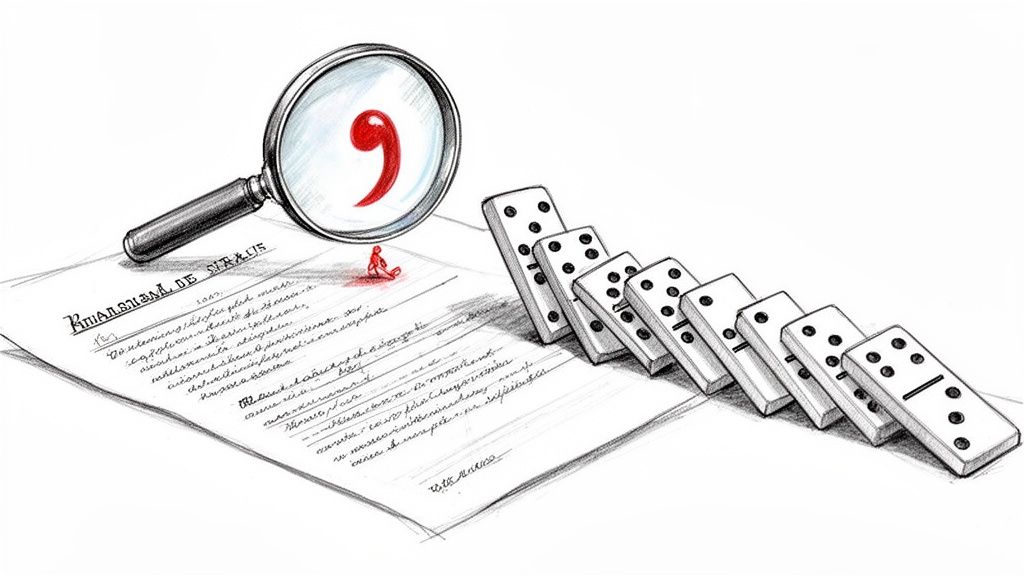
In the legal world, words aren't just for communication; they are the very foundation of rights, obligations, and consequences. A single misplaced comma or a subtly mistranslated term can be like a tiny crack in a dam, ready to give way under pressure. The cost of a mistake like this isn't just a simple misunderstanding—it can spiral into devastating financial losses and serious legal trouble.
Think about a multi-million dollar international business deal. A clause outlining late delivery penalties gets translated in a way that softens the language, turning a strict deadline into something more like a polite suggestion. When the supplier inevitably misses the date, the company discovers its legal recourse has vanished, all because of one badly chosen word. This isn't just a "what if" scenario; it's a real-world risk that businesses navigate every day.
And cross-border legal disputes are far from rare. In a recent survey of 200 companies, a staggering 38% reported being involved in international litigation over just a two-year period. Discover more insights about cross-border legal challenges. This statistic alone shows how critical accurately translated documents are for defending a company's interests.
The Domino Effect Of A Single Error
One small mistake in a legal translation can set off a chain reaction, and the fallout is often far more expensive than the initial cost of a professional legal document translation service.
- Invalidated Contracts: Mistranslating a term related to jurisdiction or governing law can make the entire contract unenforceable, leaving your company completely exposed.
- Failed Mergers and Acquisitions: During due diligence, an inaccurately translated financial report could obscure massive risks, causing a deal to collapse or leading to a disastrous acquisition.
- Immigration Denials: For an individual, a simple error on a translated birth certificate or legal affidavit can lead to a visa or residency application being denied, creating immense personal and professional upheaval.
An inaccurate legal translation is a ticking time bomb embedded in your document. It may go unnoticed during signing but can detonate months or even years later during a dispute, audit, or legal proceeding, when the stakes are highest.
Building A Defense Against Inaccuracy
The good news is that these disasters are entirely preventable. Reputable translation providers have robust quality control systems designed to catch and fix errors before they can do any damage. This isn't just a spell-check; it's a multi-layered defense strategy.
The first line of defense is the translator themselves. A high-quality service will only assign your project to a linguist who is not only a native speaker but also has specific, verifiable expertise in the relevant area of law, whether that's intellectual property, corporate law, or litigation.
Then comes a multi-step review. At a minimum, a second legal translator should comb through the entire document, comparing it to the original to check for accuracy, consistency, and the correct legal terminology. This editor is your safety net, ensuring nothing slips through the cracks.
The Role Of Technology And Human Expertise
Modern technology certainly helps, but it can't replace the critical judgment of a human expert.
- Terminology Databases: Translation providers maintain extensive glossaries of approved legal terms for specific clients and legal fields. This ensures a term like "force majeure" is translated the exact same way across hundreds of pages of documents.
- AI as a First-Pass Tool: Artificial intelligence is great for producing a high-quality initial draft very quickly. This frees up the human translator to focus their energy on nuance, context, and complex legal ideas—the areas where machines still fall short. AI makes the process faster, but the human expert ensures it's legally sound.
Ultimately, the real cost of inaccuracy is the loss of certainty and protection. By choosing a provider with rigorous quality controls, you're not just buying a translation; you're investing in the legal integrity of your documents and protecting yourself from potentially ruinous consequences down the road.
How To Choose The Right Translation Provider
Picking the right legal document translation service is about more than just finding the lowest price. The company you trust with your documents becomes a guardian of your most sensitive information and a critical link in your international legal efforts. A smart choice means looking closely at their actual expertise, how they protect your data, and the technology they use.
The right partner does more than swap words from one language to another; they grasp the legal gravity behind every term. You need a service that delivers absolute precision, confidentiality, and reliability, whether you're translating a simple birth certificate or the intricate details of a cross-border merger.
Evaluate Translator Qualifications And Specializations
The single most important factor is the expertise of the people who will actually work on your documents. A general translator might know the language, but they will almost certainly miss the legal nuances that can completely change a document's meaning and enforceability.
When you're vetting a provider, get specific with your questions about their team:
- Legal Background: Do their translators have any formal legal training, like a law degree or paralegal certification? This is a strong indicator they understand the underlying legal concepts, not just the words used to describe them.
- Area of Specialization: Legal translation isn't one-size-fits-all. An expert in patent law might be lost in a real estate contract. Ask if they have specialists in the specific legal area you need.
- Native Speakers: For the best results, the translator should be a native speaker of the target language. This is the only way to ensure the final document sounds natural and uses the correct legal and cultural phrasing.
When your needs are highly specific, you might want to directly hire translators who have that proven blend of legal knowledge and linguistic skill. This approach puts your documents in the hands of professionals who are fluent in both legal systems.
Scrutinize Security And Confidentiality Protocols
By their very nature, legal documents are packed with sensitive information—confidential business plans, personal data, and privileged communications. Because of this, the provider's security measures are not just a feature; they're a fundamental requirement. A data breach could have devastating legal and financial fallout.
A reputable service will be open and clear about its security practices. Be sure to ask about:
- Data Encryption: Are your files encrypted while they're being uploaded and downloaded, as well as while they're being stored?
- Data Deletion Policies: What happens to your documents after the translation is delivered? A provider like DocuGlot, for instance, automatically deletes all files after 24 hours to minimize risk.
- Confidentiality Agreements: Do their translators operate under strict non-disclosure agreements (NDAs)? The service provider should also be willing to sign an NDA with your firm.
Choosing a provider is an act of trust. A service that openly details its security measures—from end-to-end encryption to strict data handling policies—demonstrates a commitment to earning that trust and protecting your most valuable information.
Compare Traditional Agencies And Modern Platforms
The translation world is generally split into two camps: traditional agencies and modern, tech-driven platforms. Traditional agencies often offer a very hands-on, managed service, which can be great for massive, long-term projects with many moving parts. The tradeoff is that they tend to be slower and more expensive.
Modern platforms, on the other hand, usually leverage a hybrid model. They combine the speed of AI with the critical oversight of human experts. These services are typically faster, more affordable, and provide clear, upfront pricing and delivery estimates. For many law firms and businesses, this mix of efficiency and quality hits the sweet spot.
To dig deeper into which model is right for you, check out our complete guide to legal document translation. In the end, the best choice always comes down to your project's unique demands for speed, budget, and the level of human touch required.
To help you stay organized during your search, use this checklist to compare potential providers side-by-side.
Provider Comparison Checklist
| Evaluation Criterion | What to Look For | Why It Matters |
|---|---|---|
| Translator Expertise | Verified legal background (e.g., JD, paralegal), specialization in your legal field, native speaker of the target language. | Ensures the translator understands legal concepts, not just words, which is crucial for accuracy and avoiding liability. |
| Security Protocols | End-to-end data encryption, clear data deletion policies (24-hour deletion is ideal), NDAs for all staff. | Protects sensitive and confidential client information from breaches, safeguarding your firm's reputation and legal standing. |
| Turnaround Time | Clear, guaranteed delivery times. Look for services that offer expedited options for urgent needs. | Legal deadlines are often rigid. A reliable turnaround prevents delays that could jeopardize a case or transaction. |
| Certification & Notarization | The ability to provide certified translations with a Certificate of Accuracy and options for notarization. | Many courts, government agencies, and official bodies require certified documents to consider them valid. |
| Pricing Structure | Transparent, per-word or per-page pricing. Watch for hidden fees or complex tiered systems. | Clear pricing allows for accurate budget forecasting and avoids unexpected costs, especially on large-scale projects. |
| Customer Support | Responsive, knowledgeable support staff who can answer technical and legal-specific questions. | When issues arise, you need quick and effective support from people who understand the stakes of legal work. |
Using a structured approach like this ensures you're not just comparing prices, but the actual value and security each provider brings to the table. It helps you make a confident, well-informed decision that protects both your clients and your firm.
Preparing Your Documents For A Flawless Translation
The quality of your final translation really boils down to the prep work you do upfront. Think of it like a chef in a high-end kitchen—the final dish is only as good as the ingredients they start with. Giving your translator clear, final, and well-supported material is the single best thing you can do to ensure a fast, accurate, and cost-effective result.
Taking a few minutes to get organized first can save you a world of headaches later. It’s the difference between a simple word-for-word conversion and a legally sound document that holds up where it counts.
Finalize The Source Document
This is the golden rule: always provide the final, locked version of your document. Sending a draft and then following up with a flurry of revisions is a recipe for disaster. Even a tiny change can create a ripple effect, forcing the translator to backtrack and re-work entire sections. This not only adds to the cost and timeline but also opens the door for new errors to creep in.
It’s like asking a builder to move a wall after the drywall and paint are already done. Locking in the document from the start ensures a single, clean pass, which is exactly what you want for something this important.
Create A Simple Glossary
Every legal niche is filled with its own jargon. To keep everything consistent, especially if you have a stack of documents, it helps to put together a simple glossary. This doesn't need to be a complex legal dictionary—a basic two-column list works perfectly.
- Key Terms: Jot down any company-specific names, recurring legal phrases, or technical terms that appear often.
- Preferred Translation: If you have an established way you want these terms translated, list it here. If not, the translator will establish a consistent term for you.
This little cheat sheet acts as a style guide for the translator, ensuring a term like "indemnification clause" is translated the same way on page 5 as it is on page 50.
Providing context and a glossary is like giving a translator both a map and a compass. The document is the map, but the contextual information is the compass that points them toward the true meaning and intended legal effect.
Provide Essential Context
Legal documents don't exist in a vacuum. The story behind a document gives a translator critical clues to navigate ambiguities and nail the intended meaning. Your legal document translation service provider doesn't need the entire case history, but a few key details can make all the difference.
Always be clear about how the document will be used. For example:
- Is it for internal review? This might call for a quicker, more straightforward translation where capturing the general meaning is the main goal.
- Is it for a formal court submission? This demands the highest level of precision, often requiring certification and strict adherence to the court's formatting rules.
- Who is the intended audience? A contract drafted for a team of corporate lawyers will use very different language than a terms of service agreement meant for the general public.
Following these steps sets your translator up for success. For a deeper dive into the process, check out our guide on how to translate legal documents effectively. A small investment of time upfront always pays for itself with a smoother process and a far more reliable final product.
Protecting Confidentiality In Legal Translation
Legal documents are more than just paper; they're a repository of your most sensitive information. Think about it—they hold everything from trade secrets and business strategies to deeply personal data. Protecting this information during the translation process isn't just a good idea; it's a critical necessity. The second a file leaves your secure network, it's exposed. This makes choosing a legal document translation service one of the most important security decisions you'll make.
We all know the temptation of free, instant online translators. But when it comes to legal documents, the risk is far too high. Many of these platforms have murky privacy policies that could allow them to log, store, or even analyze your confidential data. In a worst-case scenario, your sensitive legal files could end up in a public data set, leading to a disastrous breach.
What Robust Security Actually Looks Like
Real security isn't just a buzzword on a website. It’s a comprehensive, multi-layered system designed to shield your information at every step. A professional service should be able to walk you through their specific, verifiable protocols. Anything less is a red flag.
This defense-in-depth approach should always include a few key elements:
- End-to-End Encryption: This is the absolute minimum. It means your documents are scrambled and unreadable from the moment you upload them, while they're being worked on, and until they are safely back in your hands.
- Strict Data Deletion Policies: Your data shouldn't be sitting on a server forever. A reliable provider will have a clear, automated process for wiping files after a set period. For instance, DocuGlot permanently deletes all files after just 24 hours, dramatically shrinking the window of vulnerability.
- Confidentiality Agreements: Every single person who comes into contact with your document, from the translator to the project manager, must be bound by a strict non-disclosure agreement (NDA). The service provider should also be ready to sign an NDA with you for an extra layer of legal assurance.
In the world of legal translation, data security isn't just a feature—it's the foundation. Without an ironclad guarantee of confidentiality, even a perfect translation becomes a major liability.
Practical Steps For Protecting Your Files
While a good provider has its responsibilities, you can also take proactive steps on your end. Before you even think about sending a document, it's smart to add your own layer of protection. Learning how to make PDFs password protected is an easy and effective way to bolster security. This simple action creates one more barrier, ensuring only the people you authorize can ever open the file.
When vetting a potential partner, don't be shy. Ask direct questions about their security infrastructure. A reputable legal document translation service will welcome the scrutiny and give you straight answers. Their transparency is one of the best indicators of their commitment to keeping your critical information safe, private, and confidential from start to finish.
Your Top Questions About Legal Translation, Answered
Even after getting the lay of the land, you probably still have a few questions about how legal document translation works in practice. That’s perfectly normal. Getting clear answers to these common questions will help you feel confident you're making the right call.
Let’s dive into some of the most frequent queries we hear.
What's the Real Difference Between a Certified and a Notarized Translation?
This is easily one of the most common points of confusion, but the distinction is actually straightforward once you break it down.
A certified translation comes with a formal statement—a "Certificate of Accuracy"—signed by the translator or the translation company. This certificate is their professional guarantee, attesting that the translation is a complete and accurate reflection of the original document. Think of it as a quality seal. This is what most official bodies, like USCIS, demand.
A notarized translation takes it one step further. Here, the translator signs their Certificate of Accuracy in front of a Notary Public. The Notary then adds their stamp and signature, but they aren't verifying the translation itself; they're only verifying the identity of the person who signed the certificate. This extra step is all about fraud prevention and is often required for high-stakes documents like international powers of attorney or business contracts where identity verification is critical.
Can I Really Trust AI with My Legal Documents?
You can, but you have to be smart about how you use it. AI translation tools are fantastic for speed and are incredibly cost-effective. They're a great choice for internal reviews, sifting through mountains of documents in e-discovery, or just getting the gist of a contract written in another language. Today's AI can even handle tricky legal jargon surprisingly well for a first pass.
But when it comes to submitting a document to a court, a government agency, or any other official party, a human expert still needs to have the final say.
The best strategy is a hybrid one. Use a sophisticated AI service to generate a high-quality initial translation that keeps your original formatting. Then, have a qualified human legal translator review and polish it. This gives you the speed of AI with the irreplaceable nuance and accountability of a human expert.
This approach truly gives you the best of both worlds: efficiency and rock-solid reliability.
So, How Much Does Legal Translation Typically Cost?
Pricing for legal translation is all over the map. Old-school translation agencies usually charge by the word, and those rates can swing wildly depending on the languages involved (a Spanish translation will cost less than a Finnish one), the document's complexity, and how fast you need it. On top of that, you'll often see extra fees for certification, notarization, or tricky formatting.
Modern, tech-driven platforms tend to offer much clearer pricing. Many services now charge based on the document's size (like its character count), giving you a firm, upfront quote before you spend a dime. The only way to know for sure is to upload your document for an instant quote. It takes the guesswork out of the equation and lets you budget with confidence.
Ready for fast, secure, and format-preserving translations? DocuGlot uses top-tier AI to deliver accurate results in over 100 languages while keeping your document’s original layout intact. Get your instant quote and start translating in minutes at https://docuglot.com.
Tags
Ready to translate your documents?
DocuGlot uses advanced AI to translate your documents while preserving formatting perfectly.
Start Translating