A Guide to Financial Translation Services for Global Business
Financial translation is the art of converting financial documents from one language to another, but it's much more than just swapping words. The real challenge—and where the expertise comes in—is preserving the precise meaning, context, and legal weight of every single number and phrase. It’s about ensuring that critical financial information remains ironclad and compliant as it crosses borders and regulatory systems.
Decoding the Language of Global Finance
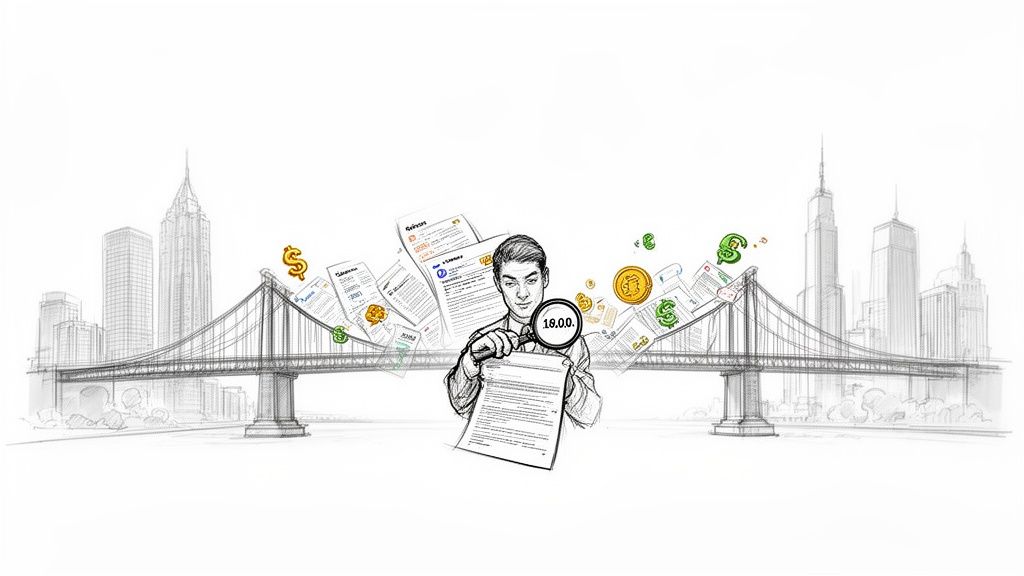
Imagine a high-stakes interpreter at a G7 summit. When leaders negotiate a treaty, the interpreter isn't just translating words; they're conveying subtle intent, cultural nuance, and the full weight of every commitment. A single slip-up could spark an international incident. Financial translation operates on that same level of precision, but for the universal language of money.
In global business, documents like annual reports, merger agreements, and investment prospectuses are the bedrock of trust and legal compliance. A misplaced decimal point, a misunderstood regulatory term, or a misaligned table can derail a deal, attract hefty fines, or even trigger lawsuits. This is exactly why professional, expert-driven translation is non-negotiable.
The Core Purpose of Financial Translation
At its heart, financial translation exists to make sure everyone is looking at the exact same financial picture, regardless of their native language. It creates a single source of truth for investors in Tokyo, regulators in Brussels, and shareholders in New York.
And the need for this clarity is only getting bigger.
The market for these specialized services is massive. The global translation industry, with financial services as a major pillar, was valued at around USD 42.62 billion in 2025. That number is expected to climb to USD 50.02 billion by 2033, a clear signal of just how crucial precise translation has become in our interconnected economy. You can dig deeper into the market research about translation industry growth.
Who Relies on These Services
So, who is actually using these services? The list is long, and their needs are incredibly specific.
- Multinational Corporations: They need their annual and quarterly reports translated flawlessly to communicate performance to global shareholders.
- Investment Banks & VCs: Their teams rely on accurate translations to conduct due diligence for cross-border mergers, acquisitions, and funding rounds.
- Compliance Departments: These folks are tasked with making sure every piece of documentation meets local and international standards, like IFRS or GAAP.
- Legal Firms: They require perfect translations for contracts, litigation materials, and other legally binding financial documents where one wrong word can change everything.
A great financial translation is completely invisible. The finished document should feel as if it were originally drafted in the target language, with every number, chart, and legal clause perfectly preserved and contextually sound.
Ultimately, this isn't just a back-office support function; it's a strategic imperative. For any company serious about competing on the world stage, accurate and reliable financial translation is the foundation for building trust, managing risk, and capitalizing on global opportunities.
Getting Lost in Translation: Financial Terminology and Global Rules
When you're dealing with financial translation, you’re navigating a minefield. It boils down to three huge challenges that are all tangled together: the specific words you use, the rules you have to follow, and even how the document looks. If you drop the ball on any one of these, you're looking at more than just a simple mistake—you could face legal trouble, create a document that’s completely unusable, or just plain confuse everyone.
In this world, a straight word-for-word translation is a recipe for disaster. It doesn't work.
Think of financial language as a bunch of local dialects. A word might mean one thing in London but something entirely different in Tokyo, or it might not even exist. This is where basic machine translation really falls flat, spitting out gibberish that can destroy a document's credibility.
The Devil Is in the Details: Financial Lingo
In finance, words have very specific, very important jobs. Take amortization and depreciation. Both are about spreading out the cost of an asset over time, right? But you use amortization for things you can’t touch, like a patent, and depreciation for things you can, like a factory machine. Mix them up, and any savvy investor will think you don't know the first thing about accounting.
It’s not just the technical stuff, either. Little phrases and local expressions can throw a wrench in the works. An American investor might talk about a company having a solid "moat"—a clever term from Warren Buffett for a competitive edge. Translate that literally into Spanish (foso) or German (Wassergraben), and you’ll get nothing but blank stares.
It's not about swapping words. It’s about conveying the exact financial meaning in a new context. That requires a real person who knows both the language and the industry inside and out.
Untangling the Global Web of Regulations
Every country plays by its own financial rulebook. A document that’s perfectly legal and standard in the United States could get you into hot water in the European Union. This regulatory maze is exactly why you can't just hand these documents over to any translator; you need specialized financial translation services.
The two big players on the global stage are:
- Generally Accepted Accounting Principles (GAAP): This is the rulebook for the U.S. It's known for being very detailed and specific.
- International Financial Reporting Standards (IFRS): Used by over 144 countries (think the EU, Canada, Australia), this framework is more about the big-picture principles.
A great translator knows these aren't just acronyms—they're different ways of thinking. For example, GAAP lets companies use the LIFO (Last-In, First-Out) method for their inventory. IFRS, on the other hand, says absolutely not. So, if you're translating a U.S. annual report for European investors, you can't just change the words. You have to add notes or adjust the presentation to explain these critical differences so the report makes sense and is compliant there.
Don't Underestimate a Clean Layout: Document Formatting
Formatting is the unsung hero of financial documents. An annual report with broken tables and weird spacing looks unprofessional and untrustworthy. It's like trying to put together a puzzle with bent pieces—even if all the information is there, the final picture is a mess.
Keeping the original layout intact during translation is a serious technical hurdle. Tables filled with crucial data need to line up perfectly. Currency symbols need to be switched (a period for a decimal point in the U.S. becomes a comma in Germany). Page breaks can't suddenly chop a critical footnote in half.
When a translation process messes up the formatting of a PDF or Word file, it creates a massive headache. Your team ends up wasting hours trying to piece it all back together. This is why tools that can preserve the document’s original structure aren’t just a nice-to-have; they're essential for anyone who takes their financial communications seriously.
Comparing Modern AI with Human Translation
The world of translation has changed, and it’s not looking back. What used to be a purely manual craft, totally reliant on human linguists, has become a dynamic partnership between people and technology. For financial translation, this is a major turning point, blending the irreplaceable nuance of a human expert with the sheer power of artificial intelligence.
This isn’t about replacing experts—it’s about giving them superpowers. The old way of doing things, with human-only translation, is incredibly thorough but can be painfully slow and expensive. Think about translating a 200-page annual report; the time and cost add up fast. But modern AI is worlds away from the clunky online translators we used to know.
The Rise of the Hybrid Model
Today, the smartest approach is a hybrid one. Advanced AI does the initial heavy lifting, translating huge volumes of text while—and this is crucial—keeping the original document's layout perfectly intact. This first pass can get a document 80-90% of the way to the finish line in a tiny fraction of the time.
Then, a human expert steps in to handle the final review. This “expert-in-the-loop” process is where the real value is created. The linguist can focus their energy on refining complex terminology, double-checking regulatory compliance, and catching subtle cultural meanings that AI might miss.
This blend of speed and precision puts top-tier financial translation within reach for everyone. It's no longer just for massive multinational corporations; startups seeking international funding and enterprises managing global compliance can now get the same level of quality.
By automating the most time-consuming parts of the job, this model slashes turnaround times and costs, opening up global markets for more businesses. To get a feel for what's driving this change, it's worth looking into the best LLM models that are the brains behind these advanced systems.
This infographic breaks down the main hurdles that any financial translation service, whether human or AI-powered, has to clear.

As you can see, it all comes down to getting the terminology, regulations, and formatting exactly right.
To really see the difference, let’s compare the old and new ways of working side-by-side.
Comparing Translation Workflows Human vs AI-Assisted
This table breaks down how traditional human-only workflows stack up against modern AI-assisted platforms across the factors that matter most to a business.
| Criteria | Human-Only Translation | Modern AI-Assisted Platforms |
|---|---|---|
| Speed | Slow, often taking weeks for large documents like annual reports or prospectuses. | Extremely fast, with initial drafts ready in minutes or hours, not weeks. |
| Cost | High, typically billed per word. A 50,000-word report can be very expensive. | Significantly lower. Costs can be reduced by up to 90% by automating the bulk of the work. |
| Accuracy | High, but dependent on the individual translator's skill and consistency. | Very high initial accuracy, with a human expert providing the final polish and guaranteeing precision. |
| Formatting | A major headache. Recreating complex layouts manually is time-consuming and prone to error. | Seamless. The original document’s formatting, from tables to charts, is preserved automatically. |
| Scalability | Limited. Scaling up for large, urgent projects requires assembling and managing a large team. | Highly scalable. Can handle massive volumes of text simultaneously without a drop in performance. |
| Consistency | Can vary between translators or over the course of a long project. | Excellent. AI ensures consistent terminology across thousands of pages. |
The takeaway is clear: while human expertise is still essential for the final product, an AI-assisted approach offers a more efficient, scalable, and cost-effective path to get there.
AI's Impact on the Translation Market
The data backs this up. The global translation market is projected to be worth USD 42.62 billion in 2025, and technology is a huge driver of that growth. The machine translation segment alone was valued at over USD 1.1 billion in 2022 and is expected to hit USD 3 billion by 2027. That’s a powerful trend.
This technology can now achieve near-human accuracy for many language pairs, a milestone first hit with news articles and now seen in specialized areas like finance. For a business, this translates into real savings by cutting down on manual errors and speeding up the entire process. If you want to dive deeper, you can explore more about how AI is reshaping the translation sector in our related article on AI versus human document translation services: https://docuglot.com/pt/blog/servicos-de-traducao-de-documentos-compare-ia-vs-especialistas-humanos.
The Irreplaceable Human Element
Even with all these incredible advancements, the human touch remains absolutely critical for high-stakes financial documents. An AI is a brilliant tool, but it doesn't understand legal liability or the subtle context behind a merger agreement.
A human expert is essential for:
- Navigating Ambiguity: They catch idiomatic phrases or culturally specific financial concepts that an algorithm would likely misunderstand.
- Ensuring Legal Compliance: A seasoned financial translator knows the crucial differences between reporting standards like GAAP and IFRS and can apply them correctly.
- Final Accountability: At the end of the day, a person has to sign off on the translation, taking responsibility for the accuracy of a legally binding document.
The future of financial translation isn't a showdown between humans and machines. It’s a powerful partnership where technology delivers speed and scale, and human expertise provides that final, essential layer of precision, context, and trust.
How to Choose the Right Financial Translation Service
Picking a financial translation service is a high-stakes decision. It goes way beyond just getting the words right. Your translation partner is essentially a custodian of your company's financial integrity, responsible for making sure sensitive documents are not only accurate but also secure, compliant, and professionally formatted for a global audience. One wrong move could lead to serious compliance headaches, a damaging data breach, or a major hit to your credibility.
That's why you have to look past the slick marketing and really dig into what a provider can do. You need a partner who gets that an annual report isn't just a block of text—it's a legally binding document. A pitch deck isn't just a slideshow; it's the key to unlocking global investment.
Core Competencies to Verify
Before you sign on the dotted line, you have to investigate their actual capabilities. A generalist translation agency probably won't have the deep knowledge required for the intricate world of finance. Your evaluation should rest on three non-negotiable pillars.
Here’s what you need to zero in on:
Sector-Specific Expertise: Does the provider actually have experience with financial documents like yours? Don't be shy—ask for case studies or work samples of annual reports, compliance filings, or investment prospectuses they've handled. Their linguists need to be fluent in the language of finance, understanding terms like GAAP, IFRS, amortization, and EBITDA as core concepts, not just vocabulary words.
Robust Security Protocols: Financial documents are packed with sensitive, confidential information. You absolutely must verify their security measures. Ask them about end-to-end encryption, secure file transfer protocols, and their data deletion policies. A trustworthy service will be upfront about how they guard your data every step of the way.
Advanced Technical Capabilities: Can their system handle the complex formatting of your original files? This is a huge, often overlooked, issue. It's incredibly common for a translation to completely wreck the tables, charts, and layouts in a PDF or DOCX file. The right provider uses technology that preserves your document’s structure, saving your team from the nightmare of manually rebuilding files.
Creating Your Evaluation Checklist
To make a smart decision, you need a practical checklist. Asking the right questions upfront helps you compare services on an even playing field and find the perfect fit, whether you're a startup chasing funding or a global enterprise.
Choosing a translation partner is like choosing a financial auditor. You need absolute trust in their expertise, their process, and their commitment to confidentiality. Any compromise in these areas introduces unacceptable risk.
Use these questions to guide your vetting process:
- Specialization: Can you show me examples of financial documents you’ve translated for other companies in my industry?
- Security: What specific steps do you take to guarantee the confidentiality of our data, from the moment we upload it to when it's deleted?
- Formatting: How does your process ensure that the tables, charts, and overall layout of our original document remain perfectly intact?
- Technology: Do you use an AI-assisted workflow? If so, what is the human expert's role in guaranteeing quality?
- Compliance: Are your translators familiar with both GAAP and IFRS standards, as well as the specific regulatory rules of our target markets?
By focusing on these critical areas, you can confidently select financial translation services that deliver on both accuracy and security. To see how modern solutions are built to handle these demands, you can explore specialized options for financial document translation that put precision and format preservation first.
Financial Translation in the Real World
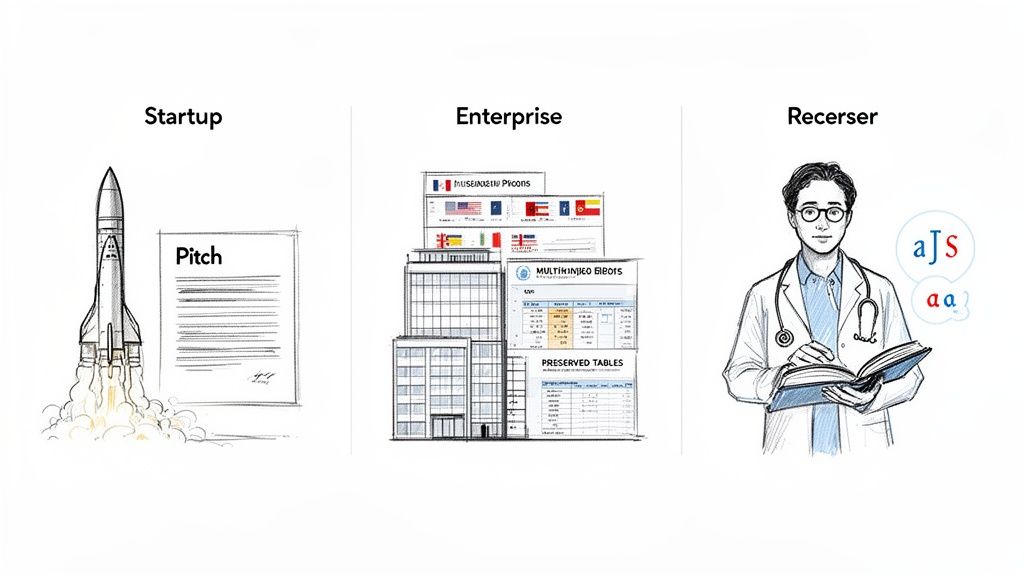
Talking about accuracy and compliance in theory is one thing, but where the rubber really meets the road is in solving real-world business problems. From nimble startups chasing their first round of funding to massive global enterprises, the need for precise, format-perfect translation is universal. Let’s walk through a few scenarios that show how modern solutions help businesses not just survive, but thrive on the global stage.
These aren't just hypotheticals. They show how the right service can deliver fast, affordable, and reliable results, proving that high-quality translation is no longer a luxury for the Fortune 500. It's a powerful tool for growth that's within reach for businesses of all sizes.
The Startup Securing Global Funding
Imagine a fast-growing tech startup. They've got a killer product and a polished pitch deck, but their ideal investors are spread across Europe and Asia. The challenge? They need to translate a dense 50-page business plan—packed with financial projections, market analysis tables, and technical specs—into three different languages. Oh, and the deadline to meet a crucial funding round is the end of the week.
Trying to do this the old-fashioned way is a non-starter. The cost would be prohibitive for a young company, and managing a team of freelancers against a tight deadline is a recipe for disaster.
Instead, they use an AI-powered platform. They upload their DOCX file, and in a matter of hours, they get back three fully translated versions. The platform’s AI does the heavy lifting, translating the text while keeping every single chart and table perfectly intact. A human financial expert then swoops in for a final check, ensuring key terms like "burn rate" and "customer acquisition cost" are flawlessly localized. The result? The startup hits its deadline, impresses investors with crisp, professional documents, and closes its funding round.
The Enterprise Compliance Team
Now, picture a large multinational corporation. Its compliance team is on the hook for preparing quarterly financial reports for shareholders and regulators in five different countries. These documents are complex, highly structured, and legally binding. A single misplaced decimal or a butchered footnote could trigger serious legal and financial blowback.
Their biggest headache isn't just getting the words right; it's the formatting. The reports are a maze of intricate tables, official statements, and legal disclaimers that must look identical in every language. In the past, the team would waste days painstakingly rebuilding these layouts after getting the translated text back—a mind-numbing process ripe for human error.
By bringing a document-preserving translation service into their workflow, they’ve completely changed the game. The platform automatically maintains the original PDF layout, making every translated report a perfect mirror of the source. This doesn't just ensure consistency and compliance; it frees up the team to focus on high-value analysis instead of playing graphic designer.
The demand for this level of precision is driving huge market growth. In fact, the finance and accounting sector is projected to dominate 29% of the translation management systems market by 2025. This trend is all about the non-negotiable need for accuracy in critical documents. You can dive deeper into the data on the booming market for translation management systems.
The Academic Researcher
Finally, let's consider an economic researcher. She’s about to publish a groundbreaking study in several international journals. Her paper is full of complex economic theories, statistical tables, and dozens of critical citations. For her work to earn respect from a global audience, every last detail has to be translated with absolute fidelity.
Her primary fear is that a standard translation tool will misinterpret nuanced academic jargon or, even worse, mangle the footnotes and citations that form the very foundation of her research. The integrity of her entire study is on the line.
She opts for a service known for its sophisticated context handling and format preservation. The AI model has been trained on academic texts, so it nails specialized terms. More importantly, it recognizes and protects every footnote, reference, and data table. She gets back a professionally translated paper that retains all its scholarly rigor, ready for peer review and global recognition.
Integrating Translation into Your Business Workflow
Making financial translation a natural part of your daily operations is how you turn global ambition into reality. The old way—treating translation as an afterthought, a panicked one-off task—just doesn't cut it. It’s time to move beyond chaotic email chains and build a predictable, repeatable process.
It all starts before a single word gets translated. The first step is to get your own house in order. Make sure your source documents are clear, concise, and stripped of any confusing corporate jargon or idioms that won't make sense elsewhere. A well-written original is the bedrock of a great translation; it heads off misunderstandings and saves a ton of rework later on.
Creating an Efficient Translation Process
A simple, smart workflow makes all the difference. Kick things off by creating a shared glossary of your company’s key terms. This might sound small, but it’s a game-changer. It guarantees that your brand names, product features, and internal metrics are handled the same way every single time, no matter who translates them. As you integrate financial translation services, constantly searching for ways of improving workflow efficiency is critical for your long-term success.
A modern, digital-first process should look something like this:
- Centralize Your Files: Set up a single, designated spot for uploading documents like PDFs or DOCX files to your translation platform. This simple act kills version control headaches for good.
- Select the Right Service Tier: Match the service level to the document's purpose. An internal memo? A quick AI-powered translation is probably fine. Your public-facing annual report? That needs the full expert human review.
- Receive and Distribute: When the perfectly formatted translation is ready, it’s a simple click to get it into the hands of your international teams or stakeholders.
Adopting a structured workflow transforms translation from a bottleneck into a business accelerator. It empowers your team to act quickly on global opportunities, knowing they can produce accurate, professional financial communications on demand.
Making It Scalable and Cost-Effective
The goal here is a process that grows right alongside your business. An efficient system doesn't just save you time; it gives you a crystal-clear view of what you're spending. When you understand what drives your final bill, you can make smarter choices and keep your budget in check. Take some time to learn how different factors affect the overall document translation cost and you'll be able to forecast project expenses much more accurately.
Ultimately, weaving financial translation services into your day-to-day work gives you a clear path for communicating effectively across borders. With the right technology and a structured approach, any business can step onto the global stage with confidence.
Frequently Asked Questions
When you're dealing with financial translation, a lot of questions come up around security, technology, and just the nitty-gritty details of the process. It's smart to get these sorted out upfront. Making the right choice protects your business and ensures your global communications hit the mark.
Here are some of the most common questions we hear, with straightforward answers to help guide you.
How Secure Are My Documents?
This is, without a doubt, the most important question you should be asking. Your financial documents are packed with sensitive, non-public information. Any translation service worth its salt will treat security as its absolute top priority, protecting your data from the moment you upload it to the moment it's returned.
You should be looking for a service with several layers of security. Think of it like a bank vault—one lock isn't enough.
- End-to-End Encryption: This is non-negotiable. Your files must be encrypted while they're being uploaded (in transit) and while they're sitting on a server (at rest).
- Secure Data Centers: The provider's servers should be housed in facilities that meet stringent international security standards.
- Automatic File Deletion: A clear, aggressive data retention policy is a great sign. Services that automatically wipe your files after a short window, like 24 hours, dramatically reduce the risk of exposure.
Can AI Really Handle Complex Financial Reports?
It's a fair question, especially given the clunky online translators of the past. The answer is yes, but with a crucial caveat. Today's advanced AI is a powerhouse for many financial documents, but a human expert should always have the final say on high-stakes filings like IPO prospectuses.
Where AI really shines is in handling the heavy lifting. It can tear through internal reports, market research, and first drafts at incredible speed. The real game-changer is its ability to translate dense tables and complex charts without scrambling the layout. This saves an enormous amount of time on reformatting. Think of AI as the tool that does 90% of the work, with a human expert coming in to add that final layer of nuance and validation.
Translation is the simple act of converting words from one language to another. Localization goes deeper, adapting the entire content to feel native to a specific market.
What Is the Difference Between Translation and Localization?
It’s easy to use these terms interchangeably, but they represent two very different levels of service. Think of it this way: translation is the literal foundation, while localization is the fully furnished, culturally-aware building that sits on top of it.
- Translation is all about linguistic accuracy. It’s making sure a sentence in German means the exact same thing in Japanese.
- Localization, on the other hand, adapts that accurate translation to the target culture. This means swapping currency symbols (€ to $), fixing date formats (DD/MM/YYYY to MM/DD/YYYY), and using the correct local regulatory terms.
In finance, localization isn't just a "nice-to-have"—it's essential. It’s what makes a report not just readable, but truly compliant and trustworthy in a new market.
Ready to make your global financial communications seamless? With DocuGlot, you can translate complex documents into over 100 languages while keeping every single table, chart, and header perfectly in place. See how fast, secure, and format-preserving AI translation can work for you. Get your instant translation at DocuGlot.
Tags
Ready to translate your documents?
DocuGlot uses advanced AI to translate your documents while preserving formatting perfectly.
Start Translating