A Guide to Document Translation Services Online
Online document translation services give you a quick, effective way to turn your files into different languages. They often use AI to keep the original formatting and layout intact, which is a game-changer. These platforms are built to handle all sorts of file types, from PDFs to DOCX, making them indispensable for anyone working in a global setting.
Why Online Document Translation Is the New Standard
In a world that’s more connected than ever, breaking down language barriers isn't just a nice-to-have; it's essential. The old way of translating a document was a slow, manual grind that often wrecked the file's professional look. Today, document translation services online are like a modern Rosetta Stone, but with a serious upgrade.
These services do more than just swap words. They preserve the entire document experience. Think about it: you've got a 50-page business proposal loaded with charts, tables, and specific branding. A basic translation tool would spit out a jumbled mess, leaving you to spend hours piecing the layout back together. The best online platforms prevent that nightmare by translating everything—text, structure, and style—in one clean step.
The Shift from Niche Tool to Essential Infrastructure
What used to be a secondary support task has moved to the core of global business. As digital communication exploded across borders, the need for instant, reliable translation went from a convenience to a necessity. Whether it's a legal team sharing contracts internationally, a researcher distributing their latest findings, or a small business localizing product manuals, the demand for translation that respects the original format is massive.
This growing dependency is obvious when you look at the market's explosive growth. The numbers show just how much software-driven solutions are taking over the industry.
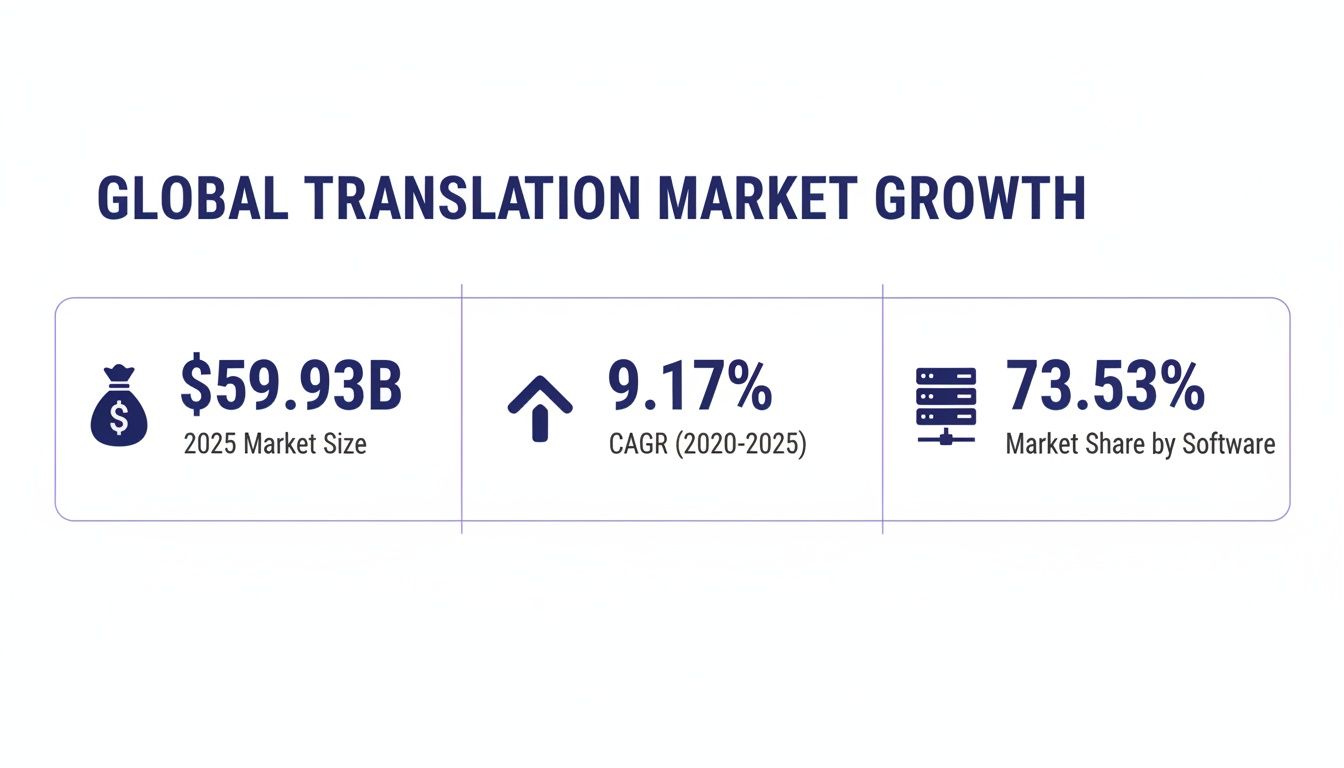
The data speaks for itself. The market isn't just big; it's growing fast, and it's overwhelmingly powered by software and online platforms.
A Modern Necessity for Global Operations
The impact of this shift is huge. Companies can now enter new markets faster, law firms can manage international cases with greater ease, and researchers can collaborate without language getting in the way. The major advantages driving this trend are clear:
- Preserving Integrity: This ensures that critical documents like contracts, reports, and manuals look professional and are structurally identical, no matter the language.
- Boosting Efficiency: It drastically cuts down the time and manual work needed to reformat translated files, freeing up your team for more important tasks.
- Improving Accessibility: Information becomes instantly available to a much wider audience, from international customers to your own multilingual team members.
The global translation services market is projected to be worth around USD 59.93 billion in 2025 and is on track to hit USD 92.95 billion by 2030, growing at a compound annual growth rate of 9.17%. That surge is largely fueled by software, which already holds about 73.53% of the market share as of 2024, all thanks to the power of cloud-based platforms. You can discover more insights about these market trends and what's driving them.
Choosing Your Translator: AI Speed vs. Human Nuance
The very first—and most critical—decision you'll make when using document translation services online is who (or what) will do the translating. This isn't just a simple vendor choice; it's a strategic fork in the road between the brute-force efficiency of AI and the delicate, contextual touch of a human expert. Getting this right from the start is the key to a successful outcome.
Think of it this way: AI translation is your brilliant, lightning-fast junior analyst. It’s perfect for churning through huge volumes of text in minutes. Need the gist of a 100-page report for an internal meeting now? AI is your best friend.
A professional human translator, on the other hand, is the seasoned senior partner you bring in for the high-stakes deals. They handle the documents where every single word matters—legal contracts, creative marketing campaigns, or complex medical reports. In these cases, nuance, cultural fluency, and precision are absolutely non-negotiable.
When AI Is the Smartest Choice
AI-powered translation has found its sweet spot, and it’s not about replacing humans entirely. It’s about leveraging its core strengths—speed and scale—for specific jobs where efficiency is the name of the game.
Here are a few scenarios where AI is the clear winner:
- Internal Communications: Think company-wide memos, training guides, or internal wikis. The goal is clear comprehension, not poetic genius.
- High-Volume Content Processing: Sifting through thousands of customer reviews from different countries or scanning academic papers to spot trends.
- Creating a First Draft: AI can produce a solid first pass in a fraction of the time, which a human expert can then polish. This saves a ton of time and money.
The economics are hard to ignore. As AI gets better, it’s fundamentally changing how businesses handle translation. Many companies are now perfectly happy with an "80% machine-quality output" for internal documents, especially when it can cost up to 80% less and be delivered 10 times faster than a traditional human-only workflow.
Key Insight: The smartest strategy often isn't choosing one or the other. It's about knowing when to use each. Let AI handle the heavy lifting, then bring in human experts to add that final, critical layer of polish where it counts.
The Irreplaceable Value of Human Expertise
For all its power, AI still struggles with one thing: genuine human understanding. A professional translator does far more than just swap words. They interpret intent, adapt cultural idioms, and make sure the tone hits just the right note for the intended audience.
This human touch is indispensable for:
- High-Stakes Legal and Financial Documents: A single poorly translated clause in a contract or financial report can have disastrous consequences.
- Creative and Marketing Content: Brand slogans, ad campaigns, and website copy need to connect emotionally and feel natural, not like a dictionary wrote them.
- Official and Certified Translations: Documents for immigration (like USCIS), academic transcripts, or medical records require a formal certificate of accuracy from a qualified human.
The technology that lets AI handle language is fascinating. If you’re curious, digging into the fundamentals of Natural Language Processing (NLP) helps explain why AI is so good with patterns but still falls short on grasping true intent. We also have a more direct comparison of when to use AI versus human experts for your document translations in our detailed guide.
AI vs Human Translation at a Glance
To make the decision easier, here's a quick comparison of AI and Human translation services across the factors that matter most.
| Factor | AI Translation | Human Translation |
|---|---|---|
| Speed | Nearly instantaneous, handles huge volumes in minutes. | Takes time, depends on document length and complexity. |
| Cost | Very low cost, often free for basic use. | Significantly higher cost, priced per word or project. |
| Accuracy | Good for gist and literal meaning, but prone to errors. | High accuracy, with context and nuance preserved. |
| Nuance & Culture | Lacks cultural understanding; often misses idioms. | Excellent; adapts content for cultural relevance and tone. |
| Best For | Internal docs, large-volume analysis, first drafts. | Legal, marketing, medical, and official documents. |
| Certification | Cannot provide certified translations for official use. | Provides legally recognized Certificates of Accuracy. |
Ultimately, there's no single "best" choice—only the right choice for your specific document. By weighing AI's raw efficiency against the irreplaceable nuance of a human expert, you can build a translation strategy that's both cost-effective and perfectly suited to your needs.
Picking the Right Translation Service: What Really Matters
Choosing an online document translation service can feel a bit like navigating a maze. So many options, so many features—how do you know which one to trust? The truth is, not all services are built the same. A truly reliable platform stands on a few non-negotiable pillars that safeguard your document’s integrity, your data, and your deadlines.
Think of the next few sections as your personal buyer’s guide. Before you even think about uploading a file, you need to know what to look for. By evaluating any potential service against these core features, you can sidestep common headaches like scrambled formatting, surprise costs, and security risks.
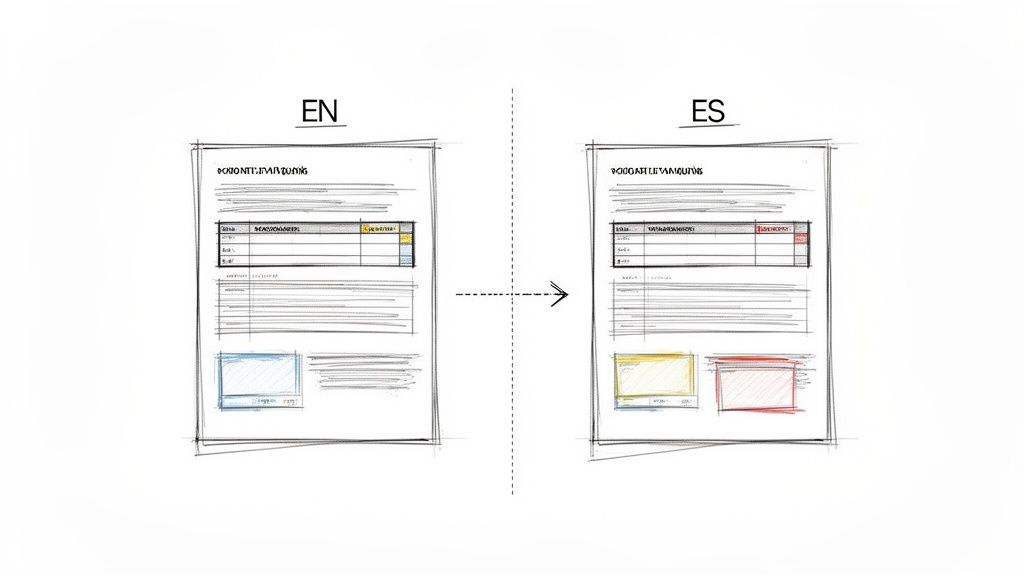
1. Perfect Format Preservation
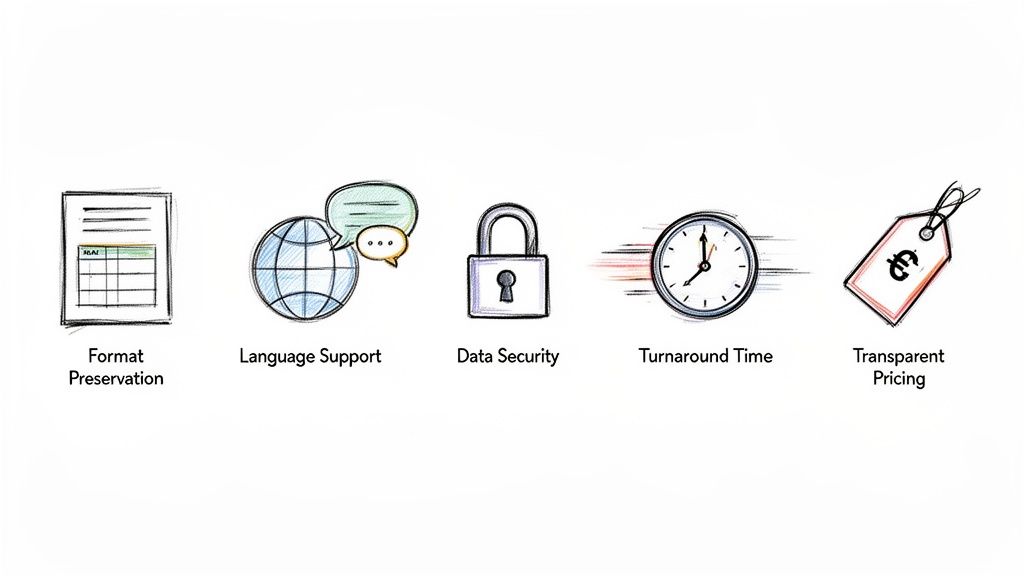
Imagine you’ve just poured weeks into crafting a 100-page business proposal. It’s perfect—filled with custom tables, carefully placed images, and specific fonts. You upload it for translation and get back a wall of plain text. All your hard work, gone. This is, without a doubt, the most common failure of basic tools and the #1 feature you need to investigate.
A top-tier service does more than just swap words; it deconstructs and rebuilds your entire document. Your translated file should be a perfect mirror of the original, keeping everything just as you intended.
This means preserving:
- Layout and Structure: Headers, footers, columns, and page breaks stay exactly where you put them.
- Visual Elements: Charts, graphs, and images remain intact and correctly positioned.
- Typography: Fonts, text sizes, bolding, and italics are all maintained for a professional finish.
This single feature is the difference between a document that’s ready to go and one that needs hours of manual, frustrating rework.
2. Comprehensive Language Support
Don't be fooled by a simple number. A service might boast support for 100+ languages, but the real value is in the details. True quality lies in a platform's ability to handle crucial regional dialects.
For instance, simply translating into "Spanish" isn’t specific enough. Do you need Castilian Spanish for an audience in Madrid, or Latin American Spanish for a campaign in Mexico City? The same nuance applies to Portuguese (Portugal vs. Brazil) and Chinese (Simplified vs. Traditional). A service that offers this level of granularity shows it understands global communication, ensuring your message is not just understood, but culturally on-point.
3. Ironclad Data Security
When you upload a sensitive legal contract, a confidential financial report, or private medical records, you’re placing a huge amount of trust in that provider. That trust needs to be earned with transparent, robust security measures.
Key Takeaway: Never, ever compromise on security. Your documents are valuable. A reputable service will treat their protection as its highest priority, with clear and verifiable security protocols.
Look for platforms that treat rock-solid security as a standard feature, not a premium add-on. Here’s what that looks like:
- End-to-End Encryption: Your files must be encrypted from the moment you upload them to the moment you download them (in transit) and while they’re stored on the server (at rest).
- Automatic File Deletion: The best services have a strict data retention policy, automatically and permanently wiping your files from their servers after a short window, like 24 hours.
- A Clear Privacy Policy: The provider should state, in no uncertain terms, that they will never share your documents or personal data with anyone.
These aren't just technical buzzwords; they are essential safeguards against data breaches and privacy violations. For a closer look at what separates the good from the great, our guide to the best document translation software digs deeper into evaluating providers.
4. Predictable Turnaround and Transparent Pricing
Finally, a reliable service respects your two most valuable resources: your time and your money. There should be absolutely no guesswork involved. From the moment you upload a document, you should get instant, clear answers on turnaround time and cost.
Predictable turnaround times are essential for planning. A quality platform will analyze your document's length and give you a solid estimate, whether it's a few minutes for a short memo or a couple of hours for a dense report.
Transparent pricing is just as critical. You should see the exact cost before you click "translate." This is usually based on the word count of your original document, with no hidden fees or surprise charges down the line. An instant quote puts you in control.
Document Translation Service Evaluation Checklist
To help you make the right choice, use this checklist to weigh your options. It breaks down the essential features and explains why each one is critical for getting the results you need.
| Feature | What to Look For | Why It Matters |
|---|---|---|
| Format Preservation | Does it maintain the original layout, tables, images, and fonts? Look for "mirror-image" replication. | Saves you hours of manual reformatting and ensures your document remains professional and ready-to-use. |
| Language Support | Does it offer specific regional dialects (e.g., Brazilian Portuguese vs. European Portuguese)? | Ensures your message is culturally appropriate and resonates with your specific target audience. |
| Data Security | Are files end-to-end encrypted? Is there an automatic file deletion policy (e.g., within 24 hours)? | Protects your sensitive information from unauthorized access and data breaches. |
| Turnaround Time | Does the service provide an instant, automated time estimate before you pay? | Allows for accurate project planning and helps you meet tight deadlines without any guesswork. |
| Pricing Model | Is the pricing transparent and upfront, based on word count? Are there any hidden fees? | Provides budget clarity and prevents unexpected costs, allowing you to make an informed financial decision. |
| File Type Support | Can it handle all your common file types (PDF, DOCX, PPTX, XLSX, etc.) without conversion issues? | Offers flexibility and convenience, so you don't have to waste time converting files before translation. |
| Translation Quality | Does it use advanced AI models? Is there an option for human review for high-stakes documents? | Determines the accuracy and readability of the final output. The right balance of AI speed and human nuance is key. |
By methodically checking these boxes, you can confidently select a service that not only meets your technical requirements but also becomes a trusted partner in your global communication efforts.
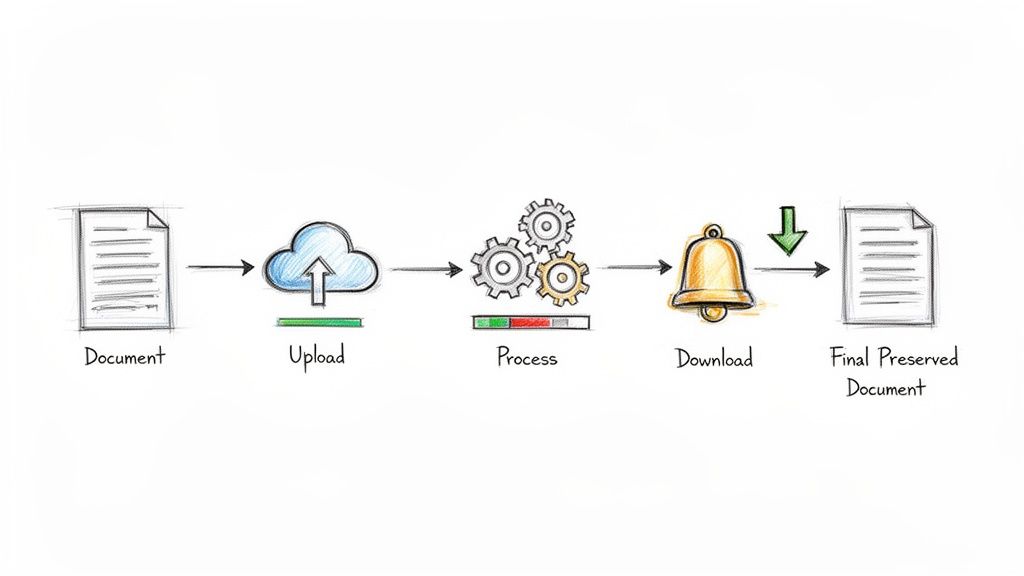
What Actually Happens to Your Document? From Upload to Download
Thinking about how an online document translation service works can feel a bit like a black box. You upload a file, and a translated one comes out. But what happens in between?
Let's walk through a real-world example to pull back the curtain. Imagine we have a critical 50-page business proposal in a DOCX file. It’s packed with tables, charts, and specific branding. Messing up the layout is simply not an option. Our mission: translate it from English into both German and Japanese to send to potential partners.
This is how it unfolds on a modern platform.
A clean, simple interface is your starting point. A clear "Upload" button and intuitive language selectors mean you can get started right away without any friction.
Stage 1: The Secure Upload
First things first, you have to get the document into the system. Instead of attaching it to a risky email, you'll use the platform’s secure portal. We just drag and drop our 50-page DOCX file right into the browser.
The best services use end-to-end encryption, which means your file is protected from the second it leaves your computer. This isn't just a fancy feature; it's a must-have for protecting sensitive business strategies and financial data from being intercepted.
Stage 2: Picking Your Languages and Quality Level
Once the file is uploaded, the platform asks what you need. We select German and Japanese from a dropdown list. Then comes an important choice: the service tier. This usually comes down to the quality of the AI model you want to use—maybe a "Basic" tier for getting the general gist of a document, or a "Premium" tier that uses more sophisticated AI for complex business language.
For a high-stakes proposal like ours, we're definitely choosing the Premium tier. This gives us the best shot at getting the nuance and professional tone right, which is everything in business communication.
Stage 3: Getting an Instant Price
Before you hit "go," you need to know what it will cost. A transparent platform shows you the price right away. The system scans the document's word count—let’s say it’s 15,000 words—and calculates the exact price based on the languages and the Premium tier we selected.
No hidden fees. No waiting for a sales rep to call you back. You see a clear, upfront cost for each language, letting you make a quick, informed decision. This kind of transparency is a huge sign of a customer-focused service.
A Quick Tip: If you're working with a PDF, the process is pretty much the same. But, because of how complex PDF layouts can be, they sometimes throw a curveball. It's a good idea to learn how to translate a PDF while keeping the format so you can prep your file for the best results.
Stage 4: The Magic of Automated Translation
With everything confirmed, we click "Translate." This is where the platform’s AI engine really shines. It’s not just swapping words; it’s analyzing the entire document's structure.
Here’s a quick look at what’s happening behind the scenes:
- Content Extraction: The system carefully pulls out all the text while creating a map of where every table, image, and header belongs.
- Neural Machine Translation: That text is then run through advanced neural networks that are specifically tuned for business German and Japanese.
- Document Reconstruction: Finally, the newly translated text is placed back into a new document, perfectly rebuilding the original layout.
For a 50-page file, this whole process might take about an hour. A good service will show you a progress bar and, more importantly, shoot you an email the second it's ready.
Stage 5: The Final Download
An email lands in our inbox with a secure link to our translated documents. With a single click, we download two brand-new files: Business-Proposal_DE.docx and Business-Proposal_JP.docx.
When we open them up, we see perfectly translated proposals. The tables are all there, the charts are in the right spots, and our company branding looks exactly as it should. A task that once took a team of people weeks to complete is now done in under an hour. The entire journey, from start to finish, is handled through a secure and incredibly efficient workflow.
Real-World Scenarios Where Online Translation Excels
It's one thing to talk about features, but it’s another to see how a tool actually solves a real-world problem. That's where the value of document translation services online really clicks. These aren't just abstract pieces of tech; they're practical answers to specific, often high-stakes, challenges that professionals run into every single day.
Let's step away from the spec sheets and look at a few tangible scenarios. By exploring these use cases, you'll see exactly how the blend of speed, accuracy, and format preservation leads to real, measurable results.
For the Small Business Entering New Markets
Picture a small e-commerce shop that sells artisanal coffee makers. They're a hit locally, but they see a huge opportunity to expand into Europe—specifically Germany, France, and Spain. The biggest roadblock? The language barrier. All their detailed product manuals, marketing flyers, and warranty cards are in English.
The Challenge:
Translating and then manually reformatting every document for three new languages would be a logistical nightmare. The manuals are loaded with diagrams, technical spec tables, and step-by-step instructions. If that formatting gets messed up, the manuals become confusing and unprofessional, tarnishing the brand’s reputation before they even make their first sale.
The Online Solution:
The business owner uses a service that’s built to preserve formatting. They simply upload their original design files (like a DOCX or PDF). In just a few hours, they get back perfectly translated versions that look identical to the originals. The tables are intact, the diagrams are in the right place, and the branding is consistent. This lets them launch in three new markets at once with polished, print-ready materials, massively speeding up their time-to-market.
For the Legal Team Managing International Contracts
Now, think about a corporate law firm handling a merger between an American tech company and a Japanese manufacturing giant. The deal involves hundreds of pages of legal contracts, financial statements, and due diligence reports. Here, accuracy isn't just important—it's everything. But so is efficiency, and the document’s structure is legally critical.
The Challenge:
These contracts are full of specific clauses, numbered lists, and footnotes that have to stay exactly where they are. A simple text-only translation would create a jumbled mess, making it nearly impossible for the Japanese legal team to review the documents properly. On top of that, the sensitive nature of the deal makes data security a massive concern.
The Online Solution:
The legal team opts for a secure, enterprise-grade online service that offers end-to-end encryption and an automatic file deletion policy. They upload the complex DOCX files and get back translated versions that maintain every single structural detail.
Key Advantage: This is about more than just words; it's about preserving the document's legal framework. The translated contract is a mirror image of the original, so both legal teams can reference specific sections and clauses without any confusion. The result is a much smoother and faster negotiation.
For the Academic Researcher Sharing a Thesis
An academic researcher has just finished a groundbreaking 200-page PhD thesis in PDF format. To get international recognition and collaborate with peers in South Korea, she needs to translate the entire work. Her thesis is dense, packed with complex charts, data tables, scientific formulas, and a long bibliography.
The Challenge:
The sheer size of the document makes manual translation incredibly expensive and slow. But more importantly, the intricate formatting of the charts and citations is essential to the paper's integrity. A corrupted layout would make the research hard to follow and could seriously undermine its credibility.
The Online Solution:
The researcher uploads her massive PDF to a platform designed to handle book-length projects. The service translates the entire thesis while meticulously reconstructing the charts, keeping the bibliography's formatting perfect, and ensuring all visual data stays intact. She gets back a professionally translated thesis that’s ready for international review, accelerating her ability to collaborate and share knowledge across the globe.
For the Healthcare Provider Improving Patient Accessibility
A large hospital in a diverse city serves many Spanish-speaking and Vietnamese-speaking patients. To improve care and ensure everyone gives informed consent, they need to translate dozens of critical documents: patient intake forms, medical history questionnaires, post-op care instructions, and more.
The Challenge:
These forms are often complex, with checkboxes, tables, and layouts designed to guide patients through the process. The hospital's administrative team simply doesn't have the time or design skills to recreate all these forms in multiple languages. They also need a solution that works for different digital formats; for instance, knowing the best way of translating Google Forms is a huge plus for gathering patient feedback.
The Online Solution:
By using a document translation service, the hospital's operations team can quickly get their entire library of patient forms translated. They upload the original files and, in a short time, have formatted, ready-to-use versions in Spanish and Vietnamese. This doesn't just help them meet accessibility standards; it builds trust and improves patient safety by giving people clear information in their own language.
Got Questions? Let's Clear Things Up.
Diving into the world of online document translation can feel a little daunting. It's completely normal to have questions swirling around, especially when you're dealing with important files. Is it secure? Can a machine really get the nuance right? What’s going to happen to my beautifully formatted report?
These are all valid concerns. Let's tackle them head-on, one by one. Think of this as a no-nonsense Q&A session to give you the confidence you need.
How Secure Are My Documents With an Online Service?
This is usually the first question on everyone's mind, and for good reason. Trust is everything when you’re uploading sensitive information. The best services treat security as their absolute top priority, not an afterthought.
The gold standard here is a multi-layered security protocol. Look for services that use end-to-end encryption for your files, both while they're being uploaded (in transit) and while they're stored on a server (at rest). This basically scrambles your data, making it completely unreadable to anyone who shouldn't have access.
A truly trustworthy provider will also be crystal clear about their data retention policy. An excellent sign is the automatic and permanent deletion of your files from their servers after a short period, like 24 hours. This dramatically shrinks the window of exposure and shows a real commitment to your privacy.
The Privacy Promise: A reputable service will have an ironclad, easy-to-find privacy policy that explicitly states they will never share your documents with third parties. If a provider is vague or cagey about their security practices, that's a massive red flag.
Can AI Really Handle Complex Legal or Technical Jargon?
It's a fair question. Not too long ago, the answer would have been a hard "no." But modern AI has come a long, long way. Today’s neural machine translation (NMT) models are trained on gigantic, specialized datasets, which makes them surprisingly good at navigating the dense terminology in legal, medical, and technical documents.
Premium AI tiers, in particular, can grasp context with a level of precision that was unthinkable just a few years ago. They can correctly translate complex clauses in a contract or specific technical terms in an engineering manual with a very high degree of accuracy.
But let’s be realistic. For documents where the stakes are highest—think court filings, patent applications, or clinical trial data—the smartest play is often a hybrid approach.
- Step 1: Use a high-quality AI service for a fast, cost-effective first draft. This will get you about 95% of the way there in a fraction of the time and cost.
- Step 2: Have a human expert, a specialist in that specific field, review the AI-translated document. This final polish ensures every critical nuance is absolutely perfect.
This two-step process gives you the best of both worlds: the incredible speed of AI and the irreplaceable judgment of a human professional.
What Happens to My Formatting—My Tables, Charts, and Layout?
This question gets right to the heart of what separates a great service from a deeply frustrating one. We've all been there: you copy and paste something, and the formatting completely explodes. It becomes a chaotic wall of text that takes hours to fix.
A true format-preserving platform is engineered to prevent this exact nightmare. It doesn't just read the words; it analyzes the entire structure of your document. It intelligently maps out where every table, chart, header, footer, image, and even font style belongs.
Once the text is translated, the service meticulously rebuilds the document in the new language, making sure it's a perfect visual mirror of the original. This feature is non-negotiable for professional materials like business reports, product manuals, or marketing presentations where the layout is just as important as the content. Without it, you’re only getting half the job done.
How Do I Know the Final Cost Before Committing?
Nobody likes surprise fees. Pricing transparency is a huge indicator of a company that respects its customers. You should never have to guess what the final bill will be or hand over your credit card just to see a price tag.
A quality platform will give you an exact price quote instantly, right after you upload your document and choose your language and service level. The cost is almost always based on the word count of the source document—a fair and straightforward metric.
This instant quote should appear with no strings attached. You shouldn't have to sign up, create an account, or enter payment details to get it. This puts you in the driver's seat, allowing you to make a fully informed decision without any pressure or hidden charges.
Ready to try a translation service that keeps your formatting pristine and your data private? With DocuGlot, you can translate your documents into over 100 languages with total confidence. Get an instant quote and see just how simple it can be. Try DocuGlot today
Tags
Ready to translate your documents?
DocuGlot uses advanced AI to translate your documents while preserving formatting perfectly.
Start Translating