Document Translation: A Practical Guide to Mastering document translation
Document translation is the process of converting a written document from one language to another. But it's so much more than just swapping out words. True document translation is about preserving the entire document—the original formatting, the layout, the tables, and all the visual elements. The goal is to produce a translated file that is instantly ready to use.
What Is Document Translation and Why Does It Matter?
Think of it like this: you need to rebuild an exact replica of a house in another country. Just replacing the original bricks with local ones won't cut it. That's simple word-for-word text replacement. To truly succeed, you have to replicate the architectural plans (the formatting), the complex systems like plumbing and electrical (the tables and charts), and the interior design (the styles and fonts).
This is the central challenge of modern document translation. In a globalized world, businesses, legal experts, and academics are constantly sharing complex files across borders. A poorly translated document—one where tables are a mess, paragraphs don't line up, and headers are missing—just creates confusion, wastes valuable time, and looks unprofessional. The real objective is a final document that looks and feels identical to the source, just in a new language.
The Driving Force Behind Format Preservation
The need to preserve a document's structure isn't about looks; it's a critical business function. Clear, professional communication is the backbone of everything from international sales contracts to global marketing campaigns. When a translated user manual is impossible to read or a legal agreement loses its structure, the fallout can be serious.
This demand is reflected in the numbers. The global market for document translation services was valued at $34,496.3 million in 2021 and is on track to hit $44,562 million by 2025. For companies regularly dealing with complex DOCX or PDF files, services that keep the original layout intact can slash post-translation editing time by up to 50%. That’s a huge win for efficiency.
At its heart, document translation is about fidelity—not just to the words, but to the entire document's integrity. It ensures that your message, intent, and professionalism are understood perfectly, no matter the language.
Key Challenges in Document Translation
Translating documents accurately while preserving their original structure is fraught with challenges. The traditional approach often leads to frustrating and time-consuming manual rework. Here’s a look at the common roadblocks and how modern solutions are changing the game.
| Challenge | Traditional Approach Impact | Modern Solution Advantage |
|---|---|---|
| Complex Formatting | Manual reformatting of headers, tables, and lists after translation, which is slow and prone to errors. | Automated layout preservation technology keeps the original structure, saving hours of tedious work. |
| File Type Incompatibility | Converting files like PDFs to editable formats often breaks the layout, requiring extensive cleanup. | Direct translation of complex file types (PDF, DOCX, PPTX) without intermediate conversion steps. |
| Mixed Content | Images with embedded text or complex diagrams are often skipped or require separate, manual translation. | Advanced tools can extract and translate text from images, keeping visual context intact. |
| Consistency | Maintaining consistent terminology across large documents or multiple files is difficult and leads to confusion. | Use of translation memory (TM) and glossaries ensures key terms are translated uniformly every time. |
These obstacles highlight why a simple "translate text" button is never enough for professional documents. A comprehensive solution is needed to handle the entire file, not just the words within it.
Key Reasons Format-Preserving Translation is Essential
The demand for high-fidelity translation is driven by a few key factors that affect professionals across the board:
- Globalization and Market Expansion: When companies expand into new markets, they need to localize everything from product guides to marketing materials. Preserving the original branding and layout is non-negotiable for maintaining a consistent global identity.
- Cross-Border Collaboration: International teams depend on shared documents for projects, reports, and daily communication. A smooth translation workflow means everyone is on the same page—literally—without wasting time fixing broken files.
- Legal and Compliance Requirements: In fields like law and medicine, the structure of a document can be just as important as the words. Contracts, patents, and patient records have to maintain their exact formatting to be legally valid and easily understood. You can learn more about choosing the right online document translation services to meet these critical needs.
What a Modern Translation Workflow Actually Looks Like
Think of modern document translation as a highly efficient assembly line, one that takes your original document and produces a perfect mirror image of it in another language. The entire process is built to handle everything—from tricky layouts in a PDF to massive files—so that what you get back is professional and ready to use. It all kicks off the second you hit "upload."
It doesn't matter if you're starting with a DOCX file, a polished PDF, or a plain TXT file. The first step is always analysis. The system does more than just count words; it maps out the document's entire architecture. We're talking headers, footers, tables, images, and all the little formatting styles that give it structure. Keeping that layout intact is non-negotiable. After all, what good is a translated report if a critical table is broken or a heading is lost in the shuffle?
From Upload to Translation Engine
Once the system has a blueprint of your file's structure, it gets the content ready for the translation engine. This is where a clever bit of tech called intelligent chunking comes into play. Instead of trying to swallow a 200-page report whole, the system breaks it down into manageable segments, or "chunks."
This approach neatly sidesteps system overloads and those frustrating page limits you might see elsewhere. It means even a book-length manuscript can be processed smoothly. Each little chunk holds onto its original context, which helps the translation engine do its job accurately before everything is put back together at the end.
This flow chart gives you a quick look at the kind of structural challenges a modern workflow is designed to solve.
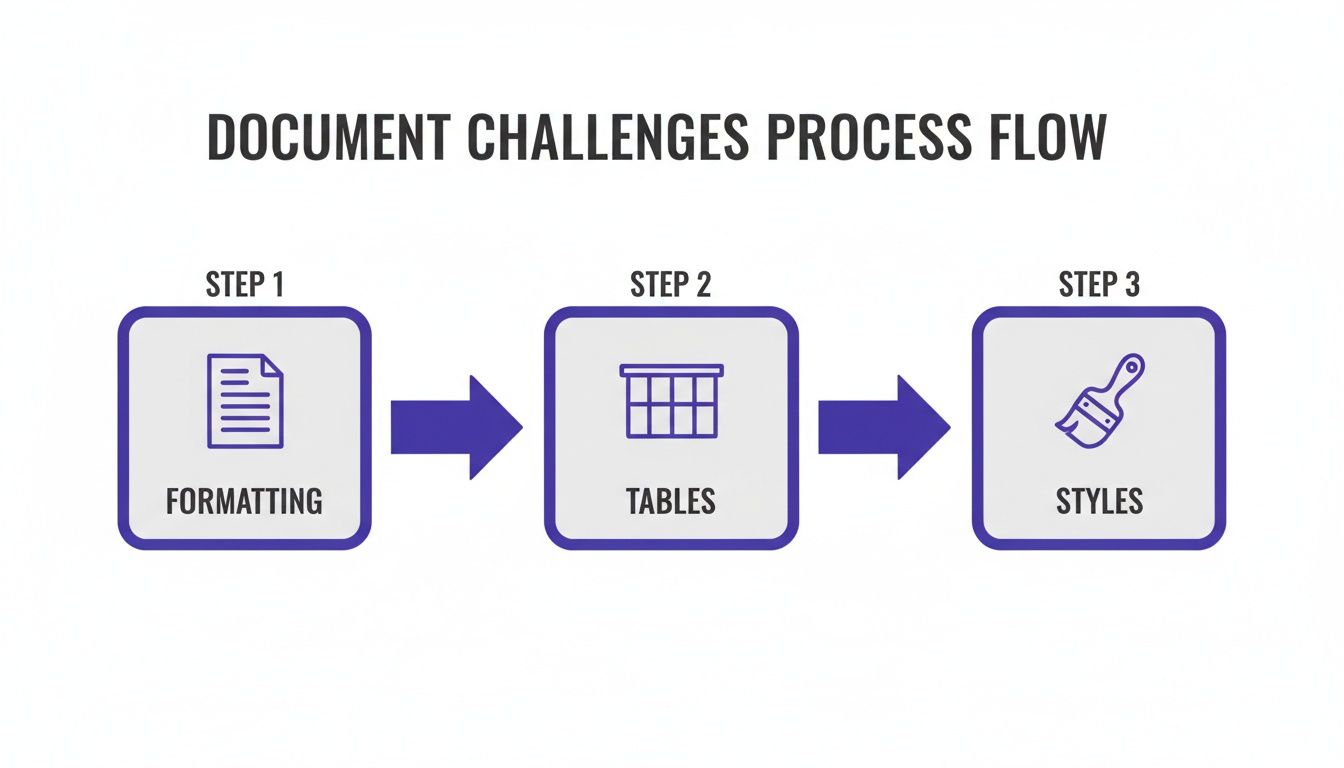
As you can see, key elements like formatting, tables, and styles are handled in a specific order to preserve the document's integrity from start to finish.
AI vs. Human: The Power Behind the Process
The heart of the workflow is the translation engine itself, and you generally have two options: AI or human. Each has its place, and knowing the difference will help you pick the right tool for the job.
- AI Translation (Machine Translation): This is the powerhouse behind most of today's automated services. Fueled by sophisticated neural networks, AI delivers incredible speed and is much easier on the budget. It’s a fantastic fit for a huge range of tasks, from internal company memos to translating massive volumes of user manuals where getting it done fast is the top priority.
- Human Translation: Here, a professional linguist translates the document by hand. It's a lot slower and costs more, but it remains the undisputed champion for content that needs a deep understanding of culture, a creative touch, or absolute legal precision—think major marketing campaigns or court filings.
For the vast majority of business, academic, and personal documents, AI translation strikes a powerful balance of speed, accuracy, and cost. The technology has come so far that it can now handle complex sentences and industry-specific jargon with impressive skill.
Choosing Your Quality Tier
When you go the AI route, you'll often see different quality tiers offered. This isn't just about good vs. bad translation; it's about matching the sophistication of the AI model to the complexity of your document.
- Basic Tier: This is your go-to for general-purpose translation. It uses a solid AI model that’s great with straightforward content, making it perfect for things like internal emails or documents where the main goal is just clear understanding.
- Premium Tier: This option uses a more advanced, context-aware AI model. It's been specifically trained on nuanced language, complex jargon, and subtle idioms. This makes it the clear winner for technical papers, legal agreements, and financial reports where every single word counts.
You can think of it as the difference between someone who is fluent in a language (Basic) and a subject matter expert who also happens to be a native speaker (Premium). Both are correct, but the expert gives you a much deeper and more precise understanding of specialized topics. To get a better handle on the bigger picture, exploring modern translation practices can fill in a lot of the gaps.
Ultimately, the entire workflow—from file analysis and chunking to engine selection and final reassembly—is designed to make your life easier. It takes care of all the tedious, mechanical work so you can get a high-quality, perfectly formatted document in a fraction of the time and cost of old-school methods.
Who Needs Document Translation and Why?
The need for high-quality document translation isn't some abstract business theory. It’s a real, often urgent, problem for people in all sorts of industries every single day. The specific reasons might differ, but the goal is always the same: get a translated file back that is accurate, looks right, and is ready to use immediately.
Let's walk through a few scenarios where this isn't just a "nice-to-have," but an absolute necessity.
Businesses Entering New Markets
Picture a marketing team at a growing tech startup. They’ve poured everything into a brilliant new product and are ready to launch in Japan. Their entire strategy depends on having a perfect Japanese version of their product manual—a complex DOCX file packed with technical diagrams, spec tables, and branded headers.
They try a free online tool first, and it's a complete mess. The text itself is awkward, but the real disaster is the formatting. The layout is destroyed. Tables are shattered, images are all over the place, and the professional design they obsessed over for weeks is gone. This file isn't just unusable; it's embarrassing. It could kill their brand credibility before they even get started.
With their launch date looming, they try a proper document translation service. They upload the original DOCX, and just hours later, they get a flawless Japanese version back. Every table, header, and image is exactly where it should be. They can now hit their deadline, look professional, and give their new customers the clear instructions they need. The headaches of slow turnarounds and broken files are gone.
Legal Professionals Managing Compliance
Now, think about a legal team in the middle of a cross-border merger. They're juggling dozens of legal contracts, compliance forms, and evidence files between teams in the United States and Germany. In this world, precision is everything.
A single clause or even a footnote in the wrong place can change the entire meaning of a contract. A messed-up table in a compliance form could trigger huge regulatory fines. They simply can't risk any structural mistakes because the document's integrity is just as important as the words themselves.
By using a service that preserves formatting, the team can convert these critical documents with confidence. A 50-page English contract becomes a 50-page German contract with the exact same layout. This ensures both legal teams are literally on the same page, preventing costly misunderstandings and keeping the high-stakes merger moving forward.
This demand for precision is a huge driver of market growth. The translation services market is projected to jump from USD 956.81 billion in 2025 to USD 1.18 trillion by 2035. A massive piece of that pie—over 25.5%—is expected to come from the judicial segment, as global business demands more and more flawless contract translations. You can dive deeper into these trends in Research Nester's detailed report.
Academics Collaborating on Research
Finally, imagine a university researcher working with an international colleague on a new study. They’re constantly sharing dense academic papers filled with citations, complex charts, and the rigid formatting required by scientific journals. For them, preserving that structure is non-negotiable if they want to get published.
If the researcher needs to translate a colleague's paper from French to English, a simple copy-paste job would be a catastrophe. It would strip out all the crucial academic formatting. Citations would turn into plain text, data tables would be a jumbled mess, and the document would be useless for collaboration or submission.
Instead, by using a tool built for document translation, the researcher can upload the paper and get a new version back with every citation, table, and style element perfectly intact. This makes global collaboration seamless, allowing scholars to share knowledge without the frustrating task of manually rebuilding their work. In every one of these cases, the right translation workflow provides a direct, powerful solution to a very real problem.
How to Ensure Your Documents Remain Secure
When you upload a sensitive file for document translation, you're handing over a lot of trust. It could be a confidential business contract, private medical records, or proprietary research. In these cases, security isn't just a nice-to-have feature—it's everything. Protecting that data properly involves a few key layers, starting the second you hit "upload."
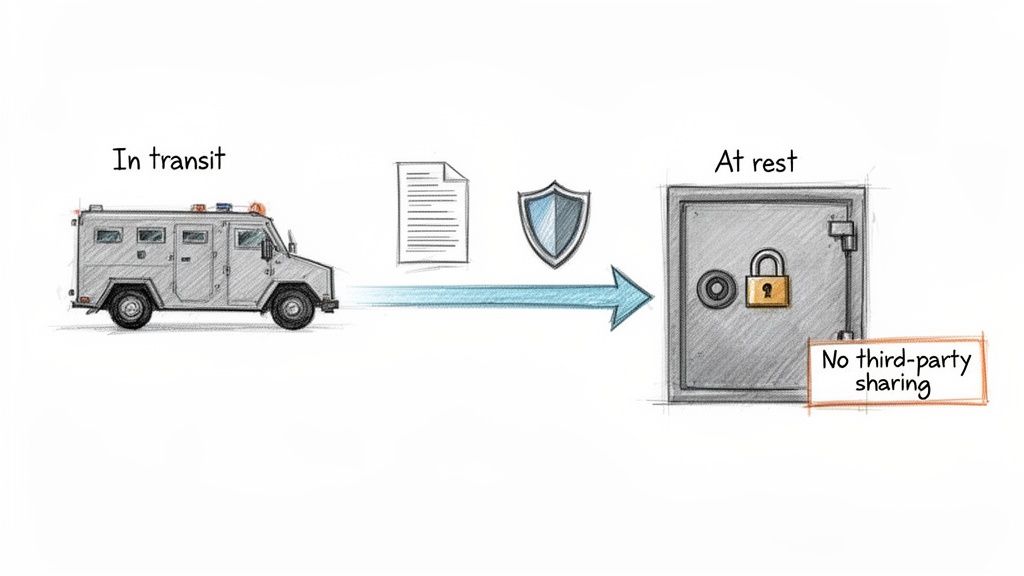
Think of the journey your document takes in two stages. First, there's encryption in transit. This is like putting your file in a locked, armored van for its trip from your computer to the service's servers, making sure no one can peek at it along the way.
Then, once it arrives, it needs encryption at rest. This is the digital equivalent of a secure bank vault. It ensures your file stays locked down and unreadable while it's being stored and processed.
The Cornerstones of Data Privacy
Encryption is the technical foundation, but a company’s policies are just as crucial. These two rules separate a truly professional service from a casual tool and should be non-negotiable when you're dealing with sensitive information.
A solid security framework always includes:
- A Strict No Third-Party Sharing Policy: Your documents should never, ever be shared with or sold to outside companies. The provider must guarantee your data is used only for the translation you requested—and nothing more.
- Automatic File Deletion: A trustworthy service should have a clear, automated policy for deleting your files after a set period, like 24 hours. This drastically shrinks the window of risk and ensures your data isn't just sitting on their servers forever.
This combination of strong encryption and strict data handling creates a secure environment you can trust with even the most confidential materials.
Your privacy is paramount. A service's commitment to security should be clear, absolute, and backed by transparent policies. If a provider is vague about how they protect your data, consider it a major red flag.
Why Security Matters in the Age of AI
The rise of AI has made document translation faster and more accessible than ever. With neural machine translation now achieving over 95% accuracy for major languages, it's no surprise that adoption has skyrocketed—over 70% of European professionals now use it in their work. Security-conscious platforms that offer strong encryption and auto-deletion are especially critical for healthcare providers translating patient records, where both precision and privacy are absolutely vital.
For legal, medical, and corporate users, these security measures are a must. A breach of client confidentiality or patient data can have devastating consequences, which is why a verifiable commitment to data protection is so important. And it doesn't stop at translation; maintaining the integrity of your documents is an ongoing process where a robust modern legal document management system is essential.
When you're shopping for a document translation provider, you need to scrutinize their security features just as closely as you do their translation quality. They're two sides of the same coin. A service that excels at both gives you the confidence to translate any document without a second thought.
Getting a Grip on Price, Speed, and Quality
When you're looking for a document translation service, it often feels like you're juggling three things: cost, speed, and the quality of the final product. Getting these three to work together is the real secret to finding a service that actually helps you, rather than just giving you a cheap but unusable file. The goal should be a process that’s clear, predictable, and delivers excellent results every single time.
A lot of translation services are stuck in the past, forcing you into an old-school, quote-based system. You upload your document, fill out a bunch of fields, and then... you wait. Eventually, an email lands in your inbox with a price. This back-and-forth is not only slow but it keeps you in the dark, making it nearly impossible to quickly compare your options. The modern, and frankly better, way to do it is with transparent, instant pricing. You should see the exact cost before you ever hit "translate."
How Much Should This Actually Cost?
Transparent pricing puts you in the driver's seat. The best services use a simple cost-per-word model, so you see the total fee upfront. No hidden charges, no surprises after the fact.
Another thing to watch out for is the minimum cost. Many providers hit you with a high minimum charge, which is a real pain if you just need to translate a simple one-page memo. A service with a low minimum fee is a lifesaver for individuals and small businesses who have smaller, occasional translation needs. If you want to see how this all plays out in a real budget, it's worth exploring a full breakdown of document translation costs and pricing models.
How Long Will This Take?
Often, speed is just as critical as the price tag. When you're using an AI-powered service, the main things that affect turnaround time are the document's length and how complex its formatting is. A quick, one-page letter might be done in a couple of minutes, while a dense, 200-page technical manual could take a few hours.
The whole process should be hands-off. You upload the file, and the system takes it from there without needing you to babysit it. A feature that makes a huge difference is email notification. Getting a simple "Your file is ready" email lets you switch gears and focus on other work instead of constantly checking a progress bar.
The best services don't force a trade-off between speed and convenience. They blend fast, automated translation with smart notifications, so you're never left waiting around for a file to finish.
It All Comes Down to the Tech
At the end of the day, the quality of your translation depends entirely on the AI engine doing the heavy lifting. And let's be clear: not all AI is created equal. The top services rely on enterprise-grade AI models that are constantly being refined to better grasp context, industry-specific jargon, and the subtle nuances of language.
This is precisely why having different quality tiers, like Basic and Premium, is so incredibly useful.
- Basic AI Models are fantastic for everyday documents. Think internal memos, general correspondence—anything where getting the main point across clearly is the goal.
- Premium AI Models are trained on much more specialized and complex data. This makes them far more adept at handling the precise terminology found in legal contracts, scientific papers, or technical user guides.
Paying for a service that uses better AI isn't just an extra cost; it's an investment in the final document. It’s what separates a translation that’s just "good enough" from one that’s truly professional, accurate, and ready to be shared.
Best Practices for Flawless Translation Results
Getting a perfect document translation isn't just about picking the right tool; it's about the process. A few simple steps, both before you upload your file and after you get it back, can make all the difference between a good translation and a great one. Think of it as a partnership—the work you do upfront sets the stage for a successful outcome.
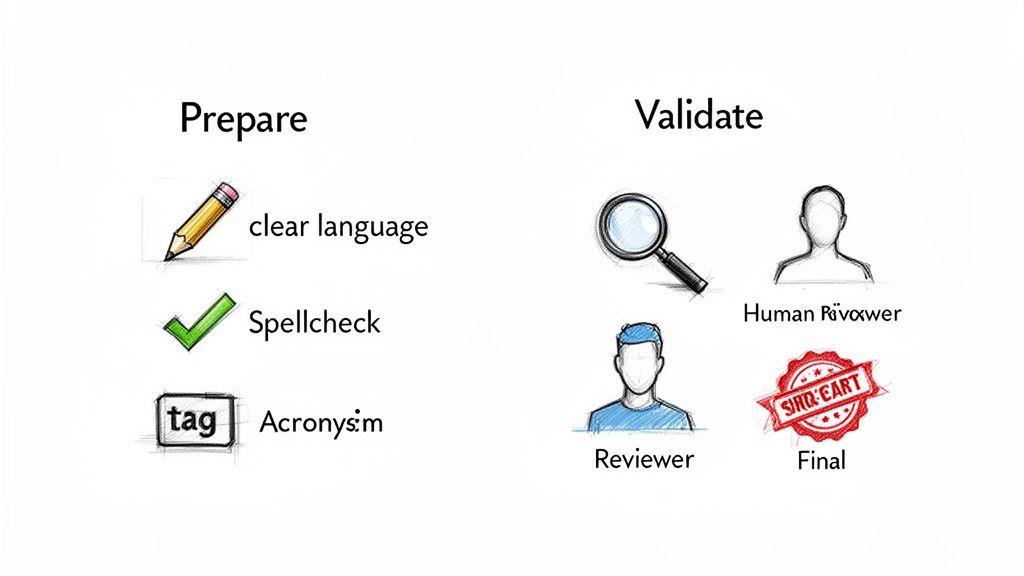
The entire process boils down to two key stages: preparing your original document and then validating the final translation. Nail both of these, and you'll consistently get the quality you’re looking for.
Preparing Your Source Document for Translation
The old saying "garbage in, garbage out" is especially true for translation. The quality of your original file directly shapes the quality of the final product. A clean, clear, and well-structured document is far easier for any translation engine, human or AI, to interpret correctly.
Here are four simple but powerful things you can do to prep your file:
- Use Clear and Simple Language: Try to avoid slang, regional idioms, or overly complex sentences. The more straightforward your writing is, the more accurately its meaning will be carried over into another language.
- Run a Spell Check: This one seems obvious, but it’s crucial. Typos and grammatical mistakes in the source text can trip up the translation engine, leading to strange or just plain wrong outputs. A quick proofread is your best friend.
- Define Acronyms and Jargon: If your document is filled with industry-specific terms or internal acronyms, spell them out the first time they appear. This provides the context needed to avoid misinterpretation.
- Ensure Clean Formatting: Before you hit upload, give your document's structure a once-over. Tidy up messy tables, fix inconsistent heading styles, and clean up any other formatting quirks.
Spending a few minutes on these steps removes ambiguity, giving the AI the best possible chance to deliver an accurate, context-aware translation right from the start.
Validating Your Translated Document
Once your translated file is back, it's always a good idea to give it a final review. This is especially true for critical content like legal contracts, patient records, or technical manuals. Modern AI is remarkably accurate, but a quick human check is the ultimate safety net.
Even with the most advanced AI, a final human review is the gold standard. It’s your last chance to ensure that the tone, context, and critical terminology are absolutely perfect.
You don't even have to be a native speaker to do a useful spot-check. Focus on what you know. Confirm that brand names, product numbers, key dates, and essential legal clauses have been handled correctly.
Beyond that, just scan the document. Does the marketing copy still sound persuasive? Does the user guide still feel authoritative? This final check ensures the document not only says the right thing but also feels right to the reader. You can find more practical advice in our guide on the best way to translate a document.
Your Document Translation Checklist
To make things even easier, we've put together a simple checklist. Following these steps will help you build a repeatable process for achieving high-quality document translations every time.
| Phase | Action Item | Why It's Important |
|---|---|---|
| Preparation | Write in clear, simple language. | Avoids idioms and slang that translate poorly. |
| Preparation | Run a final spellcheck and grammar check. | Prevents source-text errors from causing translation mistakes. |
| Preparation | Define all acronyms and specialized jargon. | Provides crucial context for technical or industry-specific terms. |
| Preparation | Ensure formatting is clean and consistent. | Helps preserve the original layout and structure. |
| Validation | Spot-check key terms, numbers, and names. | Confirms critical data points are correct. |
| Validation | Review the overall tone and flow. | Ensures the translated text feels natural to a native speaker. |
| Validation | Have a native speaker review critical documents. | Provides the ultimate quality assurance for high-stakes content. |
Taking a structured approach like this transforms translation from a simple task into a reliable part of your workflow, ensuring your message lands perfectly with any audience, anywhere in the world.
Got Questions? We've Got Answers
As you dive into the world of document translation, a few questions tend to pop up again and again. Getting these sorted out will help you feel confident you're picking the right tool for the job. Let's tackle some of the most common ones.
Will AI Mess Up My Document's Formatting?
It’s a fair question. You’ve spent hours getting that report or presentation just right, and the last thing you want is a jumbled mess. The good news is that modern AI translation tools are built specifically to recognize and preserve complex layouts—think tables, charts, headers, and columns.
The technology scans the structure of your original file and works to mirror it exactly in the translated version. For most standard business documents, it works like a charm. If your document has an extremely artistic or unconventional design, you might need to make a few small manual tweaks afterward, but usually, the formatting holds up remarkably well.
When Is It Worth Paying for a Premium AI Translation?
Think of it like this: Basic AI is great for getting the general gist of a document or translating straightforward content. It’s like having a conversation with someone who is fluent in the language.
You’ll want to opt for a premium tier when the stakes are higher and every word matters. This is for documents loaded with specific industry jargon, complex legal phrases, or sensitive cultural nuances. Premium AI models are trained on specialized data, making them more like a subject matter expert. They don't just translate words; they understand context. This makes them perfect for legal contracts, technical manuals, or medical research papers where a tiny mistake could have big consequences.
Is My Confidential Information Safe with an AI Translator?
Absolutely, but only if you choose a provider that takes security seriously. Handing over sensitive files requires trust, so you need to look for a service with robust security measures baked in. At a minimum, this means end-to-end encryption to protect your file while it's in transit and encryption-at-rest for when it's stored on their servers.
A trustworthy service will be transparent about its privacy policy and guarantee your data won’t be sold or shared. Even better, look for a provider that automatically deletes your files from their servers after a set period, like 24 hours.
With these safeguards in place, you can confidently use AI translation for most confidential business documents. Just be sure to do a quick check of a provider's security credentials before uploading anything highly sensitive, like proprietary R&D data or protected health information.
Ready to translate your documents with perfect formatting and complete security? DocuGlot offers an AI-powered solution that preserves your layout across 100+ languages. Get started at DocuGlot.
Tags
Ready to translate your documents?
DocuGlot uses advanced AI to translate your documents while preserving formatting perfectly.
Start Translating