A Practical Guide to Certified Translation Services
Ever wonder what makes a translation "official"? It’s more than just swapping words from one language to another. A certified translation comes with a formal guarantee—a promise that the translated document is a complete and accurate mirror of the original.
What Are Certified Translation Services
Think of it this way: anyone can translate a sentence, but not just anyone can certify it for official use. A certified translation elevates a standard translation by adding a layer of accountability. It’s a formal, legally significant assurance, much like how a notary public verifies a signature.
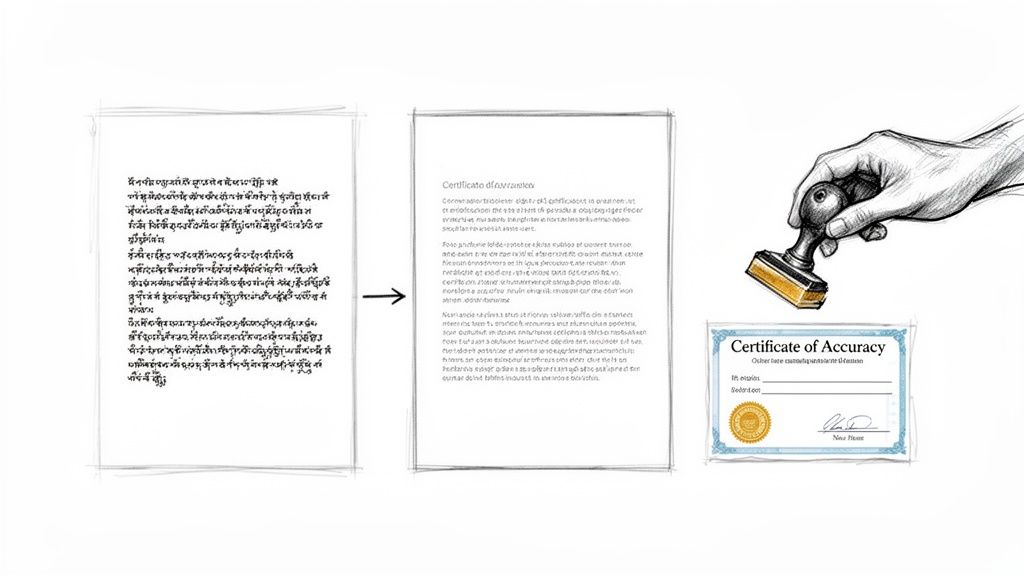
This promise is captured in a document called a Certificate of Translation Accuracy. This isn't just a piece of paper; it's a signed statement that is attached to both the original and translated documents.
Typically, this certificate includes:
- A formal declaration that the translation is a true and accurate version of the source document.
- The name and contact details of the translator or translation company.
- The date of translation and a signature from a qualified representative.
Why This Formal Promise Matters
Institutions like U.S. Citizenship and Immigration Services (USCIS), federal courts, and universities can't afford to take chances. They need absolute certainty that the birth certificates, legal contracts, or academic transcripts they receive haven't been altered or misinterpreted in translation.
A certified translation provides that confidence. It creates a formal record, proving that a qualified professional has vouched for the work. This is precisely why a standard, uncertified translation will almost always get rejected in legal, immigration, or academic situations—it simply lacks the required accountability. Our guide to official document translation dives deeper into these strict requirements.
This isn't just red tape. The need for this level of assurance is a cornerstone of global communication and legal integrity. Without it, the door is wide open to fraud, misrepresentation, and costly mistakes in high-stakes scenarios.
The Growing Demand for Certified Translations
The numbers tell the story. The global translation services market, valued at USD 41.78 billion this year, is expected to hit USD 50.02 billion by 2033. A huge part of that growth comes from the non-negotiable need for certified translations in international business, law, and immigration.
In the U.S. alone, the market reached USD 9.02 billion last year, driven by an ever-increasing demand for verified accuracy in documents for patents, corporate compliance, and immigration filings.
Navigating Different Types of Official Translations
While you've probably heard the term "certified translation" thrown around, the world of official documents is a bit more complex. Getting the hang of the key differences between certified, notarized, and sworn translations is crucial. Picking the wrong one can mean rejected applications, frustrating legal delays, and wasted money.
It helps to think of these not as levels of quality, but as different tools for different jobs. Each type carries a specific legal weight and is treated differently depending on the country and the specific office asking for it. The right choice boils down to where the document is going and what it's for.
Certified Translations: The Standard of Accuracy
As we've covered, a certified translation is all about one thing: accuracy. The translator or their agency attaches a signed statement, often called a Certificate of Translation Accuracy, which is their formal promise that the translation is a true and complete mirror of the original document.
This is the go-to requirement in countries like the United States, the UK, Canada, and Australia. It's what USCIS immigration, universities, and many legal bodies expect because it establishes a clear line of responsibility. The entire focus is on the linguistic quality of the translation.
Notarized Translations: An Extra Layer of Identity Verification
Here's where a lot of people get confused. Notarizing a translation does not make the translation itself more accurate or official. The notary public isn't checking the quality of the translation; in fact, they probably don't even speak the language.
So, what do they do? The notary's role is simply to verify the identity of the person signing the Certificate of Translation Accuracy. They watch the translator or agency representative sign the certificate, check their ID, and then add their own official stamp and signature. It's an extra step to prevent fraud by confirming the certifier is exactly who they say they are.
- When is it needed? Some institutions, especially certain schools, universities, or government agencies, might ask for this as an added formality.
- What it isn't: It's not a stamp of approval on the translation itself. The translation provider is still 100% responsible for the accuracy.
If you're dealing with paperwork that needs this extra step, you'll want to work with a service that knows the process inside and out. You can learn more about how to get a notarized document translation done right to avoid any hiccups.
Sworn Translations: A Different Legal Status Altogether
Sworn translations are a completely different animal, operating under a legal system you’ll mainly find in civil law countries across Europe (think France, Spain, Germany) and Latin America. A sworn translator (traducteur assermenté in French, for instance) is a professional who has been officially appointed by a court or Ministry of Foreign Affairs in that country.
A sworn translator is essentially an officer of the court. Their translations are considered to have formal legal value on their own, often without needing a separate certification statement, because the translator's official stamp and signature carry legal weight.
This is a massive difference from the system in the US or UK, where the certification comes from a company. With a sworn translation, the authority comes directly from the translator's government-approved status. If you send a standard US-style certified translation to a Spanish court, it will almost certainly be rejected. They need a document prepared by one of their officially recognized sworn translators.
As you explore translation options, it's also important to separate these official, human-powered services from other technologies. For instance, advanced AI audio translator services are incredibly useful for other tasks but serve a completely different purpose and have no legal standing for official documents.
When You Absolutely Need a Certified Translation
Figuring out the different kinds of official translations is one thing, but knowing exactly when you need them is what really counts. Some situations are incredibly high-stakes, where a standard, uncertified document isn't just a misstep—it’s a surefire way to get rejected. These are the moments when certified translation services become non-negotiable.
Think of it like a casual promise versus a signed contract. For a quick email or an internal memo, a simple translation might do the job. But when you’re dealing with official authorities, they need a formal document they can trust implicitly. Handing over an uncertified translation is like showing up to a legal hearing without a lawyer; you're missing the professional validation that the system requires.
Immigration and Government Submissions
This is probably the most frequent and critical reason people seek out certified translations. Government agencies, especially immigration authorities like U.S. Citizenship and Immigration Services (USCIS), build their entire process on verification and trust. They mandate certified translations for all foreign-language documents to be certain the information is accurate and hasn't been tampered with.
Common documents that absolutely need certification for immigration include:
- Birth Certificates: To prove your identity, age, and family connections.
- Marriage and Divorce Certificates: To verify marital status.
- Passports and Visas: To confirm your travel history and legal status.
- Police Clearance Records: To complete essential background checks.
If you fail to provide a certified translation for any of these, you’re almost guaranteed to get a Request for Evidence (RFE) or an outright denial of your application. For a closer look at this, you can learn more about our dedicated USCIS document translation services, which are built to meet these exact standards.
Legal Proceedings and Contracts
In the legal arena, every single word carries enormous weight. Contracts, affidavits, court transcripts, and evidence all demand flawless accuracy. A certified translation gives the court confidence that the translated text is a true and faithful mirror of the original—a must-have for any fair legal process.
A single misinterpreted clause in a business contract or a poorly translated witness statement can have devastating financial and legal consequences. Certification creates a chain of accountability, making the translation a reliable piece of evidence.
Academic and Professional Credentials
When you’re applying to a university abroad, trying to get a professional license, or having your credentials evaluated, your academic and work history must be crystal clear. Educational institutions and licensing boards need certified translations of documents like diplomas, transcripts, and professional certificates to properly assess your qualifications. It’s the only way to ensure your hard-earned achievements get the recognition they deserve.
This need is even more pronounced in highly regulated fields. North America, for example, is the leader in the certified translation market, especially in the life sciences. That segment alone was valued at USD 1.45 billion globally last year, with the region accounting for 46.08% of the revenue, all driven by the strict demands of clinical trials and regulatory compliance. Technical translations represent the largest overall segment at 39.45%, which just goes to show how critical certified accuracy is in specialized industries. You can find more insights about the top markets for translation services and see this trend in action.
The Certified Translation Process from Start to Finish
So, what actually happens when you order a certified translation? It’s easy to think of it as some mysterious process happening behind the scenes, but it's actually a very structured workflow. Every step is designed to guarantee accuracy, security, and a clear paper trail from the moment you upload your file to the second you get the finished documents back.
It all starts with your original document. The quality of this source file is the bedrock of the entire project. Think about it: a blurry photo of a birth certificate or a poorly scanned legal contract is full of ambiguities. Even the sharpest translator will struggle to decipher smudged text or unclear stamps. That’s why providing a clean, high-resolution digital copy is the most critical first step you can take.
Step 1: Submitting Your Document for a Quote
Once you have a good digital copy, you’re ready to get a quote. Modern translation platforms have made this part incredibly simple. You just upload your document to a secure online portal, and the system instantly analyzes it to give you a clear, upfront price. No surprises.
This analysis typically looks at a few key things:
- Word Count: How many words are in the document?
- Language Pair: What are the source and target languages (e.g., Spanish to English)?
- Complexity: Does the document contain dense legal jargon or technical terms?
This automated approach takes all the guesswork out of the equation. You get a precise cost and a reliable delivery estimate before you even commit to the project. Most platforms easily accept common file types like PDF, DOCX, or JPG.
Step 2: The Translation and Quality Control Workflow
After you approve the quote, the real work begins. This is where providers can differ. Many services now use a hybrid model that combines the raw speed of AI with the critical thinking of a human expert. An AI engine might generate the first draft, but then a professional human translator steps in to meticulously review, edit, and perfect it.
This human touch is absolutely essential for certified documents, where every word matters. The translator ensures that legal phrases are rendered correctly, cultural nuances aren't lost, and the formatting mirrors the original document. After the translation is done, it usually goes through another round of quality assurance (QA) with a second person to catch any lingering errors and ensure the final text is flawless.
This chart illustrates some of the most common reasons why people need this level of official certification.
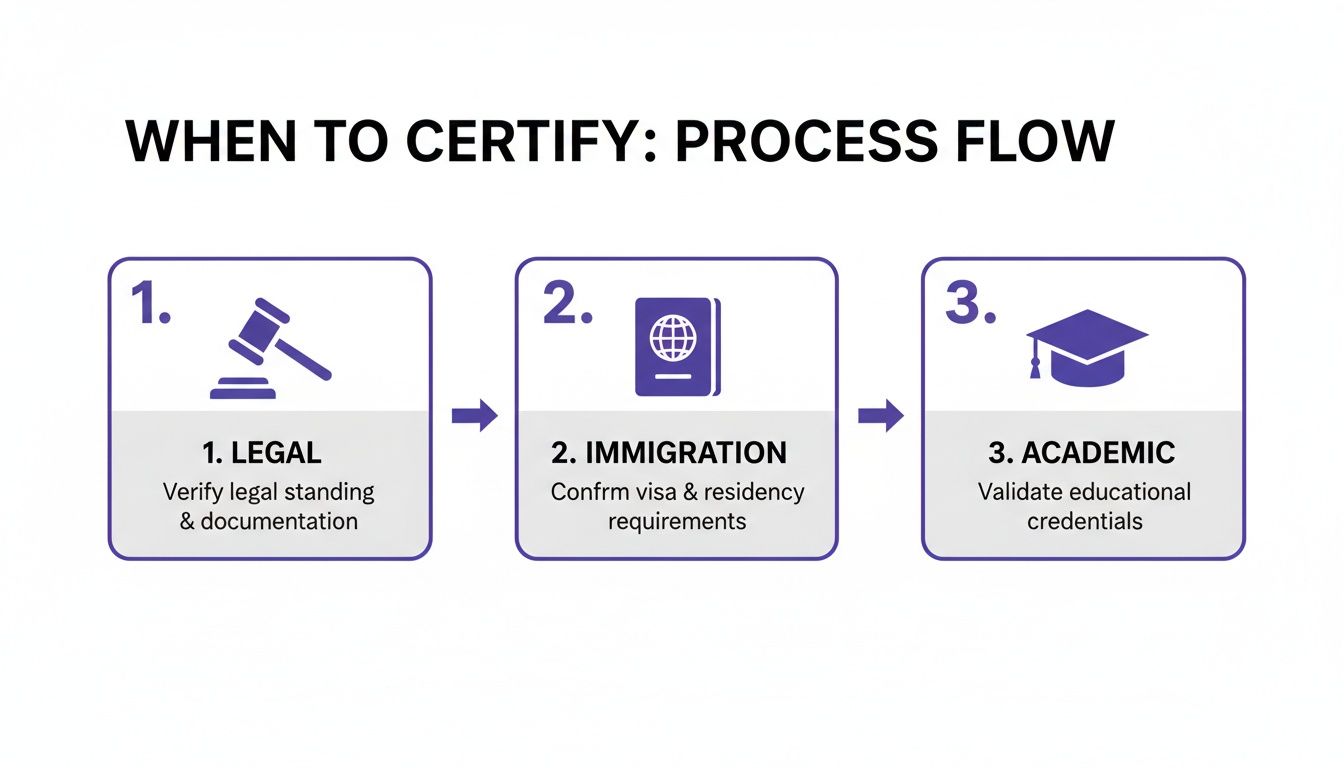
As you can see, the stakes are high for legal, immigration, and academic documents, which is why a formal, verifiable process is non-negotiable.
The global translation market, valued at USD 39.37 billion last year and projected to hit USD 46.22 billion by 2028, is leaning heavily into this hybrid approach. With the machine translation segment alone expected to grow over 25% by 2027, the trend is clear: AI platforms will handle the heavy lifting and complex formatting, while human certification provides that final, indispensable layer of trust. You can learn more about these translation industry trends and what they mean for the future.
Step 3: Certification and Final Delivery
The last stage is what officially makes the translation "certified." The provider prepares a formal Certificate of Translation Accuracy. This is a signed statement attesting that the translation is a complete and faithful representation of the original document, done to the best of the translator's ability.
The Certificate of Accuracy isn't just a piece of paper; it’s the legal instrument that gives your translated document its official weight. It directly ties the translator's professional reputation to the quality and correctness of the work.
Finally, all the files are bundled together and sent to you, almost always as a secure digital package. This package will include:
- A digital copy of your original source document.
- The translated document, formatted to look just like the original.
- The signed Certificate of Translation Accuracy.
These three items together make up the complete certified translation package, ready for you to submit to USCIS, a court, a university, or any other official body.
How to Choose the Right Translation Provider
Picking the right certified translation provider can feel overwhelming, especially when you're up against a tight deadline for a legal case or an immigration application. You've got traditional agencies, sleek online platforms, and everything in between. It's tempting to just go for the cheapest option, but the real goal is finding a partner who gets it right—accurately, securely, and on time, every time.
A good starting point is to look for a provider who knows your industry inside and out. The skills needed to translate a killer marketing campaign are worlds apart from what's required for a complex patent application or sensitive medical records. Look for proof that they've handled documents like yours before; it's a strong sign they understand the specific jargon and strict rules of your field.
Evaluating Provider Credentials and Security
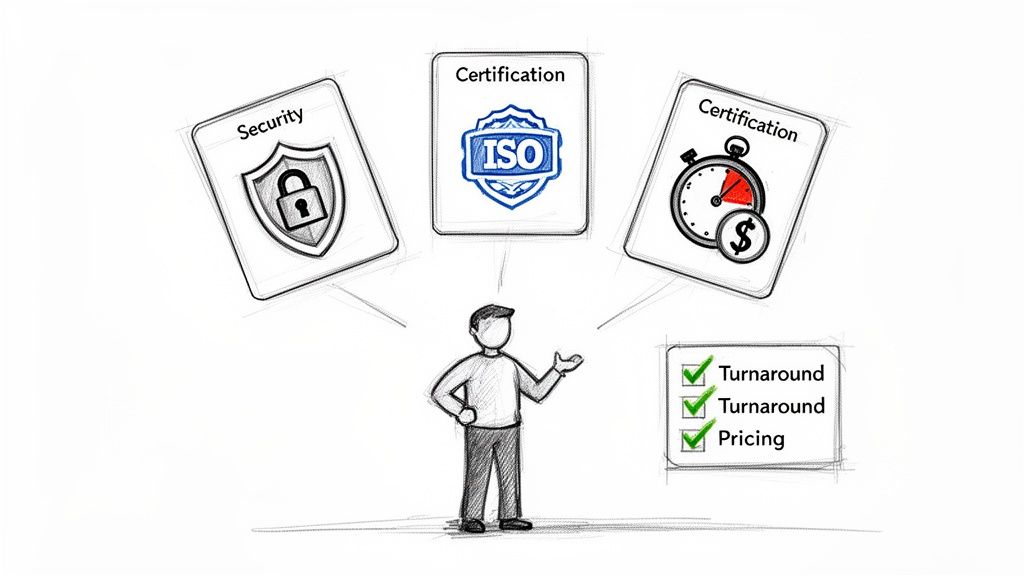
When you’re handing over confidential documents, you can't afford to take chances. Checking a provider's credentials is non-negotiable. One of the clearest signs of quality and commitment to security is an ISO certification. Standards like ISO 17100 (for translation services) or ISO 27001 (for information security) are more than just badges; they prove a provider follows internationally recognized processes for quality control and data protection.
Beyond those formal certifications, keep an eye out for these trust signals:
- Rock-Solid Security: Do they talk openly about using encryption for file transfers and storage? What's their policy on deleting your data once the job is done? A trustworthy service will make it clear that your documents are for their eyes only.
- Real-World Reviews: Client testimonials and case studies are your window into how the provider actually performs. Look for reviews that get specific about turnaround times, accuracy, and how helpful their support team was.
- Professional Memberships: Belonging to organizations like the American Translators Association (ATA) shows a dedication to professional ethics and staying on top of industry standards.
Comparing Service Models and Pricing
The certified translation world isn't one-size-fits-all. Traditional agencies often have deep benches of human experts and dedicated project managers, which can be great for massive, ongoing projects. The trade-off? They can be slower and pricier.
On the other end of the spectrum, you have modern platforms that use a smart blend of AI and human expertise. They use technology to handle the heavy lifting of the initial translation, then have a qualified human translator review, perfect, and certify the final document. This hybrid model often hits the sweet spot between speed, cost, and the essential human oversight official documents require. As you compare options, make sure you understand the different translation service pricing structures out there to find one that fits your budget.
A provider’s pricing should always be transparent. Be wary of vague quotes or hidden fees. The best platforms will analyze your document and give you an exact cost and delivery time before you ever hit "confirm." That puts you in complete control.
Making the Final Decision
To help you sift through the options, we’ve put together a quick checklist. Use it to weigh what matters most for your specific project.
Provider Selection Checklist
| Evaluation Criterion | What to Look For | Why It Matters |
|---|---|---|
| Industry Specialization | Evidence of work in your field (e.g., legal, medical, tech). | Ensures the translator understands niche terminology and context, leading to higher accuracy. |
| Security Measures | End-to-end encryption, clear data deletion policies, and ISO 27001 certification. | Protects your confidential information from breaches and unauthorized access. |
| Quality Certifications | ISO 17100 certification and membership in professional bodies like the ATA. | Guarantees the provider follows a documented, internationally recognized quality assurance process. |
| Turnaround Time | Clear, guaranteed delivery times (e.g., 24 hours or less). | Crucial for meeting tight legal, immigration, or business deadlines without stress. |
| Pricing Transparency | Upfront, per-word or per-page pricing with no hidden fees. | Allows you to budget accurately and avoid unexpected costs after the project starts. |
| Formatting Preservation | A guarantee to replicate the original document's layout, including seals and tables. | Essential for official documents where the visual structure is part of the record. |
| Customer Support | Accessible support channels (live chat, email, phone) with responsive agents. | Provides peace of mind and ensures you can get help quickly if questions or issues arise. |
By walking through this checklist, you can move beyond simple price comparisons and evaluate providers on the factors that truly lead to a successful outcome. This systematic approach helps you confidently choose a partner you can rely on.
Building a Smarter Translation Strategy
For any company operating on the world stage, treating certified translations like last-minute fire drills is a guaranteed way to burn time and money. This reactive scramble creates bottlenecks, inflates costs, and puts a huge strain on your legal and compliance teams. The smart move is to build a proactive strategy that turns this process from a necessary chore into a real business advantage.
The goal is to design a well-oiled machine that supports your business, not one that constantly breaks down. Think of it this way: you wouldn't just patch up leaks as they appear in your office building. You'd engineer a robust plumbing system from day one. A smart translation strategy does the same by anticipating needs, centralizing resources, and making sure your official documents flow smoothly across borders.
Creating a Centralized Workflow
The first and most critical step is to get everyone on the same page. Stop letting individual departments handle their own translation requests as isolated emergencies. A centralized workflow is the key to consistency, control, and efficiency. Instead of three different teams all searching for certified translation services, a single, organized process gives you oversight and better buying power.
This system should map out a clear path for every official document:
- A single intake point, like a dedicated portal or person, for submitting all translation requests.
- A list of pre-vetted providers who already understand your industry's jargon and compliance requirements.
- Standardized security protocols for handling sensitive information, from the moment a file is uploaded to its final delivery.
By building this central hub, you cut out wasted effort and ensure every translated document meets the exact same standard for quality and security.
Integrating Technology Wisely
A modern translation strategy isn't about choosing between people and machines; it's about using both. The best approach is a hybrid one, blending the sheer speed of technology with the critical judgment of a human expert. Using an AI-powered platform for the first pass can slash turnaround times and costs, especially when you're dealing with a high volume of documents.
But let's be clear: technology is a powerful tool, not a complete solution. For any document that needs to be certified, a qualified human translator absolutely must perform the final review, edits, and validation. That human touch is what gives the translation its legal weight and guarantees it’s fit for official use.
This model gives you the efficiency of machine translation without giving up the assurance only a human professional can provide. It's about letting technology handle the heavy lifting, which frees up your experts to focus on the nuanced work of final verification and certification.
Shifting from a Task to a System
Ultimately, building a smarter translation strategy is about a fundamental shift in mindset. It’s about moving away from a project-by-project scramble and toward a scalable, predictable system that fuels your global ambitions. When you centralize your workflow and thoughtfully integrate technology, managing your certified documents becomes a secure and efficient operation.
This approach turns translation from a reactive cost center into a proactive business asset. Once your legal, compliance, and marketing teams can get the accurate certified translations they need without friction, your entire organization is better positioned to thrive on a global scale. The result is a more agile, secure, and cost-effective process that works for you, not against you.
Frequently Asked Questions
Even with a solid plan, a few practical questions always pop up when you're dealing with certified translations for the first time. Let's dig into some of the most common ones so you can navigate the process without any hitches.
Think of this as the final check-in before you move forward with confidence.
What's the Difference Between a Certified Translator and a Certified Translation?
This is a great question, and the answer often surprises people, especially in the U.S.
A certified translator is a person. They've passed a tough professional exam from an organization like the American Translators Association (ATA) and earned a personal credential that speaks to their skill.
A certified translation is all about the document itself. It’s a translation that’s accompanied by a signed "Certificate of Accuracy." This statement, usually from the translation company, promises that the translation is complete and true to the original. The key takeaway? The translator doing the work doesn't need to be personally certified to produce a certified translation.
Can an AI-Generated Translation Be Certified?
Yes, absolutely. Certification is all about the final product's accuracy, not the tools used to get there. It’s now common for a professional human translator to take a high-quality AI translation, then meticulously review, edit, and perfect it.
Once they confirm it’s 100% accurate, the language service provider issues the signed Certificate of Accuracy. This combination of AI speed and human expertise is becoming the new standard—it’s fast, affordable, and delivers the official validation you need.
This hybrid approach really gives you the best of both worlds. AI does the initial heavy lifting, and a human expert provides the final, crucial sign-off that makes the document legally sound.
How Long Does a Certified Translation Take?
Turnaround times are all over the map. A traditional agency might need a few days, sometimes longer if the document is dense or complex. On the other hand, modern platforms that use AI to kickstart the process can often turn things around much faster, sometimes in under 24 hours.
Once the translation itself is complete, adding the certification is usually a very quick final step.
Will My Document Formatting Be Preserved?
This is a critical detail, and the answer depends entirely on your provider. You have to ask about this upfront. Many basic translation tools or budget services will spit out a wall of text, completely ignoring the original layout—a disaster for official documents like contracts or academic transcripts where the visual structure is part of the information.
High-quality providers, however, build their technology to preserve formatting from start to finish. They create a translated document that mirrors the original's layout, perfectly replicating everything from tables and seals to signatures and headers. For any serious document submission, this isn't a luxury; it's a must-have.
Ready to get your documents translated with flawless formatting and guaranteed accuracy? DocuGlot’s AI-powered platform keeps your original layout intact, delivering secure and reliable translations quickly. Get your instant quote and start translating now at https://docuglot.com.
Tags
Ready to translate your documents?
DocuGlot uses advanced AI to translate your documents while preserving formatting perfectly.
Start Translating