Why Swahili-to-English Translation Fails and How to Fix It
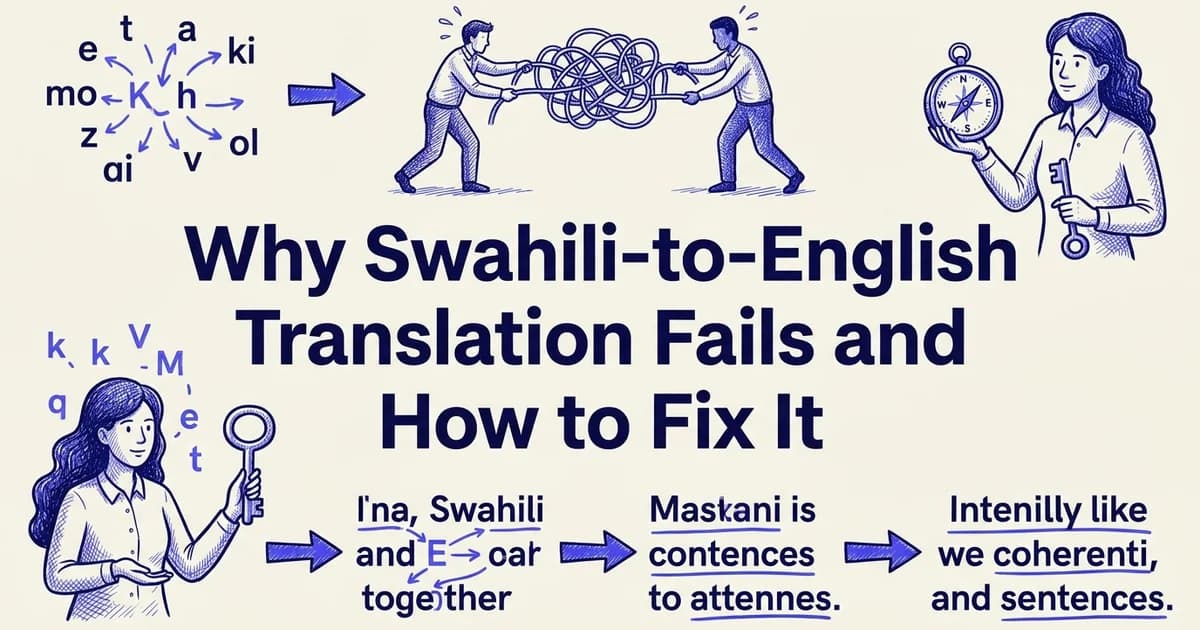
Introduction: understanding the Swahili-to-English translation challenge
Swahili is one of Africa's most widely spoken languages, yet translating it accurately into English remains a surprisingly stubborn problem. Whether you are working with a formal business document, a recorded conversation, or a casual text message, the gap between what was said and what gets translated can be significant.
The scale of the language and why it matters
Swahili connects more than 200 million speakers across East Africa, spanning Tanzania, Kenya, Uganda, the Democratic Republic of Congo, and beyond. That reach makes it a critical language for business, diplomacy, healthcare, and media. Yet its sheer diversity, across regions, registers, and social contexts, means no single translation approach works for every situation.
Why standard tools struggle
The deeper challenge is not formal Swahili. It is the way people actually speak it. According to Sauti Halisi: Towards Direct Speech-to-Text Translation for Colloquial and Code-Switched Swahili (2026), approximately 71% of conversational Swahili speech is code-switched, meaning speakers blend Swahili with English, Arabic, or local languages mid-sentence. Most translation tools are trained on clean, standardised text and simply are not built to handle that reality.
What this article covers
This guide walks through practical fixes for every common scenario: translating documents, handling speech, and decoding informal communication. It also sets honest expectations about accuracy and explains when a professional translator is genuinely the right call. For document translation specifically, a tool like DocuGlot can help you translate Swahili files across formats including PDF, Word, and PowerPoint while keeping your original formatting intact.
Quick fix: immediate solutions for translating Swahili to English
When you need to translate Swahili to English right now, three tools can get you moving within minutes. Each handles different situations, and knowing which to reach for saves real time. Accuracy varies significantly across them, so matching the tool to your task matters.
Google Translate: fastest for short text
Google Translate works well for everyday Swahili phrases, signs, and short messages. According to Google's AI Glossary for African Languages blog (2024), Google has been actively expanding its AI-powered glossary coverage for African languages, including Swahili, which improves consistency for common vocabulary.
Steps:
- Open Google Translate in your browser or app
- Select Swahili as the source language and English as the target
- Paste or type your text, or use the camera feature for printed text (see our guide on Google Translate image for that workflow)
Accuracy expectation: Good for standard, formal Swahili. Weaker on slang, regional dialects, and code-switched text mixing Swahili with other languages.
Microsoft Translator: better for longer passages
Microsoft Translator handles longer paragraphs more consistently and integrates directly into Office apps, making it practical for business users reviewing Swahili correspondence.
Accuracy expectation: Comparable to Google for formal text. Useful when you are already working inside Microsoft 365.
For documents: a format-preserving approach
Neither tool above handles formatted files well. If you are working with a Swahili PDF, Word file, or PowerPoint deck, DocuGlot translates across 8+ file formats while preserving your original layout, so headers, tables, and spacing stay intact. No subscription is required, and pricing is shown before you commit.
For more complex translation challenges, the next section explains why even these tools hit structural limits with Swahili. 🔍
Why standard translation tools struggle with Swahili
Standard translation tools were largely built on high-resource languages like Spanish, French, and Mandarin. Swahili presents a fundamentally different set of challenges, from the way speakers naturally mix languages to the scarcity of quality training data, and most commercial systems simply were not designed with these realities in mind.
The code-switching problem
Real Swahili speech rarely stays in one language. Speakers, particularly in urban East Africa, fluidly blend Swahili and English within a single sentence, sometimes within a single phrase. According to Sauti Halisi: Towards Direct Speech-to-Text Translation for Colloquial and Code-Switched Swahili (2026), code-switched content accounts for roughly 71% of natural Swahili speech in practice.
Standard translation engines are trained to expect clean, monolingual input. When they encounter a sentence that shifts mid-clause from Swahili to English and back again, the model often misidentifies the source language entirely, producing garbled or incomplete output.
Sheng and colloquial dialects
Beyond code-switching, Nairobi's Sheng dialect and other urban vernaculars layer slang, borrowed vocabulary, and grammatical shortcuts on top of standard Swahili. These forms are rarely represented in commercial training datasets, which tend to rely on formal written sources like news articles and government documents. The result is a tool that translates a formal Swahili report reasonably well but stumbles badly on a WhatsApp message or a recorded interview.
Training data gaps and cascaded systems
Most speech-to-text translation pipelines use a cascaded approach: first transcribe the audio, then translate the transcript. Each step introduces errors, and those errors compound. The Sauti Halisi research demonstrated that a direct speech-to-text translation model improved BLEU scores from 14.2 to 25.8 compared to cascaded baselines, a substantial leap that illustrates just how much the conventional approach leaves on the table.
For written documents, training data scarcity creates a parallel problem. Fewer parallel Swahili-English text corpora exist compared to European language pairs, which means models have seen far fewer examples of correct translations to learn from. This is why even well-resourced tools produce awkward phrasing or miss nuance when you translate Swahili to English from anything beyond simple, formal text.
Solution 1: using Google Translate for Swahili-to-English conversion
Google Translate remains the most accessible starting point for anyone needing to translate Swahili to English quickly. It handles everyday text reasonably well, supports voice input, and requires no account or payment. Understanding exactly how to use it, and where it breaks down, saves you from costly misunderstandings.
How to translate Swahili text step by step
Getting reliable output from Google Translate starts with how you prepare your input:
- Open Google Translate in your browser or via the Android app
- Set the source language to Swahili (Kiswahili) and the target to English
- Paste clean, punctuated text rather than raw, unformatted strings
- Break long paragraphs into shorter sentences before submitting, as shorter inputs tend to produce more accurate outputs
- Review the result critically, especially for technical terms, negations, and culturally specific phrases
For simple, formal Swahili, this workflow produces usable results. For anything nuanced, treat the output as a rough draft rather than a finished translation.
Using Google Translate for Swahili speech and audio
Google Translate's microphone feature lets you speak Swahili directly and receive an English translation in near real time. This works best in quiet environments with clear, standard Swahili pronunciation. However, colloquial speech and code-switching between Swahili and other languages create significant accuracy problems. According to Sauti Halisi: Towards Direct Speech-to-Text Translation for Colloquial and Code-Switched Swahili (2026), existing speech translation systems struggle considerably with the code-switched and colloquial Swahili that dominates real-world conversation.
Accuracy expectations and when Google Translate fails
Google has invested in African language AI, including an AI glossary for African languages covering communities across the continent. Despite this progress, Swahili translation accuracy drops noticeably in these situations:
- Legal, medical, or technical documents where precision is non-negotiable
- Idiomatic expressions and proverbs that carry cultural weight
- Agglutinative verb forms where a single Swahili word encodes tense, subject, object, and negation simultaneously
- Formatting-heavy files like PDFs or Word documents, where Google Translate strips structure entirely
For plain conversational text or quick comprehension checks, Google Translate is a practical free tool. For anything that needs to be accurate, professional, or structurally intact, it is a starting point rather than a solution. 🎯
Solution 2: translating Swahili documents while preserving formatting
When your Swahili content lives inside a formatted file, translation becomes a two-part challenge: getting the language right AND keeping the document intact. Pasting text into an online tool solves neither problem reliably. A dedicated document translation service is the more practical choice for anyone working with real-world files.
Why document translation is a different problem entirely
Copying text from a PDF into Google Translate and pasting it back is a familiar workaround, but it collapses tables, destroys paragraph spacing, strips headers, and loses any visual hierarchy the original document had. For a business report, legal brief, or formatted proposal, that broken output is unusable without significant manual reconstruction. The gap between "translated text" and "translated document" is where most Swahili-to-English workflows break down.

How DocuGlot handles formatted Swahili files
DocuGlot is built specifically for this use case. It accepts PDF, DOCX, TXT, Markdown, PPTX, XLSX, JPEG, and PNG files, translating content from Swahili to English while preserving the original structure, formatting, and layout. Here is how the process works:
- Upload your file at docuglot.com/translate. Files up to 500 MB are supported.
- Select Swahili as the source language and English as the target.
- Choose a translation tier. Basic handles standard documents efficiently; Premium applies a more capable AI model for technical or nuanced content.
- Review the transparent pricing shown before you pay. No subscription is required, so you pay only for what you translate.
- Receive your translated file via email notification when it is ready, delivered as an editable DOCX for most formats.
You can also batch translate up to 10 files across up to 10 target languages simultaneously, which is useful if you are localizing a document set or working across multiple language pairs, similar to workflows where teams translate english to vietnamese alongside other languages in a single pass.
When to use document translation versus a quick online tool
The decision is straightforward. Use a quick online tool when you need to understand a short Swahili message, caption, or phrase in seconds. Choose a document translation service when:
- The output will be shared with colleagues, clients, or stakeholders
- Formatting matters, such as contracts, reports, or slide decks
- The file contains tables, headers, or embedded images with text
- Accuracy is non-negotiable, such as medical, legal, or financial content
DocuGlot's 14-day refund policy also removes the risk of committing to a translation that does not meet your needs, making it a low-friction option for first-time users. 📄
Solution 3: handling colloquial Swahili, Sheng, and code-switched speech
Colloquial Swahili presents a fundamentally different challenge from formal written text. Street-level conversation, social media posts, and urban dialogue often blend Swahili with English, Arabic, and local languages in ways that standard translation tools simply were not built to handle.
Discover how DocuGlot Document Translation Service approaches translate swahili to english DocuGlot Document Translation Service.
Why Sheng and code-switching break standard tools
Sheng, the hybrid slang born in Nairobi's neighborhoods, mixes Swahili, English, Kikuyu, and other languages within a single sentence. A speaker might say something that shifts language mid-clause, uses invented vocabulary, or repurposes familiar words with entirely new meanings. Most translation engines trained on formal Swahili corpora have little exposure to this kind of speech, producing outputs that are either garbled or misleadingly literal.
The problem extends beyond Sheng. Urban Swahili across Dar es Salaam, Mombasa, and Kampala carries regional slang, generational vocabulary, and tonal shifts that vary block by block. When you need to translate Swahili to English from these contexts, a single AI pass rarely produces reliable results.
What the research says about direct speech translation
Researchers are actively working on this gap. According to Sauti Halisi (2026), a project focused specifically on colloquial and code-switched Swahili, direct speech-to-text translation systems improved METEOR scores from 26.5 to 38.1, a meaningful leap in capturing informal speech patterns. This suggests dedicated models trained on real conversational data can significantly outperform general-purpose tools.
Practical approaches for informal Swahili content
For most users, a hybrid workflow produces the best results:
- Use AI translation as a first draft, then flag low-confidence segments for review
- Build a personal glossary of recurring slang terms and their contextual meanings. Google's AI glossary initiative for African languages shows how structured vocabulary resources can meaningfully improve output quality
- Add context notes before submitting text, describing the speaker's region, age group, or setting
- Hire a professional translator familiar with urban Swahili when the content involves legal testimony, ethnographic research, or community health communication where mistranslation carries real consequences 🎯
For written informal content such as social media exports, chat logs saved as text files, or transcripts, DocuGlot can process TXT and DOCX formats across 100+ languages, giving you a structured starting point that a human reviewer can then refine for slang and code-switched passages.
Solution 4: translating Swahili audio and speech to English text
Converting spoken Swahili into English text adds a layer of complexity that written translation simply does not face. You are dealing with audio quality, speaker variation, background noise, and code-switching all at once, before a single word is even translated.
Speech-to-text translation versus cascaded ASR pipelines
Most mainstream tools use a cascaded approach: automatic speech recognition (ASR) transcribes the audio into Swahili text first, then a separate engine translates that text into English. Each step introduces its own errors, and mistakes compound.
Direct speech-to-text translation skips the intermediate transcription stage entirely. According to Sauti Halisi (2026), a dataset of 60 hours of authentic colloquial Swahili-English speech, direct models improved translation quality from a BLEU score of 14.2 to 25.8 compared to cascaded systems. That is a meaningful jump in real-world readability.
Step-by-step guide for translating Swahili audio
- Clean your audio first. Remove background noise using free tools like Audacity before uploading.
- Choose a platform with Swahili support. Google Translate supports Swahili voice input on mobile. Speechmatics offers enterprise-grade Swahili transcription for professional workflows.
- Upload or record directly. Most platforms accept MP3, WAV, or M4A files.
- Review the output. Always treat machine-generated audio translations as a first draft, especially for code-switched speech.
Accuracy factors and practical considerations
Several variables directly affect output quality:
- Speaker clarity: Accented or fast speech reduces accuracy noticeably
- Background noise: Even moderate ambient sound degrades ASR performance
- Code-switching: Sheng and mixed-language passages still challenge most engines
Turnaround and cost: Consumer tools are free but limited. Professional audio translation services typically charge per audio minute and can take hours to days for longer files.
For teams working with transcripts or exported audio text files, DocuGlot handles TXT and DOCX formats across 100+ languages, making it a practical next step once your audio has been transcribed and saved as an editable document. 🎙️
Prevention: best practices to ensure accurate Swahili-to-English translation
The most effective way to avoid translation errors is to build quality into the process before a single word is translated. Clean source material, consistent terminology, and structured review workflows reduce the need for costly corrections later, whether you are translating a one-page memo or a full technical manual.
Prepare clean source material
Remove formatting inconsistencies, fix obvious typos, and standardize terminology before translation begins. Clean input reduces the likelihood of cascading errors in the output.
Establish a terminology glossary
Create a reference document of key terms, proper nouns, and domain-specific vocabulary that must be translated consistently. Share this with your translation tool or professional translator.
Segment content by formality level
Separate formal business language from colloquial speech, social media content, or street-level dialogue. Different content types require different translation approaches and tools.
Review and validate output
Always compare the translated output against the source material. Check for missing words, awkward phrasing, and cultural context that may have been lost in translation.
Document your translation workflow
Record which tools you used, what settings you applied, and what quality checks you performed. This creates accountability and helps you improve the process over time.

Prepare your source material carefully
Poorly written Swahili input produces poor English output. Before translating, remove ambiguous phrasing, correct spelling errors, and break up unusually long sentences. If your content contains regional slang or code-switched phrases, flag them in advance so reviewers know where to focus attention.
Use glossaries and context to guide AI systems
Terminology consistency is one of the biggest wins available to teams that translate regularly. According to Google, its AI glossary initiative for African languages was designed specifically to standardize how key terms are handled across translation systems, reducing drift between documents. Applying a similar approach internally, by maintaining a shared glossary of approved translations for technical or brand-specific terms, keeps your output coherent across projects.
Establish a review and editing workflow
Automated translation should be treated as a first draft, not a finished product. For business-critical content, build in at least one round of human review. Assign a bilingual reviewer to check tone, accuracy, and cultural fit before any document is published or distributed.
Document your translation standards
Write down your workflow. Which file formats do you use? Which AI tier do you rely on for sensitive content? For teams translating documents at scale, DocuGlot supports batch translation across formats including PDF, DOCX, PPTX, and XLSX, with editable output and transparent pricing shown before you commit. Pairing a reliable tool with a documented process is what separates consistent quality from guesswork. 📋
When to seek professional help: escalation guide
Even the best AI tools and documented workflows have limits. Certain translation scenarios carry enough legal, medical, or reputational risk that automated output alone is not enough. Knowing when to escalate protects you from costly mistakes.
Situations that require a human translator
Some content categories demand certified or specialist human translators:
- Legal documents: Contracts, court filings, immigration papers, and compliance materials require certified translators. Errors can invalidate agreements or trigger regulatory penalties.
- Medical content: Patient records, clinical trial data, and pharmaceutical labeling involve terminology where a single mistranslation can affect safety.
- Literary and creative work: Novels, poetry, and marketing copy depend on cultural nuance and voice that AI currently handles inconsistently.
- Sworn or notarized translations: Many government agencies require a human signature attesting to accuracy.
Quality tiers and what to expect
Think of translation as a spectrum:
- Automated: Fast and affordable. Suitable for internal documents, research drafts, and general correspondence.
- Hybrid (AI + human review): AI handles the first pass; a qualified reviewer catches errors. Good balance of speed and accuracy for business communications.
- Fully professional: A certified human translator works from scratch or performs a thorough post-edit. Expect higher costs and longer timelines, typically several days per project.
Red flags that signal you need expert help
- Recurring complaints about mistranslated terminology
- Documents that will be signed, filed, or published publicly
- Content involving vulnerable populations or regulated industries
How to vet qualified translators
Look for membership in professional bodies such as the American Translators Association. Request sample translations and check for native Swahili fluency combined with subject-matter expertise. Building a long-term relationship with a trusted provider, rather than hiring ad hoc, reduces briefing time and improves consistency across projects. 🤝
For everyday document translation before escalation decisions are needed, DocuGlot lets you test output quality across formats with transparent pricing and no subscription commitment, so you can judge quickly whether a human review step is warranted.
Conclusion: choosing the right Swahili-to-English translation solution
Translating Swahili to English accurately is not a single-tool problem. The right approach depends entirely on what you are translating, who will read it, and what is at stake if something goes wrong.
Matching tools to your use case
Three scenarios define most translation needs:
- Quick, informal text: Free tools like Google Translate handle casual messages and simple lookups reasonably well. Use them as a starting point, not a final product.
- Formatted documents: When structure matters, PDF, Word, PowerPoint, or Excel files need a solution that preserves layout alongside meaning. DocuGlot is built specifically for this, supporting 8+ file formats with formatting intact and transparent per-translation pricing, so there are no surprises before you commit.
- Colloquial or culturally rich speech: Idioms, regional dialects, and community-specific expressions almost always benefit from human review, regardless of which AI tool processes the first draft.
The hybrid approach wins
Research consistently shows that AI plus human review outperforms either method alone for high-stakes content. Test two or three tools on a sample passage before committing to any workflow.
Your next step is simple: identify your most common Swahili translation scenario, match it to the appropriate tier of solution, and build from there. 🎯
Frequently asked questions
How do I translate Swahili to English?
The simplest way to translate Swahili to English is to paste text into a free tool like Google Translate for quick results. For documents, an AI-powered service like DocuGlot handles PDF, Word, PowerPoint, and other formats while preserving your original layout.
What is the best Swahili-to-English translator?
No single tool wins every scenario. Free tools suit casual queries, while document translation services work better for formatted files, and human translators remain essential for legal or medical content.
Can Google Translate translate Swahili into English?
Yes. Google Translate supports Swahili and handles standard written text reasonably well. Accuracy drops with slang, regional dialects, and code-switched speech.
How accurate is Swahili-to-English translation?
Accuracy varies significantly by context. Formal written Swahili translates more reliably than colloquial speech, where slang and English insertions are common.
How do you translate a Swahili document into English?
Upload your file to a document translation service. DocuGlot accepts PDF, DOCX, PPTX, XLSX, and image formats, returning an editable translation with formatting intact.
Can I translate Swahili audio or speech into English text?
Yes. According to Proceedings of Machine Learning Research (2026), direct speech-to-text translation handles informal Swahili and code-switching more robustly than older transcription-then-translation pipelines.
What does this Swahili word mean in English?
For single words, a dictionary or Google Translate works well. For words embedded in context, a full-sentence translation gives more reliable meaning.
Is Swahili the same language as Kiswahili?
Yes. Kiswahili is simply the language's name in Swahili itself. Both terms refer to the same language, spoken as a lingua franca by more than 200 million people across East and Central Africa.
Tags
Ready to translate your documents?
DocuGlot uses advanced AI to translate your documents while preserving formatting perfectly.
Start Translating