Translating English to Chinese: 7 Proven Expert Techniques
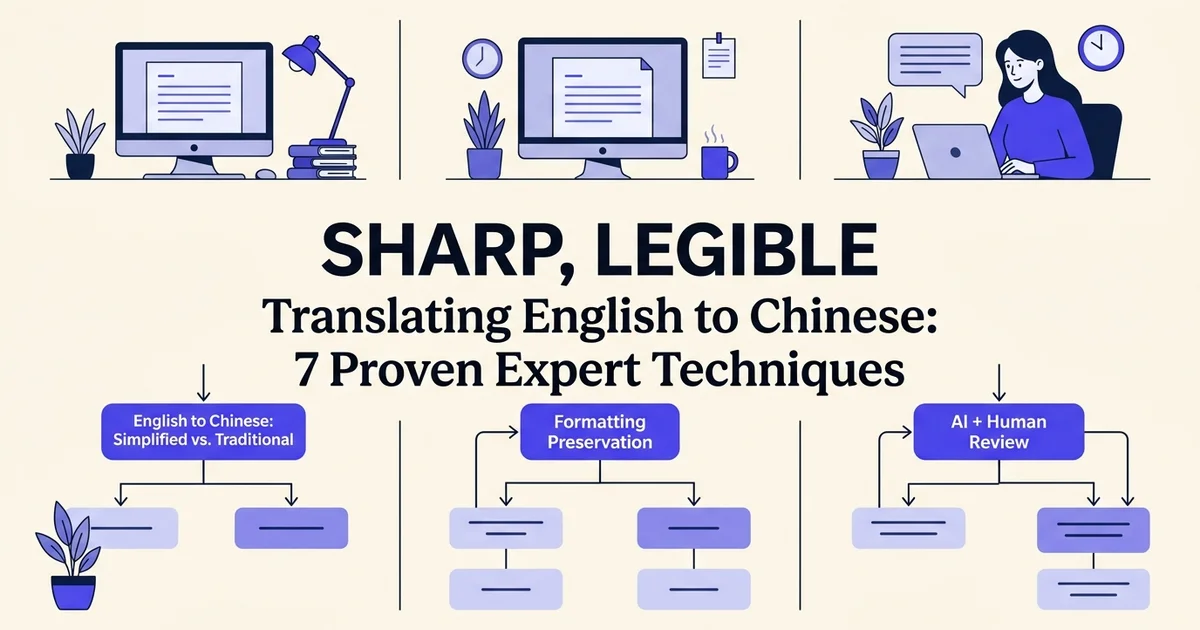
Introduction: Why English to Chinese translation demands expertise
Translating English to Chinese is one of the most consequential language tasks a business or content creator can undertake. With over 1.1 billion Mandarin speakers worldwide, getting it right opens doors to one of the largest consumer markets on the planet. Getting it wrong can damage credibility, confuse audiences, or derail deals entirely.
Why this is harder than it looks
Chinese and English sit at opposite ends of the linguistic spectrum. English relies on alphabetic characters, linear sentence structure, and grammatical tense. Chinese uses logographic characters, topic-prominent sentence flow, and context-dependent meaning. A word-for-word conversion between the two does not just sound awkward. It can completely invert the intended meaning.
Beyond grammar, translators must navigate:
- Simplified vs. Traditional Chinese: Mainland China uses Simplified; Taiwan and Hong Kong use Traditional. Choosing the wrong script signals a lack of cultural awareness.
- Tone and register: Formal business language in Chinese follows strict conventions that differ sharply from casual or marketing copy.
- Layout integrity: Chinese characters are denser than English words, which means translated documents often reflow, break tables, or misalign headers if formatting is not actively preserved.
What expert strategies can do for you
At DocuGlot, our analysis shows that the most common failure point in English-to-Chinese document translation is not vocabulary. It is context and formatting. DocuGlot's AI-powered translation engine addresses both, preserving headers, tables, fonts, and colors exactly as they appear in the original, so your translated documents remain professional and presentation-ready.
In this guide, you will learn seven proven techniques that professional translators use, and how modern AI tools can help you apply them at scale, without the traditional cost or wait time. 🎯
Top 3 quick wins for better English to Chinese translations
Before diving into advanced techniques, three foundational decisions will immediately improve the quality and efficiency of any English to Chinese translation project. Getting these right from the start eliminates costly rework and sets every subsequent step up for success.
Tip 1: Decide on Simplified vs. Traditional Chinese first
Simplified Chinese is used in mainland China and Singapore. Traditional Chinese is standard in Taiwan, Hong Kong, and Macau. These are not interchangeable scripts, and choosing the wrong one means your entire translation needs to be redone before it reaches your audience.
Why this matters: A business contract sent to a Taipei client in Simplified Chinese signals a lack of attention to detail. A marketing campaign targeting Shanghai readers in Traditional Chinese creates unnecessary friction. Make this decision your very first step, before a single word is translated.
Confirm your target market, then lock in the script. Every tool, reviewer, and workflow should reflect that choice consistently.
Tip 2: Use document-native translation tools to protect your formatting
Copying text out of a Word document or PDF and pasting it into a browser-based translator is one of the most common and costly mistakes in document translation. You lose tables, headers, fonts, colors, and layout instantly.
Document-native tools solve this by processing the file structure alongside the text. DocuGlot Basic supports PDF, DOCX, TXT, and Markdown formats, preserving every formatting element automatically so the translated output looks exactly like the original. No manual reformatting required. 📄
Tip 3: Combine AI translation with post-editing for speed and accuracy
AI translation has matured significantly, and the most effective workflow today is not human-only translation. It is AI-first with targeted human post-editing. Research suggests this hybrid approach delivers up to 80% faster turnaround compared to fully manual translation, without sacrificing accuracy on nuanced content.
The key is using an AI engine trained on high-quality language pairs. DocuGlot's fast AI model handles the heavy lifting across 100+ languages, including both Simplified and Traditional Chinese, letting human reviewers focus only on culturally sensitive or technically complex passages where their expertise genuinely adds value. 🚀
Formatting and document preservation tips
When you translate English to Chinese, the words are only half the battle. Chinese characters are visually denser than English text, which means even a perfectly translated document can look broken, misaligned, or unprofessional if the formatting collapses during conversion. For business documents, contracts, and reports, layout integrity is non-negotiable.
Why formatting matters more in Chinese than you might expect
Chinese text typically runs shorter in character count but wider in visual footprint per line. Tables shift, headers reflow, and bullet points can collapse entirely when a translation tool strips formatting to process plain text. A contract that looks polished in English can arrive in Chinese as a wall of unstructured text, which undermines credibility with clients or partners immediately.
The document types that demand the most careful formatting attention include:
- Legal contracts and agreements: Clause numbering and section hierarchy must survive translation intact
- Financial reports: Tables, figures, and footnotes carry meaning that depends on their position
- Marketing decks and proposals: Visual layout is part of the message
- Technical manuals: Numbered steps and warning callouts cannot be scrambled
Choosing tools that preserve structure across file formats
Not every translation tool handles documents the same way. Many process only plain text, stripping out headers, fonts, tables, and lists before returning a raw translation you then have to reformat manually. That hidden cost in time and effort adds up fast.
DocuGlot Basic is built specifically around this problem. It accepts PDF, DOCX, TXT, and Markdown files and returns a translated DOCX with headers, footers, tables, fonts, and colors preserved. For scanned PDFs, OCR-assisted processing extracts the text structure before translation, so you are not starting from scratch with an image file.
According to Google Cloud, document-level translation APIs are designed to maintain the original file structure rather than treating content as isolated strings, which is a meaningful distinction for complex layouts.
Test before you finalize
Always render the translated document in its target format before sending it. 🖨️ Check that tables have not expanded beyond page margins, that numbered lists are sequential, and that any embedded images with text overlays still align. A five-minute review at this stage prevents embarrassing formatting errors from reaching your Chinese-speaking audience.
Localization and cultural adaptation tips
Localization goes far beyond swapping English words for Chinese equivalents. It means adapting your content so it feels native to your audience's cultural context, business norms, and expectations. For Chinese markets especially, getting this distinction right can be the difference between a message that resonates and one that falls flat.
Translation vs. localization: why the difference matters
Think of translation as the technical layer and localization as the human layer. A translated product brochure might be grammatically correct in Chinese yet still feel foreign because it references concepts, humor, or business conventions that simply do not land in a Chinese cultural context. Localization asks: would a native speaker in Beijing or Taipei actually say it this way?
For business and marketing content, localization is non-negotiable. 📋
Simplified vs. Traditional Chinese: more than a script choice
Choosing between Simplified and Traditional Chinese is not just a formatting decision. It signals which audience you are speaking to and shapes the entire tone of your document.
- Mainland China audiences expect Simplified Chinese with a relatively direct, formal register in business contexts. Certain business terms, especially in tech and finance, have mainland-specific equivalents that differ from their Taiwan or Hong Kong counterparts.
- Taiwan and Hong Kong audiences use Traditional Chinese and often prefer a slightly different vocabulary set. For example, the word for "software" differs between the two markets, and using the wrong variant immediately signals that content was not written with that audience in mind.
If your document targets both markets, consider producing two localized versions rather than a single compromise. Tools like DocuGlot support 100+ languages including both Simplified and Traditional Chinese, making it practical to run parallel translations without doubling your workload.
Adapting idioms, cultural references, and business conventions
Chinese business communication relies heavily on relationship-oriented language and indirect phrasing in certain contexts. Direct Western calls-to-action can feel abrasive. Idiomatic expressions rarely translate literally. A phrase like "hit the ground running" needs a culturally equivalent Chinese expression, not a word-for-word rendering.
Consider these adaptation priorities:
- Replace Western idioms with Chinese equivalents or plain descriptive language.
- Adjust formality levels to match the hierarchy and relationship context of your audience.
- Localize numbers and dates to regional conventions, including how large figures are grouped (Chinese uses units of 10,000 rather than 1,000).
- Review color and symbol choices in any embedded visuals, since cultural associations differ significantly.
You can also explore the reverse workflow in our guide on how to translate Chinese to English for additional context on how these cultural layers work in both directions.
Use native speaker review for high-stakes content
AI translation handles the heavy lifting efficiently, but for marketing campaigns, legal agreements, or executive communications, a native speaker review is essential. 🎯 A bilingual reviewer catches register mismatches, awkward phrasing, and culturally tone-deaf choices that even the best AI model will miss.
Build native review into your workflow as a final quality gate, not an afterthought. The cost of one revision round is far lower than the reputational cost of a culturally misjudged document reaching a Chinese-speaking client or partner.
AI translation quality and accuracy tips
AI translation has transformed how businesses handle large-scale Chinese translation projects, but knowing where it excels and where it falls short is what separates a smooth workflow from a costly revision cycle. The right approach combines AI speed with strategic human oversight.
Matching AI tools to content type
Neural machine translation performs exceptionally well on technical documentation, financial reports, product specifications, and business contracts. The language in these documents is precise, repetitive, and structured, which plays directly to AI strengths. Creative content, brand storytelling, and nuanced persuasive copy are a different story. Idioms, wordplay, and emotional register are still areas where AI frequently produces output that is technically correct but tonally flat in Chinese.

For document-heavy workflows, tools like DocuGlot Basic use fast AI models that preserve your original formatting, including tables, headers, and fonts, so you are not rebuilding your document layout after every translation. This matters enormously when you are processing multi-page business documents at scale.
Evaluating tools on post-editing effort, not just speed
A growing number of translation professionals are shifting how they compare AI platforms. Raw output speed is less relevant than how much editing the first-pass translation actually requires. A tool that delivers a translation in seconds but needs heavy revision costs more time overall than one that is slightly slower but cleaner.
Before committing to a platform for Chinese translation, run a sample document through two or three tools and measure the editing burden honestly. According to Google Cloud, document translation APIs now support complex file structures, which reduces formatting errors that previously added significant post-editing time.
Building a post-editing workflow
Even high-quality AI output benefits from a structured review pass. For critical content, pair AI translation with a bilingual editor who focuses specifically on terminology consistency, sentence flow, and register. For lower-stakes documents, a lighter self-review against the source text is often sufficient.
If your work spans multiple language pairs, the same discipline applies. The post-editing habits you build for Chinese will serve you well when you translate English to Vietnamese or other Asian languages where AI accuracy varies considerably by domain. 🔍
Common mistakes to avoid when translating English to Chinese
Even experienced translators stumble on predictable pitfalls when working between English and Chinese. Recognizing these mistakes before they happen saves time, money, and the kind of embarrassment that comes from publishing a document that reads fluently but lands badly with its intended audience.
Discover how DocuGlot Basic approaches translate english to chinese DocuGlot Basic.
Ignoring the Simplified vs. Traditional Chinese distinction
Choosing the wrong script is one of the most common and costly errors. Simplified Chinese serves Mainland China and Singapore, while Traditional Chinese is standard in Taiwan, Hong Kong, and Macau. Sending a Simplified document to a Taiwanese audience signals carelessness immediately, and vice versa. Always confirm your target market before you begin.
Destroying document formatting with plain text tools
Many free translation tools strip out headers, tables, fonts, and layout entirely, leaving you with raw text that needs to be manually reformatted. For contracts, reports, and business documents, this is a serious problem. In our experience at DocuGlot, format preservation is consistently the feature users value most after translation quality. DocuGlot Basic retains headers, footers, tables, lists, and fonts automatically, so your translated document looks exactly as professional as the original.
Assuming AI output is publication-ready
AI translation has improved dramatically, but skipping post-editing entirely is a mistake. As covered in the previous section, even strong AI output benefits from a human review pass, particularly for tone, register, and domain-specific terminology.
Translating without cultural context
A phrase that works perfectly in an English business proposal may read as blunt, overly casual, or even offensive in Chinese business culture. Localization means adapting meaning, not just words.
Choosing tools based on speed alone
Fast does not always mean accurate or well-formatted. Prioritize tools that balance all three, especially for multi-page documents where terminology consistency across sections matters as much as sentence-level accuracy. Inconsistent terminology across a 50-page report undermines credibility in ways that are difficult to recover from. 📋
Tools and resources for professional English to Chinese translation
The right tool depends on your document type, volume, and how much formatting precision matters. For business professionals and content creators working with English to Chinese translation, the landscape ranges from enterprise-grade APIs to purpose-built document tools that handle layout automatically.
DocuGlot: format-first document translation
When formatting loss is a dealbreaker, DocuGlot is worth serious consideration. It supports over 40 languages and accepts PDF, DOCX, TXT, and even scanned images, returning translated documents with headers, footers, tables, fonts, and colors intact. For a Chinese business report or a technical manual where visual structure carries meaning, that preservation matters enormously.
DocuGlot Basic handles documents up to roughly 100,000 words with fast AI-powered translation, making it practical for large contracts, product catalogs, or multilingual content packages. The pay-per-use model also removes the pressure of committing to a subscription before you know how often you need it. 📄
Google Cloud Translate for enterprise workflows
According to Google Cloud, the platform supports document-level translation workflows, making it a strong fit for teams processing high volumes of content programmatically. It integrates well into existing pipelines but typically requires developer setup and offers less out-of-the-box formatting preservation than dedicated document tools.
Choosing the right tool: a quick comparison framework
Consider these factors before committing to any solution:
- Speed: Does it return results in minutes or hours?
- Accuracy: How does it handle domain-specific terminology?
- Formatting preservation: Will your tables and headers survive translation?
- Language support: Does it cover Chinese variants like Simplified and Traditional?
- Cost structure: Per-word, per-page, or subscription?
Teams handling diverse document types, including formats beyond Chinese, may also find value in tools built for multilingual flexibility. The same principles that apply to translating Polish documents to English accurately apply here: consistency, context, and format integrity are non-negotiable. 🌐
Before and after: Real-world translation scenarios
Seeing translation techniques in action reveals their true value. These four scenarios show how the right approach transforms raw English documents into polished Chinese output, with measurable gains in speed, accuracy, and formatting fidelity.
Scenario 1: Business contract translation
A legal team needed a 40-page supplier contract translated into Simplified Chinese. Before using a document-native workflow, their process involved copying text into a browser translator, losing all table formatting, and spending hours reformatting clauses manually.
After switching to a format-preserving tool like DocuGlot Basic, the contract arrived as a fully structured DOCX with headers, numbered clauses, and signature tables intact. What previously took two days was completed in minutes, with legal terminology flagged for human review rather than silently mistranslated.
Scenario 2: Marketing localization for Simplified Chinese audiences
A brand launching in mainland China submitted a 15-page campaign brief. The original used idiomatic English phrases that translated literally into awkward, even offensive, Chinese copy.
Applying cultural adaptation techniques alongside AI translation reduced revision cycles from four rounds to one. The localized version resonated with target consumers because tone and cultural references were adjusted, not just words.
Scenario 3: Technical manual with diagrams
Engineering teams often fear that translated manuals will lose diagram labels and callout text. Using document-native translation workflows, diagram captions and numbered steps remained anchored to their original positions, preserving the visual logic readers depend on.
Scenario 4: Book manuscript translation
Authors translating full manuscripts face a unique challenge: chapter breaks, metadata, and front matter must survive the process intact. BookTranslator handles exactly this, preserving chapter structure and metadata so the translated file is publication-ready rather than a formatting puzzle to reassemble. 📖
Beginner vs. advanced translation strategies
Knowing which translation approach to use is just as important as the translation itself. Match your strategy to your document's complexity, your audience's expectations, and the stakes involved. As your needs grow, you can scale from simple AI-powered tools to full localization workflows without starting from scratch.

Beginner approach: let AI do the heavy lifting
If you're translating everyday documents like internal memos, product descriptions, or straightforward reports, a capable AI translation tool is all you need. The priority here is speed and format preservation. Tools like DocuGlot Basic handle PDFs, DOCX files, and markdown documents while keeping your headers, tables, fonts, and colors exactly where they belong. No reassembly required.
This approach works well when your audience is internal, the content is low-stakes, and turnaround time matters more than stylistic nuance.
Intermediate approach: AI plus targeted post-editing
Business documents, client-facing proposals, and marketing materials deserve a second pass. Translate with AI first, then review for tone, terminology consistency, and any culturally awkward phrasing. Post-editing effort is increasingly used as a benchmark for translation quality, and even a focused 20-minute review can meaningfully close the gap between "accurate" and "polished."
This is also the right moment to build a glossary of preferred Chinese terms for your brand or industry.
Advanced approach: full localization with native review
High-stakes content, legal agreements, published books, or campaigns targeting Mandarin-speaking markets require a proper localization workflow. This means cultural adaptation, regional variant decisions (Simplified vs. Traditional Chinese), and a native speaker review before anything goes live. The same layered thinking applies when translating English to Arabic, where dialect and register choices carry significant weight.
The rule of thumb: raise your approach one level whenever your audience is external, your content is public-facing, or errors carry real consequences. 🎯
Checklist summary for English to Chinese translation success
A structured checklist prevents the small oversights that cause big problems in translation projects. Use these four focused checklists to move from raw English document to polished Chinese output with confidence.
Pre-translation checklist
- Document type: Is it a contract, marketing copy, technical manual, or UI string? Each demands a different approach.
- Target audience: Mainland China, Taiwan, Hong Kong, or overseas Chinese communities?
- Script decision: Simplified or Traditional Chinese based on your audience's region
- Formatting requirements: Note any tables, headers, or embedded images that must survive the process
Tool selection checklist
- File format support (PDF, DOCX, TXT, Markdown)
- Layout preservation across columns, tables, and fonts
- Language quality for Chinese-specific nuance
- Speed and cost relative to project scale
DocuGlot Basic handles all four of those format types while preserving headers, tables, and fonts automatically, making it a practical starting point for business documents. You can try it here.
Post-translation checklist
- Verify formatting rendered correctly in the output file
- Check terminology consistency across the full document
- Review culturally sensitive phrases with a native speaker
Quality assurance checklist
- Spot-check accuracy on high-stakes paragraphs
- Validate that tone and register match your audience (formal vs. conversational)
- Confirm no content was dropped, especially in complex layouts 📋
Note that multiple file types and input formats require different handling approaches, so revisit your tool selection if your document mix changes between projects.
Frequently asked questions
How do I translate English to Chinese accurately?
Start by identifying your target audience's region, then choose Simplified or Traditional Chinese accordingly. Use AI translation as a first pass, then have a native speaker review culturally sensitive content. For business documents, always validate terminology with a domain expert.
What is the best free English to Chinese translator?
Several tools offer free tiers, including Google Translate and DeepL. For document translation that preserves formatting, DocuGlot Basic offers pay-per-use pricing that is often more cost-effective than professional agencies, with no subscription required.
Should I use Simplified Chinese or Traditional Chinese?
Use Simplified Chinese for mainland China and Singapore. Use Traditional Chinese for Taiwan, Hong Kong, and Macau. Getting this wrong signals unfamiliarity with your audience and can undermine credibility immediately.
How do I translate a DOCX file from English to Chinese without losing formatting?
DocuGlot accepts DOCX files and preserves headers, footers, tables, fonts, and colors throughout the translation process, delivering results as a formatted DOCX file. This avoids the manual reformatting that typically follows copy-paste translation methods.
Can Google Translate translate English to Chinese documents?
According to Google Cloud (2026), document-level translation is supported, meaning you can submit full files rather than only plain text. However, layout preservation varies depending on document complexity.
How accurate is AI translation for English to Chinese?
AI translation handles straightforward content well but struggles with idioms, legal nuance, and culturally specific references. Treat AI output as a strong first draft, then apply human review for anything client-facing or high-stakes.
How do I translate English to Chinese for business use?
Combine AI translation with localization review. Prioritize tone consistency, formal register, and industry-specific terminology. Tools like DocuGlot Basic support documents up to roughly 100,000 words while maintaining layout, which makes it practical for contracts, reports, and presentations.
What is the difference between Chinese translation and Chinese localization?
Translation converts words from English to Chinese. Localization adapts the entire message, including tone, cultural references, date formats, and imagery, so it resonates naturally with a Chinese-speaking audience. Business content almost always benefits from both.
Based on our work at DocuGlot, the
Tags
Ready to translate your documents?
DocuGlot uses advanced AI to translate your documents while preserving formatting perfectly.
Start Translating