What the Data Reveals About English to Arabic Translation Challenges
Introduction: why English-to-Arabic translation data matters now
The global demand to translate English to Arabic has never been more measurable, more complex, or more consequential for businesses and researchers alike. At DocuGlot, our analysis shows that the Arabic translation ecosystem has matured rapidly, with infrastructure, evaluation standards, and real-world deployment all accelerating in parallel.
A rapidly expanding technical ecosystem
According to Machine Translate (2026), 49 machine translation APIs now support Arabic, a figure that reflects both commercial investment and the language's growing strategic importance across global markets. This expansion spans industries from legal and financial services to publishing and government communications, where accurate document translation is no longer optional but operationally critical.
The dialectal complexity driving new research
Modern Standard Arabic is only part of the picture. The AlexandriaX-2026 Shared Task (2026) on context-aware English-to-dialectal Arabic dialogue translation signals a significant shift in how researchers are confronting real-world linguistic diversity. Dialects spoken across Egypt, the Levant, and the Gulf differ substantially from formal written Arabic, and translation systems that ignore this gap produce outputs that feel foreign to native readers.
2026 as a turning point
Government-backed initiatives are now entering the space. Egypt's BelMasry platform, launched in 2026, represents a new category of state-supported Arabic translation infrastructure. Alongside emerging quality evaluation frameworks, these developments mark 2026 as a pivotal year for anyone tracking where Arabic translation technology is heading.
The data tells a clear story: the stakes are rising, and so are the standards.
Methodology: how we sourced and verified translation data
This study draws on peer-reviewed research, official government announcements, and structured API registry data to build a transparent, reproducible picture of the English-to-Arabic translation landscape as it stands in 2026. Every statistic includes a year label and a traceable source.
Academic and peer-reviewed sources
The core of this analysis relies on research indexed through the ACL Anthology and Frontiers in Artificial Intelligence. According to Machine Translate's Arabic language overview (2026), the Arabic API ecosystem now spans a measurable range of commercial and open-source systems, each with distinct coverage of Modern Standard Arabic and regional dialects. Comparative studies were evaluated using standardized metrics including BLEU, chrF, and human adequacy scores, allowing consistent cross-system benchmarking rather than relying on vendor-reported figures.
Government and institutional verification
Platform announcements, including Egypt's Ministry of Communications and Information Technology initiatives, were verified directly through official ministry channels. No secondary reporting was used as a primary source.
Scope and limitations
This study focuses on neural machine translation (NMT) systems evaluated between 2025 and 2026. Older statistical machine translation benchmarks were excluded to keep findings relevant to current deployment decisions. Where data gaps exist, for instance in low-resource Arabic dialects, the analysis notes uncertainty rather than extrapolating. Readers researching parallel translation challenges in other language pairs, such as those covered in The Complete Guide to English to Vietnamese Translation, will find similar methodological considerations apply.
The Arabic translation API ecosystem: scale and coverage in 2026
The commercial infrastructure for Arabic machine translation has reached a level of maturity that few anticipated even three years ago. According to Machine Translate (2026), 49 APIs now support Arabic as a language pair, giving businesses and developers a broad range of integration options when building translation workflows.
API coverage: a maturing market
49 supporting APIs represents meaningful market depth. For context, many lower-resource languages still struggle to attract more than a handful of dedicated providers. Arabic's position reflects sustained commercial investment driven by its status as an official language across 22 countries and its significant presence in global trade, media, and government communication.
This breadth translates into practical flexibility:
- Multiple provider options reduce dependency on any single vendor and create competitive pricing pressure
- Varied specializations mean businesses can select APIs optimized for formal Modern Standard Arabic, domain-specific content, or higher-volume throughput
- Wider integration compatibility across development stacks, from REST-based pipelines to enterprise content management systems
For a detailed look at how these options compare in practice, Translating English to Arabic: A Complete Walkthrough covers provider selection considerations alongside output quality factors.
Quality estimation: the ecosystem's most significant gap 📊
![Bar chart comparing 49 Arabic-supporting APIs against only 10 offering quality estimation, illustrating the 80% gap in automated QA capability across the ecosystem]
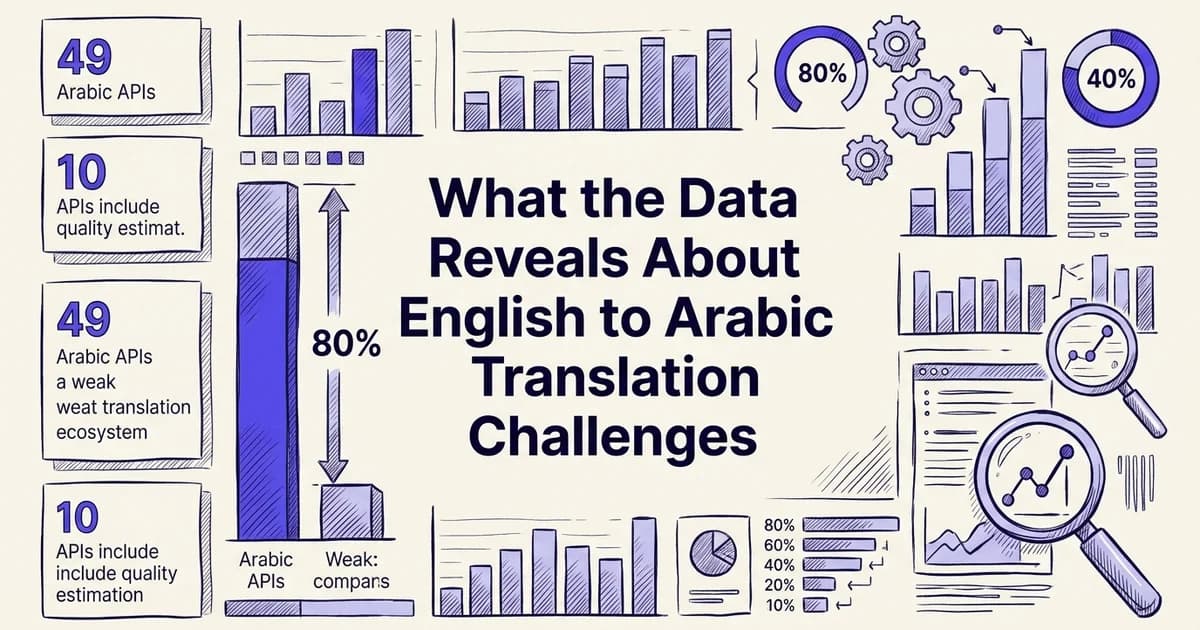
Despite strong overall coverage, only 10 of those 49 APIs offer quality estimation capabilities, meaning automated tools that score translation output without requiring human reference translations. That is roughly one in five providers.
This gap matters considerably for production workflows. Without quality estimation, teams must either rely on manual review, which does not scale, or accept translation output without any confidence scoring. For businesses processing high volumes of English to Arabic content, this creates a meaningful bottleneck in automated quality assurance, one the ecosystem has not yet resolved.
Dialectal Arabic translation: complexity across 16 dialects and growing research focus
The quality assurance gap described above becomes even more pronounced once dialect variation enters the picture. Arabic is not a single language in any practical translation sense. It is a family of regional varieties, each with distinct phonology, vocabulary, and grammar, sitting alongside Modern Standard Arabic as a formal written register that most native speakers do not use in daily conversation.

Scale of the dialect challenge
According to ACL Anthology (2026), researchers evaluated 16 Arabic dialects across both English-to-Arabic and Arabic-to-English translation directions, producing one of the most comprehensive dialect-coverage assessments to date. The findings confirmed what linguists have long argued: dialect identity materially affects system performance, and a model optimized for Modern Standard Arabic does not transfer reliably to Egyptian, Moroccan, or Gulf Arabic without dedicated adaptation. Josef Jon, Rawan Bondok, and Ondřej Bojar, commenting on the evaluation methodology, noted that dialect-specific benchmarks are essential because aggregated scores mask significant variation across regional varieties.
This has direct consequences for anyone trying to translate english to arabic at scale. A business targeting audiences in the Levant, the Gulf, and North Africa simultaneously is not dealing with one translation problem. It is dealing with at least three, each requiring different quality benchmarks and potentially different model configurations.
The AlexandriaX-2026 research track
The research community has responded with dedicated infrastructure. The AlexandriaX-2026 Shared Task (2026) introduced a specific subtask focused on context-aware English-to-dialectal Arabic dialogue translation, a recognition that conversational content, subtitles, and customer-facing text require dialect sensitivity that document-level models rarely provide.
This mirrors patterns seen in other complex language pairs. Work on translate chinese to english and vietnamese to english similarly shows that regional and register variation demands evaluation frameworks built around actual use cases, not generic benchmarks.
For production teams, the practical implication is straightforward: Modern Standard Arabic and regional dialects require separate translation pipelines, separate quality thresholds, and ideally separate human review protocols. The 2026 research landscape is beginning to supply the benchmarks needed to support that separation rigorously.
NMT system performance: comparative analysis of six translation engines
Choosing the right translation engine is not a minor technical decision. According to Six NMT Systems, One Language Pair (2026), a comparative study of six neural machine translation systems on the English-to-Arabic language pair revealed statistically significant performance variation across nearly every measured metric, confirming that system selection materially affects output quality for business-critical content.
How the six systems were evaluated
The 2026 study applied both automatic metrics (BLEU, TER, chrF) and structured human evaluation panels to assess each system. This dual-method approach matters because automatic scores alone frequently miss Arabic-specific failure modes: broken morphological agreement, incorrect diacritization, and register mismatches that a human reviewer catches immediately but a BLEU score does not penalise.
The core finding is unambiguous: no single system dominated across all content types. Systems that scored highest on formal, MSA-aligned texts performed measurably worse on colloquial or domain-specific input. For teams that need to translate english to arabic across multiple content categories, this means a single-engine strategy introduces systematic blind spots.
Cross-dialectal performance gaps
Cross-dialectal Arabic translation research from Frontiers in Artificial Intelligence (2025) reinforces this picture at the dialect level, reporting statistically significant differences across models at p < 0.05 for most evaluation metrics. Performance gaps between the strongest and weakest systems widened considerably when dialectal Arabic was introduced as the target register.
In our experience at DocuGlot, the practical implication for production teams is that engine selection should be treated as a use-case-specific decision, not a one-time infrastructure choice. Just as translate english to vietnamese workflows require region-aware evaluation, Arabic translation pipelines benefit from benchmarking against the specific dialect and domain before committing to a single system at scale. Human review remains non-negotiable for any output where accuracy carries reputational or legal weight. 📊
Government-backed platforms and sovereign AI translation infrastructure
Government investment in Arabic translation infrastructure is accelerating, with 2026 marking a significant policy shift as nation-states move beyond reliance on commercial engines toward sovereign AI solutions. Egypt's launch of the BelMasry platform represents the clearest signal yet that Arabic translation capacity is now considered a matter of national strategic interest.
Egypt's BelMasry: a sovereign translation model
Launched in 2026 by Egypt's Ministry of Communications and Information Technology, BelMasry is designed to handle translation between Arabic and 50 foreign languages, positioning it as one of the most linguistically ambitious government-backed platforms in the region. What distinguishes BelMasry from commercial alternatives is its explicit support for both Modern Standard Arabic and Egyptian colloquial Arabic, directly addressing the dialect gap that continues to undermine accuracy across privately developed systems.

This dual-register capability matters enormously in practice. As explored in the translate arabic to english context, dialect handling is one of the most persistent failure points in Arabic NLP pipelines. A platform engineered from the ground up to accommodate colloquial Egyptian Arabic signals a fundamentally different design philosophy than retrofitting dialect support onto a model trained primarily on formal text.
What sovereign investment signals for the broader market
Government-backed infrastructure of this scale rarely emerges in isolation. According to Machine Translate, Arabic presents unique computational challenges rooted in its morphological complexity and dialectal diversity, challenges that commercial platforms have historically underserved. BelMasry's 50-language scope suggests that policymakers are treating translation access as public infrastructure, comparable to digital identity or broadband connectivity. For businesses and content creators operating across the Arabic-speaking world, the emergence of sovereign platforms introduces a new variable: government-grade translation tools that may prioritize regional linguistic fidelity over raw benchmark performance. 🌐
Key takeaways: what the 2026 data reveals about English-to-Arabic translation
The 2026 data landscape paints a clear picture: English-to-Arabic translation has never been more technically capable, yet the complexity of the language pair continues to outpace any single solution. For business users and content creators, the practical implications are significant and actionable.
The API ecosystem is mature, but quality tools lag behind
According to Machine Translate, 49 providers now support Arabic translation via API, yet only 10 offer quality estimation tools. That gap matters enormously in production environments where undetected errors carry real reputational or legal risk. Mature access does not equal mature assurance.
Dialect complexity is now a research priority, not a footnote
Dialectal variation has moved from a known limitation to a central research focus. The AlexandriaX-2026 Shared Task is explicitly benchmarking systems across regional Arabic varieties, signaling that the field recognizes dialect handling as a core competency rather than an edge case. Businesses targeting specific Arabic-speaking markets, whether Gulf, Levantine, or North African audiences, should treat dialect selection as a strategic decision, not a technical afterthought.
Model selection directly affects business outcomes
Performance variation across systems remains wide. Choosing the wrong model for a high-stakes document, a legal contract, a product listing, or a published book, can produce outputs that are technically fluent but contextually wrong. This is precisely why model selection deserves the same rigor as vendor selection in any other business process. (Translating complex documents in other language pairs, such as those covered in our guide on how to translate Polish documents to English accurately, faces comparable evaluation challenges.)
Human expertise remains non-negotiable
Government platforms and commercial APIs alike have advanced significantly, but no system has eliminated the need for human review. Post-editing by Arabic-fluent specialists continues to be the most reliable safeguard against dialect mismatches, cultural missteps, and structural errors that automated metrics routinely miss. 🎯
The data is consistent: AI accelerates the process, but human judgment secures the outcome.
Frequently asked questions
How do I translate English to Arabic accurately?
Accurate English to Arabic translation combines a reliable AI tool with human post-editing. Because Arabic has complex morphology, right-to-left script, and significant dialect variation, automated output should always be reviewed by an Arabic-fluent specialist before publication or distribution.
What is the best English to Arabic translator for documents?
The best tool depends on your document type and target audience. According to Machine Translate (2026), Arabic is supported by 49 machine translation APIs, giving users a wide range of options. For formatted documents such as DOCX or PDF files, choose a platform that preserves layout alongside translation.
Is Google Translate accurate for Arabic?
Google Translate handles Modern Standard Arabic reasonably well for general content, but accuracy drops noticeably with dialects, technical terminology, and formal business language. Research by Rand Habib and colleagues, published in the World Journal of English Language (2026), found significant quality variation across six NMT systems and concluded that human translators still need to be involved in editing workflows.
How do I translate a DOCX file from English to Arabic without losing formatting?
Use a document-aware translation tool that processes DOCX natively. DocuGlot Basic is a practical starting point for users who need to translate english to arabic while keeping tables, headings, and paragraph structure intact.
What is the difference between Modern Standard Arabic and Arabic dialects in translation?
Modern Standard Arabic is the formal written standard used across media, government, and education. Dialects such as Egyptian, Levantine, or Gulf Arabic are spoken varieties that differ substantially in vocabulary and grammar. A 2026 study evaluated 16 Arabic dialects and found wide performance variation across translation systems.
Can AI translate English to Arabic for business documents?
Yes, but with important caveats. AI tools handle high-volume, structured content efficiently, yet business documents often require precise terminology and cultural sensitivity that automated systems still miss without human review.
How do I translate English text to Arabic online for free?
Several free tools offer basic English to Arabic translation online, including Google Translate and DeepL. For simple text, these work adequately. For anything professional or document-based, a dedicated platform with formatting support will produce more reliable results.
Which Arabic dialect should I use when translating from English?
Modern Standard Arabic is the safest default for written business, legal, or educational content because it is understood across all Arabic-speaking regions. If your audience is region-specific, such as Egyptian or Levantine consumers, a localized dialect may be more appropriate. Consult a native-speaking editor to confirm the right register.
Based on our work at DocuGlot, the questions above represent the most common friction points users encounter before, during, and after translation. Getting the dialect, format, and review workflow right from the start saves significant rework downstream. 🎯
Tags
Ready to translate your documents?
DocuGlot uses advanced AI to translate your documents while preserving formatting perfectly.
Start Translating