Choosing a Spanish Translation Service for Your Business
When you need to connect with the more than 500 million Spanish speakers across the globe, a professional Spanish translation service becomes more than just a tool—it's your cultural and commercial lifeline. It's about moving beyond simple word-for-word conversion to build a genuine bridge, ensuring your message lands exactly as you intended.
Why Your Business Needs a Spanish Translation Service
In our interconnected world, speaking your customer's language isn't just a nice-to-have; it's a fundamental part of doing business. Relying on free, automated tools for anything important is a gamble. One awkward phrase or mistranslation in a critical document can lead to cringeworthy mistakes, costly misunderstandings, and a black eye for your brand. A dedicated Spanish translation service is the answer.
Think about the effort you put into your English content. Your marketing copy, legal agreements, and user manuals are all meticulously worded to strike the perfect tone and deliver a precise message. A professional service simply extends that same care and precision into Spanish, protecting your brand's voice and credibility in a new market.
It’s More Than Words—It’s Genuine Connection
The real magic happens in the nuances. Spanish isn't a single, uniform language; it's a rich tapestry of regional dialects and cultural norms. The way someone speaks in Madrid is quite different from how they communicate in Mexico City or Buenos Aires. A true professional helps you navigate this complex landscape.
Here's what that looks like in practice:
- Cultural Fluency: They make sure your idioms, humor, and cultural references actually make sense to your target audience, steering you clear of awkward or even offensive gaffes.
- Technical Accuracy: They get the jargon right. In fields like law, medicine, or engineering, one wrong word can have serious legal or safety implications.
- Consistent Brand Voice: Your brand has a unique personality. A quality service ensures that personality shines through consistently, building trust and recognition with Spanish-speaking customers.
A professional translation isn't about avoiding mistakes. It's about building trust. It shows a new audience that you respect them enough to speak their language with the same fluency and care you use in your own.
The Strategic Edge of Speaking the Language
Bringing a Spanish translation service into your operations is a powerful strategic decision that opens up massive opportunities for growth. It gives you the confidence to march into new markets, support your international teams, and deliver a better experience to a much wider audience.
Imagine a US-based e-commerce store translating its product listings and customer support guides for the Latin American market—that's an instant expansion of its potential customer base. Or a law firm that can securely translate sensitive contracts for its Spanish-speaking clients, guaranteeing total clarity and compliance. This isn't just an expense; it's an investment that transforms your business from a foreign entity into a local player, ready to connect and compete.
Human vs. AI Translators: Finding Your Best Fit
Picking the right translation method can feel overwhelming. Let’s break it down with an analogy. Think of a master chef (a human translator), a high-speed food processor (an AI translator), and a chef using the latest kitchen gadgets (a hybrid approach). Each has its place, depending on the meal you’re trying to create. That's exactly how you should approach your Spanish translation service options.
Your decision really comes down to what you need most, balancing four key factors: speed, cost, accuracy, and nuance. There’s no single "best" method, just the right fit for your specific project.
To give you a clearer picture, we've created a simple comparison of the three main approaches. This should help you quickly see the pros and cons of each and figure out which one aligns with your goals.
Comparing Translation Methods: Human vs. AI vs. Hybrid
| Feature | Human Translation | AI Translation | Hybrid (AI + Human Review) |
|---|---|---|---|
| Accuracy | Highest, especially for nuance, culture, and context. | Varies; good for gist, but can miss subtleties. | High; combines machine accuracy with human refinement. |
| Speed | Slowest; quality work takes time. | Fastest; nearly instantaneous. | Faster than human-only, slower than pure AI. |
| Cost | Highest; priced per word by a skilled professional. | Lowest; often a low flat fee or subscription. | Mid-range; more affordable than full human translation. |
| Context & Nuance | Excellent; understands idioms, tone, and cultural specifics. | Limited; struggles with sarcasm, humor, and cultural context. | Very good; a human editor catches and corrects AI's misses. |
| Ideal For | Marketing, legal contracts, creative content, medical records. | Internal docs, user reviews, large-volume initial drafts. | Technical manuals, business reports, website localization. |
As you can see, the best choice really depends on what you're translating. High-stakes legal documents have very different requirements than internal emails.
The flowchart below maps out how a smart translation strategy can open doors to new markets and drive real business growth.
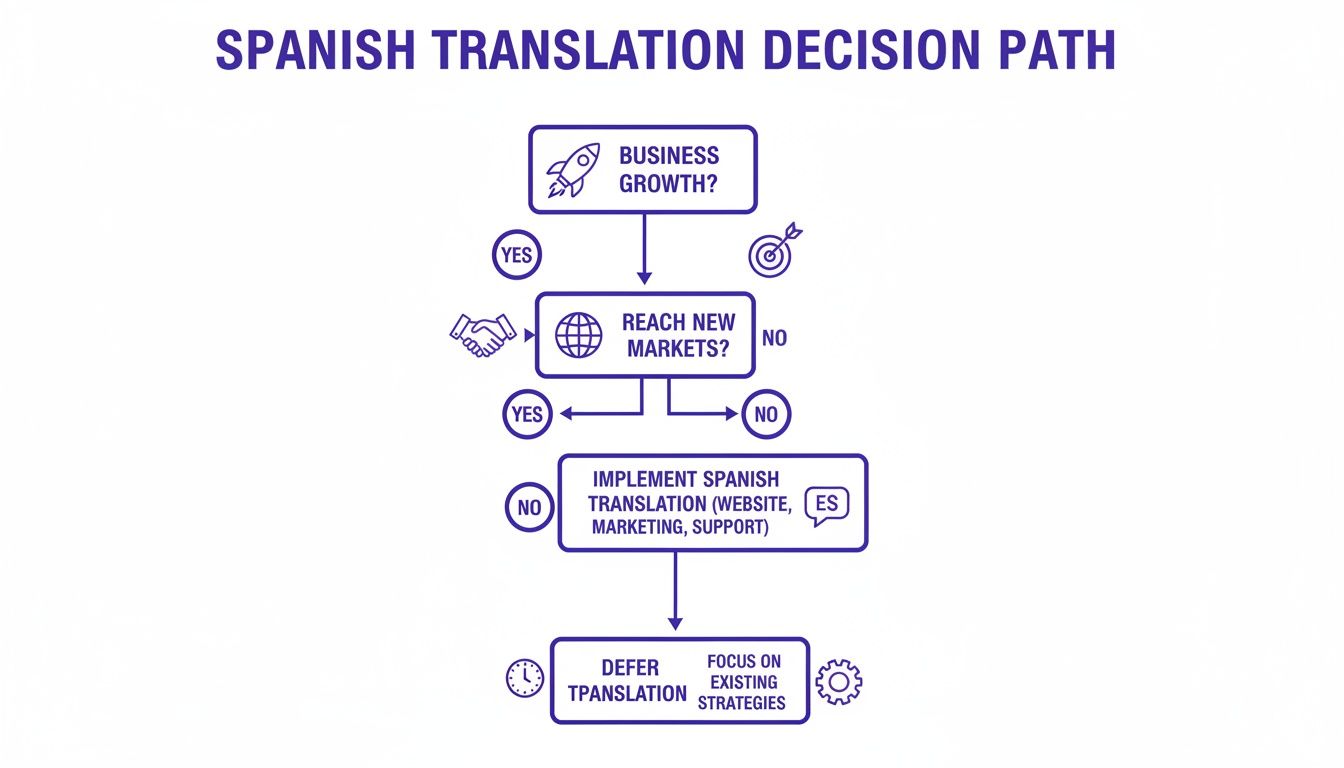
This illustrates a simple truth: engaging with new audiences in their own language isn't just a courtesy—it's a direct path to growth. Ignoring it means leaving opportunity on the table.
When To Use AI Translation
AI translation is your best bet when speed and volume are what matter most. Think of it as the perfect tool for tasks that need to be done right now, and on a massive scale.
It’s fantastic for getting the general meaning of internal company memos, sorting through huge batches of customer feedback, or translating knowledge base articles where the goal is just to get information across. The technology has come a long way.
The impact of AI on the translation industry is undeniable. Translation software now holds a 72.88% market share, with advanced neural systems capable of cutting project turnarounds by as much as 80%.
This kind of efficiency is a game-changer for many businesses. For those exploring automation, looking into how an AI chatbot for small business works can offer more insight into how these language technologies create operational wins.
When To Insist On Human Translation
For all of AI's advancements, some jobs absolutely require a human touch. A professional translator does more than just switch out words—they interpret meaning, navigate cultural subtleties, and capture the right tone.
For creative marketing copy, legally binding contracts, or sensitive medical documents, a human expert is simply non-negotiable. They catch the nuances, idioms, and cultural references that algorithms still miss, ensuring your carefully crafted message lands exactly as you intended. This is where the "master chef" proves their worth, adding the artistry that a machine can't replicate.
For a deeper look at this, you might be interested in our guide on how to choose between AI and human translators.
Finding The Sweet Spot With Hybrid Translation
This is where you get the best of both worlds. The hybrid model is a smart, practical approach that uses AI to do the initial heavy lifting quickly and affordably. Then, a professional human translator steps in to review, edit, and perfect the text.
This "AI-first, human-finished" workflow is perfect for a wide range of business documents:
- Technical Manuals: The AI can handle repetitive, technical terms, while a human expert makes sure the instructions are crystal clear and accurate.
- Customer-Facing Reports: You get a solid first draft from the AI, and a human reviewer ensures the final product sounds professional and aligns with your brand voice.
- Website Localization: Let the AI translate the bulk of your site's content, then have a human linguist polish the key landing pages and calls-to-action for maximum impact.
By combining machine speed with human expertise, the hybrid approach delivers a top-notch Spanish translation service that is both faster and more cost-effective than a fully human process, without sacrificing the quality you need for professional communication.
What Really Matters in a Spanish Translation Service?
It’s easy to assume all Spanish translation services do the same thing: change words from one language to another. But anyone who’s been through the process knows that’s just the starting point. The real difference between a seamless, professional experience and a frustrating one comes down to a few critical features that separate the experts from the amateurs.
Think of these as your non-negotiables—the things you need to look for to ensure you get a result that saves time, protects your brand, and actually works.
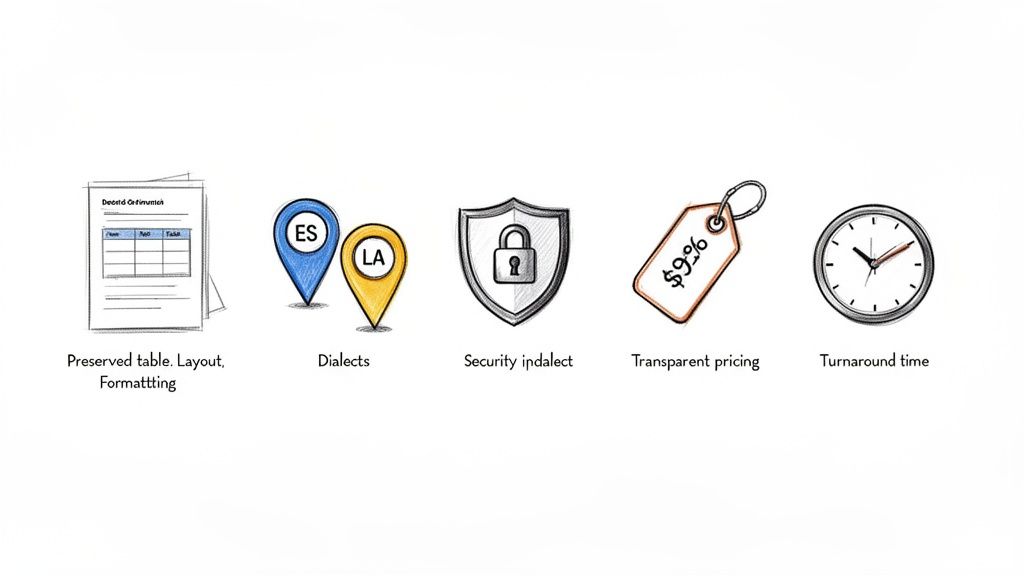
Let's start with a big one that’s often overlooked until it’s too late: preserving your document's formatting. Have you ever spent hours perfecting a report with custom tables, branded fonts, and specific headers, only to get the translation back as a jumbled wall of plain text? It’s a nightmare.
A top-tier service anticipates this. It doesn't just translate the words; it intelligently rebuilds the translated document to perfectly mirror the original layout. This single feature can save you hours of painful reformatting work.
Getting the Language and Dialect Just Right
Next up is something that can instantly make or break your connection with your audience: support for different Spanish dialects. The Spanish spoken in Madrid is not the same as the Spanish you'll hear in Mexico City. Using the wrong one is a dead giveaway that you're an outsider, and it can make your message feel awkward or even unprofessional.
A modern Spanish translation service understands this nuance and gives you options. You should be able to choose from:
- European Spanish: Best for audiences in Spain.
- Latin American Spanish: A neutral option that works well for most of the Americas.
- Specific National Variants: Crucial for highly targeted content aimed at countries like Argentina or Colombia.
This isn’t just a minor detail. It’s about showing your audience you understand their world, which builds trust and makes your message land with real impact.
No-Surprise Pricing and Realistic Timelines
The days of mysterious quotes and hidden fees are over. A modern service should offer clear, upfront pricing before you ever click "translate." You should be able to upload your file and get an instant, exact cost based on its size and the level of service you need. This transparency makes budgeting simple and predictable.
Speed matters, too. While a human-only translation might take days or even weeks, today’s AI-powered platforms can often turn around high-quality translations in just minutes or hours. The service should give you a reliable estimated delivery time and let you know the second your file is ready, keeping your workflow moving smoothly.
Ironclad Security and Confidentiality
When you upload a document for translation, you’re handing over your data. For sensitive materials like legal contracts, financial reports, or medical records, trust is everything. A reliable service has to make security a top priority.
A provider’s security policy is a huge tell. Look for a clear commitment to encrypting your data both during upload (in transit) and while on their servers (at rest). Most importantly, they should have an automatic file deletion policy. Your sensitive documents shouldn't sit on their servers forever.
This focus on security isn't just a nice-to-have; it's a global standard. The translation industry is heavily regulated, especially in Europe, where rules like GDPR set a high bar for data protection. In fact, with its diverse languages and strict regulations, Europe holds a massive 45.2% of the global translation market share. This has forced the best providers to adopt rigorous security practices to protect their clients. You can learn more about the key drivers of the translation market to see how these trends are shaping the industry.
By keeping an eye out for these key features—formatting, dialect support, clear pricing, and robust security—you can pick a service that truly delivers. To see how modern tools are making this possible, take a look at our guide to the best translation software for business.
Real-World Uses for Spanish Document Translation
Let's move beyond the technical side of things and talk about where the rubber meets the road. A professional Spanish translation service isn't just about swapping words; it’s a problem-solving tool for real, high-stakes communication challenges professionals face every single day. Whether you're trying to crack a new market, stay compliant with the law, or share research globally, the right translation partner is what makes it possible.
The need for these services is exploding. The entire global translation market is already valued at USD 41.78 billion, and experts predict it will hit USD 50.02 billion by 2033. This isn't just a niche industry; it’s a reflection of our deeply interconnected world.
Driving Business Growth and Market Expansion
For any company, from a small business to a major enterprise, Spanish-speaking markets represent a massive opportunity. But you can't just show up—you need to communicate with the same polish and brand voice that got you where you are. This is where a dedicated service makes a real difference.
Here are a few ways businesses put these services to work:
- Marketing Collateral: Translating brochures, website copy, and social media posts so your brand’s personality connects authentically with local customers.
- Product Manuals: Providing crystal-clear instructions is non-negotiable for a good user experience and safety. It also cuts down on customer support calls.
- International Contracts: When it comes to legal agreements, precision is everything. Proper translation prevents expensive misunderstandings and protects you from legal headaches.
And it’s not just about text. To truly engage new audiences, many companies need audio and video content localized. Services that provide high-quality voice overs in Spanish can be a game-changer.
Ensuring Precision in Legal and Medical Fields
In fields like law and healthcare, the stakes couldn't be higher. A single misplaced word can have life-altering legal or medical consequences. Here, absolute accuracy isn't a goal; it's the bare minimum.
In these fields, translation is a matter of precision and trust. There is zero room for ambiguity when dealing with a patient's medical history or the fine print of a legal affidavit.
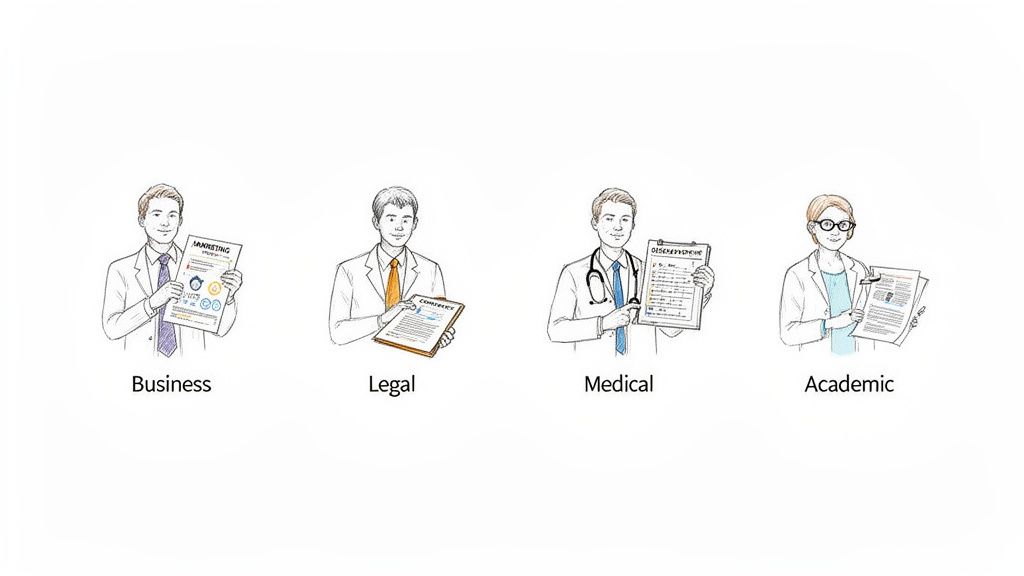
Legal and medical professionals depend on specialized translation for documents like:
- Case Files and Evidence: Translating witness statements, court documents, and other evidence for international legal cases where every detail matters.
- Patient Records: Making sure medical histories, consent forms, and treatment plans are perfectly understood by both doctors and their Spanish-speaking patients.
- Pharmaceutical Documents: Accurately translating clinical trial data, drug inserts, and regulatory paperwork submitted to health authorities.
The biggest hurdle is the jargon. These documents are packed with dense, technical language. A service that truly understands this specialized vocabulary is essential for upholding professional standards and managing risk.
Advancing Academic Research and Global Collaboration
For academics, the mission is to share knowledge far and wide. Language should be a bridge to collaboration, not a barrier. Translating research allows important work to find a global audience, sparking new ideas and conversations.
Here’s how scholars and universities use translation:
- Research Papers and Theses: Making academic findings accessible to Spanish-speaking colleagues and institutions all over the world.
- Educational Content: Translating textbooks, online courses, and lectures to better serve international students and global programs.
- Conference Materials: Preparing presentations and publications for international conferences to maximize the impact of their work.
By using a reliable translation service, researchers can be confident that their complex ideas and data are presented with the same clarity as in the original language. It’s a powerful way to break down academic silos and build a more connected global research community.
How to Choose the Right Translation Provider
Picking a Spanish translation service shouldn't feel like a shot in the dark. With the right framework, you can confidently choose a partner that hits the mark on quality, speed, and security every time. It’s all about moving from abstract ideas to a practical, step-by-step evaluation.
The process really boils down to a simple checklist. When you know exactly what to look for, you can systematically compare your options and avoid any nasty surprises down the road.
Your Spanish Translation Service Evaluation Checklist
Let’s get practical. Use this table as a scorecard when you're sizing up different providers. It covers the essential features we’ve talked about and, more importantly, explains why each one is non-negotiable for a smooth, professional experience.
| Evaluation Criteria | What to Look For | Why It Matters |
|---|---|---|
| Document Formatting | A firm guarantee that the service preserves the original file layout—tables, headers, styles, and all. | This saves you countless hours of frustrating reformatting work. Your translated document should be ready to use the moment you get it back. |
| Dialect Options | The ability to select specific Spanish dialects, like European or Latin American Spanish. | Using the right dialect makes your content feel authentic and professional to your target audience, which is critical for building trust. |
| File Type Support | Broad support for common file formats like PDF, DOCX, and whatever else you use day-to-day. | A flexible service should work with your documents as they are, without forcing you to convert files into different formats first. |
| Pricing Model | Clear, transparent pricing provided upfront—before you commit to anything. | This kills the risk of hidden fees and surprise costs, making it easy to budget and plan your projects with confidence. |
| Security Protocols | Strong data encryption (both in transit and at rest) and a clear, automatic file deletion policy. | This is all about protecting your sensitive business, legal, or personal information from prying eyes and ensuring it isn't stored forever. |
| Turnaround Time | A realistic and clearly stated delivery estimate for your specific document. | Knowing when to expect your file back helps you manage project timelines and avoid disruptive delays in your own workflow. |
This checklist gives you a solid foundation for comparing services apples-to-apples, ensuring you make a decision based on the factors that truly matter for your business.
What a Modern Onboarding Experience Feels Like
Once you have a shortlist of providers that tick these boxes, the next step is to see their workflow in action. Modern platforms have worked hard to get rid of the clunky, email-heavy processes of traditional translation agencies. The experience should feel intuitive, fast, and completely transparent.
Here's a quick walkthrough of what you should expect from a platform like DocuGlot:
Effortless Document Upload: You should be able to just drag and drop your file. A good service will handle PDFs, DOCX files, or even Markdown without a problem and start analyzing it right away.
Clear Language and Dialect Selection: The interface will then ask you to pick your target language. For Spanish, this is where you’ll pinpoint the exact dialect you need to make sure your message lands just right with your audience.
Choosing Your Service Tier: Many providers offer different service levels. You might see a "Basic" option for quick, general translations and a "Premium" tier that uses more advanced AI for complex or highly nuanced material.
Instant, Transparent Quoting: This is the moment of truth. Before you spend a dime, the platform should show you the exact, final cost. This upfront quote gives you total control over your budget.
Secure Payment and Job Confirmation: After you review the price, you can pay securely. The moment it’s confirmed, the translation job kicks off, and you should get a notification that your project is officially underway.
This whole process, from uploading your file to getting confirmation, often takes less than a minute. It’s a completely different world from the old model of emailing files back and forth, waiting days for a quote, and chasing down invoices.
Prepping Your Documents for the Best Results
While a great Spanish translation service can work wonders, a little prep work on your end can make a good translation truly excellent. Taking a few simple steps before you upload your document sets the stage for a more accurate and efficient result.
Here are a few quick tips:
- Write Clearly and Simply: Use direct, straightforward language in your original document. Avoid overly complex sentences, slang, or idioms that could trip up an AI model or even a human translator.
- Finalize Your Text: Make sure the source text is the final, proofread version. Trying to make changes after the translation has already started is inefficient and might cost you extra.
- Check for Consistency: Ensure key terms are used consistently throughout your document. This helps the translation model maintain that same consistency in the final output.
By using this checklist, knowing what a modern user journey looks like, and prepping your files properly, you can choose the right provider with total confidence. This approach turns translation from a complicated chore into a simple, reliable part of your workflow.
Common Questions About Spanish Translation Services
Even after digging into the details of a professional Spanish translation service, it's natural to have a few questions left. It's a big decision, and you want to be sure you’re thinking about accuracy, cost, and all the little logistical details.
To clear things up, I’ve pulled together the questions that come up most often. Think of this as a quick-reference guide to help you feel confident and make the right call for your projects.
How Accurate Are AI Spanish Translation Services?
This is the big one, and for good reason. I'll be honest—modern AI translation has gotten scarily good, especially on high-quality platforms. For a huge amount of business, technical, and academic content, these systems can deliver remarkably accurate results because they’ve learned from billions of real-world examples.
But context is everything. When you're dealing with content that relies on creative flair, cultural nuance, or a very specific persuasive tone—think marketing copy, critical legal arguments, or literary works—nothing beats a final pass by a native human translator. That’s still the gold standard.
The smartest play is often a hybrid approach. Let the AI handle the heavy lifting for speed and efficiency on the first draft. Then, bring in a human expert to polish your most important, customer-facing content. You get the best of both worlds: speed and quality.
Will My Document Formatting Be Preserved?
We’ve all been there. You spend hours getting a report just right—perfecting the tables, headers, and fonts—only to have a basic translation tool spit back a wall of plain, jumbled text. It’s incredibly frustrating.
This is where a quality service really proves its worth. A professional platform is built from the ground up to preserve your document's original structure. It intelligently rebuilds the translated file to mirror the source, keeping your tables, styles, and headers exactly where they should be. This feature alone can save you hours of mind-numbing reformatting work, so it's a must-have when you're choosing a provider.
What Is the Difference Between European and Latin American Spanish?
While a Spanish speaker from Madrid and one from Mexico City can understand each other, the differences in their day-to-day language are significant. Using the wrong dialect can make your message feel awkward or out of touch, instantly eroding trust with your audience.
Here are a few quick examples:
- Computer: In Spain, it's an ordenador, but in most of Latin America, you’ll hear computadora.
- Car: A Spaniard drives a coche, while many Latin Americans drive a carro or an auto.
- Bus: Depending on where you are, it could be an autobús, a camión (Mexico), a colectivo (Argentina), or even a guagua (Caribbean).
Choosing the right dialect is essential for making a genuine connection. A good Spanish translation service will always let you specify the regional variant you need, ensuring your content lands just right and builds credibility.
How Is the Cost of a Translation Calculated?
Pricing is another area that’s been completely transformed for the better. The old agency model was often a black box. You’d get a per-word rate, but then project management fees and other hidden costs would creep in, and you’d have to wait days just to get a quote.
Today’s AI-powered platforms are much more transparent. Here’s what you should expect:
- Upfront Pricing: Simply upload your document and get an exact, all-inclusive price before you commit to anything. No surprises.
- Document-Based Cost: The price is based on the document's size (word or character count), not confusing hourly rates.
- Tiered Options: Many services offer different levels, like a "Basic" tier for speed and a "Premium" one for more complex files, so you only pay for what you actually need.
This straightforward approach takes the guesswork and financial risk out of the equation. If you want to see how this works in practice, you can learn more about how to estimate your document translation cost with modern tools. That kind of predictability makes planning and budgeting so much easier.
Ready to translate your documents with confidence? DocuGlot offers an AI-powered service that preserves your original formatting, supports multiple Spanish dialects, and provides instant, transparent pricing. Get started today and see how easy professional translation can be at https://docuglot.com.
Tags
Ready to translate your documents?
DocuGlot uses advanced AI to translate your documents while preserving formatting perfectly.
Start Translating