Secure Document Translation: Why It Matters and What to Look For
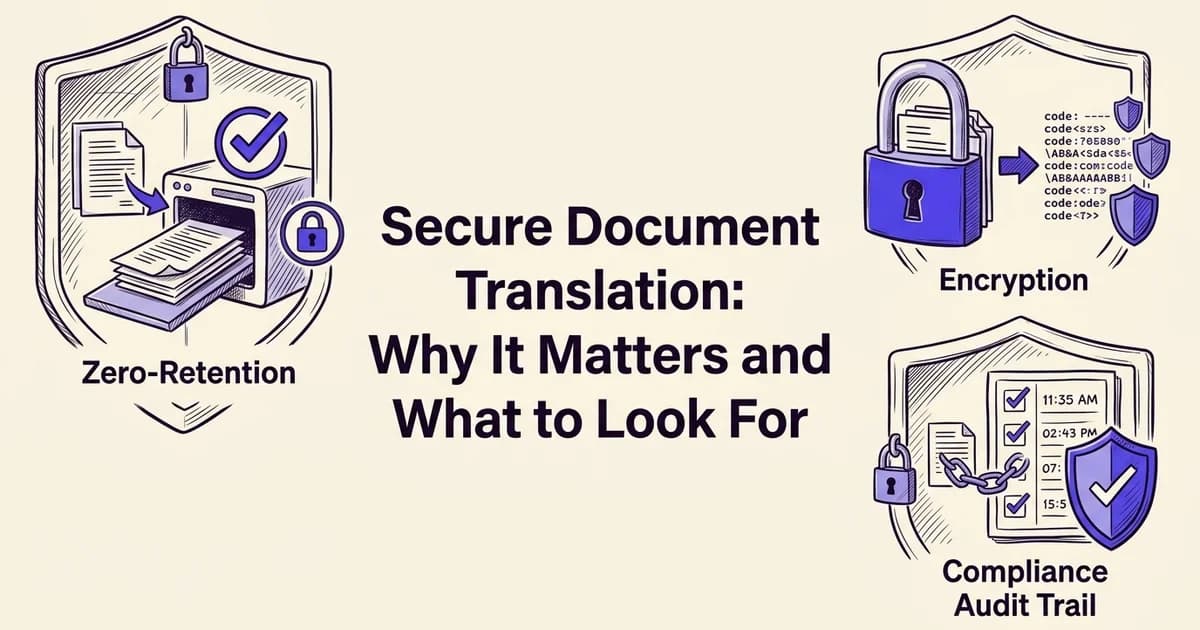
Introduction: The risk of translating sensitive documents online
Every day, businesses face a quiet dilemma: documents need to reach global audiences, partners, or regulators, but sending sensitive content through an unknown translation tool feels like handing your keys to a stranger. Legal contracts, medical records, financial reports, and HR files all carry information that, if exposed, could trigger serious legal and financial consequences.
The real cost of getting it wrong
The numbers make the stakes concrete. According to IBM's Cost of a Data Breach Report via LegalReader, the global average cost of a data breach has reached $4.45 million, and 45% of organizations have already encountered privacy issues tied to AI deployments. Translation workflows are increasingly AI-powered, which means they carry the same exposure risks as any other AI system handling confidential data.
Why free tools fall short for business use
Consumer-grade translation tools, including many free browser-based options, are built for convenience, not compliance. They often store uploaded documents on external servers, use submitted content to train future models, and offer no contractual data protection guarantees. For a business handling client data or operating under GDPR, HIPAA, or similar frameworks, that is simply not acceptable.
What this guide covers
At DocuGlot, our analysis shows that most businesses are not looking for perfection; they are looking for a trustworthy, practical framework. This article breaks down exactly what a secure document translation service should offer, from encryption standards to compliance certifications, and how to evaluate your options with confidence. 🔐
Quick fix: The essentials for secure document translation
If you need a fast answer before diving deeper, here it is: a genuinely secure document translation service must meet three non-negotiable requirements before you upload a single page of sensitive content. Everything else is secondary.
Verify zero-retention data policies
Before uploading any sensitive document, confirm in writing that the translation service does not store, retain, or use your data for model training. Enterprise-grade platforms like Azure AI Translator process data transiently without storing it in data centers.
Check for GDPR compliance and data processing agreements
Ensure your translation provider has a signed Data Processing Agreement (DPA) in place, as required under GDPR Article 28. This creates a legally binding framework for how your personal data is handled and gives you enforceable recourse if breaches occur.
Redact or anonymize sensitive identifiers before translation
Strip or mask personally identifiable information, financial data, or proprietary details before submitting documents. This adds a critical second layer of defense and reduces the risk exposure even if data is inadvertently accessed.
The three non-negotiable requirements
Before choosing any translation tool, confirm it offers all of the following:
- Zero-retention policy. Your documents should be deleted immediately after translation, not stored on servers for reuse or model training. According to Acolad (2024), verifying how long a provider retains uploaded files is one of the first checks any security-conscious user should perform.
- A written data processing agreement (DPA). Under GDPR Article 28, any vendor processing personal data on your behalf must sign a formal DPA. No signed agreement means no legal accountability.
- Data residency controls. You should know exactly where your data is processed and stored, particularly if your organisation operates across jurisdictions with conflicting privacy laws.
Quick decision tree: what level of protection do you need?
- Legal or medical documents: Require all three guarantees above, plus encryption in transit and at rest. No exceptions.
- General business documents: At minimum, confirm zero-retention and a clear privacy policy before uploading.
For everyday business translation without a subscription commitment, DocuGlot Basic is built around a privacy-first approach, making it a practical starting point for teams that need reliable, no-subscription document translation without compromising on data handling. ✅
Why this problem happens: Understanding document translation security risks
Most document translation security breaches don't happen because of hackers. They happen because professionals reach for the most convenient tool available, without realizing that "convenient" often means "your data is being used to train someone else's AI model." Understanding why this gap exists is the first step toward closing it.
How consumer translation tools handle your data
Free and consumer-grade tools like Google Translate, the free tier of DeepL, and general-purpose AI assistants like ChatGPT are built on a simple trade: you get translation for free, and the provider may retain your input to improve its models. According to AI Translation and Data Privacy: What Legal Teams Need to Know in 2026, this creates a serious exposure risk when professionals paste contract clauses, patient records, or financial summaries into these tools without a second thought.
The core issue is data retention vs. transient processing. Enterprise-grade infrastructure, such as Azure AI Translator, processes text transiently, meaning your content is translated and immediately discarded, never written to storage or used for training. Consumer tools typically offer no such guarantee.
The compliance landscape is tightening fast
Regulations are catching up with the risk. GDPR already imposes strict rules on how personal data is processed and transferred. HIPAA governs protected health information in the US. And the EU AI Act (Regulation (EU) 2024/1689) is now in phased application, adding new obligations around high-risk AI systems, including those that process sensitive documents.
The gap between awareness and readiness is stark: only 24% of companies report confidence in their ability to manage AI data privacy effectively. For legal teams, healthcare providers, and financial professionals, that statistic represents real liability exposure every time a document is uploaded to the wrong tool. 🔒
Solution 1: Implement a zero-retention, enterprise-grade translation platform
The most direct fix for document translation security risks is choosing a platform built around a simple principle: your data should never persist beyond the moment it is needed. Zero-retention architecture means documents are processed transiently, deleted immediately after translation, and never used to train AI models or stored on third-party servers.
What zero-retention actually means in practice
Many translation tools retain uploaded content indefinitely, using it to improve their models or storing it in ways users never see. A genuine zero-retention platform works differently. Your document enters the system, gets translated, and is purged. No logs of the content, no training pipelines, no residual copies sitting in a cloud bucket somewhere.
According to AI Translation Security and Data Privacy: What to Check (Acolad), enterprise translation tools with proper privacy controls can be as secure as any other business system. The problem is not AI translation itself. It is using consumer-grade tools that were never designed with enterprise data handling in mind.
This distinction matters enormously for legal contracts, patient records, and financial filings, where even a brief, unintended retention window creates compliance exposure.
How to evaluate and deploy a secure platform
Implementation does not need to be complex. Follow this process to reduce risk quickly:
- Request written guarantees. Ask vendors directly for a Data Processing Agreement (DPA) that specifies retention periods, deletion protocols, and subprocessor relationships. Vague privacy policies are a red flag.
- Confirm data residency options. Depending on your jurisdiction, data may need to stay within specific regional boundaries. Verify whether the platform offers EU, US, or other regional hosting.
- Check for audit logging and access controls. Enterprise deployments should record who accessed what and when, with role-based permissions to limit exposure.
- Review the AI model's training data policy. Confirm explicitly that your documents are excluded from any model improvement pipeline.
Why DocuGlot fits this model
DocuGlot is built around security and privacy as core values, not afterthoughts. Documents are processed without persistent storage, and the platform supports the format fidelity that sensitive professional documents require, including PDFs, DOCX files, and structured formats with tables, headers, and fonts preserved exactly.
For teams that need fast turnaround without sacrificing control, DocuGlot Basic offers a practical starting point. If your workflow involves high volumes or more complex documents, you can explore how the platform handles scale in this guide on how to get fast document translation online in minutes. 🛡️
The key takeaway: zero-retention is not a premium feature. It should be the baseline expectation for any tool handling professional documents.
Solution 2: Anonymize and redact sensitive data before translation
Zero-retention policies protect your data during and after translation, but anonymization adds a critical second layer of defense before your document ever leaves your hands. By stripping or masking sensitive identifiers at the source, you limit what can be exposed even if something goes wrong further down the line.

Think of anonymization as a safety net beneath the safety net. Even the most secure translation platform cannot protect data that was never sensitive to begin with. If a document reaches a translation engine with names, account numbers, and medical IDs already replaced by neutral placeholders, a breach becomes far less damaging.
What counts as sensitive PII in documents
Before uploading anything to a translation tool, it helps to know exactly what you are looking for. The most common categories of personally identifiable information found in business documents include:
- Full names and job titles in contracts, reports, and correspondence
- Financial data such as account numbers, invoice totals, and payment terms
- Medical IDs and health records in clinical or insurance documents
- Physical and email addresses in customer-facing materials
- National ID numbers, passport details, and tax identifiers
According to Acolad (2025), enterprises increasingly treat PII redaction as a non-negotiable step in their translation workflows, not an optional extra.
A practical redaction workflow before uploading
Implementing redaction does not require specialist software. A repeatable four-step process works well for most teams:
- Identify the document type and flag which PII categories are likely present
- Redact or pseudonymize sensitive fields using tools like Adobe Acrobat, Microsoft Word's built-in redaction, or dedicated platforms such as Redactable
- Replace identifiers with consistent placeholders (for example, [CLIENT_NAME_1]) so the translated text remains coherent
- Review the redacted version before uploading to confirm nothing was missed
Once translated, you can reinsert the original values using your placeholder key. This approach works particularly well when using a professional document translation service that preserves document structure, since your placeholders will appear in exactly the right positions in the output.
How anonymization limits breach impact
According to Language IO (2025), pseudonymization is one of the most effective mitigation strategies available because it renders intercepted data meaningless without the corresponding key. In practical terms, this means that even if a document were accessed without authorization during processing, an attacker would find placeholders rather than real client data. 🔒
Platforms like DocuGlot Basic complement this approach well. Because it processes documents in formats like PDF and DOCX while preserving headers, tables, and structured layouts, your placeholder substitutions remain intact and correctly positioned throughout the translated output. There is no reformatting chaos to unpick afterward, which makes the reintegration step clean and reliable.
The combination of pre-upload redaction and a privacy-focused translation platform is more resilient than either measure alone.
Solution 3: Establish a data processing agreement and compliance framework
Technical safeguards like redaction and encryption only go so far. Without a legally binding agreement that defines how your translation provider handles data, you have no enforceable recourse if something goes wrong. A data processing agreement (DPA) transforms good intentions into contractual obligations.
Discover how DocuGlot Basic approaches secure document translation service DocuGlot Basic.
Why GDPR Article 28 makes DPAs non-negotiable
Under GDPR Article 28, any organisation that shares personal data with a third-party processor must have a written DPA in place before processing begins. This applies directly to translation services. According to Legal Reader (2026), legal teams should confirm in writing that a provider does not use uploaded documents to train AI models and that GDPR compliance is explicitly documented in the contract. A verbal assurance or a vague privacy policy page does not satisfy this requirement.
What a compliant DPA must include
Not all DPAs offer the same level of protection. When reviewing a translation service contract, your legal team should verify the following elements are present:
- Data retention limits: Clear timelines for how long documents are stored and a process for deletion upon request
- Sub-processor register: A full list of any third parties the provider shares data with, such as cloud infrastructure or AI model vendors
- Audit rights: Your right to request evidence of compliance, including security certifications and access logs
- Data breach notification: Defined timelines for notifying you of any incident, typically within 72 hours to align with GDPR requirements
- Lawful basis for processing: Confirmation that the provider processes data only for the stated translation purpose
Building a compliance matrix across frameworks
If your organisation operates across jurisdictions, a single DPA may not be enough. You need a compliance matrix that maps your translation workflow against GDPR, HIPAA (for health-related documents), and the EU AI Act, which is now in phased application and increasingly relevant to AI-powered translation systems.
In our experience at DocuGlot, the organisations that handle this best treat compliance as a living document rather than a one-time checkbox. They revisit their DPAs annually and update their internal data handling statements whenever a new translation tool is introduced.
A practical starting point is creating two documents: one for internal teams explaining how translation data flows through your systems, and one client-facing statement that summarises your safeguards in plain language. According to Snap Intel (Year), agencies that proactively communicate their data privacy practices build significantly more client trust than those who wait to be asked.
Choosing a document translation service that stands behind their work with transparent policies makes this compliance documentation far easier to produce and maintain. 🔒
Prevention: Building a secure translation workflow for the future
Building security into your translation process from the start is far more effective than reacting to a breach after it happens. A repeatable, policy-driven workflow removes guesswork, reduces human error, and ensures every document reaches the right translation tier without exposing sensitive data to unnecessary risk.
Classify your documents before you translate anything
Not every document carries the same risk. A marketing brochure and a signed NDA are not equivalent, yet many teams treat them identically when choosing a translation tool. Implement a simple data classification system with at least three tiers:
- Public content: Marketing copy, blog posts, general communications
- Internal content: Internal reports, training materials, non-sensitive correspondence
- Confidential content: Contracts, medical records, financial statements, legal filings
Each tier should map to an approved translation method. Confidential documents must only flow through services with documented security controls, signed data processing agreements, and clear data deletion policies.
Train your team on what not to do
This is where most organizations fail. According to Language IO (2025), employees routinely paste sensitive content into consumer AI tools without realizing the data may be used for model training or stored on external servers. The rule should be explicit and non-negotiable: never upload confidential content to free versions of ChatGPT, Google Translate, or DeepL.
Post this policy where teams actually work. Make it part of onboarding. Repeat it.
Build a vendor evaluation checklist
Before adopting any new translation tool, run it through a standard checklist covering encryption standards, data retention limits, subprocessor transparency, and compliance certifications. Tools like DocuGlot make this evaluation straightforward by publishing clear security and privacy commitments upfront, so your compliance team is not left chasing answers.
Revisit your approved vendor list at least annually. The shift from consumer-grade to enterprise-secure AI translation is accelerating, and the options available today are meaningfully better than they were even twelve months ago. 🛡️
When to seek professional help: Escalation and expert guidance
Not every document belongs in an automated workflow, even a secure one. For certain document types, the stakes are high enough that human expertise is not optional. Knowing where that line sits can protect your organization from costly mistakes.
Scenarios that require human translation or review
Some documents carry legal, medical, or regulatory weight that demands certified human translation. These include:
- Highly sensitive legal contracts such as M&A agreements, litigation materials, and cross-border licensing deals
- Medical records and clinical trial documentation subject to HIPAA or equivalent national frameworks
- Regulatory filings submitted to government agencies, where mistranslation can trigger penalties or rejection
- Certified translations required by courts, immigration authorities, or notaries
According to Legal Reader (2026), legal teams should treat no-retention policies and human review as minimum requirements when evaluating any AI translation tool for sensitive work.

When hybrid workflows make sense
For most business documents, a hybrid approach balances speed, cost, and accuracy effectively. Use AI translation for the first pass, then route output to a qualified human reviewer for:
- Terminology verification in regulated industries
- Certification sign-off where legally required
- Final quality assurance on client-facing materials
Tools like DocuGlot Basic fit naturally into this workflow. They handle the heavy lifting of format-preserving AI translation across 100+ languages, freeing your human reviewers to focus on meaning and compliance rather than layout corrections.
Consulting data protection officers and legal counsel
For compliance-critical documents, bring in your data protection officer before selecting any translation vendor. Legal counsel should review vendor data processing agreements, especially where GDPR, HIPAA, or sector-specific regulations apply. Professional translation agencies operating in regulated industries, such as legal, pharmaceutical, or financial services, are typically equipped to provide certified outputs, confidentiality agreements, and audit trails that purely automated tools cannot replicate on their own. 🔍
Understanding common security concerns and misconceptions
Many professionals avoid AI translation entirely due to security fears, while others use consumer tools without a second thought. Both extremes miss the point. The real issue is not whether AI translation is safe, but which tools are safe and under what conditions.
Is Google Translate safe for confidential documents?
For everyday public content, Google Translate is convenient. For confidential documents, the answer is a clear no, unless you are using Google Cloud Translation with a signed data processing agreement. The free consumer version offers no contractual data protections, no guarantees about retention, and no compliance assurances. According to Legal Reader (2026), legal teams should treat consumer-grade AI tools as fundamentally incompatible with confidential document workflows.
Can AI tools use your documents to train their models?
This depends entirely on the tool's data retention policy and your contractual relationship with the provider. Consumer tools often reserve the right to use submitted content for model improvement. Enterprise solutions typically include explicit contractual prohibitions on training data use, alongside defined retention windows or zero-retention commitments.
Transient processing vs. data retention: what is the difference?
Transient processing means your document is used only to generate a translation output and is deleted immediately afterward, never stored or logged. Data retention means the provider keeps your content for a defined period, sometimes indefinitely. Enterprise-grade APIs, including Azure AI Translator, are designed around transient processing by default, which is a fundamentally different risk profile from consumer tools.
Consumer vs. enterprise translation: a side-by-side comparison
| Feature | Consumer tools | Enterprise solutions |
|---|---|---|
| Data retention policy | Often indefinite | Defined or zero-retention |
| Data processing agreement | Rarely available | Standard requirement |
| Training data use | Frequently permitted | Contractually prohibited |
| Compliance certifications | None | GDPR, HIPAA, ISO 27001 |
| Encryption in transit and at rest | Basic | AES-256 or equivalent |
| Audit trails | Not provided | Available on request |
According to Acolad (2024), the gap between consumer and enterprise translation security is not marginal. It is structural. Enterprise solutions are built from the ground up with data governance in mind, while consumer tools prioritize accessibility over protection.
Tools like DocuGlot sit firmly in the enterprise-oriented category, processing documents without retaining content for training purposes and delivering outputs directly to the user. That distinction matters enormously when the document in question contains anything sensitive. 🔐
Conclusion: Secure document translation is achievable and necessary
Protecting sensitive documents during translation is not a luxury reserved for large enterprises. It is a baseline requirement for any organization handling regulated, confidential, or legally significant content. The good news is that the right approach makes compliance straightforward rather than burdensome.
The three pillars, working together
The framework covered throughout this article rests on three reinforcing elements: zero-retention processing, document anonymization before translation, and formal DPA compliance. No single pillar is sufficient on its own. Together, they create a defensible, auditable translation workflow that satisfies regulators and protects clients.
The cost of getting it wrong
According to Legal Reader (2026), the global average cost of a data breach now stands at $4.45 million. That figure dwarfs any investment in secure tooling, staff training, or compliance infrastructure.
Your next steps
Start here:
- Audit your current translation practices to identify where sensitive data is exposed
- Select a compliant platform with documented zero-retention policies and DPA availability
- Train your teams on anonymization protocols before documents are submitted
- Test your chosen tool with non-sensitive documents first
Platforms like DocuGlot make that final step accessible, combining privacy-first processing with format preservation and broad language support. Secure document translation is achievable. The only real risk is delaying the decision. ✅
Frequently asked questions
Is Google Translate safe for confidential documents?
No. Consumer tools like Google Translate may store submitted text and use it to improve their models. As AdHoc Translations notes, free machine translation "may store your text and use it to train models." For anything sensitive, use an enterprise-grade platform with documented zero-retention policies.
How do I securely translate legal or medical documents online?
Choose a secure document translation service that offers end-to-end encryption, a signed data processing agreement, and explicit no-training guarantees. Anonymize names and identifiers before uploading where possible, and verify the platform's compliance documentation before submitting anything confidential.
Can AI translation tools use my documents to train their models?
Many consumer tools can. According to Acolad, you should verify "that your data is not used to train the public model" and that "GDPR compliance is confirmed in writing" before adopting any platform for business use.
Are free machine translation tools safe for translating contracts and NDAs?
Generally, no. Free tools lack the contractual safeguards, audit trails, and retention controls that legal documents require. Enterprise platforms with zero-retention architecture are the appropriate choice for contracts, NDAs, and similarly sensitive materials.
What security features should a professional document translation platform have?
Look for: encrypted file transfer and storage, zero data retention after delivery, a signed DPA, no model-training on your content, and format preservation to avoid manual rework. Role-based access controls and clear deletion timelines are additional indicators of a mature security posture.
How do GDPR and data privacy laws affect online translation services?
GDPR requires that any supplier processing personal data on your behalf operates under a formal data processing agreement. This applies directly to translation platforms handling employee records, customer data, or health information. Non-compliance exposes your organization to significant regulatory liability.
How can I anonymize sensitive data before using an AI translation service?
Replace names, addresses, account numbers, and other identifiers with placeholders before uploading. Translate the anonymized version, then reinsert the original details afterward. This simple step significantly reduces exposure even when using a trusted platform.
What is the most secure document translation service for businesses?
The
Tags
Ready to translate your documents?
DocuGlot uses advanced AI to translate your documents while preserving formatting perfectly.
Start Translating