What's Changing in English Translation This Year: 3 Emerging Trends
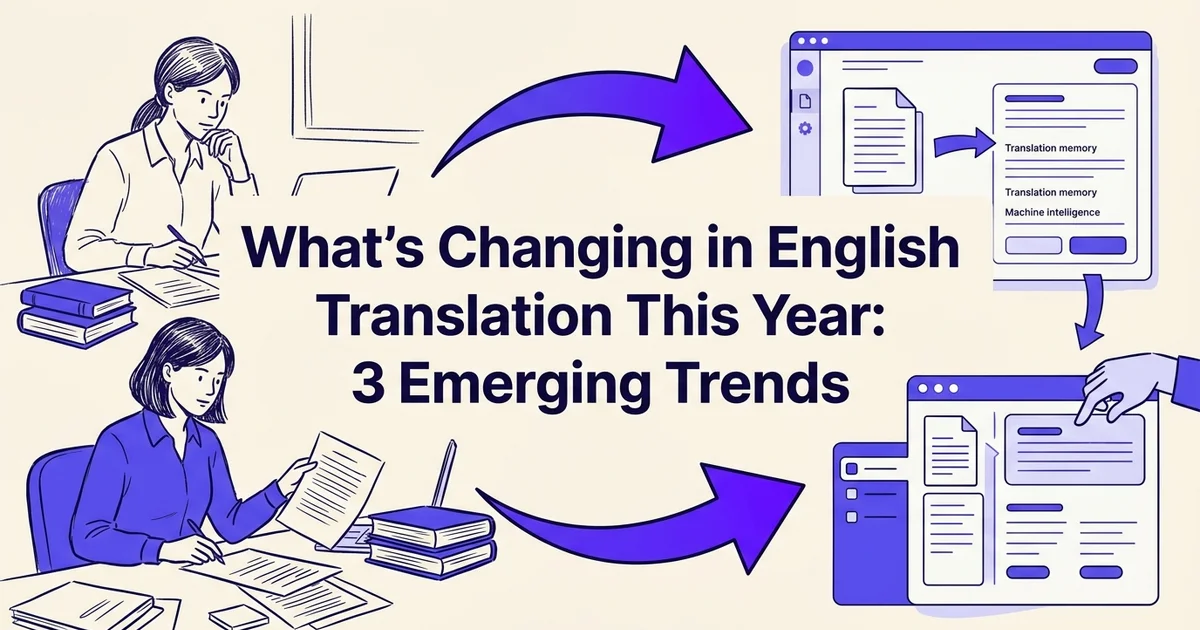
Introduction: The transformation of English translation in 2025
English translation is undergoing its most significant structural shift in decades. According to Precedence Research (2025), the global AI-enabled translation services market has already reached USD 5.18 billion this year and is projected to surge to USD 50.69 billion by 2035. That is not incremental growth. That is a fundamental reordering of how language work gets done.
At DocuGlot, our analysis shows that the workflows businesses and authors relied on just two years ago are rapidly becoming obsolete. The question is no longer whether AI will reshape new English translation projects. It is how quickly organizations can adapt to the tools and processes that are already replacing the old model.
From human-only to AI-first workflows
The most visible shift is in how translation projects are structured. Human-only pipelines, where a professional translator works through a document from start to finish, are giving way to AI-first processes where machine output is refined through human post-editing. This hybrid model is not a compromise. For most business and publishing use cases, it delivers faster turnaround, greater consistency, and measurable cost savings.
Layout-aware document translation AI is a key part of this shift. Preserving formatting, tables, columns, and visual structure across languages has historically been one of the most time-consuming parts of document translation. New AI systems handle this automatically, making them essential for business reports, legal documents, and book manuscripts alike.
The numbers behind the shift
The productivity and cost data reinforce what practitioners are already experiencing on the ground. According to Gitnux (2026), cost per word has dropped 28% with AI integration, while translator productivity has increased by 45%. These are not marginal efficiency gains. They represent a structural repricing of what translation work costs and what volume a team can realistically handle.
Zoom out further and the scale becomes even clearer. The broader language services ecosystem is on track to reach USD 90 billion by the end of the decade, signaling that demand for high-quality translation is accelerating even as the cost of production falls. 🌐
The three trends explored in this article sit at the center of that transformation.
Trend 1: Explosive growth of AI-enabled translation services and market expansion
The numbers behind AI translation's rise are striking. According to Precedence Research, the AI-enabled translation services market grew from USD 1.88 billion in 2023 to USD 2.34 billion in 2024, a compound annual growth rate of 24.9%, with projections pointing toward USD 50.69 billion by 2035. This is not a niche technology story. It is a fundamental reshaping of how the world moves language across borders. 🚀
Market size and growth projections
Multiple independent analysts now agree on the trajectory, even if their specific figures vary. Precedence Research, TechSci Research, and DataIntelo each project CAGRs ranging from 17% to 26% for AI translation through the early 2030s. The consistency across methodologies signals an established pattern rather than an emerging one.
What is driving this growth? Several converging forces:
- Globalization of digital content: Businesses operating across markets need faster, higher-volume translation than human-only workflows can deliver
- Falling cost of AI inference: Processing a document today costs a fraction of what it did three years ago
- Improved output quality: Neural machine translation has closed the gap with human translation for many document types
- Enterprise demand for speed: Teams that once waited days for translated materials now expect results in minutes
AI's share of the broader translation market
The scale of AI's penetration into traditional language services is equally significant. According to Gitnux, AI translation tools are expected to capture approximately 40% of the USD 60 billion global translation services market by 2025. That represents a structural shift in where revenue flows and how translation work gets done.
The European Commission has noted that AI translation workflows are increasingly embedded in institutional and enterprise processes, moving from experimental pilots to standard operational practice across sectors including legal, financial, and technical documentation.
What this means for organizations today
For business professionals and content teams, this growth curve has a practical implication: producing a new English translation of a complex document, whether a DOCX report, a PDF contract, or a Markdown knowledge base, is now faster and more affordable than at any previous point.
Enterprise adoption of instant document translation is accelerating precisely because the cost-per-word equation has changed. Teams exploring no subscription document translation options are finding that flexible, pay-as-you-go models now make multilingual content strategies accessible well beyond large enterprise budgets.
The market is expanding because the value proposition has genuinely improved, not just because the technology is new.
Trend 2: Layout-aware document translation AI preserves formatting and structure
The technology getting better at translation is only half the story. The other half is whether the translated document actually looks right when you open it. Layout-aware document translation AI addresses exactly this problem, and the market is responding accordingly: the segment is valued at USD 3.2 billion in 2025 and projected to reach USD 14.8 billion by 2034, growing at an 18.4% CAGR (MarketIntelo, 2025).
The formatting problem that traditional machine translation ignored
Anyone who has run a complex DOCX file through a standard machine translation tool knows the frustration. Headers collapse, table columns shift, footnotes detach from their references, and certificates lose their visual hierarchy entirely. What arrives on the other side is technically translated text sitting inside a structurally broken document.
This is not a minor inconvenience for business professionals. A contract, compliance report, or product manual that requires manual reformatting after translation adds hours of post-production work, and introduces new opportunities for error. For content creators producing books or long-form reports, the problem scales even further.
Traditional machine translation was built to handle strings of text, not documents as structured objects. Layout-aware AI changes the underlying approach entirely.
How layout-aware AI produces publication-ready output
Modern layout-aware systems parse a document's structure before translation begins, treating headers, footers, tables, images, and text blocks as distinct elements with defined relationships. The translation engine processes the text content while a separate structural layer preserves the original formatting logic.
The practical result is significant:
- DOCX files retain their original styles, fonts, and column structures
- Tables translate cell by cell without row or column displacement
- Certificates and formal documents maintain their visual layout for immediate use
- Headers and footers remain anchored to their correct positions
For a deeper look at how this works in practice, The Complete Guide to Instant Document Translation in 2026 covers the technical workflow in detail.
What this means for your workflow 📄
The clearest implication is time saved. Producing a new English translation of a formatted document no longer means budgeting hours for post-translation cleanup. Publication-ready output arrives directly, which changes how teams plan multilingual content projects from the start.
Trend 3: AI-powered long-form and literary translation for books and reports
Specialized tools combining neural machine translation with human post-editing are reshaping how books, academic manuscripts, and lengthy reports reach English-speaking audiences. What once required months of sequential work can now be completed in weeks, fundamentally changing the economics of bringing a new English translation to market. 📚
From months to weeks: the speed shift in book translation
The timeline compression is striking. A full-length manuscript that previously moved through translation in three to six months can now progress from source file to reviewed draft in a matter of weeks. AI handles the volume-intensive first pass, processing tens of thousands of words with consistent terminology and structural awareness, while human translators concentrate their expertise where it matters most: voice, tone, cultural resonance, and literary nuance.
According to ResearchAndMarkets (2024), the AI-powered document translation quality market is expanding rapidly, driven precisely by demand for end-to-end workflows that reduce turnaround without sacrificing accuracy. This is the gap that long-form translation tools are now filling.
The BookTranslator category: a dedicated service tier for long-form content
An emerging pattern in the translation industry is the rise of purpose-built services for EPUB files, book-length PDFs, and extended reports. Generic document translation tools were never designed for 80,000-word manuscripts. The BookTranslator category addresses this directly, offering features like chapter-level segmentation, glossary consistency across long texts, and output formats that are ready for publishing pipelines.
This is a meaningful distinction. Translating a business report is a different challenge from translating a novel, and the tooling is beginning to reflect that reality.
What this means for authors and publishers
The practical implication is market reach. A non-English book that previously required significant investment to bring to English-speaking readers now has a faster, more affordable path to publication. Independent authors, academic publishers, and international businesses producing research reports all benefit from reduced cost and lead time.
For teams managing multiple documents alongside long-form projects, understanding how to get fast document translation online in minutes provides useful context on integrating both workflows efficiently.
Trend 4: AI–human collaboration and quality governance in translation workflows
The most significant shift in professional translation this year is not about replacing human expertise. It is about redefining where that expertise is applied. Industry consensus is consolidating around a clear division: AI handles volume, speed, and structural consistency, while human specialists focus on domain accuracy, cultural nuance, and final quality sign-off.
The emerging governance model
For any new English translation of regulated or high-stakes content, workflow governance is becoming as important as the translation itself. Legal contracts, medical device documentation, and technical compliance materials all carry real-world consequences if terminology is inconsistent or context is misread. This has pushed organizations toward hybrid workflows with defined checkpoints rather than end-to-end automation.
According to Redokun's 2025 Translation Industry Trends and Stats (2025), the most effective translation workflows now combine machine translation for first-pass drafts with human review concentrated on terminology control, regulatory alignment, and bilingual quality assurance. The model is not sequential so much as layered: AI accelerates the process, humans govern the outcome.
Why specialized content still requires human oversight
The quality management gap is most visible in specialized domains. A general-purpose AI model trained on broad multilingual data may handle everyday business language well, but legal definitions, medical protocols, and technical specifications require controlled vocabulary that generic models do not reliably maintain. Bilingual subject-matter reviewers remain essential for catching terminology drift and ensuring that the English output meets the standards of the target jurisdiction or industry.
The European Commission has been explicit on this point: AI translation represents a transformation of workflows, not a replacement of the professionals who manage them. That framing is increasingly shared across the industry. 🔍
What this means for your projects
For businesses and content teams commissioning a new English translation of mission-critical documents, the practical implication is straightforward. Choosing a professional document translation service that combines AI-assisted processing with qualified human review delivers both the speed advantages of automation and the accuracy assurance that regulated or complex content demands. Hybrid workflows reduce risk without sacrificing turnaround time, making them the default choice for organizations where quality governance is non-negotiable.
Trend 5: Cost reduction and ROI optimization for new English translation projects
The financial case for AI-assisted translation has shifted from theoretical to measurable. According to Gitnux (2026), the average per-word translation cost dropped 28% to USD 0.07 in 2023, while AI-assisted workflows boosted translator productivity by 45% in machine translation post-editing (MTPE) contexts. For organizations planning new English translation projects at volume, these numbers represent a structural change in what's financially achievable.

The real cost gap between AI-first and human-only workflows
The 28% cost reduction figure understates the full picture when you factor in throughput. A translator working within an AI-assisted MTPE workflow processes significantly more words per day than one working without machine translation support. For a project involving 100,000 words, the difference between a human-only rate and an AI-assisted rate can translate into thousands of dollars in savings, plus faster delivery timelines that reduce downstream costs like delayed product launches or compliance deadlines.
The gap widens further at scale. Organizations producing multilingual content regularly, such as legal firms, publishers, or global SaaS companies, can model these scenarios with reasonable precision:
- Human-only workflow: Higher per-word cost, longer turnaround, maximum editorial control
- AI-first with human review: Lower per-word cost, faster delivery, quality maintained through post-editing
- Fully automated (no review): Lowest cost, fastest output, appropriate only for internal or low-stakes content
What this means for budget-constrained teams
Budget constraints no longer have to prevent organizations from producing high-quality new English translations. The cost compression driven by AI means that projects previously considered too expensive to localize properly are now financially viable. A legal document, a technical manual, or a full-length book that once required significant investment can now be processed through a document translation service that stands behind its work at a fraction of the former cost, without sacrificing accuracy or accountability.
This democratization of professional translation is one of the most consequential shifts the industry has seen in a decade. 📊
Trend 6: Developer-centric and Markdown-aware translation for technical content
Beyond legal and business documents, a quieter but equally significant shift is underway in technical communities. Developers, open-source contributors, and engineering teams are increasingly demanding new English translation workflows that treat code as sacred, preserving every bracket, backtick, and table structure while converting surrounding prose accurately.
The problem with traditional tools for technical docs
Standard document translators were built for prose. Feed them a README file, an API guide, or a developer handbook, and they frequently mangle what matters most: code blocks get reformatted, inline references lose their syntax, and table alignment collapses entirely. For a developer trying to implement a library based on a translated guide, a broken code example is not just inconvenient. It is a project-stopping error.
This gap has been largely ignored by mainstream localization platforms, which have historically focused on marketing copy, legal text, and general business content. Technical documentation has been an afterthought, leaving open-source communities to rely on manual translation or accept broken formatting as the cost of going multilingual.
Markdown-aware translation as an emerging solution 🛠️
A new category of Markdown-aware translation tools is now addressing this directly. These tools parse document structure before translation begins, isolating translatable text from code blocks, variable names, and formatting syntax. The result is a new English translation that reads naturally to developers while leaving the technical scaffolding completely intact.
In our experience at DocuGlot, technical teams working with structured formats like Markdown and HTML consistently report that format preservation is their primary concern, often ranking above translation speed or even cost. This mirrors a broader industry pattern: according to Redokun (2025), demand for translation tools that handle complex document formats without manual cleanup is growing rapidly across enterprise and developer segments.
For teams managing multilingual documentation across repositories, this means producing accurate, deployment-ready new English translations without a post-processing cleanup step. Whether you need to translate portuguese to english for a contributor community or localize an entire API reference, format-safe translation is quickly becoming a baseline expectation rather than a premium feature.
What this means for your business: Practical implications and action items
The trends covered in this article are not abstract shifts happening somewhere else. They are actively reshaping how businesses budget, staff, and scale their multilingual content operations right now. Translating that awareness into concrete decisions is where competitive advantage is built.
Evaluate your current workflow honestly
Start by categorizing your existing translation process: human-only, AI-first, or hybrid. Each model carries different cost, speed, and quality trade-offs. According to WorldMetrics (2026), AI-assisted translation can reduce costs by up to 90% compared to traditional human-only workflows, making the ROI case for hybrid models increasingly difficult to ignore.
Ask yourself:
- How much content do you translate per month? High-volume teams benefit most from AI-first pipelines with human review layers.
- What are your turnaround requirements? Same-day delivery is rarely achievable with purely human workflows.
- What is your per-word cost today? Benchmark it against AI-assisted alternatives to quantify potential savings.
Match your tools to your content type
Not every translation solution fits every content category. A literary manuscript demands nuance and cultural sensitivity. A technical API reference demands format fidelity. A business contract demands terminology precision. Choosing the wrong tool for the job undermines quality regardless of the technology involved.
Consider these alignments:
- Business documents and contracts: Prioritize terminology control and layout preservation
- Books and long-form content: Prioritize stylistic consistency and narrative flow
- Technical documentation and developer content: Prioritize Markdown awareness and format-safe output
- General multilingual content: Prioritize speed, SEO optimization, and broad language coverage
For teams producing new English translations targeting underserved language markets, tools that support less common language pairs, such as those covered in guides like google translate english to myanmar, can meaningfully expand your audience reach and improve search discoverability in those regions. 🌍
Plan for governance before you scale
Quality governance is not a final step. It is a structural requirement. Implement terminology glossaries, style guides, and human review checkpoints before volume increases, not after problems surface. According to Precedence Research (2024), the AI-enabled translation services market is projected to reach USD 50.69 billion by 2035, signaling that governance infrastructure built today will serve growing content demands for years ahead.
Key governance actions to take now:
- Define approved terminology lists for your industry and brand
- Assign human reviewers to high-stakes content categories
- Establish quality scoring benchmarks before deploying AI-first workflows at scale
- Audit outputs quarterly as models and tools continue to evolve
The businesses that treat these trends as operational priorities rather than future considerations will be best positioned as the translation landscape continues to accelerate.
Predictions and outlook: The future of new English translation beyond 2025
The translation industry is not slowing down. According to Precedence Research (2024), the AI-enabled translation services market is projected to reach USD 50.69 billion by 2035, reflecting a sustained period of investment, innovation, and structural change. For businesses planning their localization strategies today, understanding where this market is heading is as important as responding to what is happening right now.
Layout-aware AI will become the enterprise default
By 2027, layout-aware document translation is expected to shift from a competitive differentiator to a baseline expectation in enterprise workflows. Organizations that currently treat formatting preservation as a bonus feature will find it increasingly difficult to justify manual reformatting costs as AI tools make structure-aware translation the norm. The question will no longer be whether your translation tool preserves document layout, but how well it handles edge cases like complex tables, multilingual footnotes, and embedded graphics.
Hybrid workflows will define high-stakes translation
The emerging consensus across the industry points to a clear division of labor: AI handling 60 to 70% of translation volume, with human specialists concentrating on review, cultural adaptation, and quality assurance. This is not a transitional arrangement. It is likely to become the permanent operating model for legal, medical, and financial content where precision carries real consequences. Businesses that build these hybrid workflows now will have refined processes and institutional knowledge that late adopters will struggle to replicate quickly.
SEO and discoverability will reshape translation priorities 🌐
New English translations will increasingly be evaluated not just on linguistic accuracy but on downstream performance. Search visibility, keyword alignment, and audience engagement metrics are becoming part of the translation brief. This is especially relevant for content teams producing multilingual web copy, product descriptions, and long-form articles. If you are working to translate Chinese to English for a global audience, optimizing translated output for search intent is already a practical consideration, not a future one.
Specialization will fragment the market
The era of one-size-fits-all translation platforms is giving way to purpose-built solutions. Dedicated tools for book translation, technical documentation, and legal content are gaining traction as users recognize that general-purpose systems often lack the domain-specific accuracy their work demands. This fragmentation will accelerate as AI models become easier to fine-tune for narrow use cases.
Organizations that invest in the right specialized tools today will enter 2027 with measurable advantages in speed, cost efficiency, and market reach.
Year-over-year comparison: How new English translation has evolved from 2024 to 2025
The numbers tell a striking story. Between 2024 and 2025, the AI translation market more than doubled, cost economics shifted decisively in favor of AI-first workflows, and practices that were once experimental became the default for enterprise teams worldwide. The pace of change has been extraordinary even by technology standards.

Market size: from USD 2.34 billion to USD 5.18 billion
This is the headline figure. According to Precedence Research (2025), the AI-enabled translation services market grew from USD 2.34 billion in 2024 to USD 5.18 billion in 2025, representing 121% year-over-year growth. That kind of expansion in a single calendar year signals more than incremental adoption. It reflects a structural shift in how organizations approach multilingual content at scale.
Within that broader market, layout-aware document translation emerged as a particularly fast-growing segment. What was an emerging capability in 2024 has matured into a USD 3.2 billion market segment by 2025, driven by demand from publishing, legal, and technical documentation sectors where formatting fidelity is non-negotiable.
Market share: AI tools closing in on 40%
In 2024, AI translation tools captured roughly 30% of the overall translation services market. According to Gitnux (2025), that figure is expected to reach 40% by the end of 2025. For context, this means AI-assisted workflows will account for nearly half the market within a two-year window. Tasks like translating technical manuals or translating English to Vietnamese for regional markets are increasingly handled by AI-first pipelines rather than traditional agency models.
Cost per word: a 28% reduction in one year
The economics shifted just as dramatically. Average per-word translation costs dropped from USD 0.10 in 2024 to USD 0.07 in 2025, a 28% reduction that makes high-volume multilingual publishing viable for organizations that previously could not justify the expense.
Workflow maturity: hybrid became the standard
Perhaps the most meaningful qualitative shift is the normalization of hybrid workflows. In 2024, combining AI translation with human post-editing was largely experimental, piloted by early adopters. By 2025, it is the established industry standard for enterprise clients and professional publishers alike. AI quality improved enough, and layout preservation became reliable enough, that the risk calculus changed completely.
Expert roundup: What industry leaders say about new English translation in 2025
Industry leaders in 2025 are largely aligned on one conclusion: AI has moved from a peripheral tool to a structural pillar of global language services. The data and commentary coming from major analysts and institutions reinforce what practitioners are already experiencing on the ground.
AI as a workflow transformer, not a replacement
The European Commission has been direct in framing the technology's role: "AI translation and language tools are not a replacement for human translation, but they are transforming workflows by handling large volumes of routine content and enabling translators to focus on higher-value tasks." This framing captures the consensus position across professional translation bodies in 2025. The debate is no longer whether AI belongs in the workflow. It is about how to structure that workflow intelligently.
A market that has outgrown "niche" status
The numbers behind this shift are striking. AbroadLink has noted that the machine translation market reached approximately USD 1.55 billion in 2023, growing more than 30% in a single year, illustrating how AI-driven translation has become central to global language services rather than a niche add-on.
Zooming out further, Slator places the core translation and localization market at around USD 27 billion, with the wider language services ecosystem estimated at approximately USD 72 billion and expected to surpass USD 90 billion by the end of the decade.
Sustained acceleration through 2028
Growth projections show no sign of plateauing. According to Technavio via PR Newswire (2024), the global machine translation market is estimated to grow by USD 1.23 billion from 2024 to 2028, accelerating at a CAGR of 15.89%, driven primarily by rising demand for content localization. 🌐
For businesses handling multilingual documentation, including those working with complex source languages (see our guide on how to translate Polish documents to English accurately), these projections signal that investing in scalable translation infrastructure is no longer optional. It is a competitive baseline.
Regional trends: How new English translation adoption varies globally
Adoption of new English translation workflows is accelerating worldwide, but the pace, priorities, and preferred approaches differ significantly by region. Understanding where your market sits on this adoption curve helps you make smarter decisions about tools, processes, and investment levels.
North America: speed and cost at the center
North American enterprises are moving fastest toward AI-first translation workflows. The dominant driver is economic: large organizations are prioritizing cost reduction and turnaround speed above all else. AI-assisted pipelines that once took weeks to implement are now being deployed in days, with post-editing workflows becoming the operational standard rather than the exception.
Europe: quality governance leads the way
European organizations are taking a more measured approach, shaped by regulatory environments and a strong cultural emphasis on linguistic accuracy. Hybrid workflows, combining AI output with professional human review, dominate here. Compliance requirements around data handling and language quality in regulated industries (legal, pharmaceutical, financial) mean that pure automation is rarely the first choice.
Asia-Pacific: developer communities driving change 🚀
The Asia-Pacific region is seeing rapid growth in technical and developer-centric translation, particularly for software, documentation, and API content. Open-source communities are playing an outsized role, experimenting with and refining translation tooling at a pace that often outstrips enterprise adoption. According to Precedence Research (2024), the global AI-enabled translation services market is projected to reach USD 50.69 billion by 2035, with Asia-Pacific representing one of the fastest-growing regional contributors.
Latin America and Africa: rising demand for global access
Both regions are experiencing growing demand for new English translations as businesses seek entry into global markets. Content localization, e-commerce expansion, and educational access are the primary use cases fueling this growth.
What this means for your strategy
Regional differences are not just academic. According to Redokun (2025), localization priorities vary sharply across markets, which means a one-size-fits-all tool selection rarely delivers optimal results. Match your translation infrastructure to the compliance expectations, quality standards, and speed requirements of the specific markets you serve.
Frequently asked questions
What does a new English translation mean for books and documents?
A new English translation refers to a freshly produced rendering of source content into English, distinct from any prior version. For books, this often means a retranslation that reflects contemporary language norms. For business documents, it typically means converting foreign-language files into accurate, professionally formatted English output.
How do I create a new English translation of a DOCX file while keeping the original formatting?
Specialized document translation tools preserve headers, fonts, tables, and layout during conversion. DocuGlot Basic handles DOCX files directly, maintaining original formatting so you receive a clean, ready-to-use English document without manual reformatting.
Which AI tools are best for producing a new English translation of a novel or long report?
Tools purpose-built for long-form content, rather than general chatbots, perform significantly better on manuscripts and extended reports. Look for platforms that support batch processing, context retention across chapters, and format fidelity.
How accurate are AI-generated new English translations compared to human translators?
Accuracy has improved substantially, but context-sensitive content still benefits from human review. As the European Commission's Directorate-General for Translation notes, AI tools handle high volumes of routine content well, freeing human translators to focus on higher-value, nuanced work.
How much does it cost to produce a new English translation of a book using AI vs. human translators?
Human literary translation typically costs between USD 0.10 and USD 0.30 per word, making a full novel expensive. AI-assisted workflows reduce costs dramatically, often by 60 to 80 percent, though professional post-editing adds back some expense for quality-critical projects.
Can I translate Markdown technical documentation into a new English version without breaking the layout?
Yes, provided your tool explicitly supports Markdown syntax preservation. Quality platforms parse formatting tags separately from translatable text, ensuring headings, code blocks, and list structures remain intact after translation.
What are the latest trends in AI for new English translation of business documents?
The market signals strong momentum. According to Precedence Research (2025), the AI-enabled translation services market is projected to grow from USD 6.51 billion in 2026 to USD 50.69 billion by 2035, driven heavily by enterprise document translation demand.
How long does it take to generate a new English translation of a full-length manuscript with AI document translation tools?
Most AI platforms process a standard
Tags
Ready to translate your documents?
DocuGlot uses advanced AI to translate your documents while preserving formatting perfectly.
Start Translating