A Guide to Medical Document Translation Services
At its core, medical document translation is the careful process of converting vital healthcare information from one language to another. But it's far more than just swapping words; it’s about ensuring absolute accuracy and meeting strict regulatory standards.
This specialized field makes sure that everything from a patient's personal records to complex clinical trial data is perfectly understood across different languages. Getting it right is non-negotiable—it’s a matter of protecting patient safety and upholding the integrity of medical research.
What Is Medical Document Translation
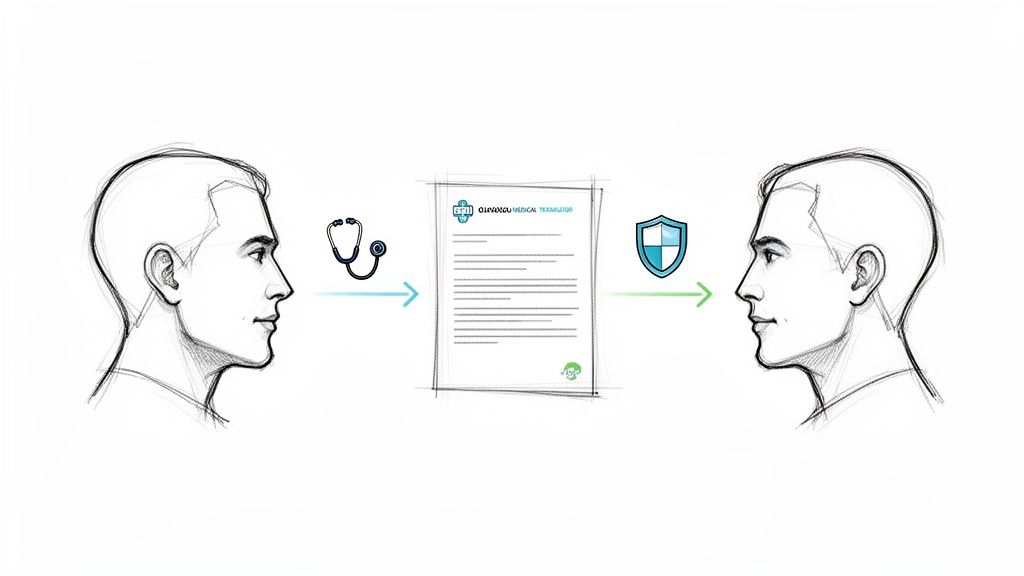
It helps to think of a medical document as a detailed blueprint for someone's health. This isn't just text on a page; it's a collection of critical instructions, sensitive personal history, and data that can literally change a life. Medical document translation takes this blueprint and meticulously recreates it in another language, making sure every clinical detail, contextual nuance, and legal requirement remains intact.
This isn't a job for a standard translation tool or a generalist translator. For example, a basic translation might swap "hypertension" for its direct equivalent. A medical translator, however, understands the full clinical weight of that term. They know that a tiny mistake in a dosage instruction or a subtle misreading of an allergy note could lead to disastrous outcomes.
It's About More Than Just Words
Ultimately, medical translation is about transferring life-saving information without a single error. It’s like having an expert interpreter for highly complex written documents. Every piece of data, whether it's in a pharmaceutical leaflet or a clinical trial protocol, has to mean the exact same thing in any language. This demands a rare blend of linguistic fluency and deep medical knowledge.
The job comes with some serious hurdles:
- Clinical Precision: Translators need a rock-solid grasp of medical terminology, anatomy, and pharmacology. There's no room for guesswork.
- Regulatory Compliance: These services must follow strict privacy laws like the Health Insurance Portability and Accountability Act (HIPAA) to keep sensitive patient information secure.
- Formatting Integrity: The original layout of a document is often part of its meaning. Think about the tables in a lab report or the diagrams in a medical device manual—they have to be preserved perfectly to be useful.
When you get down to it, medical translation is a function of patient safety. A bad translation on a company website might be embarrassing, but a single mistranslated medical term can directly harm a patient's health.
The Weight of Responsibility
The pressure on a medical translator is enormous because the stakes are so high. Imagine a new drug going through clinical trials. These trials often happen in several countries at once, producing mountains of paperwork.
Every single document—from the informed consent forms patients sign to the final reports submitted to government agencies—needs to be translated with flawless precision. One slip-up could derail the entire trial, block the drug's approval, or, even worse, put patients in danger. This is why professional medical document translation services are an essential pillar of the global healthcare system. You can see how experts navigate these demands by looking into a dedicated solution for medical document translation.
Why Accuracy and Compliance Aren’t Just Buzzwords
When it comes to translating medical documents, there's simply no room for error. A tiny mistake—a misplaced decimal in a dosage, a misunderstood allergy warning, or a poorly phrased consent form—can lead to devastating outcomes. This isn't about catching a simple typo; it's about protecting a patient's health and, in some cases, their life.
Think about it this way: a patient's medical history needs to be translated for a specialist overseas. If "hypotension" (low blood pressure) is accidentally translated as its near-opposite, "hypertension" (high blood pressure), the entire treatment plan could be dangerously flawed from the very beginning. That’s the real-world consequence of a seemingly small error. It puts patients directly at risk.
The stakes are just as high in the world of clinical research. The global life sciences translation market is surging, valued at USD 1.70 billion in 2025 and projected to nearly double by 2033. This growth is driven by international clinical trials where data from thousands of documents must be flawlessly translated to meet global standards. You can dig deeper into these numbers in the Grand View Research report.
Navigating the Regulatory Minefield
Beyond the need for clinical precision, medical translation is governed by a strict set of legal and ethical rules built to protect patient privacy. Getting this right isn't a "nice-to-have"—it's a core requirement for any translation provider in this space. The two big ones you'll hear about most are HIPAA in the U.S. and GDPR in Europe.
HIPAA (Health Insurance Portability and Accountability Act): This is the bedrock of patient data protection in the United States. It mandates that any organization handling protected health information (PHI)—and that absolutely includes a translation service—must have bulletproof security measures in place.
GDPR (General Data Protection Regulation): Across the EU, this regulation gives people control over their personal data. It enforces tough rules on how that data is collected, used, and stored, with steep penalties for getting it wrong.
These regulations aren't just red tape. They represent a fundamental promise to patients: your most sensitive information will be treated with the highest level of care and confidentiality. Ignoring these rules doesn't just open a company up to huge fines; it completely erodes the trust that is so critical in healthcare.
A translation service that isn’t serious about compliance is a service that isn’t serious about patient safety. It’s that simple. End-to-end encryption, secure data handling, and clear privacy policies are not just features—they are ethical obligations.
The Human Side of Data Security
Let’s get practical. When you upload a patient’s medical chart for translation, you're not just sending a file. You're sending a person's name, their diagnosis, and incredibly private details about their health. A truly compliant service protects that data at every single point in its journey.
Here’s what that looks like:
- Secure Upload: Your files are encrypted the second they leave your computer, so they’re protected while in transit.
- Encrypted Storage: While awaiting translation, the files are stored in an encrypted state, making them unreadable to anyone without authorization.
- Controlled Access: Only the specific people or systems directly involved in the translation can access the content. No one else.
- Secure Deletion: Once the project is done and delivered, the service follows a strict protocol to permanently and securely delete your files from its servers.
Any service you consider must be HIPAA compliant if it’s going to touch sensitive patient data. It's also helpful to understand the nuances that separate general translation from the rigorous standards of healthcare, which is where learning more about certified translation services can give you a real advantage. When you pick a translation partner, you’re not just buying a service; you're entrusting them with a profound responsibility.
Comparing AI, Human, And Hybrid Translation
Choosing how to translate a medical document isn't just a technical decision—it's a careful balancing act between speed, cost, and the level of risk you can afford to take. There’s no single "best" method. The right choice always comes down to what the document is for and who will be reading it.
Before we even get to the translation method, the first question is always about security. Is the entire process secure from start to finish?
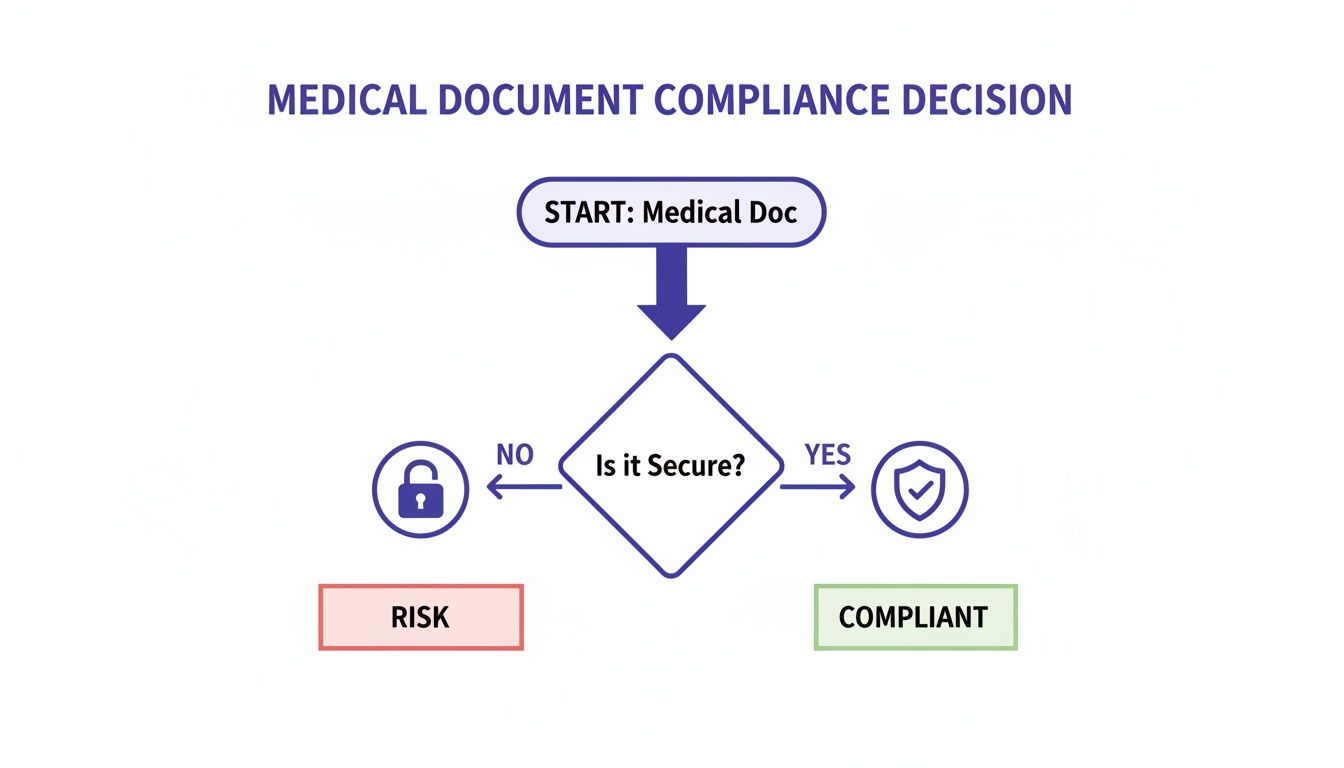
As you can see, if the process isn't secure, it's an immediate dead end. A secure, compliant foundation is the only way to begin, regardless of which translation approach you take.
The Gold Standard: Human Translation
For years, the only real option for serious medical content was a professional human translator, and for good reason. A qualified expert brings a unique blend of linguistic mastery, deep subject knowledge, and crucial cultural nuance to the table. They don't just swap words; they convey meaning and context.
This is absolutely vital for materials that patients will see, where a single culturally insensitive phrase can shatter trust and understanding. But this level of quality has its price. Human translation is almost always the slowest and most expensive route, which can make it impractical for huge volumes of internal research or administrative paperwork.
The Rise Of AI Translation
AI translation has made incredible strides. Gone are the days of awkward, literal translations. Today's AI is trained on vast libraries of scientific and medical texts, allowing it to process complex terminology with impressive speed. For internal documents, sifting through research data, or getting a quick first pass, AI is a powerhouse of efficiency.
The advantages are hard to ignore:
- Speed: An AI can process thousands of pages in the time it takes a human expert to handle just a few.
- Scalability: It can manage massive volumes of text without slowing down.
- Cost-Effectiveness: AI is far more affordable, making high-volume translation accessible to more organizations.
One of the trickiest parts of this process often involves translating scanned PDF files, which first requires advanced technology to digitize the text accurately. If you want to dive deeper into the tech behind this, our article on an AI-powered translation service is a great place to start.
The Hybrid Model: Getting The Best Of Both Worlds
The hybrid approach is quickly becoming the new industry standard for important medical documents. It’s a two-step process: AI does the initial heavy lifting, and then a human medical expert reviews, edits, and perfects the output. This is often called Machine Translation Post-Editing (MTPE).
This method gives you a powerful combination of benefits. You get the speed and scale of AI, but with the final-mile accuracy and nuanced understanding that only a human expert can provide.
To make the differences clearer, let's break them down side-by-side.
Translation Method Comparison for Medical Documents
| Feature | AI Translation | Human Translation | Hybrid (AI + Human Review) |
|---|---|---|---|
| Speed | Fastest (minutes to hours) | Slowest (days to weeks) | Fast (hours to days) |
| Cost | Lowest | Highest | Moderate |
| Accuracy | Good, but can miss nuance | Highest level of accuracy | Very high, near-human level |
| Best For | Internal R&D, large data analysis, non-critical drafts | Patient-facing documents, clinical trial materials, regulatory submissions | Patient records, medical reports, informed consent forms, instructions for use (IFUs) |
Ultimately, this comparison shows there’s a smart way to handle any type of document.
So, which model should you choose? It all comes back to the document's purpose. For internal lab notes where you just need the gist quickly, pure AI is probably a great fit. But for a patient’s informed consent form for a clinical trial? The hybrid or full human approach is the only responsible choice. Understanding these options helps you make a smart decision that protects patients, stays within budget, and meets all your compliance needs.
What to Look for in a Translation Service
When you’re vetting a medical document translation service, accuracy is table stakes. That’s the bare minimum. The real test is finding a partner who gets that the layout of a document can be just as crucial as the words on the page. A perfect translation is useless if it’s delivered as a jumbled mess.
Think about it: what good is a translated clinical trial report if all the neatly organized data tables are suddenly crammed into one long paragraph? The words might be correct, but the meaning is completely lost. For medical and scientific documents, the original layout isn’t just for looks—it’s a core part of the information itself.
Formatting Preservation Is Not Optional
In the medical world, how information is presented is often part of the message. Tables, charts, bullet points, and even bolded text aren't just stylistic choices; they're there to highlight critical data, direct the reader’s attention, and prevent misinterpretation.
When a translation service drops the ball on formatting, the fallout can be serious:
- Data Gets Misread: A scrambled lab report could cause a doctor to mix up patient data or misread a critical value. The consequences are immediate and dangerous.
- Regulatory Rejection: Agencies like the FDA and EMA have ironclad submission requirements. One poorly formatted document can get your entire submission kicked back, leading to costly delays.
- Unsafe Products: Imagine the Instructions for Use (IFU) for a new medical device. They rely on specific diagrams, numbered steps, and warning boxes. If that structure is lost in translation, someone could use the device incorrectly, putting a patient’s safety at risk.
A top-tier translation service treats your document's layout like a vital organ—it has to be preserved for the whole thing to work. The job isn’t just to switch languages; it’s to deliver a document that’s instantly usable and clear.
Security That Actually Means Something
Beyond the document itself, you have to think about data security. You’re handling Protected Health Information (PHI), and a breach isn’t just an IT headache—it's a massive legal and ethical disaster waiting to happen. You need a partner who treats security as a fundamental part of their process, not a checkbox on a marketing page.
This goes way beyond a generic privacy policy. A provider you can trust will have concrete, verifiable security measures in place to protect your sensitive files from start to finish.
Here’s what to demand:
- End-to-End Encryption: Your files need to be locked down tight, both in transit (as you upload and download) and at rest (while stored on their servers). This ensures the data is gibberish to anyone without authorization.
- Secure Data Deletion: Ask about their data retention policy. A good service will have a clear, automated process for permanently wiping your files from their systems, usually within 24 to 72 hours of completion. This drastically shrinks the window of risk.
- Ironclad Confidentiality: Read the fine print. Their terms of service must explicitly state that your documents will never be shared with or sold to third parties. Period.
These aren't just technical specs. They're the building blocks of a partnership you can actually trust with your most sensitive information.
Turnaround Times and Pricing Models That Make Sense
Finally, let’s talk logistics. You have deadlines to meet and budgets to manage. The best services are transparent on both fronts, so you can plan your projects without sweating hidden costs or blown timelines.
Turnaround time will always depend on the document's length, complexity, and the translation method you choose (AI, human, or a hybrid). A quality provider gives you a solid estimate upfront. For example, an AI service like DocuGlot might process a 50-page report in under an hour, while adding a layer of human review could take a day.
When it comes to pricing, steer clear of complicated or vague models. You want a provider who offers:
- Clear Per-Word or Per-Page Rates: You should know exactly what you’re paying for, with no fuzzy math.
- Upfront Cost Calculation: The platform should give you a final price before you click "translate." No more billing surprises.
- No Hidden Fees: Be on the lookout for extra charges for specific file types, formatting preservation, or basic security. Those should be part of the core offering, not expensive add-ons.
Finding a partner with straightforward pricing and reliable delivery times means your translation workflow will be accurate, secure, and—just as importantly—predictable.
What Kinds of Medical Documents Need Translation?
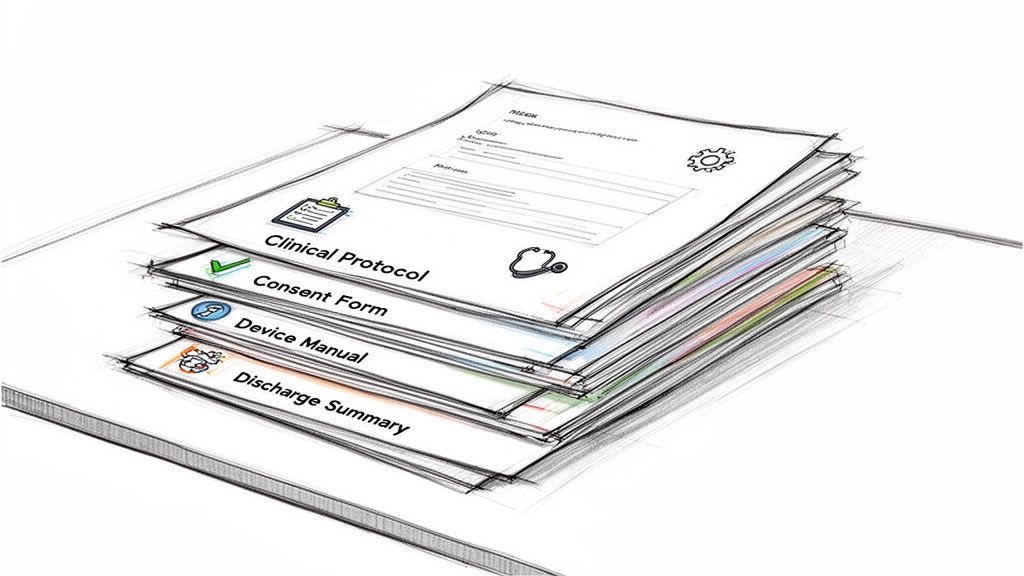
To really get a feel for what medical document translation entails, it’s best to move past the abstract and look at the actual paperwork involved. The stakes are different for every document, and each one demands its own unique level of precision. From the research lab all the way to a patient's bedside, the need for flawless translation is everywhere.
If we needed a recent reminder of how critical this is, the pandemic provided a stark one. In 2020, the global demand for healthcare translation services shot up by a staggering 49%. This was driven by the frantic need to share COVID-19 information—from vaccine guidelines to clinical trial data—in dozens of languages. It was a real-world stress test that proved just how vital accurate medical translation is. You can dig deeper into this trend by checking out market research on translation services.
Let's break down the most common documents that cross a translator's desk.
Clinical Research and Trials Documentation
The entire world of drug development and clinical research is built on a mountain of documentation where every single word counts. These documents are the bedrock for getting new drugs approved and pushing medicine forward.
- Clinical Trial Protocols: Think of these as the master blueprint for a research study. One small mistranslation can throw off the entire methodology, corrupt the data, and put the safety of participants on the line.
- Informed Consent Forms (ICFs): A patient can't agree to participate in a trial without fully understanding the risks. If an ICF is translated poorly, it’s not just an ethical breach—it can lead to serious legal trouble.
- Case Report Forms (CRFs): These are the forms used to gather patient data during a trial. The translation must be perfectly consistent across all international sites to ensure the data can be pooled and analyzed correctly.
Any confusion or ambiguity in research documents can lead to bad results, a rejection from regulators, or—in the worst-case scenario—real harm to the people in the trial. Precision isn’t just a nice-to-have; it's the absolute minimum requirement.
Regulatory and Manufacturing Materials
Once a new drug or medical device is ready to hit the market, a whole new set of documents comes into focus. These have to meet the incredibly strict standards of bodies like the FDA in the U.S. or the European Medicines Agency (EMA).
- Regulatory Submissions: This is all the official paperwork sent to government agencies for approval. The language has to be technical, exact, and use the precise terminology that regulators expect.
- Instructions for Use (IFUs): These are the manuals that come with medical devices, and they are essential for keeping patients and doctors safe. A badly translated instruction could cause someone to use a device incorrectly, leading to injury or treatment that just doesn't work.
- Package Inserts and Labels: The labels on pharmaceuticals contain crucial information about dosage, side effects, and warnings. There is zero room for error here; accuracy is non-negotiable to prevent dangerous medication mistakes.
Patient-Facing and Administrative Documents
Finally, we have the documents that patients themselves interact with during their care. For these, clarity and a human touch are just as important as technical accuracy.
- Patient Medical Records: Translating a patient's medical history—from old diagnoses to known allergies—is key to providing continuous, safe care when they travel or move to a new country.
- Hospital Discharge Summaries: Clear instructions for what to do after leaving the hospital are crucial for a smooth recovery. Patients must be able to understand their medication schedule, follow-up appointments, and what warning signs to look for, all in their own language.
- Medical Bills and Insurance Forms: Translating these administrative documents correctly helps avoid confusion and frustration, making sure patients can handle the financial side of their healthcare without unnecessary stress.
Looking at each of these examples, it becomes crystal clear why specialized medical document translation services are so important. The consequences of getting it wrong are just too high to trust anyone but an expert.
How to Choose the Right Translation Partner
Picking a partner to handle your medical translations is a big deal. It’s a decision that ripples out, affecting patient safety, your standing with regulators, and how smoothly your operations run. Now that we’ve covered the fundamentals of accuracy, compliance, and technology, it’s time to put that knowledge to work. This isn't just about finding the cheapest or quickest service; it's about finding a team whose process respects the high-stakes world of healthcare.
Think of the right partner as an extension of your own team—someone who shares your commitment to quality. To find them, you need a way to look past the marketing talk and get to the heart of what they actually do. Consider this your pre-flight checklist before handing over some of your most critical documents.
Your Vendor Evaluation Checklist
As you start talking to potential providers, frame your questions around three key areas: their quality process, their security measures, and their technology. A solid partner will have clear, confident answers for every single one.
Quality Assurance and Expertise
This is where the rubber meets the road. It's all about ensuring the final translation is not just grammatically correct, but medically precise.
- What does your quality control look like, step by step? Press for details. Do they use a hybrid model where a human expert reviews AI output (MTPE)? Who are these reviewers, and what are their qualifications in the medical field?
- Do you have translators who are subject-matter experts? You can't have a generalist translating an oncology report or the instructions for a new cardiovascular device. You need someone who already knows the terminology inside and out.
- How do you keep terminology consistent? The best services use tools like glossaries and translation memory. This ensures that a term like "non-invasive procedure" is translated the same way every single time, across all your documents.
Compliance and Security Protocols
In healthcare, data security isn't a feature; it's a requirement. A breach isn't just an IT headache—it's a potential disaster for patients and your organization.
- Can I see your certifications? Don't just take their word for it. Ask for the actual documentation proving they are HIPAA compliant or hold relevant ISO certifications, like ISO 17100 for translation services.
- What happens to my data after the translation is done? Look for a clear data deletion policy. A specific answer, like "all data is automatically deleted within 24-72 hours," is what you want to hear. Vague promises aren't good enough.
- How do you protect my data in transit? They must confirm that your files are protected with end-to-end encryption, both when you're uploading them and while they're stored on their servers.
Technology and Operational Transparency
The right technology makes the whole process smoother, faster, and more reliable. It’s the engine that powers the service.
- What file types do you work with? It’s crucial they can handle more than just simple text. You need a partner who can process PDFs, DOCX files, and even complex layouts without scrambling the formatting.
- How does your pricing work? You’re looking for complete transparency here. Are there extra fees for formatting, rush jobs, or security? A service like DocuGlot, for example, shows you the exact price before you ever click "translate."
- What kind of support can I expect? When a critical document is on the line, you need to know you can reach a real person who can help solve the problem quickly.
Choosing a translation partner is, at its core, an exercise in risk management. A provider who is open and honest about their processes, technology, and security is a provider who gets it. They understand the weight of the responsibility and are ready to meet it. Doing your homework here will help you find a service that protects your organization and, most importantly, the patients who depend on you.
Got Questions? We've Got Answers
When you're dealing with something as important as medical documents, you're bound to have questions. Let's walk through some of the most common ones that come up when people are looking for the right translation partner.
How Is Medical Translation Different From General Translation?
Think of it this way: you wouldn't ask your family doctor to perform brain surgery. Both are doctors, but their expertise is worlds apart. The same logic applies here. General translation is great for making sure everyday content flows naturally, but medical translation demands specialized knowledge in areas like clinical trials, pharmacology, or medical device engineering.
A medical translator doesn't just switch words from one language to another; they understand the critical context. A simple mix-up between "hypertension" (high blood pressure) and "hypotension" (low blood pressure) isn't just a mistake—it's a potentially life-threatening error. That’s why you can't afford to cut corners on expertise.
What Makes a Translation Service HIPAA Compliant?
Seeing "HIPAA compliant" on a website is one thing, but proving it is another. True compliance means a service has built a fortress around your sensitive patient data, or Protected Health Information (PHI). It's a non-negotiable part of the deal.
Here’s what that looks like in practice:
- End-to-End Encryption: Your documents are locked down with encryption from the moment you upload them to the moment you download them, and while they're stored on servers.
- Access Controls: The only people (or systems) who can access the data are those directly involved in the translation process. No exceptions.
- Secure Deletion Policies: Once the job is done, the service needs a clear, automated process for wiping your files permanently, usually within 24 to 72 hours.
What Is the Difference Between AI and Hybrid Translation?
The biggest difference comes down to the final quality check. AI translation is all about speed, using powerful machine learning to process huge amounts of text almost instantly. It's a fantastic option for internal communications or analyzing large datasets where you just need the gist of the information.
Hybrid translation, on the other hand, adds a critical human touch. An AI model does the initial heavy lifting, but then a qualified human medical expert steps in to review, edit, and perfect the output. This approach, sometimes called Machine Translation Post-Editing (MTPE), gives you the best of both worlds: AI's speed and a human expert's precision.
Deciding between AI and hybrid really boils down to your risk tolerance. For anything patient-facing or regulatory, the hybrid model is the way to go. It adds that essential layer of quality control, ensuring the final text is not just accurate but also perfectly clear and appropriate for its audience.
Ready to translate your medical documents with a service that gets accuracy, security, and formatting right? DocuGlot uses an AI-powered platform that keeps your original document layout perfectly intact. Get a secure, transparent, and fast translation today.
Tags
Ready to translate your documents?
DocuGlot uses advanced AI to translate your documents while preserving formatting perfectly.
Start Translating