What Is the Real Cost to Translate Documents?
The real cost to translate a document isn't a single, fixed number. It's a huge spectrum, starting from nearly free for a quick AI pass and stretching into thousands of dollars for highly specialized human experts.
As a general rule of thumb, professional translation services usually charge somewhere between $0.09 and $0.40 per word. That means a standard 10-page document could set you back anywhere from $225 to $1,000. Figuring out why there's such a massive gap is the key to making a smart, cost-effective choice.
Why Translation Costs Can Be So Deceptive
At first glance, pricing a translation project seems like it should be simple math. But the final bill is shaped by a mix of factors—some obvious, some hidden—that can turn a simple purchase into a complex investment decision.
For any business with a global footprint, translation can quickly become a major operational expense. A 50,000-word user manual needing translation for just four different markets can easily run between $18,000 and $80,000 if you’re only using traditional human agencies. That's a serious budget item.
To get a handle on this, you first need to understand the basic ways that translation providers structure their pricing. These are the building blocks of any quote you'll receive, whether it's from a freelance translator, a big agency, or a modern AI platform.
The Core Pricing Structures
Most translation providers will quote you based on one of three common models, each one built for different kinds of projects.
- Per-Word Rates: This is the gold standard of the industry. It's transparent, easy for you to compare quotes from different vendors, and works perfectly for text-heavy documents like articles, reports, and websites.
- Per-Page Rates: You'll often see this model for documents where counting words is a headache—think scanned PDFs, images with text, or official certificates. It's convenient, but be aware that it’s less precise since the amount of text on a page can vary wildly.
- Hourly Rates: This model is reserved for tasks where the word count doesn't really tell the whole story. This includes creative jobs like adapting a marketing slogan (transcreation), complex design work like desktop publishing (DTP), or deep-dive proofreading and editing.
The biggest shake-up to these traditional models has come from AI. AI-first platforms often throw out the old rulebook entirely, offering flat per-document fees or surprisingly affordable subscription plans that make high-volume translation accessible to everyone.
For a great real-world example of how a large organization handles its translation needs and the costs involved, the Bright Horizons Multilingual Support Case Study offers some fantastic insights.
In the end, controlling your budget isn’t just about hunting for the lowest price—it's about understanding the value you're getting for your money. This guide will walk you through all the key cost drivers, from rare languages to tricky file formats, so you can confidently estimate your expenses and pick the right service for any project, whether it’s a simple internal memo or a complex technical manual.
Understanding Common Translation Pricing Models
Ever wondered how a translation quote is actually calculated? It's not just a number pulled from thin air. The final price you see is based on a specific pricing model, and knowing how these work is the key to managing your translation budget effectively.
Think of it like buying fruit at a market. You might pay per apple, by the pound, or for a pre-filled basket. Each method makes sense in a different context, and the translation industry is much the same. Let's break down the common approaches so you can compare quotes with confidence.
The Industry Standard: Per-Word Pricing
For decades, the gold standard in translation has been per-word pricing. It's straightforward, transparent, and easy for everyone to understand: the total word count of your document is simply multiplied by a set rate.
This model is the go-to for most text-based files like Word documents, articles, and website content because it's inherently fair. You pay only for the exact amount of text that needs translating.
Traditionally, these per-word rates for human translation have set the benchmark. In the U.S. market, you can expect professional human translation rates to fall somewhere between USD 0.15 and USD 0.30 per word. Some agencies quote an even wider range, from USD 0.09 to USD 0.40. To put that in perspective, a 10,000-word business report could cost anywhere from $900 to $4,000 for just one language. You can explore a deeper analysis of the document translation cost to see how these numbers stack up.
When Per-Page Pricing Makes Sense
What happens when counting words isn't practical? For things like scanned PDFs of old contracts, official certificates, or even images with embedded text, trying to get an exact word count is a nightmare. That’s where per-page pricing comes in. It gives you a simple, upfront cost for the entire document.
The trade-off here is precision for convenience. A page might have 50 words or 500. You could end up overpaying for pages with very little text or getting a fantastic deal on text-heavy ones. It’s a great tool for a quick estimate but doesn't offer the same pinpoint accuracy as a per-word rate.
Hourly Rates for Specialized and Creative Tasks
Sometimes, the real work isn't just about swapping words from one language to another. For projects that demand deep creative thinking, technical skill, or design work, an hourly rate is the only model that makes sense.
This approach is typically reserved for tasks like:
- Transcreation: This is more art than science. It involves adapting clever marketing slogans or culturally specific copy so that it truly connects with a new audience, a task far beyond literal translation.
- Desktop Publishing (DTP): If your document has a complex layout with charts, graphics, and specific formatting, DTP specialists are needed to meticulously recreate that design with the translated text.
- Complex Proofreading: When reviewing highly technical or nuanced content, the job requires a subject matter expert who can catch subtle errors that a generalist would miss.
The New Game in Town: AI Translation Pricing
The rise of AI-powered translation has completely shaken up these traditional pricing structures. Instead of billing based on human effort (words, pages, or hours), AI platforms have introduced entirely new, more flexible models.
You’ll often see flat per-document fees, tiered subscription plans for businesses with ongoing needs, or a simple, transparent rate that is a fraction of the traditional cost. To see how this fits into the broader landscape, you can look at various general service pricing models and see the parallels.
Key Takeaway: AI platforms like DocuGlot are changing the cost equation. By shifting the focus from manual human labor to efficient, automated processing, they make high-quality translation faster, more accessible, and dramatically more affordable.
Translation Pricing Models at a Glance
To help you choose the right approach, here’s a quick comparison of the models we’ve discussed. This table lays out the core differences, making it easier to see which one aligns best with your project’s needs and budget.
| Pricing Model | How It Works | Best For | Typical Cost Range |
|---|---|---|---|
| Per-Word | Total words multiplied by a set rate. | Text-heavy documents (e.g., DOCX, web content). | $0.09 - $0.40 per word for human translation. |
| Per-Page | A flat rate for each page in the document. | Scanned PDFs, certificates, and files with unknown word counts. | $30 - $100+ per page, depending on complexity. |
| Hourly | Time spent on the task multiplied by an hourly rate. | Creative adaptation (transcreation), desktop publishing (DTP), complex editing. | $45 - $150+ per hour for specialized human talent. |
| AI (Flat/Sub) | A fixed fee per document or a recurring subscription. | High-volume needs, rapid turnarounds, and budget-sensitive projects. | Often pennies per word, offering 90-95% cost savings. |
Ultimately, the best pricing model depends entirely on your specific document and goals. Understanding these options empowers you to ask the right questions and find a solution that delivers both quality and value.
What Really Drives Your Translation Costs?
Ever get two quotes for the same translation project that are miles apart? It might seem random, but there’s a method to the madness. The final price tag isn't just plucked out of thin air; it’s a direct reflection of several key factors. Getting a handle on these variables is the first step to managing your budget and knowing what a fair price actually looks like.
Think of it like shipping a package. The cost isn't just about what's in the box. It’s about the package's weight, its destination, how fragile it is, and whether you need it there tomorrow or next week. Translation works the same way. Let's break down the big five factors that determine the cost.
The Language Pair: Supply and Demand 101
The single biggest factor is always the language pair—your starting language and your target language. If you need something translated from English to Spanish, you're in luck. There are countless qualified translators out there, which keeps the market competitive and rates reasonable.
But what if you need to translate that same document from English to Icelandic? Or from Japanese to Finnish? Suddenly, the pool of professional, specialized translators shrinks dramatically. When demand outstrips supply, basic economics kicks in and the price goes up.
A simple rule of thumb: The rarer the language combination, the higher the cost. Common pairs like English-to-Spanish will always be more affordable than less common ones like Korean-to-Swedish.
Content Complexity: Is It a Memo or a Medical Study?
Not all words are created equal, and this is where expertise comes into play. Translating a casual company-wide email is a world away from tackling a complex legal contract or a detailed pharmaceutical research paper. The level of specialization required directly impacts the cost.
- General Content: Think internal memos, simple blog posts, or everyday business correspondence. This requires solid language skills but not deep, specialized knowledge.
- Technical Content: This is your user manuals, engineering specs, and software documentation. Here, the translator needs to know the lingo to ensure nothing gets lost in translation.
- Expert Content: This is the top tier, reserved for medical, legal, or financial documents where a single mistake could have massive consequences. These projects demand true subject-matter experts, often with specific certifications in their field, and are priced accordingly.
The pricing model itself—whether per-word, per-page, or hourly—is just the base rate before these complexity factors are applied.
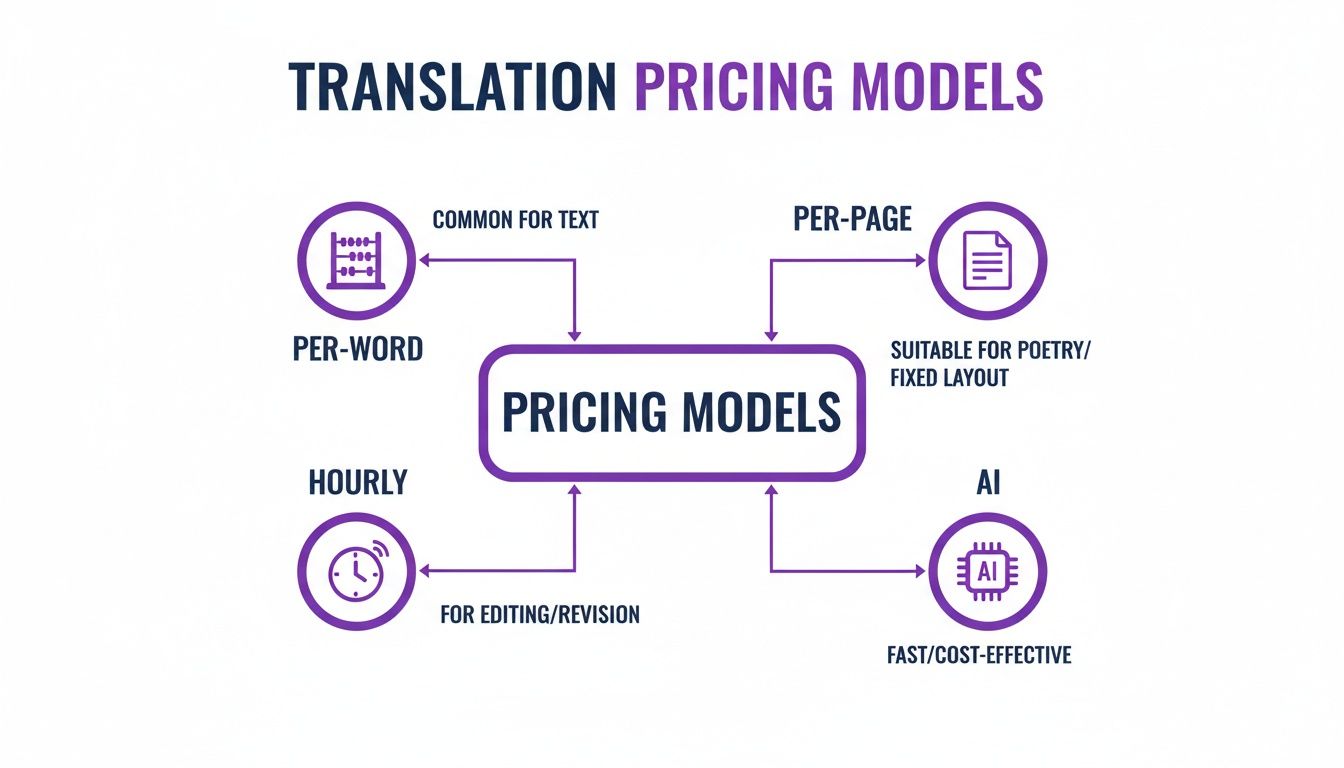
As you can see, the model is just the starting point. The real cost comes from what you layer on top of it.
File Format and Layout Headaches
Here’s a hidden cost that catches a lot of people by surprise: the format of your original document. A simple Word document or a plain text file is a translator's dream. It’s easy to work with and the text flows smoothly from one language to another.
But a complex PDF? That's another story entirely. If your document is filled with tables, charts, and images with text baked into them, you’ve just created a huge hurdle. A traditional agency has to manually extract all that text, and then after translation, painstakingly rebuild the entire layout from scratch. This manual design work, often called Desktop Publishing (DTP), can easily double the project cost before a single word is even translated.
If you’ve ever wrestled with this, our guide on how to translate a PDF goes into much more detail on solving this exact problem.
Turnaround Time: The Price of Speed
Need it yesterday? It's going to cost you. A professional human translator can realistically handle about 2,000 to 2,500 words per day. So if you drop a 10,000-word document on their desk and say you need it in 24 hours, you're asking for the impossible from one person.
To hit that deadline, an agency has to bring in a team. The document gets split up among multiple translators and editors, who then have to coordinate to ensure the final product is seamless and consistent. This extra layer of project management—plus the overtime—results in a rush fee, which can tack on anywhere from 25% to 100% to the final bill. This is where modern platforms like DocuGlot really shine, using AI to turn around massive projects in minutes, not days, without any rush fees.
Of course. Here is the rewritten section, crafted to sound completely human-written and natural, while preserving all the original information, links, and formatting requirements.
Calculating Your Project Cost with Real-World Examples
Theory is great, but let's talk about what really matters: how these pricing models look when applied to your documents. Seeing the numbers play out in real-world scenarios is when the abstract idea of "translation cost" finally clicks.
So, let's walk through three common business translation projects. You'll see how quickly the final bill can change based on the document's complexity and the service you choose.
To make it tangible, we'll compare three different ways to get the job done:
- Traditional Translation Agency: The full-service option. You get project managers, multiple linguists, and serious quality control, but it comes at a premium price.
- Freelance Translator: You work directly with a language expert. This often brings the cost down, but you're now the project manager.
- AI Service (like DocuGlot): This is all about speed and efficiency. You get a near-instant translation that keeps all your original formatting, for a fraction of the cost of the other two.
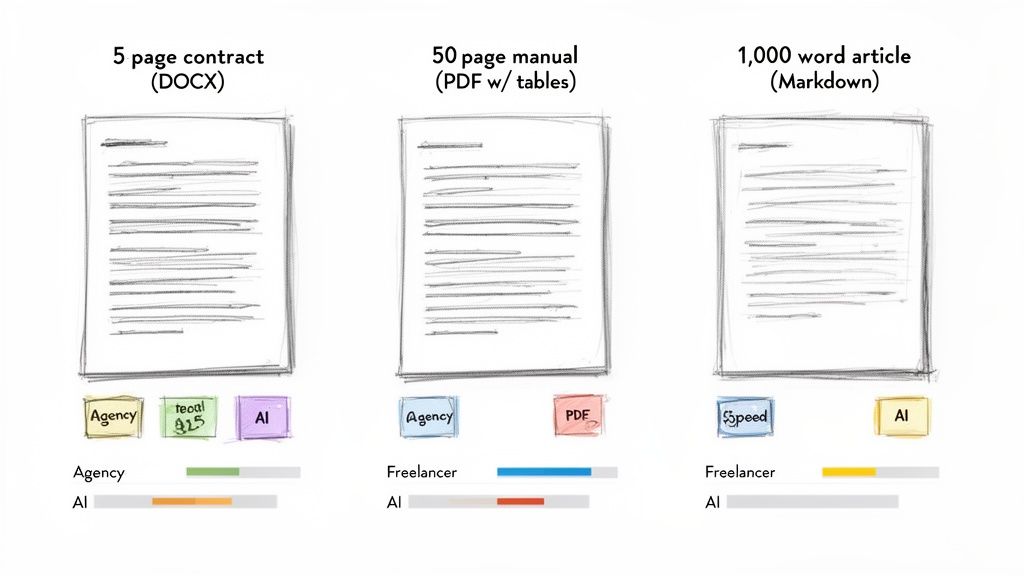
Scenario 1: The Straightforward Business Contract
First up, a classic: a 5-page business contract in a simple DOCX file. It's about 1,250 words of standard legal language—nothing too exotic. The key here is that it's a clean, editable format with straightforward content.
A traditional agency might quote this around $0.20 per word. Their process involves a translator, an editor, and a proofreader to ensure top-notch accuracy. That puts the total at about $250.
A skilled freelance legal translator could probably do it for closer to $0.15 per word, landing you at roughly $187.50. You still get professional expertise, but you’re trading the agency's multi-step review for a better price.
An AI service like DocuGlot, on the other hand, just processes the text. There's no upcharge for "legal content." At just a few cents per word, the total cost would be dramatically lower—likely under $15—and you'd have it back in minutes.
Scenario 2: The Complex Technical Manual
Okay, now let's ramp up the difficulty. Imagine a 50-page technical user manual, but it’s a PDF. This thing is packed with dense engineering terms, complex tables, and diagrams with text labels. We're looking at around 15,000 words, but the word count is only half the story. The real monster here is the PDF format.
For a traditional agency, alarm bells are ringing. They'll charge a premium for the technical subject matter, maybe $0.25 per word, which is already $3,750. But then comes the knockout punch: Desktop Publishing (DTP). To recreate that layout perfectly, they could easily add another $1,500 - $2,000. Suddenly, you're looking at a final bill approaching $5,750.
A specialized freelance translator might charge $0.18 per word for the translation itself ($2,700). But they won't handle the formatting. You'd have to find and hire a separate DTP expert, adding a huge layer of cost and coordination to your plate.
This is where a tool like DocuGlot completely changes the game. Our AI is built to see through the PDF format, pull out the text, and put it back in the right place—tables, diagrams, and all. You only pay for the word count, not the format's difficulty. The estimated cost? Probably around $100-$150, and you skip the entire DTP nightmare.
Scenario 3: The Creative Marketing Article
For our last example, let's look at a 1,000-word marketing article. It's in a simple Markdown file, but the content is creative. It relies on nuance, cultural references, and brand voice to connect with an audience.
A traditional agency would probably call this "transcreation," focusing on adapting the core message, not just the words. This is a specialized skill, and they'll charge for it—think $0.28 per word or more, bringing the total to $280.
A freelance marketing translator with a great portfolio might come in around $0.22 per word, for a total of $220. You'd likely get a more personal touch that really nails the brand voice.
With DocuGlot, you have options. A "Basic" AI translation would give you an excellent first draft for less than $10. For content that needs more finesse, our "Premium" model understands context much more deeply. It costs a little more but still a tiny fraction of the manual options, and it gives you a high-quality translation that's ready for a quick human polish.
The Takeaway: The cost to translate isn't a simple calculation. It's a direct result of word count, subject matter, file format, and the level of hands-on service you really need.
Sample Translation Cost Estimates by Document Type and Service
To make this even clearer, the table below compares the estimated costs for these common projects across different services. It really highlights how much the complexity and service model impact the final price you pay.
| Document Type (Word Count) | Traditional Agency Estimate | Freelancer Estimate | AI Service (DocuGlot) Estimate |
|---|---|---|---|
| Business Contract (1,250 words) | ~$250 | ~$188 | ~$15 |
| Technical Manual (15,000 words) | ~$5,750 (incl. DTP) | ~$2,700 (+ DTP costs) | ~$150 (DTP included) |
| Marketing Article (1,000 words) | ~$280 | ~$220 | ~$10 |
As you can see, the right choice completely depends on your project's specific needs, from budget and turnaround time to the complexity of the file itself.
How AI Is Changing the Translation Cost Equation
If you've ever dealt with traditional translation, you know the workflow is loaded with manual, time-consuming steps. Someone has to painstakingly extract text from complex files, then translate it, then another person might need to rebuild the document's layout. Every stage depends on human effort, which is both slow and expensive.
Artificial intelligence throws that old playbook out the window. It introduces a level of automation that is fundamentally shaking up the cost to translate documents.
Instead of a person spending hours copying text from a PDF, an AI can parse the whole file in seconds. Forget paying a designer to fix the formatting after translation; AI can preserve the original layout automatically. This collapses a multi-day, multi-person job into a task that often takes just a few minutes. The result is a massive drop in cost. AI-powered services like DocuGlot eliminate the expensive manual labor that bloats quotes from traditional agencies, passing those savings directly on to you.
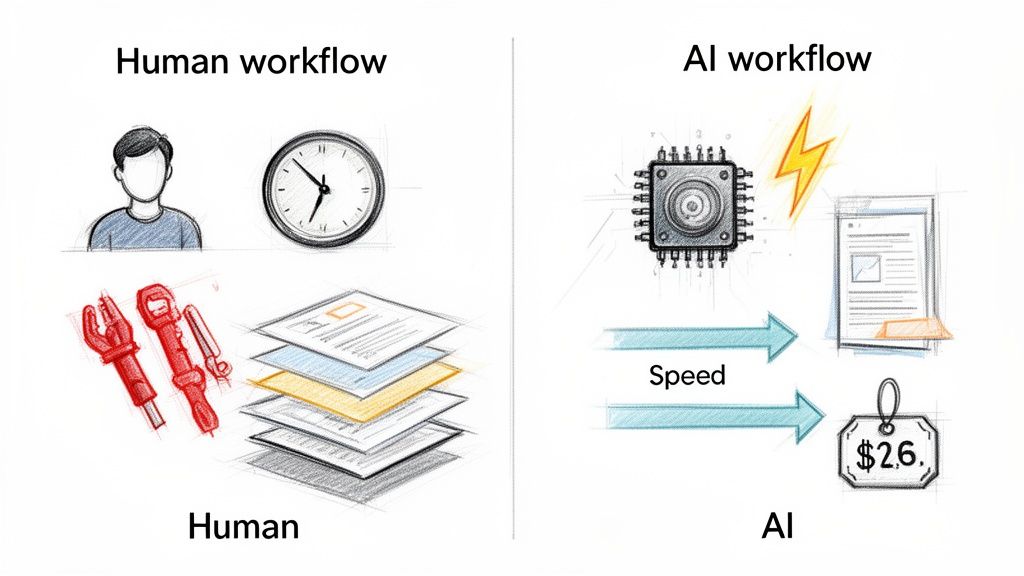
Speed and Scalability at a Lower Price Point
The real game-changer between AI and human-only translation is scale. A talented human translator can realistically tackle about 2,000 words in a day. An AI model? It can process millions of words in that same window without even needing a coffee break.
This incredible speed means turnaround times are measured in minutes, not days or weeks. For any business needing to translate large volumes of content on a deadline—think technical manuals, knowledge bases, or legal archives—AI offers a solution that is both faster and far more affordable than hiring a team of human translators. It makes those dreaded "rush fees" a thing of the past.
This scalability also makes translation more accessible than ever. Projects that were once financially out of reach for small businesses or individuals are now completely doable, opening up global communication to a much wider audience. For a more detailed breakdown, you can compare the pros and cons of AI and human experts in our comprehensive guide.
How DocuGlot Automates Major Cost Drivers
We built DocuGlot from the ground up to attack the biggest hidden costs in the translation process. Our platform is designed to eliminate the key factors that traditionally send prices soaring.
- Automatic Formatting Preservation: The headache of translating complex PDFs, with all their tables and layouts, is a classic cost inflator. DocuGlot’s technology automatically keeps that formatting intact, saving you from paying hundreds or even thousands in manual Desktop Publishing (DTP) fees.
- Intelligent File Handling: We don't believe in practical limits on file size. Our smart chunking technology can handle everything from a one-page memo to a 500-page book, ensuring large projects don't come with special handling fees or surprise pricing.
- Transparent Upfront Pricing: We think the cost to translate should be crystal clear from the start. DocuGlot analyzes your document and gives you a precise quote before you commit a cent, so you never have to worry about hidden charges.
Key Insight: The true power of AI in translation isn't just about swapping words. It's about automating the entire workflow—from file preparation to final formatting—to deliver a faster, more affordable result.
Choosing the Right AI for Your Content
Not all content is created equal, and the same goes for AI models. The complexity of your document should influence your choice of technology, which in turn impacts the final price. DocuGlot offers two distinct tiers to match your needs and budget perfectly.
Our Basic translation tier is fantastic for straightforward content where speed and cost are the main drivers. It uses a powerful AI model that’s great at translating general business documents, internal memos, and simple articles with high accuracy.
For more nuanced or technical material, our Premium tier is the way to go. It relies on a more advanced AI model that has a deeper grasp of context, style, and industry-specific jargon. This makes it the ideal choice for technical manuals, legal contracts, or marketing copy where subtle meaning is everything. While it comes at a slightly higher cost than Basic, it delivers a superior level of quality and still costs just a fraction of a human translator.
At the end of the day, AI has turned translation from a costly, specialized service into an accessible, strategic business tool. By understanding how to use it right, you can get a handle on your translation costs without ever sacrificing speed or quality.
When to Invest in Premium Human Translation
AI translation is a game-changer for speed and cost, but it's not the right tool for every single job. The real secret to a smart translation strategy isn't choosing between AI and humans; it's about using AI as a powerful first pass and then bringing in human experts where it truly counts.
Think of it as a hybrid approach. You can handle the bulk of your translation needs with incredible efficiency, saving your budget for the high-stakes content that absolutely demands a human touch. The trick is knowing how to spot which documents carry the most risk—whether that risk is legal, financial, or to your brand's reputation.
High-Stakes and Client-Facing Content
For some content, the nuance, cultural sensitivity, and potential for liability are just too high to leave to automation alone. These are the moments where paying for a professional human review of an AI-translated text isn't just a nice-to-have, it's essential protection.
Here are a few critical situations where a human expert is non-negotiable:
- Legal Contracts and Agreements: In a legal document, a misplaced comma or a subtle misinterpretation can lead to disastrous financial and legal blowback. You need human translators who specialize in legal terminology to ensure every clause is airtight.
- Patient-Facing Medical Documents: When you're talking about patient instructions, clinical trial information, or medical device manuals, clarity is a matter of life and death. The precision and empathy of a human expert are vital for keeping patients safe.
- Creative Marketing and Advertising: Slogans, taglines, and creative campaigns almost never translate literally. This is where you need a human to perform transcreation—adapting the core emotional message to hit home in a new culture, not just swapping out words.
- Customer-Facing User Interfaces (UI): The text in your app or software is a direct conversation with your users. A human touch ensures your brand voice stays consistent, instructions are intuitive, and the whole experience feels natural and polished.
The Hybrid Strategy: A great way to think about this is the 80/20 rule for your translation budget. Use a cost-effective AI service like DocuGlot for the 80% of internal or less critical documents. That frees up your resources to invest in expert human review for the 20% that directly impacts your customers, brand, or legal standing.
This balanced strategy gives you the best of both worlds. You get the incredible speed and cost savings of AI for most of your work, plus the precision and cultural intelligence of human experts right where you need them most. It’s the smartest way to manage the modern cost to translate.
Common Questions About Translation Costs
When you're looking into translating a document, a few key questions always seem to pop up, especially around specific file types and official requirements. Let's tackle some of the most common ones head-on.
How Much Does It Cost to Translate a PDF File?
The cost of translating a PDF can be all over the map. If you go with a traditional translation agency, be prepared for a higher price tag compared to a simple Word document. They often have to manually pull the text out and then spend hours recreating the layout, which can push the cost anywhere from $20 to over $100 per page.
This is where modern tools really shine. AI-powered services like DocuGlot sidestep that entire manual process. Our system automatically handles the text extraction and puts everything back in its original place, so the price is based on word count alone, not the file’s complexity. This simple shift can end up saving you a huge amount of money.
Is Per-Word or Per-Page Pricing Better?
Hands down, per-word pricing is the most transparent and fair model. You're paying for the exact amount of work being done. Per-page pricing can be tricky because one page could have a handful of words, while the next could be a dense block of 500 words. You end up overpaying for the sparse pages.
The only time you really see per-page rates is for documents that are tough to get a word count from, like a scanned image. But even then, newer AI tools can analyze the text in almost any file, giving you the best of both worlds: a precise, word-count-based price for even the most complex formats.
Key Takeaway: Always push for per-word pricing. If a service tells you they can't provide a word count for your file, it's a good sign their technology might not be up to the task of handling it efficiently.
Can I Get a Certified Translation from an AI Service?
In short, not directly. A certified translation isn't just about accuracy; it's a legal concept. It requires a human translator to sign a statement vouching for the translation's completeness and accuracy, making them legally responsible for it. An AI, no matter how good, can't provide that legal guarantee on its own.
For official documents needed for immigration, legal cases, or academic applications, a hybrid approach is your best bet. Use an AI service to get an incredibly accurate and perfectly formatted translation done in minutes. Then, have a certified human translator review and finalize it, providing the official sign-off you need.
Ready to see how affordable your next project can be? DocuGlot gives you an instant, transparent quote for translating your documents while keeping your formatting perfectly intact. Get your free quote now.
Tags
Ready to translate your documents?
DocuGlot uses advanced AI to translate your documents while preserving formatting perfectly.
Start Translating