The Real Cost of Translation A Guide to Smart Budgeting
The cost of translation can swing wildly, from just a few cents to over $0.30 per word. The final price tag all comes down to a few key things: whether you're using AI or a human translator, the languages you're working with, and how complex the material is.
To put it in perspective, a simple 1,000-word document might only set you back $20 with an AI tool, but that same document could easily cost over $200 when you go through a traditional agency.
Decoding the Cost of Translation
Asking about the "cost of translation" is a bit like asking "how much does a car cost?" Are you after a reliable daily driver or a souped-up sports car? The prices are in completely different leagues, and the same logic applies here. A great starting point is understanding fixed and variable costs, as these concepts are the foundation of how services are priced.
The translation world generally runs on a few main pricing models. Knowing which one you're dealing with is the first step to setting a realistic budget and dodging any nasty surprise fees.
Common Pricing Models Explained
The most common model you'll see is per-word pricing. It’s the industry standard for a reason—it’s transparent and predictable. You take your total word count, multiply it by the agreed-upon rate, and that's your price. This works perfectly for text-heavy documents like articles, reports, and manuals.
Sometimes, you'll encounter per-hour pricing. This usually comes into play for tasks where a simple word count doesn't tell the whole story. Think creative projects like adapting a marketing slogan for a new culture (transcreation) or complex desktop publishing that requires a lot of manual formatting.
Finally, there’s project-based pricing. This is a flat fee for the whole shebang, and it’s typically reserved for massive localization projects or multimedia jobs with lots of moving parts. Modern AI platforms like DocuGlot simplify this even further with usage-based plans; you can dig into the specifics by exploring the full cost to translate a document with our service.
Key Takeaway: The pricing model shapes your final cost. Per-word is the go-to for standard text, per-hour covers complex creative work, and project-based fees handle large, multifaceted initiatives.
AI vs Human Translation Costs
Your single biggest cost driver will be the choice between human and AI translation. It's a classic trade-off.
Traditional human translation relies on skilled linguists who charge a premium for their expertise, cultural nuance, and ability to capture subtle meaning. On the other hand, AI-powered tools offer astonishing speed and efficiency at a fraction of the cost, making them a fantastic fit for a huge range of business and personal needs.
The difference in cost and speed is pretty stark.
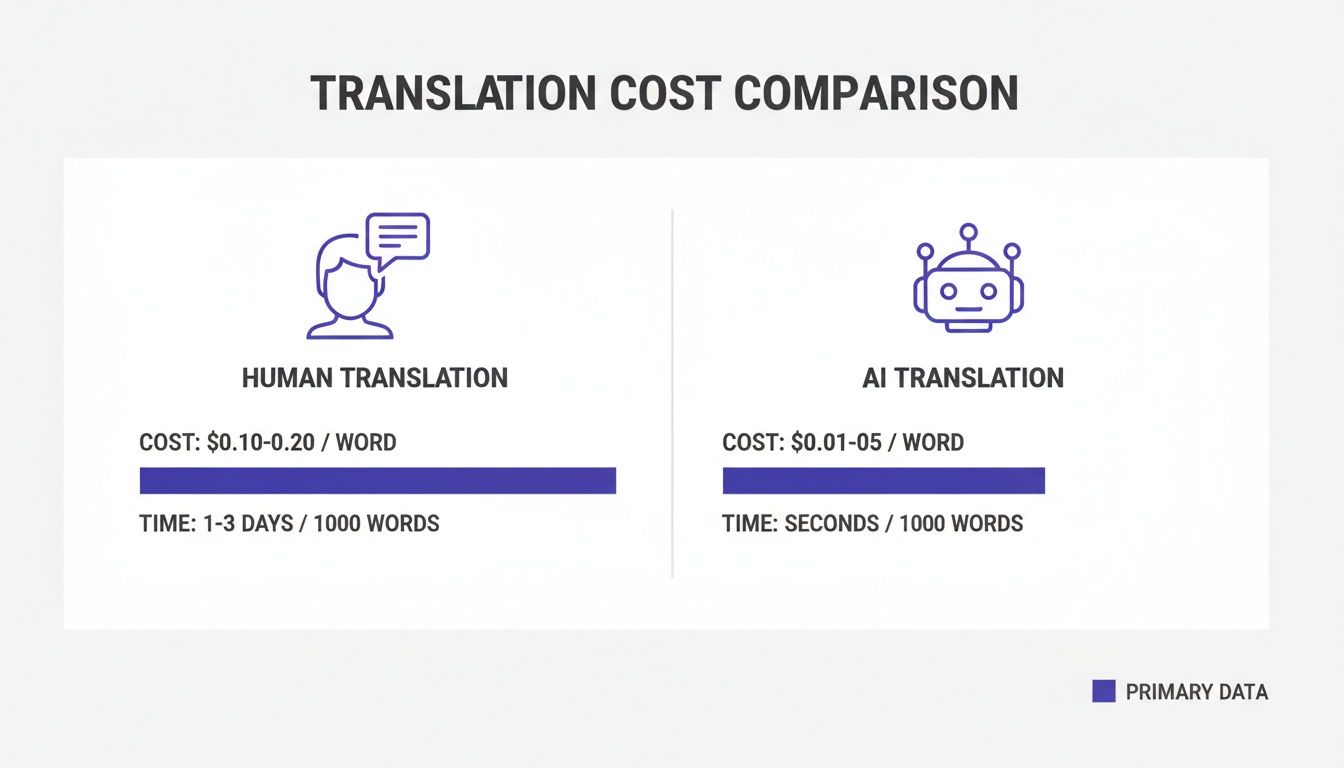
This quick comparison really brings the numbers to life.
Human vs AI Translation Cost Estimates at a Glance
Here’s a snapshot of what you might expect for a standard 5,000-word document, comparing a traditional human translator to a modern AI service.
| Service Type | Estimated Cost Range | Typical Turnaround | Key Benefit |
|---|---|---|---|
| Traditional Human Agency | $750 - $1,500+ | 3-5 Business Days | Nuance & cultural accuracy |
| AI Translation Service | $100 - $150 | Minutes to 1 Hour | Speed & cost-effectiveness |
As you can see, AI delivers translations for a small fraction of the cost and in almost no time at all. This efficiency has completely changed the game for anyone needing fast, affordable translations.
Uncovering the Hidden Factors in Your Translation Bill
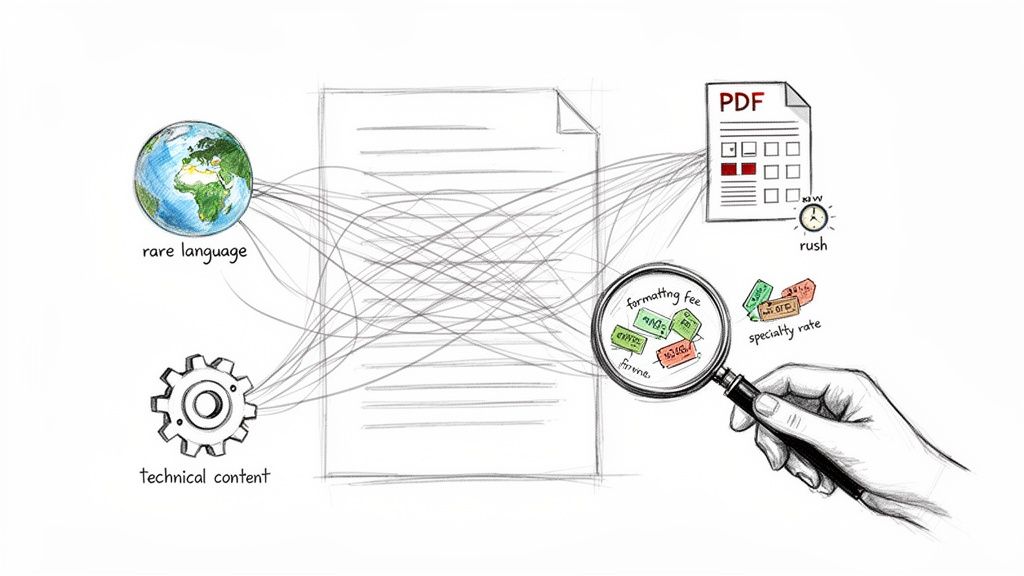
While the word count gives you a starting point for a translation quote, several other critical factors can quietly drive up the final price. These are the details that often catch people by surprise, turning a straightforward budget item into a much bigger expense. Getting a handle on these drivers is the real secret to managing your total cost of translation.
The most obvious variable is the language pair—the language you're starting with and the one you're translating into. It all boils down to simple supply and demand. If you're translating from English to Spanish, you're in luck. There's a huge pool of talented translators, and that competition helps keep rates reasonable, usually somewhere between $0.15 and $0.20 per word.
But let's say your project needs to go into Icelandic or a less common regional dialect. Suddenly, the game changes. The number of experts qualified for that work is dramatically smaller, creating a specialist's market where they can rightly charge more for their rare skills. This scarcity can easily push rates past $0.30 per word, potentially doubling what you expected to pay.
The Complexity Surcharge
Beyond the languages themselves, the subject matter of your document is a huge cost factor. Translating a simple marketing email is a world away from tackling a dense legal contract or a highly technical engineering manual. The more specialized the content, the higher the price tag.
This "complexity surcharge" isn't just about difficult words; it's about the expertise needed to translate them accurately. These documents require a translator who is not only a language expert but also a subject-matter expert. One wrong word in a legal clause or a misplaced decimal in a technical schematic can lead to disastrous consequences.
To get it right, agencies bring in specialists, and that expertise comes at a premium. You can expect this to add a surcharge of 20-50% on top of the standard per-word rate.
The Specialist Premium: Content that demands deep industry knowledge—think legal, medical, or engineering—always costs more. You're paying for a specialist who can guarantee precision and help you sidestep critical, costly errors.
The Hidden Cost of Formatting
Here’s the one that trips up almost everyone: document formatting. People naturally assume the translated version will be a mirror image of the original, just in a different language. With traditional translation services, that’s almost never the default.
Preserving the layout of a complex PDF or a carefully designed presentation is a serious technical hurdle. A translator can't just open a PDF and start typing. The entire document has to be manually rebuilt by a desktop publishing (DTP) specialist.
This painstaking process involves:
- Extracting all the text from the locked file.
- Getting the content translated, usually in a separate document.
- Flowing the new, translated text back into the original design.
- Meticulously adjusting every font, image, and spacing element to accommodate the new text (which is often longer or shorter than the original).
This DTP work is typically billed by the hour, and it can add hundreds of dollars and several days—sometimes even weeks—to your project timeline. A seemingly simple 20-page PDF can quickly become a major expense. This is exactly the kind of costly, time-consuming bottleneck that modern platforms like DocuGlot are designed to eliminate by automatically preserving your file's original structure.
Traditional Agencies vs. Modern AI Platforms
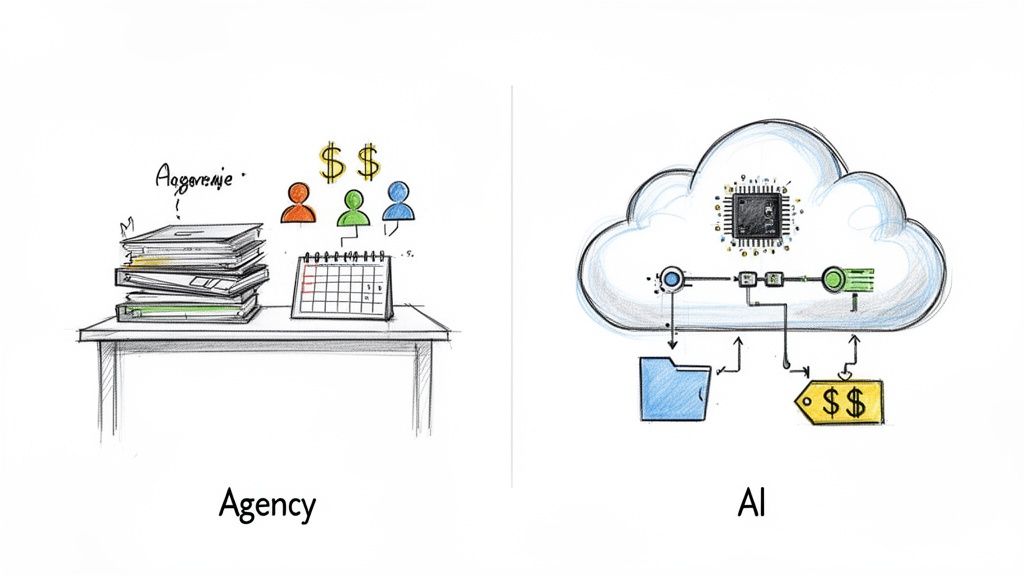
Not too long ago, if you needed a document translated, you had one real choice: a traditional translation agency. Today, that old-school model is up against a new breed of AI-powered platforms. This isn't just about new tech versus old tech; it's a completely different way of thinking about efficiency, security, and the real cost of translation.
The Old Guard: How Agencies Work
Think of a traditional agency like a general contractor building a house. They’re your main point of contact, but they manage a whole crew of subcontractors and add a significant markup for their trouble. It's a structure with a lot of moving parts, and you pay for every single one.
This model is built on layers of human management that drive up your final bill.
- Project Managers: They’re the coordinators, juggling your files, deadlines, and questions.
- Vendor Coordinators: Their whole job is to find and manage freelance translators.
- Translators & Editors: These are the experts doing the actual work, but the agency marks up their rates to turn a profit.
- DTP Specialists: If your document has complex formatting, a separate desktop publishing team has to manually reconstruct it, adding yet another expense.
Every one of these roles adds overhead. The agency needs to cover salaries, office space, and its own profit margin, which is how you end up with typical rates of $0.20 to $0.30 per word.
The New Way: The AI-First Model
Modern AI platforms like DocuGlot flip this model on its head. Instead of hiring that general contractor, you’re using a set of powerful, automated tools that get the job done directly. This approach cuts out the expensive human "middleware" and puts advanced translation technology right at your fingertips.
By automating the most time-consuming parts of the job—file management, linguist coordination, and layout preservation—these platforms slash the operational costs. There's no back-and-forth between project managers and freelancers. The software handles the entire workflow, and those savings get passed straight to you.
The Value Shift: This is more than just a lower price tag. Modern platforms change the entire value equation. You’re trading administrative bloat for incredible speed, better security, and straightforward pricing.
What This Means for You: Speed, Clarity, and Security
The benefits of an AI-first approach go way beyond cost. The biggest leap is in pure efficiency. A translation that might take an agency days or even weeks of emailing files and coordinating schedules can be finished in minutes or hours. It’s a game-changer.
This new model also brings a level of honesty to the cost of translation. Forget waiting around for a custom quote based on fuzzy math and hidden markups. You get a clear, instant price based on your document. You know exactly what you’re paying before you start. For a deeper dive into this, you might find our guide comparing AI vs. human translation services helpful.
Finally, your information is much safer. With an agency, sensitive documents often get passed around via email between multiple people, creating more opportunities for a breach. Platforms like DocuGlot process everything in a secure, encrypted system. Your files are automatically deleted after a set period, minimizing risk. The result is a faster, more affordable, and fundamentally more secure way to get high-quality translations.
Figuring Out Your Translation Budget
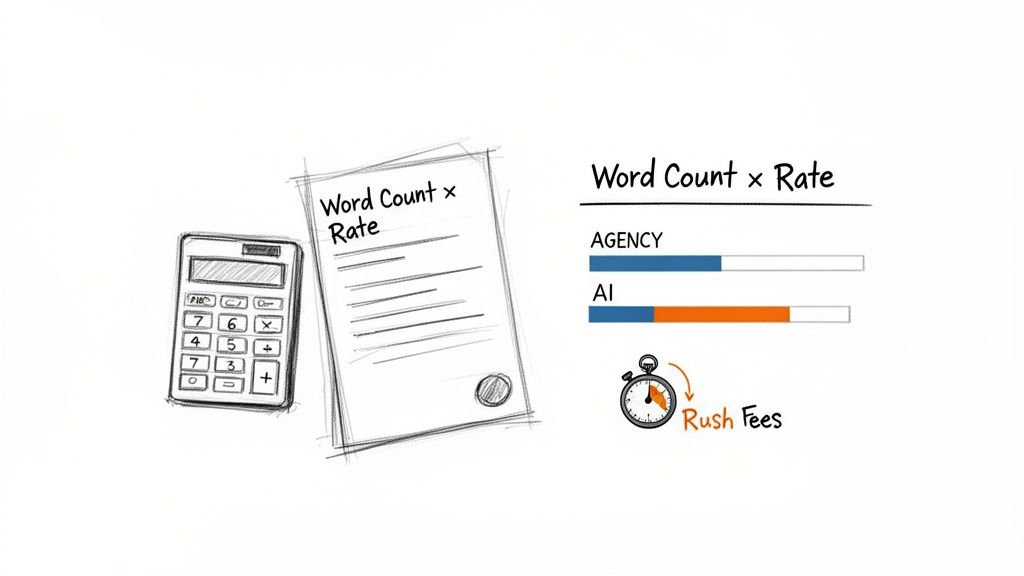
Trying to estimate your translation expenses shouldn't feel like guesswork. Once you understand the basic formula and the key factors we've already covered, you can build a solid budget and sidestep any last-minute surprises. This practical mindset is all you need to forecast the true cost of translation for any project.
At its heart, any translation budget starts with a simple calculation. Think of this as your starting point before layering in other variables that will shape the final price.
The Basic Budget Formula: (Total Word Count) x (Per-Word Rate) = Base Translation Cost
This simple multiplication gives you a solid baseline. From there, you can account for any extra charges like rush delivery, technical complexity, or special formatting to get a much more realistic picture of your total investment. For AI-driven projects, it can also be helpful to understand the underlying tech costs. Resources like this guide on OpenAI API pricing and cost management can provide deeper insight into how those expenses are structured.
Real-World Translation Cost Scenarios
Let's put this into practice with a couple of common document types. We'll look at what you might expect from a traditional agency versus a modern AI service like DocuGlot.
Scenario 1: 15-Page Business Proposal (DOCX)
This is your typical business document, coming in at around 6,000 words. The language is professional but not highly technical, making it a relatively straightforward job.
- Traditional Agency: An agency might quote $0.20 per word, which puts the base cost at $1,200. After tacking on a 15% project management fee, you're looking at a final bill of about $1,380 and a wait of several business days.
- AI Service (DocuGlot): The cost here is transparent and significantly lower. A simple, pay-as-you-go rate could put the total around $120. The translation is usually done in less than an hour, and just as importantly, the original DOCX formatting stays perfectly intact.
Scenario 2: 50-Page Technical Manual (PDF)
Now for something trickier. This document is a hefty 15,000 words and is packed with industry jargon, diagrams, and tables. For agencies, the PDF format alone is a huge hurdle.
- Traditional Agency: The technical nature could easily trigger a 30% complexity surcharge, bumping the rate to $0.26 per word. That’s $3,900 just for the translation. To recreate the PDF layout, they'll need desktop publishing (DTP) services, often billed at $50/hour. For a 50-page manual, that could be 10 hours of work, adding another $500. The grand total? $4,400, with a one- to two-week turnaround.
- AI Service (DocuGlot): The process is worlds apart. Even if you opt for a Premium quality setting to handle the technical terms, the cost might only be around $450. The game-changer is that DocuGlot preserves the PDF's complex formatting automatically, completely sidestepping that expensive and time-consuming DTP step.
Estimating Your Document Translation Cost
When you put these scenarios side-by-side, a clear pattern emerges. Agencies often have layers of fees for management, specialized content, and formatting, while AI platforms offer a direct, automated, and much more budget-friendly alternative.
If you want a precise, instant quote for your own files, you can learn more about how to estimate your document translation cost with a transparent pricing model. This way, you can plan your budget with confidence, making decisions based on clear, predictable expenses instead of complicated, variable quotes.
Why Translation Costs Are a Growing Concern
In today's deeply connected world, speaking your customer's language isn't just a nice-to-have—it’s a fundamental part of doing business. Whether you’re an e-commerce brand reaching shoppers overseas or a multinational firm managing a global supply chain, the demand for multilingual content has skyrocketed.
This boom has turned what was once a specialized service into a massive global industry, and with it, understanding the cost of translation has become a serious strategic conversation. As companies expand, the sheer volume of content—websites, marketing campaigns, legal contracts, support docs—piles up, putting immense pressure on budgets.
Just look at the numbers. The global translation services market has swelled from about $32 billion in 2009 to over $52 billion in 2022. It’s on track to hit an eye-watering $65.5 billion by 2026. This incredible growth shows just how essential cross-language communication is, but it also shines a light on a major financial hurdle. You can discover more insights about the market's rapid expansion and what it means for businesses like yours.
The Economic Barrier of Traditional Translation
So, where does all that cost come from? The high price of traditional, human-powered translation is the main culprit. Skilled human translators are experts, and they charge accordingly—typically anywhere from $0.10 to $0.30 per word for common language pairs.
Think about what that means in practice. A single 10,000-word business contract could easily set you back $1,000 to $3,000. Now, imagine translating dozens or even hundreds of documents into multiple languages. The costs don't just add up; they multiply into a figure that can feel completely out of reach.
This economic wall can effectively lock smaller businesses out of international markets, stopping them from competing with larger corporations. The expense becomes a major roadblock to global ambition.
The Core Challenge: As the need for multilingual content explodes, the high, inflexible costs of traditional translation create an unsustainable financial burden. It forces businesses into a tough choice: chase global growth or stay fiscally responsible.
This is exactly why modern AI solutions have become so critical. They're not just about speed or convenience; they represent a fundamental shift that makes global communication affordable. By automating the heavy lifting, AI dramatically lowers the financial barrier, allowing companies to manage their translation budgets without giving up on their international goals. It turns the cost of translation from an obstacle into a manageable part of a smart growth strategy.
Navigating Pricey Markets and Tough Regulations
Let's be honest: not all translation projects are priced the same. The cost can skyrocket depending on where you're doing business. Some regions just come with a built-in premium, thanks to a unique mix of economic pressures, language complexities, and strict rules. Figuring out these high-cost areas is crucial if you want to budget accurately for going global.
Europe, for instance, is the undisputed hub of the translation world. It’s a dense, intricate patchwork of cultures and languages, all operating within a single economic zone. This linguistic diversity alone creates a massive, constant demand for translation, but that's just one piece of the puzzle that makes it an expensive place to operate.
The European Premium
Think about it: the European Union has 24 official languages. A single product launch or policy change could mean spinning up nearly two dozen separate translation projects at once. That kind of volume creates a fiercely competitive market for top-tier linguists, which naturally pushes their rates up.
But it's not just about the languages. Europe’s notoriously strict regulations add another costly layer to everything. Complying with rules like the General Data Protection Regulation (GDPR) isn’t optional—it’s the law. This means that documents handling personal data, like contracts or user agreements, often need a certified translation to be legally valid, and that certification comes with a hefty price tag.
When you mix high linguistic diversity, steep labor costs, and a rigid legal framework, translation stops being just a service. It becomes a high-stakes, essential part of doing business.
This reality can be a tough pill to swallow for companies trying to break into the EU. The costs and logistical headaches are no joke, often causing major delays and blowing through budgets before a single product hits the shelves.
Why Regulations Make Translation More Expensive
Compliance with regulations is a huge cost driver, especially if you're in finance, healthcare, or the legal field. Here’s a quick breakdown of why it adds so much to the final invoice:
- Certified Translations: Official documents often require a formal certification—a signed statement from the translator vouching for the translation's accuracy. This extra step and added liability can easily tack on 20-30% to the cost.
- Subject-Matter Experts: You can't just have anyone translate complex regulatory text. You need a specialist who understands both the language and the specific legal or technical field. That kind of specialized expertise commands a much higher rate.
- Increased Scrutiny: The stakes are incredibly high. One mistranslated clause in a contract could spark a legal nightmare. This means every word has to be meticulously reviewed and proofread, which adds more time and, you guessed it, more cost.
The European market is the perfect case study for all of this. Projections show that by 2035, Europe will account for a staggering 45.2% of the entire translation services market, largely because of its multilingualism and regulatory maze. The prices reflect this reality. Human translation can run anywhere from €0.15 to €0.40 per word. To put that in perspective, a simple 5,000-word report could set you back as much as €2,000, and that's often before any agency fees.
You can dive deeper into these trends and find additional insights into the translation services market. For any business eyeing this market, it really highlights how valuable a smart, compliant AI solution can be in making these challenges manageable.
Your Questions About Translation Costs, Answered
When you're looking into translation services, it's easy to get bogged down in the details. You're probably wondering about the real costs, what affects them, and how to get the best value without sacrificing quality. Let's tackle some of the most common questions people have when it comes to the cost of translation.
When Should I Use AI Instead of a Human Translator?
This is a great question, and the answer really comes down to what you're trying to accomplish with your document. Think of it this way: AI translation shines when you need speed, efficiency, and to keep costs down on a large scale.
It's a fantastic fit for internal company documents, user manuals, or huge batches of customer support articles. In these cases, you need a good, clear translation, and you need it fast. AI delivers that perfectly.
On the other hand, you'll want to stick with a professional human translator for high-stakes content where every single word matters. We're talking about creative marketing campaigns, literary fiction, or legally binding contracts. These require a deep understanding of nuance, culture, and subtle meaning that only a human expert can provide.
Rule of Thumb: If your goal is straightforward communication for functional content, AI is a smart, efficient choice. If you need to persuade, inspire emotion, or navigate tricky legal language, investing in a human translator is the right move.
Does Document Formatting Really Affect the Price?
It absolutely does, and this is a major "gotcha" with traditional translation agencies. A simple text file is one thing, but if you hand them a polished PDF with complex tables, custom fonts, and embedded images, the cost of translation can skyrocket.
Why? Because old-school agencies have to manually rebuild your document's layout after the text is translated. This process, called desktop publishing (DTP), is slow, tedious, and billed by the hour. It's not uncommon for DTP to add hundreds of dollars and days—or even weeks—to a project timeline.
This is where modern platforms like DocuGlot completely change the game. Our technology is built to automatically preserve your original file's layout, which means those DTP costs and delays are completely eliminated.
What Content Types Are Best for Basic vs. Premium AI?
Not all AI is built the same, which is why it's important to match the tool to the task. The choice between a "Basic" and "Premium" AI model really boils down to how complex your original document is.
Basic AI: This is your go-to for everyday, straightforward content. Think internal emails, simple product instructions, or general business updates. The language is direct, with very little ambiguity.
Premium AI: You'll want to opt for a premium model when you're dealing with more challenging material. This includes things like technical manuals full of industry jargon, dense academic papers, or detailed financial reports. The more advanced AI has a much better grasp of specialized terminology and context, giving you a far more accurate translation for tough texts.
Ready to see how affordable and simple high-quality translation can be? With DocuGlot, you get transparent pricing and perfectly preserved formatting every time. Upload your document and get an instant quote today!
Tags
Ready to translate your documents?
DocuGlot uses advanced AI to translate your documents while preserving formatting perfectly.
Start Translating