A Practical Guide to the Translation of Medical Terms
When we talk about the translation of medical terms, we're not just swapping words. We're dealing with a high-stakes field where one small slip-up can have serious consequences for patient safety and the success of a clinical trial. It’s a discipline that demands more than just knowing two languages; it requires a deep, specialist-level understanding of medicine itself.
Why Precision in Medical Translation is Non-Negotiable
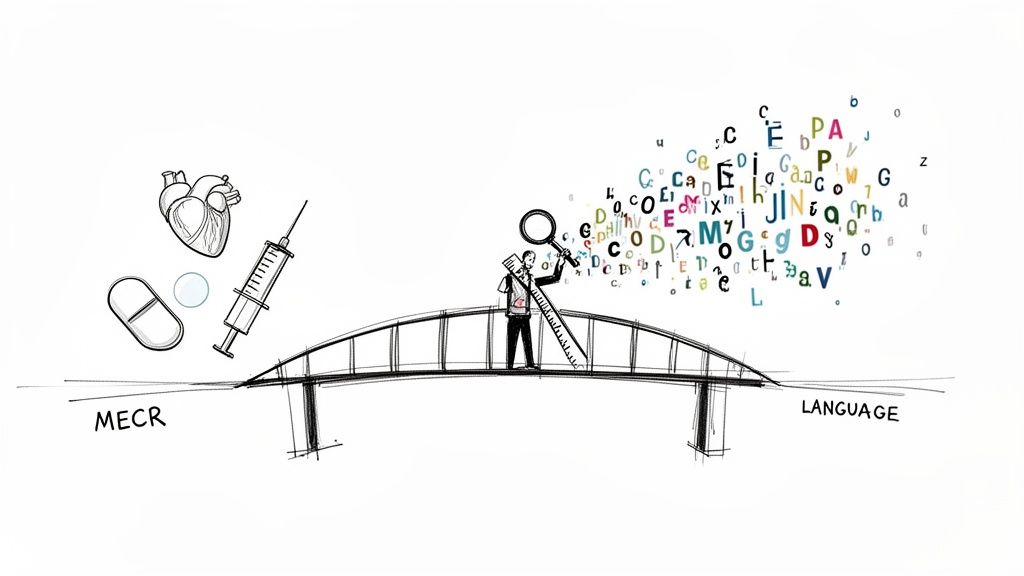
Think of a medical translator less like a dictionary and more like an engineer building a critical bridge between two complex worlds: language and medicine. If a single decimal point is out of place in dosage instructions, or a patient’s symptom is described with the wrong nuance, a routine medical event can quickly become a crisis.
This isn't hyperbole. The stakes in medical translation are incredibly high and affect every part of the healthcare ecosystem. Whether it's a simple patient leaflet or a complex protocol for a global clinical trial, absolute clarity and accuracy are the foundation of everything we do.
The Real-World Impact of Accuracy
Let’s follow a new drug on its journey to market. Before it can be approved and sold in other countries, every piece of its documentation has to be perfectly translated for regulators, doctors, and patients. This isn't a short list. It includes things like:
- Clinical Trial Protocols: These documents ensure researchers in Tokyo, Berlin, and Rio de Janeiro are all following the exact same steps.
- Informed Consent Forms: Participants need to understand precisely what they are agreeing to, including all potential risks and benefits.
- Patient Information Leaflets (PILs): Simple, clear instructions are essential for patients to take their medication safely and effectively.
- Medical Device Manuals: Surgeons and technicians rely on these for operating sophisticated equipment where there is no margin for error.
In every single one of these cases, there is absolutely zero room for interpretation. A tiny misunderstanding could derail a multi-million dollar trial or, worse, put a patient’s health at risk. For instance, confusing “hypertension” (high blood pressure) with “hypotension” (low blood pressure) could lead a doctor to prescribe a treatment that is not just wrong, but actively harmful.
The ultimate goal of medical translation is to be completely invisible. A perfectly translated document reads as if it were written from scratch by a medical expert in that language, with no ambiguity about its meaning.
Moving Beyond Literal Translation
This guide will peel back the layers of this fascinating and critical field. We’ll go far beyond the simplistic idea of word-for-word translation and get into the real challenges that make the translation of medical terms so complex—from navigating dense acronyms to adapting health concepts that change from one culture to another.
We'll also dive into the rigorous quality assurance processes that are non-negotiable in this industry. These aren't just best practices; they are essential safeguards designed to catch mistakes before they can cause harm. By walking through practical workflows and looking at real examples, you’ll see firsthand why this work demands such a careful, expert-driven approach.
Decoding the Unique Challenges in Medical Language
Translating medical terms isn't just about swapping words from one language to another. It's a completely different ballgame. Medical language is its own ecosystem, full of subtle nuances and hidden traps that standard translation tools just can't handle.
Think of it this way: you wouldn't use a conversational language app to translate a highly technical engineering blueprint, right? The app might recognize words like "bolt" or "stress," but it would completely miss the critical engineering context. A small mistake there could lead to a catastrophic failure. The stakes are just as high in medicine, where a seemingly minor error can have devastating consequences for a patient.
The Problem with Literal Translation
This is where things get dangerous. A literal, word-for-word translation is often the root cause of the most serious errors in medical communication. Medical terminology is loaded with unique structures that simply don't have a direct equivalent in other languages, which is why a more sophisticated approach is non-negotiable.
Here are three of the most common linguistic traps translators fall into:
- Eponyms: These are diseases, symptoms, or instruments named after a person, like Parkinson's disease or Hodgkin's lymphoma. A literal translation is gibberish; the name often has to be replaced with a descriptive equivalent that makes sense in the target language.
- Acronyms and Abbreviations: Medicine is an alphabet soup of acronyms—think CABG (Coronary Artery Bypass Graft) or MRI (Magnetic Resonance Imaging). These need to be correctly identified, expanded, and then translated into the recognized local equivalent, which can differ from one region to another.
- Neologisms: Medical science is always moving forward, which means new terms for treatments, technologies, and diseases pop up all the time. A translator has to be a genuine subject-matter expert to grasp the meaning of these brand-new words and convey them accurately.
To get a handle on this complexity, advanced techniques like Named Entity Recognition (NER) in NLP are a game-changer. This technology can automatically spot and categorize specific medical terms, setting the stage for much more accurate translations.
The table below highlights some of the most common pitfalls we see in the field. These are the kinds of mistakes that can easily slip through a non-specialized process but can have very real consequences.
Common Pitfalls in Medical Term Translation
| Error Type | Example | Potential Consequence |
|---|---|---|
| False Friends | "Preservative" in English vs. "Préservatif" in French (which means condom). | A patient might mistakenly believe their food contains condoms, leading to confusion and distrust. |
| Polysemy | The word "positive" can mean a good outcome ("positive results") or the presence of a disease ("positive test"). | Misinterpreting a positive test result as good news could delay critical treatment for a serious condition. |
| Colloquialisms | Translating "feeling blue" literally into another language for a mental health screening. | The target audience may not understand the expression, leading to an inaccurate assessment of their mental state. |
| Cultural Mismatch | A pain scale using facial expressions that are not universally understood. | A healthcare provider could misjudge a patient's pain level, resulting in improper pain management. |
Understanding these potential errors is the first step. The real solution lies in combining linguistic skill with deep clinical and cultural knowledge.
Why Clinical and Cultural Context Is King
Words on their own are just part of the puzzle. The clinical context is everything. A single term can mean completely different things depending on the situation. Take the word "positive." It can be incredibly confusing. It might signal a good thing ("the treatment had a positive effect") or confirm a serious illness ("the test result was positive for cancer"). A translator without medical training could easily miss this crucial distinction.
And it doesn't stop there. Cultural nuances play a huge role, especially when you're writing for patients.
Concepts of pain, wellness, and even how symptoms are described can differ dramatically across cultures. A direct translation might be clinically correct but culturally inappropriate or confusing, which can seriously damage patient trust and their willingness to follow treatment plans.
This absolute need for precision is why specialized translation is a booming market. In fact, translation services are projected to make up a massive 40.4% share of the healthcare language market in 2025. This demand is fueling the industry's growth from USD 1.95 billion in 2025 to an expected USD 3.68 billion by 2032. At its core, this growth is driven by the non-negotiable need for accuracy to ensure patient safety and meet strict regulatory rules. You can dig into more of these market trends with this report from Coherent Market Insights.
This all goes to show that the translation of medical terms isn't just a language job. It demands a deep-seated understanding of medicine and a sharp awareness of cultural context to make sure every message is delivered safely and effectively.
Building a Modern Quality Assurance Framework
When you're dealing with medical translation, accuracy isn't just a goal—it's a life-or-death requirement. You can't just hand a document to a skilled linguist and hope for the best. You need a rock-solid, multi-layered quality assurance (QA) framework designed to catch even the most subtle error before it can cause harm. This is the industry's gold standard for a reason.
Think of this framework as a series of checkpoints. Each one is built to verify a different aspect of the translation, moving from establishing a consistent language foundation, to bringing in the right technology, and finally, to validating the meaning itself. This structured approach is what turns a simple translation task into a reliable, repeatable, and safe process.
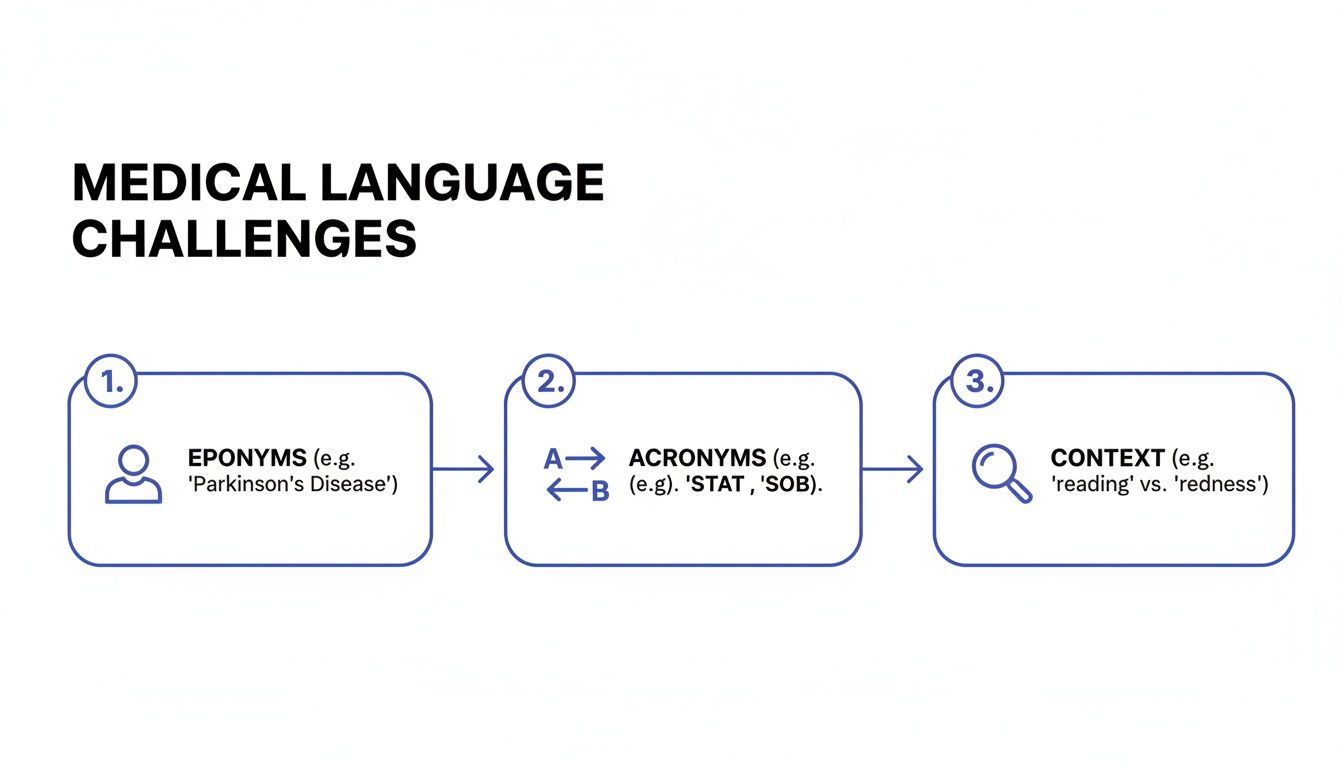
The unique quirks of medical language—from obscure eponyms to context-heavy acronyms—are precisely what a robust QA system is designed to handle, ensuring every word is clear and consistent.
Starting with Terminology Management
The bedrock of any high-quality medical translation project is terminology management. Essentially, you're creating a custom dictionary, or "termbase," specifically for your project. This centralized glossary defines critical concepts and locks in their approved translations.
For example, a term like "adverse event" has to mean the exact same thing on page one as it does on page five thousand of a clinical trial report. A termbase makes that happen, preventing dangerous little variations from creeping in. It’s an indispensable single source of truth for any large-scale project.
This is powered by some pretty sophisticated software. The market for medical terminology software is expected to climb from USD 1.25 billion in 2025 to USD 2.08 billion by 2030. Healthcare providers, making up 63.39% of this market, lean on it to standardize everything from patient instructions to SNOMED CT codes in electronic health records (EHRs). You can dig into more of the industry trends in the full market report from Mordor Intelligence.
The Synergy of AI and Human Experts
The next layer in a modern QA setup is where technology and human expertise really shine together. It’s a process known as Machine Translation Post-Editing (MTPE), and it creates a workflow that’s both incredibly fast and incredibly accurate. It’s a perfect case of letting the machine do the heavy lifting, with a human specialist providing that final, critical touch.
Here’s how the MTPE workflow usually breaks down:
- Initial AI Translation: A medically-trained AI model gets the first crack at the document, producing a rapid first draft. Because it's trained on medical language, this initial pass is miles ahead of what you'd get from a generic translation tool.
- Human Post-Editing: A human translator with deep subject-matter expertise then goes through the AI's work with a fine-toothed comb. They fix any errors, adjust for nuance, and make sure the tone is right for the audience, whether that’s a doctor or a patient.
- Final Quality Check: To be extra sure, a second linguist often does a final proofread to catch anything that might have been missed, ensuring the document is polished and ready.
This hybrid approach gives you the speed of automation without ever sacrificing the precision that medical content absolutely demands.
In the MTPE model, the AI is a highly efficient assistant, not a replacement. The human expert is always the ultimate authority, the one responsible for making sure the final translation meets the highest standards of clinical accuracy and clarity.
Demystifying Crucial Validation Steps
The final, and arguably most critical, layer of the QA framework is all about validation. This is where you confirm, beyond a shadow of a doubt, that the translation is accurate. One of the most powerful validation methods out there is back-translation.
The process is simple but effective. An entirely new, independent linguist—who has never seen the original document—translates the finished text back into the source language. The project manager then sits down and compares this back-translation with the original.
Any differences between the two versions immediately flag potential ambiguities or outright errors in the first translation. For instance, if "mild discomfort" was translated and then came back as "minor pain," that’s a signal to go back and make sure the intended level of severity is captured perfectly. It's a meticulous process, but it provides an objective check on meaning that is second to none.
Putting Translation Workflows into Practice
It’s one thing to talk about quality frameworks in theory, but it’s another thing entirely to see them in action. When you’re dealing with real medical documents, abstract concepts become concrete, step-by-step processes. Let’s walk through how these workflows unfold in three very different, yet common, medical translation projects.
Each scenario shows how the right blend of technology and human expertise delivers both accuracy and efficiency. Whether it's a high-stakes clinical trial or a simple patient handout, the core principles are the same, but the execution is carefully adapted to the document's specific risks and audience.
Case Study 1: The Clinical Trial Protocol
Think of a clinical trial protocol as the master blueprint for a research study. When that trial goes global, this document needs to be translated flawlessly so that every site—from Madrid to Mumbai—is operating from the exact same playbook. Even a tiny inconsistency could jeopardize the entire study, costing millions and delaying life-saving treatments.
The workflow for a document this critical is understandably rigorous:
- Prep and Terminology Lock-Down: The project kicks off by preparing the source files and building a detailed termbase. This isn't just a glossary; it's a set of rules that locks in the approved translations for non-negotiable concepts like "primary endpoint," "adverse event," and specific drug names. Consistency is everything.
- AI-Powered First Pass: A specialized machine translation engine, one that's been trained on millions of words of medical and scientific text, creates the first draft. This gets the bulk of the content translated quickly and, just as importantly, keeps the document's complex formatting intact for regulatory submissions.
- Expert Human Review: Next, a medical translator who lives and breathes clinical research meticulously refines the AI-generated text. Then, a second, independent medical expert performs another full review to catch any subtle errors or ambiguities the first reviewer might have missed.
- The Back-Translation Sanity Check: For the ultimate quality guarantee, a third linguist—who hasn't seen the original document—translates the protocol back into the source language. This final reconciliation process confirms that no meaning or nuance was lost along the way.
A rock-solid protocol translation is the foundation of any successful global clinical trial. It ensures the data gathered from around the world is consistent and reliable, which is non-negotiable for getting regulatory approval.
Case Study 2: The Patient Information Leaflet
A patient information leaflet (PIL) for a new drug presents a completely different kind of challenge. Yes, the information must be 100% accurate, but the real goal here is clarity and cultural connection for a non-medical audience. The aim is to empower patients with information they can actually understand and use, not overwhelm them with jargon.
The localization process for a PIL goes far beyond simple word-for-word translation:
- Simplifying the Source: Before any translation begins, the original English text might be reworked to strip out jargon and simplify complicated sentences. A simpler source document is much easier to adapt for a global audience.
- Cultural Adaptation: The translation team does more than translate words; they adapt concepts. This could mean changing units of measurement (pounds to kilograms), swapping out cultural references that won't land, or adjusting the tone to build trust with local patients.
- Readability Testing: In many regions, the translated leaflet is tested with focus groups of actual patients. This crucial, user-focused step confirms that the instructions are easy to follow, which is vital for patient safety and ensuring they take their medication correctly.
This process highlights how the translation of medical terms for patients is as much about effective communication as it is about technical precision. You can see how experts tackle these unique projects by learning more about professional medical document translation.
Case Study 3: The Medical Device Manual
Finally, let's look at the manual for a sophisticated surgical device. The audience is highly technical—surgeons, nurses, and biomedical engineers—and there is absolutely zero room for error. The translation must be precise, unambiguous, and perfectly in sync with the device's software and physical controls.
The workflow for a medical device manual is all about technical fidelity:
- Glossary and UI Alignment: A termbase is essential, but this one is laser-focused on technical specs, operational commands, and the exact terminology used in the device's user interface (UI).
- Flawless Formatting Preservation: Manuals are filled with intricate diagrams, tables, and warnings. Using technology that preserves the original layout is critical to keeping visuals and text perfectly aligned. A misplaced arrow or caption could have serious consequences.
- In-Context Validation: The translated manual is often reviewed right alongside the physical device or its software. This final check ensures that an instruction like "Press the red button" corresponds to the button labeled with the translated text, preventing catastrophic user error in a real-world surgical setting.
Navigating HIPAA Compliance and Data Security
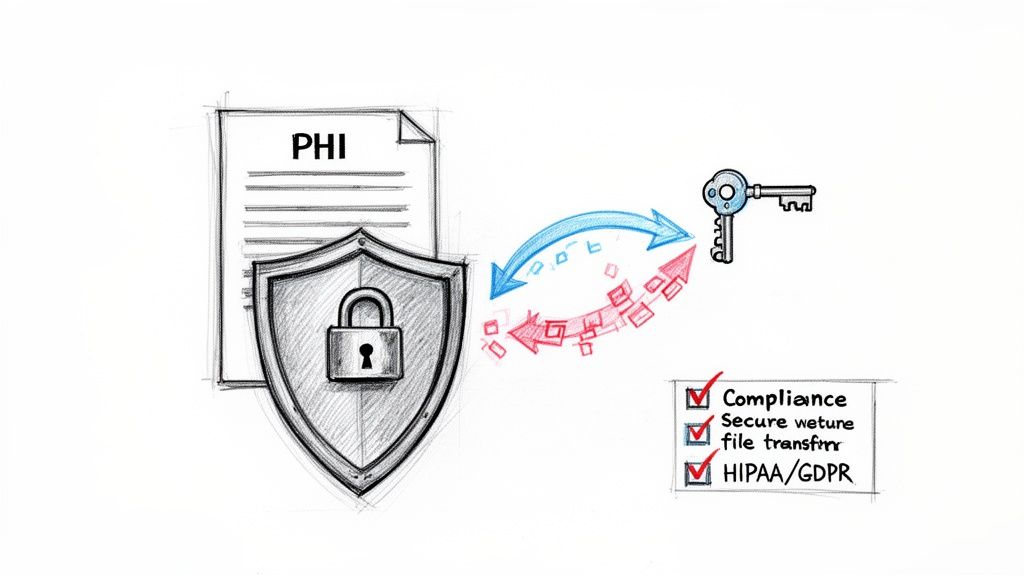
When you're translating a patient's medical history or the results of a clinical trial, you’re not just moving words from one language to another. You're handling some of the most private information a person has. That's why rock-solid data security and strict regulatory compliance aren't just best practices in the translation of medical terms—they are non-negotiable.
Think of regulations like HIPAA in the United States or GDPR in Europe. They act as the digital guardians of a patient's records, setting firm rules for how Protected Health Information (PHI) can be touched, stored, and shared. Break those rules, and the penalties are severe. This means any translation partner you work with, or any software you use, has to be completely compliant. No exceptions.
The Core Principles of Secure Translation
Protecting this kind of data during the translation process is an absolute must. One slip-up can lead to devastating fines, legal battles, and a total erosion of patient trust. This commitment to security needs to be woven into every single step, from the moment you upload a file to the second you deliver the finished translation.
There are three security fundamentals that are absolutely essential:
- End-to-End Encryption: Every document must be encrypted while it's being uploaded or downloaded (in transit) and while it's sitting on a server (at rest). Encryption essentially scrambles the data, turning it into unreadable code for anyone without the right key.
- Strict Access Controls: The only people who should ever see a sensitive document are those who absolutely need to for the project. This is known as the principle of least privilege, and it dramatically shrinks the risk of a data breach.
- Secure Data Deletion: Once a project is wrapped up, any files containing PHI need to be permanently wiped from the system based on a clear data retention policy. This prevents old, forgotten data from becoming a ticking time bomb.
Security in medical translation isn't an add-on feature; it is the foundation upon which trust is built. A compliant workflow ensures that the focus remains on linguistic accuracy, confident that patient privacy is rigorously protected from start to finish.
This is more important than ever as the industry grows. The global medical translation market is expected to hit USD 6.42 billion by 2028, expanding at a 6.5% CAGR. This boom means more sensitive data is crossing borders every day, making secure protocols absolutely critical.
Choosing Compliant Partners and Platforms
When you're vetting a translation service or a new piece of software, you have to dig into its security credentials. Don't just take their marketing claims at face value; ask for clear documentation of their security measures. This guide on HIPAA compliant data transfer is a great resource for understanding what to look for.
A platform you can trust will be open and transparent about how it protects your data. A clear, easy-to-understand privacy policy is a great starting point. As an example of what this looks like in practice, you can see how we handle data by reading our own policy at https://docuglot.com/privacy. At the end of the day, making sure your partners are compliant doesn't just protect the patient—it protects your entire organization.
Choosing the Right Tools for Your Translation Needs
When it comes to translating medical terms, you're faced with a spectrum of choices, from powerful AI platforms to highly specialized human linguists. The key isn't to find the single "best" tool, but rather the best fit for your specific project. Making the right choice hinges on a clear-eyed assessment of your document's purpose, risk, and audience.
Think of it as a balancing act. You need to weigh factors like the document type, the potential fallout from an error, your budget, and how fast you need the final translation. An internal research paper, for example, has entirely different stakes than a patient-facing informed consent form.
When AI-Powered Platforms Are the Perfect Fit
AI translation has become an incredibly powerful asset for certain kinds of medical documents. These tools truly shine when speed, cost-effectiveness, and preserving the original formatting are your top priorities. They excel at handling high-volume, low-risk content where the main goal is to quickly grasp the core information.
Consider using an AI-powered solution for tasks like:
- Translating Internal Research: Quickly converting academic papers or internal studies for review by your multilingual teams.
- Initial Document Screening: Getting a fast, accurate gist of foreign-language medical records or literature to see if they're relevant.
- Handling Large Datasets: Processing thousands of pages of non-critical data for analysis where consistency is crucial.
For these jobs, a purpose-built platform can be a game-changer. You can find detailed comparisons and insights by exploring guides on modern document translation software. These tools are often brilliant at keeping the original layout of complex documents, which is a massive time-saver for technical materials.
AI translation is like a highly skilled research assistant. It can process vast amounts of information with incredible speed and accuracy, but it lacks the nuanced judgment of a seasoned medical professional for patient-critical decisions.
When Human Expertise Is Non-Negotiable
While AI is a powerful ally, some documents carry a level of risk that absolutely requires the nuanced touch and contextual understanding of a human expert. For any content that directly impacts patient safety, regulatory approval, or legal liability, a full-service human translation team is indispensable.
Human-led translation is essential for:
- Patient-Facing Content: This includes informed consent forms, patient information leaflets, and discharge instructions, where clarity and cultural sensitivity can directly affect health outcomes.
- Clinical Trial Documentation: Protocols, investigator brochures, and regulatory submissions must be flawless to ensure trial integrity and gain approval from health authorities.
- High-Stakes Legal and Regulatory Documents: Any material that carries legal weight requires the validation and accountability that only a human professional can provide.
This approach involves a rigorous, multi-step process including translation, editing, and proofreading by medical specialists. It's more time-intensive and costs more, but for high-risk documents, it's the only way to guarantee the required level of precision.
AI Translation vs Human Expertise A Decision Guide
To help you decide, here’s a quick comparison of when each approach makes the most sense. This table breaks down the key factors to consider, guiding you toward the right solution based on your document's specific needs and criticality.
| Factor | Best for AI-Powered Tools (e.g., DocuGlot) | Best for Human-Only Services |
|---|---|---|
| Document Type | Internal research, non-critical data, preliminary reviews, training materials. | Patient consent forms, regulatory submissions (IND, NDA), clinical trial protocols, legal contracts. |
| Risk Level | Low to moderate. The impact of a minor error is minimal and can be easily corrected. | High. Any error could lead to patient harm, legal liability, or regulatory rejection. |
| Primary Goal | Speed, cost savings, high-volume processing, and preserving original document format. | Uncompromising accuracy, cultural nuance, regulatory compliance, and legal defensibility. |
| Turnaround Time | Urgent. When you need a "good enough" translation in minutes or hours. | Flexible. When precision is more important than speed; typically takes days or weeks. |
| Budget | Limited. When you need to translate large volumes of content cost-effectively. | Sufficient. When the budget allows for premium, multi-step quality assurance processes. |
Ultimately, a smart strategy often involves both. You can use AI for efficiency on lower-risk documents and lean on human experts for critical validation and high-stakes content. This balanced approach empowers you to make informed and safe choices for every medical translation project you tackle.
Common Questions About Medical Translation
It’s completely normal to have questions when you're dealing with something as important as medical translation. Let's walk through some of the most frequent ones to clear things up and help you make the right choices for your projects.
What Should I Look for in a Medical Translator?
A top-notch medical translator is really a hybrid professional—part linguist, part subject-matter expert. You're not just looking for someone who can speak two languages; you need someone who understands the world the document comes from.
They should absolutely be a native speaker of the target language and have complete professional command of the source language. But the real difference-maker is their background.
Look for credentials like:
- A degree in a life science or direct experience working in a clinical setting.
- A proven track record translating for the healthcare or pharmaceutical industry—ask for examples.
- Professional certifications, like those from the American Translators Association (ATA), which are a good sign of their commitment and skill.
Can I Just Use a Standard AI Translator?
I'd strongly advise against it. While general AI translation tools are great for everyday tasks, they just aren't built for the high-stakes world of medicine. They haven’t been trained on the specific, nuanced language of clinical trials or patient records.
This means they can easily miss subtle but critical distinctions, leading to errors that could have serious consequences.
Standard AI tools simply can't promise the HIPAA compliance needed for handling sensitive patient data. And they almost always miss the precise meaning required in a medical context. While specialized AI is a better starting point, a human medical expert should always review any high-risk document.
What Exactly Is a Terminology Glossary or Termbase?
Think of a termbase as your project's custom dictionary. It’s a central, curated list of key terms—like drug names, specific medical devices, or clinical trial jargon—along with their approved translations. We build this before the main translation work even starts.
This simple tool is a powerhouse for quality control in the translation of medical terms. It guarantees that everyone on the team uses the exact same wording for critical concepts across every single document, project after project. It’s all about creating consistency and eliminating any room for error.
How Do You Actually Check if a Medical Translation Is Accurate?
Verifying accuracy isn't a one-and-done check. It’s a multi-layered quality assurance (QA) process designed to catch even the smallest error before it can cause a problem.
A standard verification workflow usually looks like this:
- Translation: The initial translation is done by a qualified medical translator.
- Editing: A second, independent translator reviews the translation, comparing it line-by-line against the original document.
- Proofreading: A third expert does a final polish, hunting for any lingering grammatical mistakes or stylistic issues.
For the most sensitive documents, we often add another layer: back-translation. Here, a completely new translator, who has never seen the original text, translates the document back into the source language. By comparing this new version to the original, we can immediately spot any subtle shifts in meaning that might have crept in.
Ready to handle your medical and technical documents with speed and precision? DocuGlot offers an AI-powered solution that translates your files while keeping every table, header, and style perfectly intact. Secure, fast, and supporting over 100 languages, it’s the smart choice for your translation needs. Try it today at DocuGlot.com.
Tags
Ready to translate your documents?
DocuGlot uses advanced AI to translate your documents while preserving formatting perfectly.
Start Translating