How to Create a Perfect Translation Document
So, what exactly is a translation document?
Simply put, it’s the finished product you get when you convert a file from one language to another. But here's the crucial part: a good translation document preserves everything—not just the words, but the original layout, formatting, and overall intent. It's less of a conversion and more of a mirror image, rebuilt to connect with a completely new audience.
Why a Perfect Translation Document Is Your Global Key
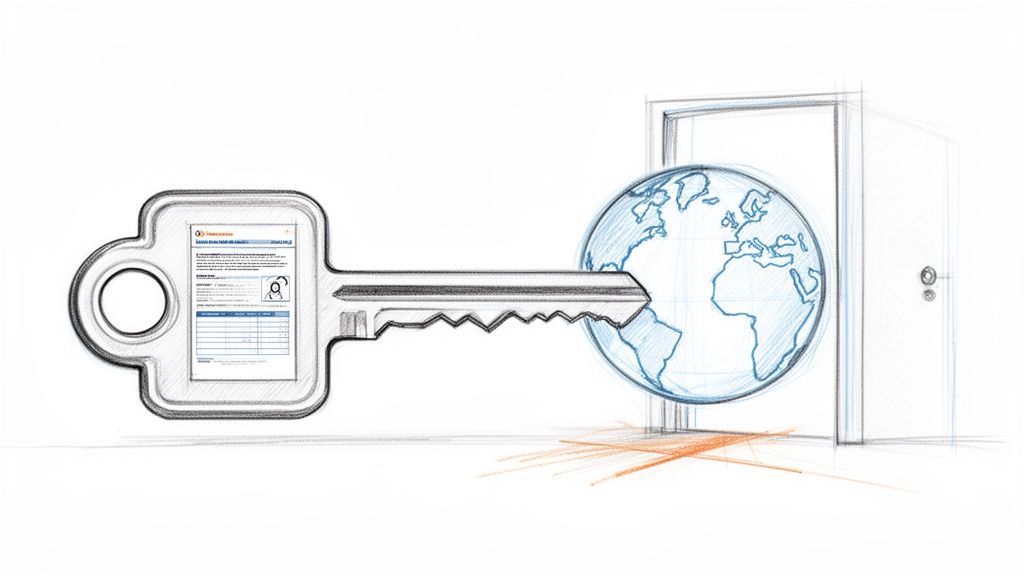
Imagine your original document is a locked door. On the other side of that door is a new market full of potential customers, a new partner for an academic collaboration, or a new understanding required for a legal agreement. A truly well-executed translation document isn't just a file with swapped-out text; it’s the key that unlocks that door, opening up a world of global opportunities.
The biggest challenge in translation today has moved beyond just getting the words right. The real test is keeping the entire document's integrity intact, from its visual design to its subtle nuances. This becomes especially tricky with complex files like PDFs and Word documents, which are packed with rich formatting.
To give you a clearer picture, let's break down the common hurdles.
Key Challenges in Document Translation
Here’s a quick overview of the primary obstacles you’ll likely face. Understanding these challenges is the first step toward overcoming them.
| Challenge Area | Description of Problem | Primary Impact |
|---|---|---|
| Format Preservation | Maintaining the original layout, including headers, footers, tables, and columns, after the text is translated. | The translated document can look broken, unprofessional, and be difficult to read, undermining its credibility. |
| File Type Compatibility | Not all tools can handle complex file types like scanned PDFs, InDesign files, or technical diagrams without corrupting them. | Delays, added costs for manual reformatting, and potential loss of critical information. |
| Visual Elements | Ensuring images with embedded text are translated and that charts and graphs remain accurate and legible. | The message becomes confusing or misleading if visuals don't align with the new text. |
| Language Nuances | Dealing with languages that expand or contract in length (e.g., German is often longer than English), which can break a fixed layout. | Text can overflow, get cut off, or create awkward white space, ruining the design. |
These issues highlight why a simple copy-paste approach just doesn't work for professional documents.
Preserving More Than Just Words
A successful translation has to protect the entire ecosystem of your document. Think about all the small but critical components that give your content its professional feel and make it easy to understand:
- Headers and Footers: In reports or manuals, these are essential for branding, page numbers, and keeping track of versions.
- Tables and Charts: These aren't just decorations; they convey complex data visually. They must stay intact and easy to read.
- Font Styles and Formatting: We use bold text, italics, and different fonts for a reason—to add emphasis and guide the reader. Losing them weakens the message.
- Images and Captions: The link between an image and its description is vital for context. It has to be preserved.
When these elements get jumbled or lost in translation, the final document ends up being a mess. The reader gets something that feels unprofessional, disjointed, and confusing, which completely erodes trust in your brand or your work.
The Modern Approach to Translation
Not too long ago, translating a visually complex document was an absolute nightmare. The process was painful: you'd have to extract the text, send it off to a translator, get the translated text back, and then spend hours painstakingly re-inserting it into the original design, fighting to fix layouts that kept breaking.
A translation document is the vessel for your message. If the vessel is broken—with jumbled layouts or missing tables—the message itself becomes compromised, regardless of how accurate the words are.
Thankfully, advanced AI-powered tools have completely changed this workflow. Modern translation platforms are engineered to see a document’s structure, not just its text. They intelligently deconstruct the file, translate the text segments, and then perfectly reconstruct the document in the new language, formatting and all.
This ability to preserve the original format is a true game-changer. It means legal contracts keep their precise clause structure, marketing brochures retain their visual pop, and academic papers hold onto their carefully placed citations and figures. For anyone needing to create a professional translation document quickly and without breaking the bank, mastering this modern process is no longer a nice-to-have—it's essential for clear and effective global communication.
Navigating the Labyrinth of Different File Formats
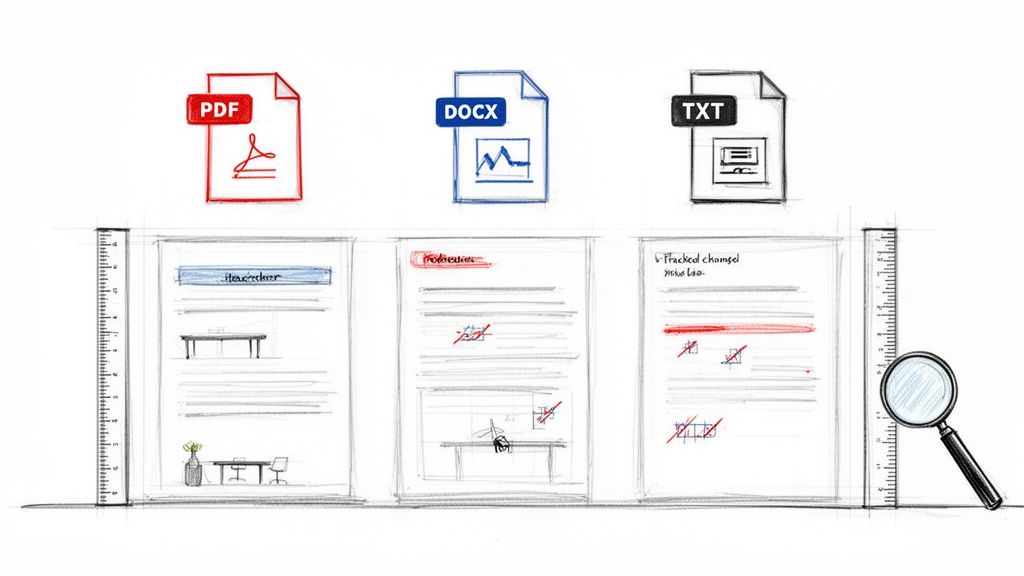
When you set out to create a translation document, you’re dealing with a lot more than just the words on the page. Think of your original file like a blueprint for a house. The text is just the labels—"kitchen," "living room," "master bedroom." The formatting, on the other hand, is everything else: the walls, windows, and doors that give the whole thing shape and purpose.
If you just swap out the text without paying attention to the layout, it's like scattering those room labels on a blank sheet of paper. You might have the right words, but the blueprint is gone, and the result is completely useless. Every file format comes with its own structural quirks, turning what seems like a simple task into a surprisingly complex puzzle.
The Challenge of Locked Layouts in PDFs
PDFs are everywhere for a reason: they look the same no matter where you open them. That consistency is their biggest strength, but it's also a massive headache for translation. A PDF is essentially a snapshot of a document, freezing text, images, and tables into a fixed layout.
This locked-in structure makes it incredibly difficult to pull the text out for translation without shattering the visual design. Old-school translation methods often leave you with a mess—text overflowing its boxes, images pushed off the page, and tables that are completely mangled. For something like a polished marketing brochure or an illustrated manual, that's a dealbreaker.
The heart of the problem is that PDFs are built for viewing, not editing. A successful PDF translation needs a tool that can meticulously deconstruct the fixed layout, translate the text, and then perfectly reassemble the whole thing, piece by piece.
This is precisely why you need specialized tools. To dig deeper into this specific challenge, check out our guide on how to translate a PDF while keeping its layout perfectly intact.
Handling Dynamic Content in DOCX Files
At first glance, Microsoft Word (DOCX) files seem much easier. They’re built for editing, after all. But their dynamic nature brings its own set of problems. A DOCX file is more than just text; it’s a complex web of hidden formatting commands.
These files are full of elements that can easily break during the translation process:
- Headers and Footers: These often contain critical info like page numbers, document titles, or version numbers that absolutely must be preserved.
- Tracked Changes and Comments: For collaborative documents, these features provide essential context. A clumsy translation process can wipe them out or misalign them completely.
- Tables and Columns: Text length changes dramatically between languages. German, for instance, is often 30% longer than English. This expansion can easily wreck tables and make columns unreadable.
For a legal contract or a detailed technical report, keeping these structural elements intact isn't just a nice-to-have; it's non-negotiable. A broken table or a missing header can undermine the entire document's credibility.
The Hidden Structure of "Simple" TXT Files
Even a plain text (TXT) file, the simplest format of all, has its own hidden rules. It might not have fancy fonts or embedded images, but its structure is often defined by invisible characters like line breaks, tabs, and precise spacing. This is especially true for files used in software development or data processing.
For example, a TXT file might hold lines of code, configuration settings, or video subtitles where every single space and line break is crucial. If you translate the text but ignore that underlying structure, the software will crash or the data will be corrupted. A quality translation document workflow respects this hidden framework, ensuring the final file works exactly as it should.
2. Choosing Between AI and Human Translation for Documents
The old debate of AI versus human translation often boils down to a simple trade-off: speed versus quality. But that’s a bit too simplistic. The truth is, the best way to handle your translation document really depends on the job itself. It's less about which one is "better" and more about which tool is right for your specific needs, budget, and what's at stake.
Think of it like building furniture. A power drill (our AI) is the perfect tool for putting together a simple bookshelf—it's fast, efficient, and gets the job done. But if you’re crafting a piece of fine, custom cabinetry, you’d never dream of using just a power drill. You need the touch, skill, and precision of a master carpenter (a human translator).
The trick is knowing when to reach for the power tool and when to call in the expert. In fact, some of the smartest strategies use both—letting AI do the heavy lifting before a human expert adds that crucial, final polish.
When AI Translation Is the Smart Choice
Artificial intelligence is an amazing ally when your top priorities are speed, volume, and cost. AI-powered platforms are at their best in situations where you need to quickly get the gist of a document or process a huge amount of text without blowing your budget.
Here are a few scenarios where an AI-first approach makes perfect sense:
- Internal Reviews: You need to translate internal drafts, reports, or emails for team members who speak different languages. Here, clear communication is the goal, not flawless prose.
- Data Analysis: Imagine sifting through thousands of customer reviews, survey responses, or social media comments from global markets. AI can do this in a flash, helping you spot key trends.
- Non-Critical Communications: For routine emails or basic informational content, minor imperfections aren't going to cause any real problems.
- Getting a Head Start: AI can produce a fast, format-preserved first draft of a complex document, which a human expert can then take over and perfect.
In these cases, getting a workable translation in minutes instead of days is a huge win. It helps your team move faster and make decisions without getting bogged down waiting for manual work.
Where Human Expertise Is Non-Negotiable
As powerful as AI is, it just can't match the deep cultural understanding, creativity, or nuanced judgment of a professional human translator. For any content where the stakes are high, relying only on a machine is a big gamble.
A machine can translate the words in a marketing slogan, but only a human can tell you if that slogan will resonate with—or accidentally offend—a local culture. That kind of cultural intelligence is irreplaceable.
Here are the times when you absolutely need a human expert:
- Marketing and Advertising: Translating creative campaigns, taglines, and brand messaging is about more than just words. It requires adapting cultural nuances and emotional tone, a skill we call transcreation.
- Legal Contracts: Legal documents demand 100% precision. One misunderstood word can lead to massive financial or legal fallout.
- Medical Instructions: When it comes to patient records, drug information, or medical device manuals, accuracy is a matter of health and safety. There is simply no room for error.
- High-Value Content: Any document that is a direct reflection of your brand's voice, quality, and credibility to the public should always be handled by a professional.
If you're ever curious about the subtle differences between machine-generated and human-written text, a tool like an AI Text Humanizer tool can show you how to refine machine translations to sound more natural. It really highlights the gap that only a human expert can fill. For a more detailed breakdown, check out our guide comparing the specifics of AI vs. human document translation services.
AI vs Human Translation: A Practical Decision Guide
Choosing the right translation method can feel overwhelming. This table breaks down the key factors to help you decide which approach is the best fit for your specific document translation project.
| Factor | AI Translation (e.g., DocuGlot) | Traditional Human Translation |
|---|---|---|
| Speed | Nearly instant. Ideal for large volumes and tight deadlines. | Slower. Dependent on translator availability and document complexity. |
| Cost | Significantly lower. Priced per word or via subscription. | Higher. Priced per word, with minimum fees and project management costs. |
| Accuracy | High for literal text and common languages, but can miss nuance. | Highest. Experts ensure technical and contextual precision. |
| Cultural Nuance | Limited. Struggles with idioms, humor, and cultural references. | Excellent. Adapts content to resonate with the target audience. |
| Consistency | Perfectly consistent. Uses the same term every time. | High, but can vary slightly between different translators. |
| Best For... | Internal docs, data analysis, initial drafts, low-impact content. | Legal contracts, marketing, medical docs, high-value customer-facing content. |
Ultimately, the best choice depends on your priorities. If you need a quick, low-cost translation to understand a document's core message, AI is a fantastic tool. But when precision, cultural relevance, and your brand's reputation are on the line, nothing beats the expertise of a professional human translator.
Your 5-Step Guide to a Flawless Translation
Getting a great translation document isn't about luck; it's about having a smart, repeatable process. When you follow a clear path, you can reliably get high-quality translations that nail both the meaning and the visual layout of your original file. I've broken down the entire workflow into five simple, actionable steps.
Think of it like building IKEA furniture. If you just dump all the pieces on the floor and start winging it, you’ll end up with a wobbly mess. But if you follow the instructions step-by-step, you get a solid, professional result every time.
Step 1: Prepare Your Source Document
Before you even think about translating, you need to get your source file in order. A clean, clear original document is the foundation for a flawless translation. Start by simplifying any overly complex sentences or technical jargon that might trip up an AI model or even a human translator.
Next, give it a good proofread. Hunt down any typos or grammatical errors. Even a tiny mistake in the source text can snowball into a much bigger, more confusing error in the translated version. A few minutes of prep here can save you a massive headache later on.
Step 2: Select Your Translation Options
With your document prepped and ready, it’s time to choose the right settings for the job. Modern platforms give you a ton of control, letting you dial in the output for your specific needs. This is where you make the key decisions that really impact the quality of your final translation document.
You’ll typically need to define:
- Source and Target Languages: Be specific. Are you translating to "Spanish," or more precisely, to "Mexican Spanish" or "Argentine Spanish"? Those regional dialects can make a huge difference.
- Quality Tier: Many services offer different levels. A "Basic" tier might be fine for quick, internal docs, while a "Premium" tier is better for customer-facing or technical content that needs more nuance.
- Glossary or Terminology: Do you have brand names, product features, or industry terms that need to be translated a certain way every single time? Upload a glossary to lock in that consistency.
This flowchart shows a typical decision process for choosing between a fully automated translation and one that gets a human review.
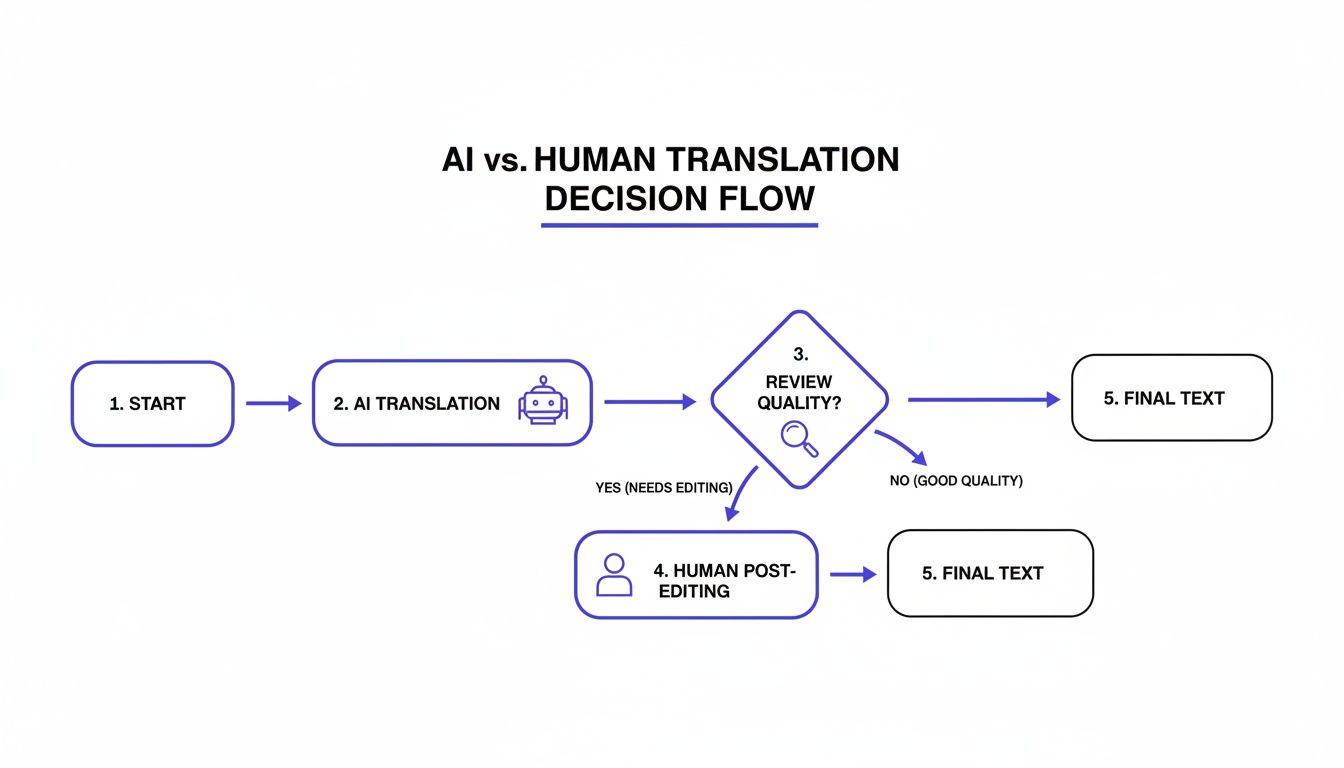
As you can see, even AI-first workflows often include a human review step. It’s all about blending the speed of machines with the critical eye of a person.
Step 3: Upload and Process the File
Once your settings are dialed in, the next part is easy: just upload your document. The magic of today’s best platforms is their ability to process the file while keeping its structure perfectly intact. The AI doesn't just see a wall of text; it sees the layout, the tables, the headers, and the images.
As the system works, it deconstructs the original file, translates the text, and then meticulously puts it all back together in the new language. This is what saves you from the soul-crushing task of manually reformatting everything later.
Step 4: Conduct a Final Quality Review
Even the smartest AI can miss subtle context. That’s why a final quality check is absolutely essential. The good news is you don't always need to be fluent in the target language to spot obvious problems.
Your review should focus on layout and common sense. Do the tables look right? Are there sentences that seem bizarrely long or cut off? Does the document look professional and flow logically?
This is your last chance to catch any weird formatting glitches or glaring translation errors. For anything important, this is where you’d loop in a native speaker for a final linguistic polish.
Step 5: Finalize and Export
After your review, all that's left is to export the finished product. The ideal output is a ready-to-use translation document in the exact same file format you started with. A PDF goes in, a translated PDF comes out. A DOCX goes in, a translated DOCX comes out.
This seamless final step means your document is ready for prime time the second it’s done, saving you a ton of time and effort.
Protecting Your Data During Document Translation
When you upload a sensitive file for translation, have you ever stopped to ask: where does my data actually go? If you’re dealing with legal contracts, private medical records, or internal company memos, data security isn’t just a nice-to-have feature—it’s everything.
Choosing a translation service without vetting its security is like sending a confidential letter in an unsealed envelope. The safety of your translation document is entirely in the hands of the provider’s infrastructure and policies. It's on you to make sure they’re up to snuff, protecting your information from prying eyes at every step.
Core Security Features to Demand
Not all translation platforms treat security with the same level of seriousness. To really protect your information, you need to look for a few non-negotiable security measures that act as a digital fortress for your data.
Here are the absolute must-haves:
- End-to-End Encryption: This is foundational. It means your document is scrambled from the moment you upload it, while it’s being processed, and until you download the translated version. Without the right key, the data is just gibberish to anyone else.
- Secure Data Handling Policies: The service should be transparent about how they manage and protect user data. Look for clear, public policies that spell out who has access and under what specific circumstances.
- Automatic File Deletion: A trustworthy service won’t hang onto your files forever. Look for a commitment to automatically and permanently delete your documents from their servers after a short period, like 24 hours. This drastically shrinks the window of risk.
Think of these not as optional upgrades, but as the bare minimum for any service you entrust with sensitive documents.
The AI Training Dilemma
Here’s a modern-day catch you need to be aware of: how AI-powered services use your data. Some free or less-than-reputable tools might quietly use the content of your uploaded documents to train their AI models. Your private information could become a permanent part of their system—a massive risk for any confidential material.
Always pick a service that explicitly guarantees it will never use your documents to train its AI without your direct consent. Your intellectual property and confidential data should remain just that: yours.
This commitment is a clear sign that a provider respects your privacy and ownership. For ironclad legal protection, it's also crucial to understand the details of their Data Protection Agreement before you start uploading.
The reliance on AI translation is booming, with the global language services market projected to hit USD 76.78 billion by 2025. This growth, fueled by machine translation in document-heavy workflows, makes secure platforms more critical than ever. At the same time, the need for skilled human translators is also on the rise, with an estimated 7,200 annual job openings in the US alone. This highlights how the future lies in a smart, secure partnership between AI tools and human expertise. You can find more on these language industry trends from Kent State University.
How to Manage Translation Costs and Timelines
Let's be honest, whenever you need a document translated, the first two questions that pop into your head are almost always: "How much is this going to cost?" and "How fast can I get it back?"
Striking the right balance between cost, speed, and quality is the name of the game. Get it right, and you get great value. Get it wrong, and you're looking at budget blowouts or missed deadlines.
The price tag on a translation isn't just a random number. It usually follows one of a few common pricing models—per-word, per-page, or even a subscription for those with constant translation needs. To get a really detailed breakdown, check out our guide to document translation costs.
Decoding Translation Pricing Models
So, what actually goes into that final price? It's more than just a simple word count. A few key factors really shape the cost.
- Language Rarity: Translating between English and Spanish is pretty standard and affordable. But if you need to go from, say, Icelandic to Japanese, you're tapping into a much smaller pool of experts, and the price will reflect that.
- Document Complexity: A straightforward, text-only Word document is one thing. A technical manual packed with industry jargon, complex tables, and diagrams is a completely different beast and will cost more to get right.
- Quality Tier: You get what you pay for. A quick AI-only pass is cheap and fast, perfect for getting the gist of something. But for important content, a premium service with a human translator and a reviewer will cost more—and deliver the accuracy you need.
The classic trade-off in document translation is speed versus quality. An AI can churn through a 50-page report in a few minutes. A human translator would need days to do the same job. The real trick is knowing when that raw speed is worth sacrificing a bit of human nuance.
How Technology Helps Keep Costs in Check
Modern tools have completely changed how we handle translation, making it far more efficient and affordable. For anyone dealing with a lot of content, a Translation Management System (TMS) is a must-have.
The TMS market hit a value of USD 2.16 billion in 2024 and is expected to soar to USD 5.47 billion by 2030. Why the boom? Companies using this kind of software have seen costs drop by as much as 90% by automating tedious tasks and cutting down on human error. You can read more about what's driving this trend in this detailed market report.
Many AI-driven platforms also give you incredible control over your budget. Instant quote calculators are a great example. You just upload your file and get an exact price on the spot—no more guesswork. This transparency lets you weigh your options and make smart decisions that fit both your budget and your timeline, ensuring every translation document is a solid investment.
Got Questions About Document Translation? We've Got Answers.
Jumping into a document translation project can feel like navigating a maze. A lot of questions pop up, especially when you're dealing with important files. Let's clear up some of the most common ones so you can move forward with confidence.
Can I Really Trust AI with My Legal or Medical Documents?
This is a big one, and the answer is nuanced. For something as critical as a legal contract or a patient's medical history, think of AI as an incredibly fast and efficient assistant, not the final decision-maker.
AI is brilliant at producing a first draft. It can get the bulk of the work done in minutes, keeping the original document's structure intact and saving a ton of time. But when accuracy isn't just important—it's essential—you absolutely need a human expert to review the output. This hybrid approach gives you the best of both worlds: the raw speed of AI and the critical eye of a professional who understands the specific terminology and legal or medical implications.
AI can get you 95% of the way there almost instantly. That final 5% from a human expert is what ensures every term is spot-on and the document is ready for official use.
How Do I Stop My PDF Formatting from Getting Wrecked?
We’ve all been there. You run a document through a generic translation tool, and it spits out a wall of plain text, destroying all your careful formatting. The tables are gone, the images are missing, and you're left with hours of painstaking work to put it all back together.
The secret is to use a service built from the ground up to preserve formatting. Don't settle for tools that just rip out the text. Look for platforms that are designed to deconstruct the entire file—text, tables, images, and all—translate the content, and then meticulously reconstruct it in the original layout. This is the only way to get a translated PDF that looks just like the original and is ready to go.
What's the Real Difference Between Translation and Localization?
This is probably one of the most important distinctions to understand, as it completely changes how your message lands with a new audience. Getting it right is crucial.
Translation is about word-for-word accuracy. It’s the process of converting text from one language to another, ensuring the literal meaning is correct. Think of it as making sure "Hello, how are you?" becomes its direct equivalent in Spanish.
Localization goes so much deeper. It’s about adapting the entire experience to feel natural and native to a specific culture. This means changing more than just the words—it involves adjusting idioms, cultural references, date formats (like DD/MM/YYYY vs. MM/DD/YYYY), and even choosing images that will resonate with a local audience. It’s the difference between being understood and truly connecting.
Ready to create a perfectly formatted translation document in minutes? At DocuGlot, we combine top-tier AI with advanced format preservation to deliver accurate, professional translations that are ready to use instantly. Give our service a try today.
Tags
Ready to translate your documents?
DocuGlot uses advanced AI to translate your documents while preserving formatting perfectly.
Start Translating