Translating Vietnamese to English: A Step-by-Step Approach
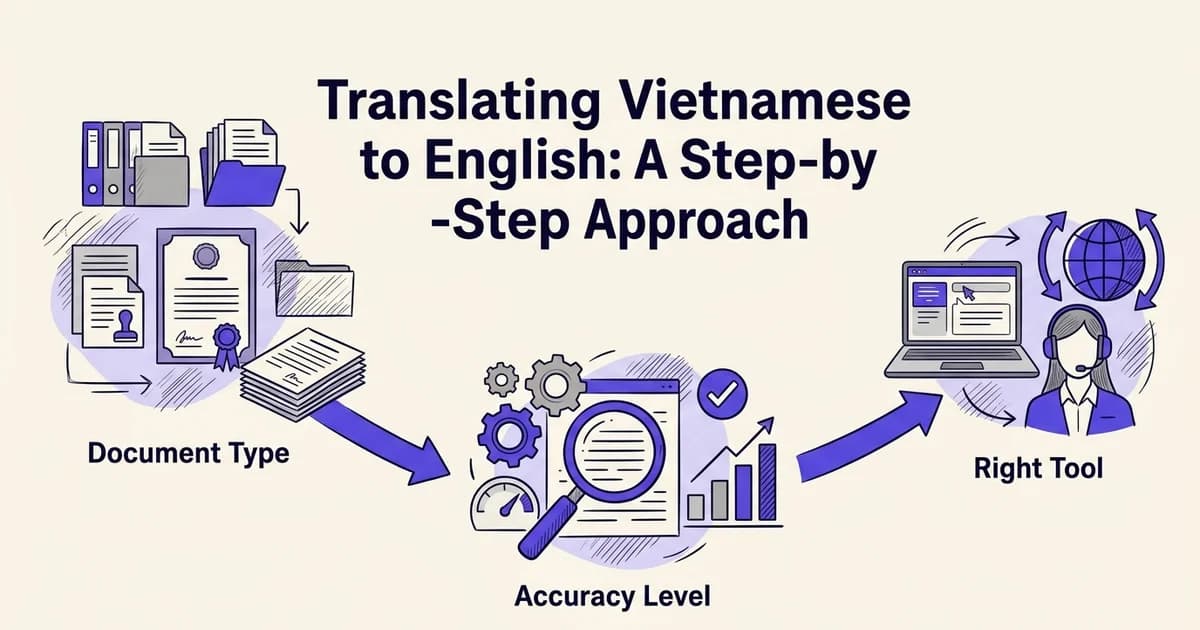
- Access to a Vietnamese document or text you want to translate
- Basic familiarity with uploading files to online platforms
- Understanding of your translation accuracy requirements (casual vs. business)
- Optional: a glossary of key terms for your specific industry or context
Introduction: why translating Vietnamese to English matters
Whether you're expanding into Southeast Asian markets, collaborating with Vietnamese partners, or localizing content for a global audience, the ability to translate Vietnamese to English accurately is a genuine business necessity. The method you choose directly shapes both the quality of your output and how well your original formatting survives the process.
At DocuGlot, our analysis shows that most translation problems aren't about language alone. They're about losing tables, headers, and layouts in the process.
The cost difference between approaches is significant. AI-powered platforms can deliver translations at a fraction of traditional costs, while professional human translation typically runs between $0.08 and $0.25 per word.
This guide walks you through every option available, from free browser tools to dedicated AI document solutions like DocuGlot Basic, helping you choose the right approach for your specific needs and budget. 🌏
What you'll need: prerequisites and preparation
Before you translate Vietnamese to English, a few minutes of preparation will save you significant time and frustration later. Knowing exactly what you have and what you need from the final result shapes every decision that follows.
Identify your document type
Check whether your source material is:
- Plain text or DOCX: the most straightforward format to work with
- PDF: either digitally created or scanned from a physical page
- Scanned image or image-based PDF: requires optical character recognition (OCR) before translation can begin
DocuGlot Basic handles PDF, DOCX, TXT, and Markdown files while preserving formatting elements like headers, tables, lists, fonts, and colors, so your translated document looks as polished as the original.
Determine your accuracy requirements
- Casual communication (personal messages, informal notes): free tools are usually sufficient
- Business-critical content (contracts, reports, marketing materials): prioritize AI platforms or professional translators for precision and consistency
Gather supporting materials
Collect any glossaries, brand terminology lists, or style guides relevant to your content. Consistent terminology matters especially in technical or legal documents.
Clean your source document
Remove unnecessary formatting clutter, fix obvious typos in the Vietnamese text, and confirm the document is complete before uploading. A clean input consistently produces a cleaner, more accurate translation output. ✅
Step 1: assess your document and choose the right translation method
Before you translate Vietnamese to English, take five minutes to evaluate what you're actually working with. The type of document, its intended use, and its file format will directly determine which tools and settings will serve you best, saving you time and rework later.
Identify your document type
Determine whether you're working with plain text, a formatted document (DOCX, PDF), or a scanned image. This classification directly impacts which tool you'll use and how much preprocessing is needed.
Check the file format and size
Note the file extension (.txt, .docx, .pdf) and approximate page count or word count. Larger documents may benefit from batch processing, while small snippets work fine with quick online tools.
Clarify your accuracy requirements
Ask yourself: Is this for internal reference, client-facing content, or legal review? Business-critical documents demand higher accuracy than casual communication, which determines whether you need AI platforms or professional human translation.
Set your timeline and budget
Establish realistic deadlines and cost constraints. Quick turnarounds and premium accuracy typically require paid solutions, while flexible timelines allow for free or low-cost tools.
Evaluate document complexity
Not all Vietnamese documents are equal. A short personal email needs a very different approach from a 50-page business contract with nested tables, headers, and footnotes.
- Simple text documents: Plain paragraphs with minimal formatting translate cleanly with almost any tool.
- Formatted documents: Reports, contracts, and manuals with tables, columns, headers, and branded fonts require a tool that actively preserves layout. Losing that structure mid-translation creates hours of manual cleanup.
- Scanned images and PDFs: These require OCR (optical character recognition, the process of extracting text from images) as a preprocessing step before translation can even begin. Research suggests OCR and layout extraction are increasingly treated as distinct stages, separate from the translation process itself.
Assess your accuracy requirements
Ask yourself honestly: what happens if a phrase is slightly off?
- Casual or personal content: A good AI translation is usually sufficient.
- Business-critical or legal content: Errors carry real consequences. You need a tool with strong AI quality and, ideally, human review afterward.
Identify your file format
Confirm your file type before choosing a tool:
| Format | Typical challenge |
|---|---|
| DOCX | Usually straightforward; formatting must be preserved |
| PDF (text-based) | Layout extraction needed |
| PDF (scanned) | OCR required first |
| TXT / Markdown | Simple; minimal formatting concerns |
Match your needs to the right tool
Once you understand your document, you can match it to a capable tool. DocuGlot Basic handles PDF, DOCX, TXT, and Markdown formats while actively preserving headers, tables, fonts, and colors throughout the translation. For most business professionals and content creators, this covers the full range of everyday Vietnamese documents without requiring separate preprocessing tools or manual reformatting afterward.
Factor in budget and timeline
Translation costs vary widely. Professional human translators offer precision but come with higher fees and longer turnaround times. AI-powered tools like DocuGlot use a pay-per-use credit model with no recurring billing or auto-renewal, which makes budgeting predictable for one-off projects. According to MixTranslate, the best AI translation tools in 2026 balance speed, accuracy, and cost in ways that make them genuinely competitive for professional use cases.
Define your deadline and budget now. It will make every subsequent step faster. ✅
Step 2: prepare your Vietnamese document for translation
Before any translation tool touches your text, a clean, well-structured source document produces significantly better results. Garbage in, garbage out applies doubly to Vietnamese, where tonal diacritics and complex formatting can confuse even the best AI models.
Clean up formatting inconsistencies
Remove extra spaces, fix line breaks, and standardize fonts. Vietnamese text with inconsistent diacritical marks or mixed encodings will confuse translation engines.
Separate content by type
If your document mixes body text, headers, and metadata, organize them logically. Translation tools perform better when similar content is grouped together.
Verify character encoding
Ensure your Vietnamese document is saved in UTF-8 encoding. Incorrect encoding can corrupt Vietnamese diacritical marks (tones) and produce garbled output.
Remove or flag untranslatable elements
Identify proper names, brand names, technical terms, or abbreviations that should remain unchanged. Mark these clearly so the translation tool doesn't alter them.
Clean up formatting and spacing
Open your document and remove stray line breaks, double spaces, and inconsistent paragraph gaps. These artifacts often appear when copying text from PDFs or web pages and can fragment sentences mid-translation. Consistent spacing helps translation engines parse complete thoughts rather than isolated fragments.
Verify Vietnamese diacritics are intact
Vietnamese relies on a layered system of diacritics to distinguish meaning. The word "ma" alone has six distinct meanings depending on its tone mark. Scan your document visually, or paste a sample into a Unicode checker, to confirm characters like ắ, ồ, and ệ are rendering correctly rather than appearing as boxes or question marks.
Separate proper nouns and brand names
Highlight names, company titles, product names, and place names that must remain untranslated. Create a simple two-column glossary in a separate document: Vietnamese term on the left, intended English equivalent or "do not translate" on the right. This glossary becomes essential in later steps for maintaining consistency, especially in longer contracts or reports. A similar approach is equally useful when you translate Chinese to English.
Check image quality for scanned documents
If your Vietnamese document is a scanned image rather than a native digital file, image quality directly determines OCR (optical character recognition) accuracy. According to Google Cloud Document AI, document parsing treats OCR, layout parsing, and re-chunking as distinct billable steps, which reflects just how separate and critical each stage is before translation even begins. Aim for a minimum scan resolution of 300 DPI and ensure the page is well-lit and straight.
Once your document is clean and verified, upload it directly to DocuGlot Basic, which accepts PDF, DOCX, TXT, and Markdown files and preserves your original formatting including headers, tables, and fonts throughout the translation process. ✅
Step 3: translate plain text using online tools or AI platforms
Start by choosing the right tool for your content type. For quick, informal translations of short Vietnamese snippets, free tools work fine. For anything business-critical, an AI platform with context awareness will produce noticeably better results.
Use Google Translate for quick checks
Copy your Vietnamese text directly into Google Translate, set the source language to Vietnamese, and select English as the target. You should see an instant translation appear on the right.
Read the output carefully. Google Translate handles common phrases well but can stumble on idiomatic expressions, formal register, or industry-specific terminology. Treat it as a first pass, not a final draft.
Use DocuGlot for context-aware AI translation
For content that needs to read naturally in English, DocuGlot Basic applies AI models trained to preserve meaning and tone across 100+ languages. According to MixTranslate (2025), AI translation platforms typically cost between $0.004 and $0.010 per word, making them a cost-effective alternative to professional human translators.
Paste or upload your plain text, select English as the output language, and DocuGlot returns a translation that maintains the original phrasing structure. 💡 For critical content, run translations through two tools and compare outputs side by side to catch any gaps.
Pro tip: If you also need to go the other direction, our guide on how to translate English to Vietnamese covers the same workflow in reverse.
Step 4: translate formatted documents while preserving layout
Plain text translation works well for simple content, but most business and professional documents arrive as formatted files. DOCX reports, contracts, and structured templates need a tool that keeps headers, tables, and lists exactly where they belong after translation.
Upload your document to a layout-aware platform
Use a tool like DocuGlot that explicitly preserves formatting. These platforms maintain headers, footers, tables, lists, fonts, and colors automatically.
Select Vietnamese as source language and English as target
Confirm language pair selection before processing. Some tools default to auto-detection, which can misidentify Vietnamese if the text is short or ambiguous.
Review the translated document structure
After translation completes, open the output file and verify that tables, bullet points, page breaks, and formatting match the original. Layout preservation is critical for professional documents.
Export in your required format
Save the translated document in the format you need (DOCX, PDF, etc.). Ensure fonts render correctly and no special characters are lost in the export process.
Upload your document to a format-preserving platform
Open DocuGlot and upload your DOCX or PDF file directly. The platform accepts PDF, DOCX, TXT, and Markdown formats, handling documents up to around 100,000 words. Once uploaded, select Vietnamese as the source language and English as the target language before proceeding.

Verify structural integrity before downloading
After the translation processes, preview the output carefully. Check that:
- Headers and footers appear in the correct positions
- Tables retain their original column and row structure
- Numbered and bulleted lists remain properly formatted
- Fonts and colors match the source document
AI document translation is increasingly shifting toward formatting-preserving workflows, particularly for DOCX and PDF files, making this verification step faster than it once was.
Download the translated file in your preferred format. DocuGlot delivers results as a DOCX file, and PDF uploads also receive an overlay translation for direct comparison. If you regularly translate similar document types, such as Arabic contracts alongside Vietnamese reports, the workflow covered in our guide on translate Arabic to English follows the same upload-and-verify approach.
Step 5: handle scanned Vietnamese PDFs with OCR
Scanned Vietnamese PDFs present a unique challenge: the file contains an image of text, not selectable text itself. Before any translation can happen, optical character recognition (OCR) must convert those images into machine-readable characters. Skipping this step produces garbled or empty translations.
Upload your scanned PDF to an OCR-enabled platform
Open DocuGlot and upload your scanned PDF as you would any standard document. DocuGlot's OCR layer automatically detects image-based pages and triggers text extraction before passing content to the translation engine. You should see a processing indicator confirming OCR is running.
Review the extracted text before translating
Once extraction completes, scan the OCR output carefully. Vietnamese diacritical marks, such as tone indicators and vowel modifiers, are particularly prone to misreading. Correct any obvious errors at this stage, since OCR mistakes compound into translation errors downstream.
For context on enterprise-scale OCR costs, according to Google Cloud Document AI, their Enterprise Document OCR Processor is priced at $1.50 per 1,000 pages, making bulk processing affordable.
Check the final translation for residual OCR errors
After translation, read through the English output for nonsensical phrases or missing words. These typically signal characters the OCR misread. A single corrupted Vietnamese word can shift an entire sentence's meaning, so this final check is worth the few extra minutes it takes. 🔍
Step 6: proofread and edit your English translation
Once your translation is complete, a careful review pass ensures the final document reads accurately and professionally. Even high-quality AI translations benefit from a human eye, particularly for business documents where tone and precision carry real weight.
Discover how DocuGlot Basic approaches translate vietnamese to english DocuGlot Basic.
Read for natural English phrasing
Read the entire translation aloud or at a careful pace. Flag any sentences that feel awkward, overly literal, or grammatically off. Vietnamese sentence structure differs significantly from English, so direct translations can occasionally produce phrasing that is technically correct but stilted in practice. Rewrite these passages for clarity and flow.
Verify proper nouns, numbers, and dates
Check that Vietnamese personal names, company names, and place names are rendered consistently throughout the document. Confirm that numbers, currencies, and dates match the original exactly. A misplaced digit or an incorrectly formatted date can create serious problems in legal or financial documents.
Compare against the original for completeness
Work through both documents side by side, paragraph by paragraph. Look for any content that was skipped or condensed during translation. In our experience at DocuGlot, omissions most often occur around bullet lists, footnotes, and parenthetical clauses, so pay extra attention to those areas.
Adjust tone for your audience
Refine the language to match your intended register. A formal contract requires different phrasing than a marketing brochure. Make targeted edits for tone, formality, and business-appropriate vocabulary before finalising the document. 📝
Common mistakes to avoid when translating Vietnamese to English
Even with a solid workflow in place, a few recurring errors can undermine the quality of your final document. Knowing what to watch for saves you time, protects your professional reputation, and ensures your translated content is accurate from the first read.
Relying solely on free tools for important documents
Free translation tools are useful for quick, informal tasks, but they frequently struggle with complex sentence structures, legal phrasing, and industry-specific terminology. According to MixTranslate, AI-powered translation platforms purpose-built for documents consistently outperform general-purpose free tools on accuracy and formatting retention. For business-critical files, use a dedicated document translation solution like DocuGlot Basic, which preserves your original formatting while delivering AI-powered accuracy.
Ignoring Vietnamese diacritics
Vietnamese is a tonal language where diacritical marks fundamentally change word meaning. For example, "ma," "má," "mà," "mả," "mã," and "mạ" are six distinct words. Always ensure your source document is clean and legible before uploading. Poorly formatted or low-resolution scans cause OCR (optical character recognition, the process of converting image text to machine-readable text) errors that corrupt diacritics and produce nonsensical output.
Mistranslating proper nouns and cultural references
Never translate proper nouns, brand names, or culturally specific Vietnamese terms without context. Personal names, place names, and idiomatic expressions often have no direct English equivalent and should be either retained or explained with a brief clarifier. When in doubt, keep the original term and add a parenthetical note for your English-speaking audience.
Skipping the proofreading step
No translation tool, however advanced, eliminates the need for a final review. Submitting unproofread translations in professional communication risks misunderstandings that are difficult to walk back. As covered in the previous step, always review for omissions, tone, and terminology before your document leaves your hands. 📋
Why this method works: formatting preservation and accuracy
The step-by-step approach outlined in this guide produces better results than ad-hoc translation because each stage serves a distinct purpose. Separating OCR, parsing, and translation into discrete steps gives you clear checkpoints for quality control, so errors are caught before they compound.

Formatting is preserved automatically
One of the biggest hidden costs in document translation is reformatting. When you translate Vietnamese to English using a dedicated platform like DocuGlot Basic, headers, tables, lists, fonts, and colors carry over intact into the delivered DOCX file. You spend zero time rebuilding the layout.
Vietnamese diacritics are handled correctly
Vietnamese uses a complex system of tone markers and diacritics that generic tools frequently misread. Dedicated translation platforms process these characters at the parsing stage, before translation begins, ensuring the source text is accurate input rather than garbled approximations.
Transparent processing keeps costs predictable
According to Google Cloud Document AI Pricing, document parsing is billed by page and separates OCR, layout parsing, and re-chunking into distinct cost components. Understanding this structure helps you choose the right tool for your document type and budget without surprises.
Proofreading closes the accuracy gap
Automated translation handles volume and speed. Human review handles context. Combining both within a clear workflow is what moves a translation from functional to professional. 📋
Alternative methods: comparing translation approaches
Not every translation task requires the same tool. Choosing the right approach depends on your document type, budget, and how much formatting accuracy matters. Here is a practical breakdown of the main options available when you need to translate Vietnamese to English.
Google Translate
Google Translate is free and handles quick text snippets well. However, it strips formatting from documents and can misread technical or business terminology. It works for casual reference but falls short for structured files like contracts or reports.
DocuGlot
DocuGlot Basic is built specifically for document translation, preserving headers, tables, fonts, and lists throughout the process. According to Mixtranslate, AI translation platforms benchmark at roughly $0.004 to $0.010 per word, making DocuGlot a cost-effective choice for business documents that need to look professional on delivery.
Professional human translators
Human translators deliver the highest contextual accuracy. Professional human translation typically costs between $0.08 and $0.25 per word, which adds up quickly for longer documents. Reserve this option for legally binding or highly sensitive content.
Happy Scribe
Happy Scribe specializes in transcription and subtitle translation, with plans starting at $17 per month. It suits audio and video content more than formatted business documents.
The hybrid approach
Combine AI translation for speed and cost efficiency with a human editor for final review. Run your document through DocuGlot first, then pass the output to a subject-matter expert for a focused proofread. This balances quality with budget. 🔄
Real-world example: translating a Vietnamese business document
Walk through this scenario to see the full process in action: a procurement manager needs to translate a 5-page Vietnamese supplier contract into English before an international legal review. Here is how it unfolds using DocuGlot.
Step 1: Upload the DOCX file
Open DocuGlot and drag your DOCX contract into the upload area. Verify that formatting options are active. You should see the document preview confirm that tables, headers, and clause numbering are intact before proceeding.
Step 2: Select your language pair
Choose Vietnamese as the source language and English as the target. DocuGlot supports 100+ languages, so both options appear immediately in the dropdown.
Step 3: Review legal terminology accuracy
Once the translation processes, scan key clauses: payment terms, liability sections, and defined terms. Flag any phrases that need a subject-matter expert to confirm.
Step 4: Download and proofread for business tone
Download the formatted English DOCX. Read for tone consistency, ensuring the language suits a formal business context rather than a literal word-for-word rendering.
Result: A professionally formatted English contract is ready for legal review in under 10 minutes. 📄 DocuGlot's Standard plan at $24.99 covers roughly 10 documents of this size, making it a cost-effective choice compared to per-page professional translation fees.
Time and cost breakdown for Vietnamese to English translation
Understanding the real cost of translation helps you choose the right method before you start. Costs vary dramatically depending on quality requirements, turnaround time, and document volume, ranging from completely free to several hundred dollars for a single document.
Free tools
Google Translate costs $0 and processes short text in 2-5 minutes. It works well for quick comprehension checks but struggles with nuanced business or legal language.
AI translation platforms
Platforms like DocuGlot typically run $0.004-$0.010 per word, with most documents completed in 5-15 minutes including format preservation. The Standard plan at $24.99 covers roughly 10 business documents, making it practical for regular use.
Professional human translation
According to MixTranslate, professional translators charge between $0.08 and $0.25 per word, with turnaround times of 1-3 days. This remains the gold standard for certified legal or medical content.
Hybrid approach
AI translation combined with human editing costs $0.02-$0.15 per word with a 1-2 day turnaround, balancing quality and affordability.
Cost comparison for a 1,000-word document
| Method | Cost estimate | Turnaround |
|---|---|---|
| Free tools | $0 | Minutes |
| AI platform | $4-$10 | Under 15 minutes |
| Hybrid | $20-$150 | 1-2 days |
| Professional | $80-$250 | 1-3 days |
For most business documents, AI translation delivers the strongest value per dollar. 💡
Conclusion: choosing your Vietnamese to English translation path
Selecting the right translation method comes down to three factors: accuracy requirements, budget, and timeline. Match your approach to the task at hand rather than defaulting to one solution for everything.
Match the method to the task
- Casual communication and quick lookups: Free tools work well enough for informal messages and personal reference
- Business documents with complex formatting: AI platforms like DocuGlot Basic preserve your headers, tables, and fonts automatically, delivering polished results in minutes
- Legal, medical, or sensitive content: Invest in a professional translator who understands the stakes
Always review before publishing
Regardless of which method you choose, proofread every translated document before sharing it. Even high-quality AI output benefits from a final human check, especially for tone, terminology, and context-specific phrasing. That one extra step protects your credibility. ✅
Frequently asked questions
How do I translate a Vietnamese document to English without losing formatting?
Use a tool that explicitly preserves document structure. DocuGlot maintains headers, footers, tables, lists, fonts, and colors automatically, so your translated file looks identical in layout to the original. Upload your file at DocuGlot Basic and receive a formatted DOCX in return.
What is the best way to translate Vietnamese to English accurately?
The best approach combines AI translation with a human review pass. For everyday documents, AI tools handle the bulk translation quickly and affordably. For legal or medical content, pair AI output with a professional reviewer.
Can I translate a scanned Vietnamese PDF into English?
Yes. Tools with built-in OCR extract text from scanned pages before translating. Note that, according to Google Cloud Document AI pricing (2026), scanning and structure extraction are distinct workflow steps billed separately from translation itself.
How do I translate Vietnamese text in Word or DOCX files?
Upload your DOCX directly to DocuGlot. The platform reads the file structure, translates the content, and returns a formatted DOCX with your original styling intact. No manual reformatting is needed.
How long does it take to translate a Vietnamese document into English?
AI-powered tools typically process most documents in under a few minutes. Turnaround depends on file size and complexity. Professional human translation usually takes several days, especially for technical or certified documents.
Is Google Translate good enough for Vietnamese to English documents?
Google Translate works for quick, informal comprehension. For business, legal, or published documents, it often mishandles tone, terminology, and formatting. A dedicated document translation platform delivers more reliable, polished results.
How do I translate Vietnamese names and proper nouns into English?
Most AI tools transliterate Vietnamese names phonetically. Always review proper nouns, place names, and titles manually after translation, since automated tools occasionally standardize or alter them incorrectly.
How can I proofread a Vietnamese to English translation for business use?
Read the output aloud to catch unnatural phr
Tags
Ready to translate your documents?
DocuGlot uses advanced AI to translate your documents while preserving formatting perfectly.
Start Translating