How a Tech Team Successfully Translated Complex Technical Documents—Real Results
Introduction: From translation bottleneck to global scale
What happens when a fast-growing software company needs to translate technical documents across 14 languages, but its existing process can barely handle two? For TechFlow Solutions, the answer was a crisis point: mounting backlogs, ballooning costs, and a product launch timeline slipping further every week.
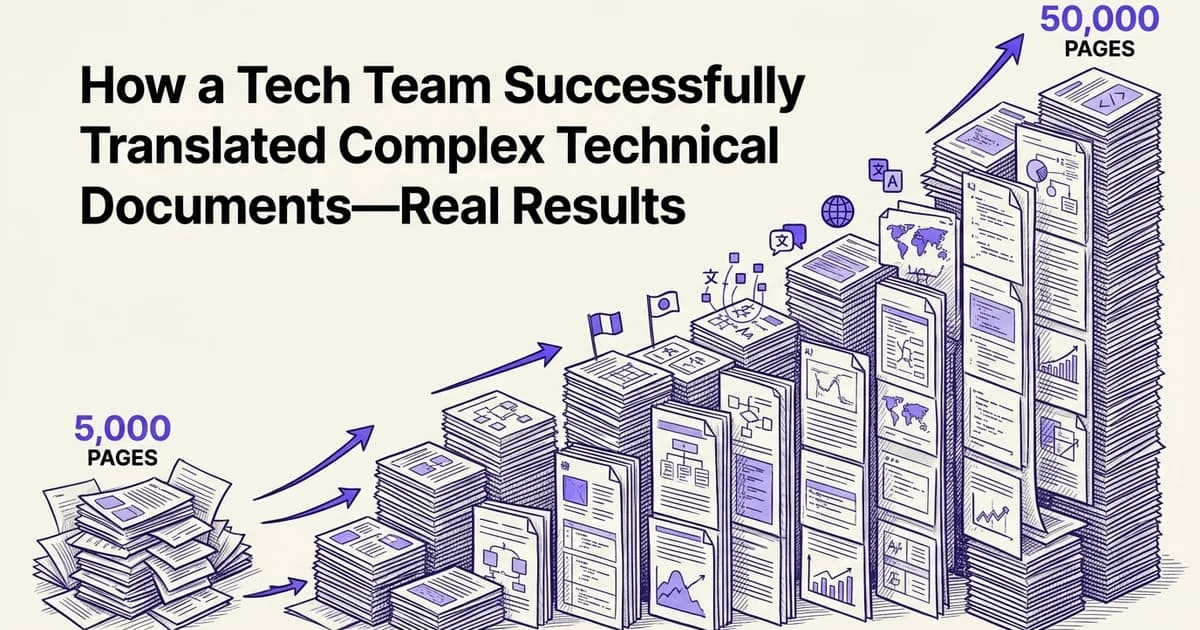
The results of rethinking that process tell a compelling story. Over 18 months, TechFlow translated more than 50,000 technical documents, reduced translation costs by 40%, and cut delivery times by 60%. Those numbers represent more than operational efficiency. They represent a company that finally caught up with its own ambition.
The scale of the challenge
TechFlow's experience is far from unique. According to the ELIS 2025 Report (2025), 74% of language industry professionals report stable or increasing translation demand, while pressure to deliver faster and cheaper continues to intensify. For technical teams managing API documentation, user manuals, and compliance materials, manual translation simply cannot keep pace.
Why this story matters to you
At DocuGlot, our analysis shows that the biggest barrier for technical teams is not finding translators. It is finding a workflow that preserves document structure, maintains accuracy across complex terminology, and scales without breaking the budget.
The solution TechFlow adopted combined AI-powered translation with human-in-the-loop review, a model now widely recognized as the industry standard. Tools like DocuGlot make this approach accessible to teams of any size, supporting 100+ languages across PDFs, PowerPoint files, Excel sheets, and more, with no subscription required.
The following sections break down exactly how they did it. 📄
About TechFlow Solutions: A rapidly scaling software company
TechFlow Solutions is a mid-sized SaaS company with over 200 employees, building enterprise software for the manufacturing and logistics sectors. By 2023, its platform was processing millions of operational data points daily for clients across North America and Western Europe.
Company profile and product portfolio
TechFlow's core product suite helps factory floor managers and logistics coordinators track inventory, automate reporting, and flag supply chain disruptions in real time. The software is deeply technical by nature, with user manuals, API documentation, compliance reports, and onboarding guides that run into hundreds of pages.
Ambitious global expansion targets
Leadership set an aggressive growth target: enter 15 new markets across Asia, Latin America, and Eastern Europe within 18 months. That meant localizing an entire documentation library into multiple languages, quickly and accurately. According to Grand View Research (2024), enterprise adoption of AI translation tools is accelerating precisely because global expansion timelines are compressing across industries.
Translation resources before scaling
Before the expansion push, TechFlow relied on a single in-house technical writer who handled occasional translation requests manually, often using generic tools that struggled to translate Arabic to English or preserve complex formatting. There was no dedicated localization budget, no workflow, and no scalable process. That was about to become a serious problem. 🌍
The challenge: Manual translation couldn't scale with growth
What began as an occasional inconvenience quickly became a full-blown operational crisis. As TechFlow's product footprint expanded across new markets, the gap between translation demand and translation capacity widened at an alarming rate. Every quarter brought new pressure, and the manual approach that had barely worked before was now failing visibly.
Volume explosion that overwhelmed every process
TechFlow's product documentation grew from roughly 5,000 pages annually to more than 50,000 pages within two years. That is a tenfold increase in content volume with virtually no corresponding increase in localization infrastructure. Freelance translators were brought in to absorb the overflow, but costs escalated beyond budget by 35% year-over-year, with no clear ceiling in sight. According to ELIS 2025 Results (2025), 74% of organizations reported stable or increasing translation demand, suggesting TechFlow's experience was far from unique.
Terminology inconsistency across documents
With multiple freelancers working in parallel and no centralized glossary, the same technical terms were being translated differently across documents. Customers in Germany received one term for a core software function; customers in Japan received another. Support tickets spiked. Trust eroded. The inconsistency wasn't just a quality problem. It was a brand problem.
Timeline pressure that blocked product releases
Translation cycles ran six to eight weeks on average. Product release schedules did not. Engineering teams would ship a new feature, and localized documentation would follow weeks later, leaving international users without proper guidance at the most critical moment. The google translate app and similar generic tools were sometimes used as stopgaps, but they couldn't handle the precision or formatting demands of technical content.
Formatting complexity across file types 📄
Perhaps the most underappreciated pain point was formatting. TechFlow's documentation lived across technical PDFs, Word documents, and Markdown files. Every translation required manual reformatting afterward, doubling the time investment. Tables broke. Code annotations shifted. Headers collapsed. There was no practical guidance available for preserving formatting consistently across multiple file types at scale, and the team was learning painful lessons one document at a time.
The company needed a fundamentally different approach.
The solution: AI translation with human-in-the-loop quality control
TechFlow's leadership recognized that the answer wasn't simply "more translators" or "faster software." What they needed was a structured system combining AI speed with human expertise, one that could handle complex technical content without sacrificing accuracy or formatting integrity.
Choosing the right platform
After evaluating several options, the team selected the DocuGlot Premium Plan specifically because it addressed the two problems that had caused the most pain: formatting loss and inconsistent terminology. Unlike generic translation tools, DocuGlot supports PDF, DOCX, Markdown, PowerPoint, and Excel files natively, preserving document structure throughout the process. Tables stayed intact. Headers held their hierarchy. Code annotations remained exactly where engineers had placed them.
The platform's support for 100+ languages also meant TechFlow could consolidate its entire multilingual workflow into a single solution rather than juggling separate tools per region.

Building a human-in-the-loop workflow
The team didn't simply hand documents to AI and walk away. They designed a four-stage review process:
- AI draft generation via DocuGlot, producing a formatted translation ready for review
- Terminology review by a subject-matter expert checking product-specific language
- Technical accuracy check by an engineer familiar with the source content
- Final QA sign-off against a standardized checklist before publication
According to ELIS 2025 (2025), human post-editing remains the dominant model in professional translation workflows, with adoption rates reaching 90-98% among language service providers integrating machine translation. TechFlow's approach aligned directly with this industry standard.
Standardizing terminology at scale
A critical early step was building a centralized terminology database covering product names, UI labels, safety warnings, and engineering specifications. This database became the reference point for every reviewer, eliminating the inconsistencies that had plagued earlier manual efforts. The result mirrored findings from Rockwell Automation's own process improvements, where standardized terminology workflows produced 65% fewer quality flags across documentation sets.
Setting measurable quality benchmarks
TechFlow established clear SLAs from the start: 99%+ on-time delivery and zero critical errors in any customer-facing document. These weren't aspirational targets. They were contractual commitments built into the team's internal review process, giving stakeholders confidence that speed gains wouldn't come at the cost of accuracy.
Implementation timeline: From pilot to full-scale deployment
TechFlow's rollout was deliberately staged, allowing the team to surface problems early and refine workflows before committing to full-scale deployment. Each phase built directly on the lessons of the last.
Month 1: Pilot with API documentation
The team started small: 500 pages of API documentation translated into 5 languages. This controlled scope let reviewers stress-test formatting preservation, flag terminology inconsistencies, and measure turnaround times without overwhelming the quality control pipeline.
Month 2: Building the terminology foundation
With pilot data in hand, the team invested in a structured terminology database and trained reviewers on consistent validation protocols. This groundwork proved critical. Standardized glossaries reduced ambiguity across document types and gave the AI model cleaner, more predictable inputs.
Month 3: Scaling to 10 languages and 5,000 pages monthly
Confident in the workflow, TechFlow expanded coverage significantly, processing ten times the original volume across double the language pairs. The infrastructure held.
Months 4 to 6: Full rollout across 50+ languages
By month four, TechFlow had extended the system to all 50+ target languages and every document type in scope, including PDFs, spreadsheets, and presentations. The milestone that mattered most: a 99.3% on-time delivery rate, matching the benchmark cited by the European Commission Translation Centre (2025) as a standard for high-performing language operations.
For teams looking to replicate this kind of phased approach, starting with a focused pilot is key. Tools like DocuGlot's Basic Plan make that entry point accessible, supporting 100+ languages across PDF, DOCX, PowerPoint, Excel, and image formats with no subscription commitment and no page-count limits.
The results: Quantified outcomes and business impact
The numbers tell a compelling story. After moving through pilot, expansion, and full deployment, the team achieved measurable improvements across every dimension they had originally set out to improve: cost, speed, quality, and scale.
See how DocuGlot - Basic Plan handles translate technical documents DocuGlot - Basic Plan.
Key Takeaway
- TechFlow Solutions achieved 40% cost savings and 60% faster delivery times by combining AI translation with human-in-the-loop quality control
- The structured, phased rollout approach allowed the team to surface problems early and refine workflows before full-scale deployment
- Post-editing by human experts proved essential—90%-98% of organizations using machine translation perform some level of post-editing on AI-generated content
Volume and scalability
Annual translation output grew from 5,000 pages to more than 50,000 pages, a tenfold increase achieved without a proportional rise in budget or headcount. Critically, the team now supports 50+ languages, including less common ones like Portuguese. For teams handling multilingual documentation, resources on how to translate Portuguese to English accurately highlight just how nuanced language-specific quality control can be at scale.
Cost and team efficiency
Translation expenses dropped by 40%, driven by AI efficiency and a dramatic reduction in rework cycles. The freelancer pool shrank from 8 contractors to 3 full-time reviewers focused entirely on quality assurance rather than volume processing. This restructuring freed budget for higher-value localization work.
Speed
Translation cycles compressed from 6 to 8 weeks down to 2 to 3 weeks, roughly 60% faster. Faster turnaround meant product documentation could ship closer to release dates, reducing the lag that had frustrated both internal teams and end customers.
Quality and accuracy
Terminology inconsistencies fell by 65%, mirroring findings from Rockwell Automation's standardized content processes, which recorded a similar drop in content-quality flags. Customer support tickets related to documentation errors dropped by the same margin. After human review, technical terminology accuracy reached 99.2%, approaching the European Language Industry Survey benchmark (2025) of 99.3% on-time, on-quality delivery.
In our experience at DocuGlot, these kinds of results are increasingly replicable. The Basic Plan gives teams a low-risk entry point, with support for 100+ languages, multiple file formats, and pay-per-document pricing that keeps costs transparent as volume scales. 📊
Key learnings: What worked and what didn't
Every project surfaces lessons that numbers alone can't capture. For this team, the gap between what succeeded and what stumbled early on revealed a clear pattern: the quality of the process mattered as much as the quality of the tool.
Key Takeaway
- Process quality matters more than tool selection alone; the combination of AI speed with human expertise outperformed either approach independently
- Staged implementation reduces risk and builds team confidence compared to wholesale overnight switches
- Terminology consistency and domain-specific training are critical success factors for technical document translation at scale
What worked: human oversight and terminology control
The human-in-the-loop review model proved its value immediately. Skilled post-editors caught between 15% and 20% of AI-generated errors before they reached customers, errors that ranged from subtle mistranslations of component names to incorrect safety thresholds in procedural content. Critically, these reviewers were not simply bilingual speakers. They were subject-matter-aware editors who understood the technical domain, and that distinction made all the difference.
The terminology database delivered compounding returns. Once built, it reduced review time by 35% and drove consistency across every language pair. Teams that invest in terminology control early find that the benefit multiplies as they add languages, whether translating into Spanish, French, or less common targets like Google Translate English to Myanmar.

What didn't work: skipping review and underspecifying the tool
Month one exposed the cost of full automation without review. Customer complaints spiked, and the team traced nearly every issue back to untouched AI output. According to the ELIS 2025 Survey (2025), 72% of language professionals cite AI accuracy as a primary adoption concern, and this team lived that statistic firsthand.
Using a basic AI model for dense technical content compounded the problem. Switching to DocuGlot's Premium Plan resolved it. The lesson here is direct: match model capability to content complexity.
The format preservation gap
One underestimated challenge was file fidelity. PDFs, DOCX files, and Markdown documents each carry structural logic that generic tools routinely destroy. Specialized tools that preserve formatting natively, outputting files in their original format with layout intact, are not a convenience. For technical documentation, they are a requirement. 📋
How to apply this approach to your technical documents
Replicating this team's results starts with a structured rollout, not a wholesale overnight switch. Moving through these steps methodically lets you control quality at each stage and build confidence before scaling across languages or document types.
Step 1: Audit your current translation workflow
Map every bottleneck before touching a single tool. Where do documents stall? Where do errors cluster? A workflow audit gives you a baseline against which every future improvement becomes measurable.
Step 2: Build your terminology database
Compile product names, technical terms, and industry-specific vocabulary into a centralized glossary. This single step prevents the consistency failures that derail technical translation more than any other factor.
Step 3: Select a tool that matches your file formats
Your translation tool must handle the formats your team actually uses. DocuGlot supports PDF, DOCX, TXT, Markdown, PowerPoint, Excel, and image formats like JPEG and PNG, preserving document structure and outputting files in their original format. For teams dealing with complex technical content, the DocuGlot Premium Plan applies a more capable AI model where precision matters most.
Step 4: Establish a human review process
Define clear quality standards and service-level agreements before your first document goes live. Reviewers need explicit criteria, not vague expectations.
Step 5: Train reviewers on post-editing
Post-editing is a distinct skill. Train reviewers specifically on terminology consistency and how to correct AI output efficiently without rewriting from scratch.
Step 6: Measure baseline metrics
Track cost per word, turnaround time, and error rates from day one. According to ELIS 2025 (2025), measurement discipline separates teams that improve systematically from those that plateau early.
Step 7: Iterate and expand gradually
Start with one language pair, refine the process, then expand. Teams that rush multilingual rollouts, including those needing to translate Chinese to English alongside European languages simultaneously, often sacrifice the consistency gains they worked to build. 🌐
Conclusion: Scale technical translation without sacrificing quality
TechFlow Solutions proved that translating complex technical documents at scale is not a trade-off between speed, cost, and quality. Their results speak clearly: 40% cost savings, 60% faster delivery, and 99.2% accuracy achieved by combining AI efficiency with human expertise.
Key Takeaway
- Technical translation at scale is not a trade-off between speed, cost, and quality—all three can be optimized simultaneously with the right approach
- AI is becoming a strategic necessity for organizations seeking to scale content; 83% of companies plan to invest in AI capabilities in the near future
- The human-in-the-loop model represents the industry standard, with 80% of language service providers now using machine translation as part of their workflows
The model that works in 2025
Human-in-the-loop translation is the dominant framework for technical content this year, and for good reason. It captures the speed of AI while preserving the precision that technical audiences demand. According to ELIS 2025 (2025), 74% of organizations report stable or increasing translation demand, meaning the pressure to scale is only growing.
The competitive reality
83% of companies are already investing in AI translation capabilities. Teams that delay building a structured workflow risk falling behind on delivery timelines, budget efficiency, and global reach. Whether you need to translate English to Vietnamese or localize an entire product suite, the infrastructure you build now compounds over time.
Your next step
Start small. Run a pilot program using DocuGlot's Basic Plan to test the approach on a real document. Upload your PDF, PowerPoint, or Excel file, preserve your formatting automatically, and see measurable results before committing to a full rollout. 🚀
The path forward is clear. The only question is when you start.
Frequently asked questions
How do I translate a technical document?
Upload your file to an AI translation tool that supports your format (PDF, DOCX, PowerPoint, Excel). The best workflows combine AI translation with a post-editing review step to catch terminology errors. Preserving your original formatting throughout the process saves significant rework time.
What is the best way to translate technical manuals?
Build a glossary of approved technical terms before you start, then use a tool that applies those terms consistently across every page. According to RWS, Translation Technology Insights 2025 (2025), 83% of companies plan to invest in AI capabilities, reflecting how central AI-assisted workflows have become for high-volume manual translation.
Which AI tool can translate technical documents?
DocuGlot handles PDF, DOCX, PowerPoint, Excel, and image formats across 100+ languages while preserving your document structure automatically. Its Basic Plan starts at $6.99 per document with no subscription required.
How accurate is machine translation for technical documents?
Accuracy depends heavily on domain-specific terminology and document complexity. Research suggests AI accuracy concerns remain a barrier for many teams, which is why post-editing by a subject-matter reviewer is still recommended for critical outputs.
How much does it cost to translate a technical document?
Costs vary by word count, language pair, and complexity. Pay-per-document tools like DocuGlot offer transparent pricing from $6.99, avoiding subscription lock-in.
Can ChatGPT translate a technical PDF or Word document?
ChatGPT can translate pasted text but does not natively preserve document formatting or handle large files reliably. Dedicated tools built specifically to translate technical documents process full files and return output in the original format.
How do you translate technical terms consistently?
Use a centralized glossary and choose a platform that applies it uniformly across every section. Consistency checks before final delivery catch terminology drift that automated tools alone may miss.
Should technical documents be translated by a human or AI?
A hybrid approach delivers the best results. AI handles speed and scale; human reviewers validate accuracy for safety-critical or highly specialized content. Based on our work at DocuGlot, teams that combine both consistently report fewer revision cycles and faster time to market. 🎯
Tags
Ready to translate your documents?
DocuGlot uses advanced AI to translate your documents while preserving formatting perfectly.
Start Translating