Translating Korean to English: Expert Strategies That Work
Introduction: Why Korean-to-English translation matters and what you'll learn
Korean is no longer a niche language in global business. Fueled by the explosive reach of K-pop, Korean cinema, webtoons, and a booming tech export economy, demand for Korean-to-English translation has surged across publishing, e-commerce, legal services, and content creation. For businesses and creators, getting that translation right is not just a quality issue. It is a revenue issue.
Why translation quality shapes real outcomes
A poorly translated product listing loses customers. A mistranslated contract creates legal exposure. A clunky subtitle pulls viewers out of the story. At DocuGlot, our analysis shows that formatting loss and structural inconsistency are among the top complaints users bring after switching from generic translation tools. Quality is not abstract. It shows up directly in reader trust, conversion rates, and professional credibility.
The accuracy gap between tools is also wider than most people expect. According to Bluente, AI document translators typically deliver 60 to 85% accuracy on real-world content, compared with over 95% for professional human localization. Knowing where you sit on that spectrum helps you make smarter decisions about when to use automation and when to invest in human review.
What this guide covers
This article walks you through 10 expert strategies for translating Korean to English more accurately, efficiently, and cost-effectively. You will learn which quick wins deliver immediate improvements, how to handle Korean's unique grammatical structure, and how to choose the right tools for documents, books, and business content. Whether you are a first-time user or refining an existing workflow, each tip includes practical context and realistic expectations on accuracy, cost, and turnaround time. 🎯
Top 3 quick wins: Immediate improvements for your Korean-to-English translation
Before diving into advanced strategies, three foundational changes can dramatically improve your results right now. These tips require no specialized knowledge, cost little to implement, and address the most common failure points that frustrate translators at every skill level.
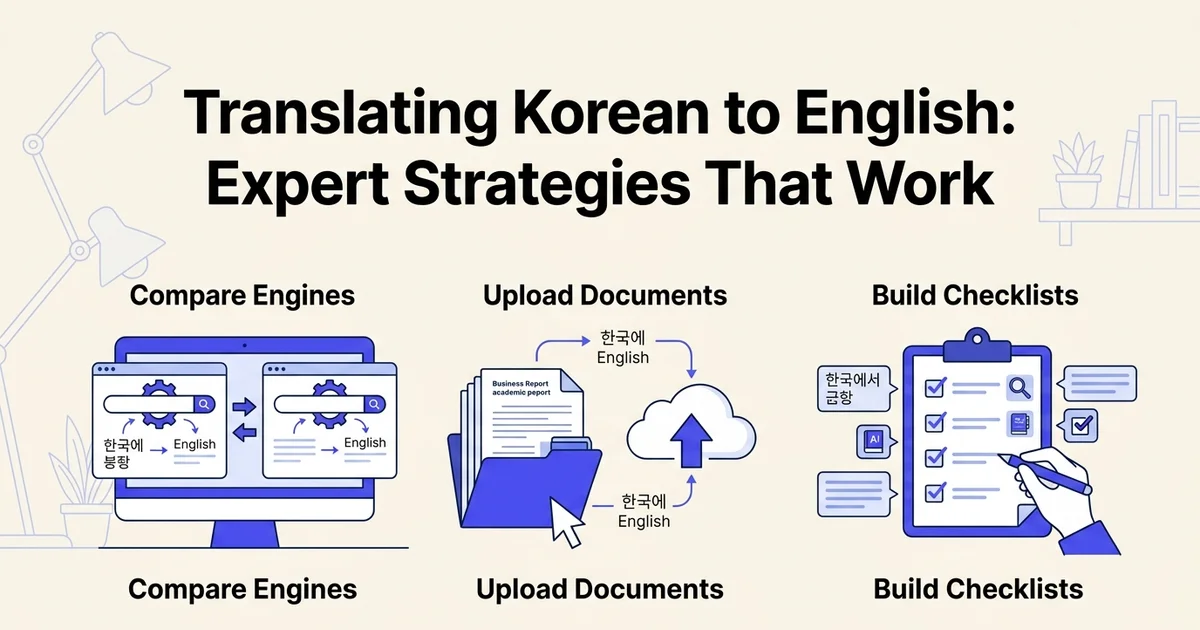
Tip 1: Compare multiple AI engines before committing to one output
No single translation engine dominates every document type. A legal contract, a product description, and a personal letter each have different vocabulary patterns, and the engine that excels at one may stumble on another. Multi-model platforms solve this by running your Korean text through several engines simultaneously and surfacing the strongest output.
According to Bluente, ensemble AI translation models can reach around 90% accuracy for Korean-to-English document translation, a meaningful jump over single-engine approaches. Spending 60 seconds comparing two or three outputs before finalizing your choice is one of the highest-return habits you can build.
Tip 2: Upload your document instead of copying and pasting text
Copying text into a basic translation box strips out every formatting signal your document contains: headers, tables, bullet lists, fonts, and column structures all disappear. The translation may be technically accurate, but reassembling the layout manually can take hours.
Uploading a DOCX, PDF, or EPUB file to a format-aware tool preserves the original structure automatically. DocuGlot Basic, for example, handles PDF, DOCX, TXT, and Markdown files while keeping headers, footers, tables, and fonts intact throughout the translation process. For anyone who regularly translates formatted business documents, this single habit eliminates the most time-consuming part of the workflow. It is the same principle that applies when you translate Portuguese to English: format integrity matters as much as linguistic accuracy.
Tip 3: Build a simple post-editing checklist for terminology consistency
Even a strong AI translation benefits from a 10-minute review pass. Korean technical and business vocabulary often has multiple valid English equivalents, and inconsistency across a single document can undermine credibility.
A minimal checklist covers three things:
- Key terms: Identify 5 to 10 domain-specific words and confirm they are rendered consistently throughout
- Honorifics and formality level: Korean encodes politeness grammatically, so verify the English register matches your audience
- Numbers and proper nouns: Dates, currency, and brand names are common error points that a quick scan catches immediately
This checklist takes minutes to create and pays dividends across every project you run. 📋
AI translation strategies: Choosing the right tool and model for your content
Not all AI translation tools perform equally, and the gap widens significantly when you move beyond short, simple sentences into complex Korean documents. Choosing the right tool for your content type is one of the highest-leverage decisions you can make before a project even begins.
Understanding the accuracy trade-off across tool tiers
Free tools like Google Translate remain useful for quick lookups and casual comprehension, but they struggle with document-level coherence, specialized vocabulary, and Korean's context-dependent grammar. Mid-tier platforms improve on this, but the most meaningful jump comes with premium multi-model systems. According to Bluente, independent accuracy tests show a clear performance gap between free tools and dedicated document translators when handling complex source material.
For anyone translating business contracts, technical manuals, or long-form content, that gap translates directly into revision time and risk.
Matching your document type to the right model
Different content categories have genuinely different requirements:
- Technical documents: Prioritize models trained on domain-specific corpora. Consistency of terminology matters more than stylistic flair.
- Business documents: Formality, tone, and precision are non-negotiable. A model that handles Korean honorifics well is essential here.
- Creative writing and books: Narrative flow and cultural nuance take priority. The TranslateBooksWithLLMs project documents how large language models can be configured specifically for long-form literary translation, preserving voice across chapters.
- Marketing and web content: Localization matters as much as translation. Idiomatic English that resonates with your target audience is the goal.
Why ensemble methods change the quality ceiling 🎯
One of the most effective strategies for high-stakes Korean-to-English translation is using ensemble methods: running the same content through multiple AI models simultaneously and selecting the strongest output per section. According to MixTranslate, leading multi-model platforms report around 90% accuracy for Korean-English document translation when ensemble approaches are applied.
This is where tools like DocuGlot deliver practical value. Rather than committing to a single model's interpretation, DocuGlot's AI-powered engine processes your uploaded PDF, DOCX, or TXT files while preserving your original formatting, including headers, tables, and fonts, so you receive a translation that is both accurate and immediately usable.
Document-level versus sentence-level translation
Sentence-level tools process text in isolation, which causes real problems in Korean, where meaning often depends on what came several sentences earlier. Document-level translation systems maintain context across paragraphs, producing more coherent output with fewer jarring shifts in register or reference. For anything longer than a single page, this distinction is not a minor technical detail. It is the difference between a translation that reads naturally and one that requires significant rewriting before it can be used. This same principle applies when you consider tools for other language pairs, such as Google Translate English to Myanmar, where context preservation is equally critical.
Hybrid workflows: Combining AI translation with professional post-editing for publication-ready quality
Once you have chosen the right AI tool for your content, the next decision is whether raw AI output is enough or whether it needs a human layer on top. For most professional and published work, the answer is a hybrid approach: AI handles the heavy lifting, and a skilled post-editor refines the result into something publication-ready.

Understanding the cost-benefit reality
The numbers make a compelling case for hybrid workflows. Human-only translation for Korean to English typically runs $0.08–$0.12 per word, meaning an 80,000-word book costs between $6,400 and $9,600. AI-only translation drops that dramatically to roughly $0.005–$0.01 per word, or $400–$800 for the same project. The hybrid middle ground, AI translation followed by professional post-editing, lands at approximately $0.03–$0.06 per word, bringing that same book to $2,400–$4,800 while delivering meaningfully better quality than raw machine output.
For business professionals and authors working at volume, this is not a marginal saving. It is a structural shift in what projects become financially viable. The same logic applies when you translate Chinese to English, where hybrid workflows are increasingly standard in publishing and localization.
Defining the scope of post-editing
Post-editing is not proofreading. A focused post-editing pass for Korean-to-English work typically covers four distinct areas:
- Terminology consistency: Korean technical, legal, or industry-specific terms often have multiple valid English equivalents. A post-editor locks in one choice and applies it throughout.
- Tone alignment: AI models sometimes shift register mid-document, moving between formal and conversational without cause. Post-editors smooth these transitions.
- Cultural adaptation: Honorifics, indirect speech patterns, and culturally specific references need human judgment to land correctly in English.
- Readability checks: Sentence structures that are grammatically correct but feel awkward in English get restructured for natural flow.
Building a repeatable post-editing checklist
Consistency across multiple documents requires a documented process, not ad hoc review. A practical checklist includes: a glossary of approved terminology, a style guide covering tone and register, a list of known AI failure patterns for Korean (such as pronoun insertion and honorific flattening), and a final read-aloud pass to catch rhythm issues.
Tools like DocuGlot support this workflow by preserving your original document formatting, including headers, tables, and font styling, so post-editors work with clean, structured output rather than spending time reconstructing layout before they can focus on language quality.
Measuring quality improvements and ROI
Switching from human-only to hybrid translation is not just a cost decision. Teams that track quality metrics typically measure error rates per 1,000 words, client revision requests, and time-to-publication. According to GitHub's TranslateBooksWithLLMs wiki, structured AI-plus-post-editing pipelines consistently outperform unreviewed machine output on fluency and consistency scores, particularly for longer documents where drift accumulates. Tracking these numbers across three to five projects gives you a reliable baseline to justify the workflow investment and refine where post-editing effort is best concentrated. 🎯
Common mistakes to avoid: Pitfalls that undermine translation quality and credibility
Even experienced translators fall into predictable traps when working with Korean-English projects. Knowing where quality breaks down before it happens saves time, money, and credibility. Here are the five most damaging mistakes and how to sidestep them.
See how DocuGlot Basic handles translate korean to english DocuGlot Basic.
Mistake 1: Translating sentence by sentence without considering the whole document
Sentence-level tools feel efficient until you read the finished document and notice that terminology shifts mid-chapter, pronouns lose their referents, and the overall tone feels inconsistent. Research suggests that document-level evaluation is essential precisely because sentence-level metrics routinely miss discourse phenomena like coherence and terminology consistency, both of which strongly affect how professional a translation feels to its final audience. For long-form content, always review the full document as a unit, not just individual passages.
Mistake 2: Ignoring formatting preservation
A beautifully translated text is useless if the layout collapses. Korean documents often use structured tables, mixed scripts, and precise spacing. Pasting content into a basic translation interface strips that structure instantly. In our experience at DocuGlot, format preservation is one of the most requested features from business users. DocuGlot Basic retains headers, footers, tables, fonts, and colors across PDF and DOCX files precisely because formatting loss is one of the most common and costly translation mistakes.
Mistake 3: Skipping cultural adaptation
Direct translation of Korean honorifics, idiomatic expressions, or industry-specific terminology into English almost always produces awkward phrasing. A product description that sounds natural in Korean can read as stiff or confusing in English without deliberate cultural adaptation. This is especially true for marketing copy, legal agreements, and published books.
Mistake 4: Using unreviewed AI output for high-stakes content
According to Bluente, AI document translators typically deliver 60 to 85% accuracy on real-world content, compared with over 95% for professional human localization. For legal, medical, or technical documents, that gap is not acceptable without a review layer.
Mistake 5: Assuming all AI tools perform equally
Korean presents specific challenges including agglutinative grammar, topic-drop constructions, and honorific registers. Not every AI tool handles these equally well. Test any platform on a representative sample of your actual document type before committing to a full project. The same logic applies if you regularly translate English to Vietnamese or work across other complex language pairs. 🔍
Tools and resources: Platforms and workflows that deliver consistent results
Choosing the right tools for Korean-to-English translation means matching platform capabilities to your actual content type, volume, and quality requirements. The difference between a free browser tool and a purpose-built document platform becomes obvious the moment you open a translated file and find your formatting in ruins.
Free tools versus premium platforms
Free tools like Google Translate and DeepL's free tier are genuinely useful for quick lookups, short paragraphs, and getting the gist of informal content. For business documents, contracts, or anything where formatting and precision matter, their limitations surface quickly. According to MixTranslate, advanced AI document translators are rated between 4.5 and 4.9 out of 5 for translation fluency in independent comparisons, consistently outperforming generic free tools on complex, structured documents.
The practical rule: use free tools for exploration, premium platforms for production.
DocuGlot for document-level translation
When your Korean source file is a formatted DOCX, PDF, or structured report, preserving the layout is just as important as preserving the meaning. DocuGlot Basic handles this directly, maintaining headers, tables, fonts, and lists through the translation process. Files are encrypted during transfer, automatically deleted after 24 hours, and the pay-per-use model means you are not locked into a subscription for occasional projects. For teams translating business documents at volume, that combination of formatting fidelity and security is genuinely difficult to find elsewhere. 🛡️
Specialized tools for books and manuscripts
For EPUB files and long-form manuscripts, chapter structure preservation is a distinct technical requirement. Tools built specifically for book translation, including BookTranslator, handle this better than general-purpose platforms. The same principle applies across language pairs: whether you are translating Korean business content or need to translate Arabic to English, the right tool depends on your file format first.
Building a repeatable workflow
A reliable toolkit combines four components:
- Translation platform suited to your file format and volume
- Terminology database capturing brand names, technical terms, and honorific conventions specific to your content
- Post-editing checklist covering register consistency, number formatting, and cultural adaptation
- Quality assurance step where a native speaker or second AI pass reviews the output before delivery
Integrating these components into a consistent pipeline, rather than treating each project as a one-off, is what separates teams that produce reliable Korean-to-English translations from those who get inconsistent results. 📋
Advanced tips: Optimizing translation quality for specific content types and industries
Once you have a reliable pipeline in place, the next step is tailoring your approach to the specific content type you are working with. Korean-to-English translation challenges vary significantly across industries, and a strategy that works for a legal contract will fall short for a marketing campaign or a novel.
Technical and legal content: build your glossary first
For technical manuals, contracts, and regulatory filings, terminology consistency is non-negotiable. Before running any document through an AI model, build a domain-specific glossary that maps Korean technical terms to their approved English equivalents. This single step can push accuracy above 90% for specialized content. Domain-specific AI models trained on legal or engineering corpora will outperform general-purpose tools here, so choose your platform accordingly.
Creative content and books: fluency over literalism
Literary translation demands a fundamentally different mindset. A word-for-word rendering of Korean prose often produces stilted English that loses the author's voice entirely. The most effective approach is a hybrid workflow: use AI for a first-pass draft, then bring in a professional editor who can restore rhythm, tone, and cultural resonance.

The economics here are more accessible than many authors expect. According to the TranslateBooksWithLLMs Wiki, an AI plus human post-editing workflow typically costs around $0.03 to $0.06 per word, bringing an 80,000-word book translation budget to roughly $2,400 to $4,800 while improving quality over raw machine translation. Korean also ranks 5th among 45 languages for long-form AI translation quality, with top models scoring an average of 8.2 out of 10 in human evaluations.
Business documents: preserve format, verify tone
Business reports, proposals, and presentations carry both textual and visual weight. Losing table structures, header hierarchies, or font styling undermines professionalism. Tools like DocuGlot Basic handle PDF and DOCX files with full format preservation, keeping headers, tables, and lists intact so your translated document looks as polished as the original. Beyond formatting, always verify that tone is appropriate for international audiences. Korean business writing often uses more formal register than equivalent English documents, and a direct translation can read as stiff or overly deferential.
Marketing and web content: adapt, do not just translate
Persuasive copy relies on cultural resonance, and Korean marketing language frequently uses emotional appeals, honorific framing, and idioms that have no clean English equivalent. Literal translations here do not just sound awkward; they lose their persuasive impact entirely. Treat marketing content as localization work, adapting the message for an English-speaking audience rather than mirroring the source structure. This same principle applies when working across other language pairs, as explored in our guide on how to translate Polish documents to English accurately.
Long-form content: translate at the document level
For multi-chapter reports, academic papers, or books, avoid translating section by section in isolation. Document-level translation preserves terminology consistency across chapters and ensures that a term introduced in chapter one carries the same meaning in chapter ten. Feeding the full document, or at minimum a shared glossary and style guide, into your translation workflow prevents the drift that makes long-form translated content feel disjointed. 📄
Conclusion: Taking action on your Korean-to-English translation strategy
The strategies covered in this article share a common thread: quality Korean-to-English translation is a system, not a single step. From building domain-specific glossaries to preserving document formatting and applying post-editing checklists, each tip compounds on the others to improve accuracy, reduce costs, and shorten turnaround times.
Start with the quick wins
You do not need to overhaul your entire workflow overnight. Three changes deliver immediate results:
- Use a multi-model platform that lets you compare outputs before committing
- Prioritize format preservation so your translated documents arrive ready to use, not ready to reformat. Tools like DocuGlot Basic handle PDFs, DOCX files, and more while keeping your original structure intact
- Build a simple post-editing checklist tailored to your most common content types
Progress toward advanced strategies as volume grows
As your translation volume increases, hybrid workflows, industry-specific glossaries, and document-level translation become essential investments rather than optional upgrades. The professionals who get the most from Korean-to-English translation treat it as an evolving capability.
Your next step: pick one tip from this article, apply it to your next project, and measure the difference. Whether you run a pilot translation through a new platform, draft your first glossary, or refine your post-editing process, action beats planning every time. 🚀
Frequently asked questions
How can I accurately translate Korean to English for business documents?
Use a tool that preserves your original formatting and supports terminology consistency across the full document. For critical business content, pair AI translation with professional post-editing to catch nuance and context errors that sentence-level tools often miss.
What is the best way to translate Korean to English while keeping the original formatting?
Choose a platform built for document-level translation rather than plain text. DocuGlot's format preservation feature maintains headers, tables, fonts, and lists across PDF, DOCX, and other formats, so your translated document looks exactly like the original.
Is Google Translate good enough for Korean to English translation?
For casual reading, yes. For business, legal, or technical content, no. According to the Bluente AI Document Translation Accuracy Study (2025), AI tools typically achieve 60–85% accuracy on real-world documents, while professional human localization exceeds 95%.
How do I translate a Korean book or manuscript into English for publication?
Korean actually performs well for AI-assisted book translation. A hybrid approach combining AI drafting with human post-editing can reduce costs by 25–60% while still reaching publication-ready quality.
What are common mistakes when translating Korean to English and how can I avoid them?
The biggest mistakes are ignoring honorific context, skipping a style guide, and treating translation as a one-pass process. Building a glossary before you start and reviewing at the document level rather than sentence by sentence prevents most of these issues.
How much does professional Korean to English translation cost compared to AI tools?
According to BookTranslator.ai (2025), human translators charge roughly $0.08–$0.12 per word, putting an 80,000-word book at $6,400–$9,600, while AI-only translation runs $0.005–$0.01 per word, or $400–$800 for the same project.
Can AI translate Korean to English accurately for technical or legal content?
AI handles technical Korean well when you provide domain-specific glossaries and review outputs carefully. For legal content, always involve a qualified human reviewer, as mistranslations carry real liability risk.
What is the most accurate online tool to translate Korean to English text and documents?
Multi-model platforms that combine several AI engines tend to outperform single-model tools. For document translation specifically, DocuGlot Basic handles up to 100,000 words with full format preservation and encrypted file handling, making it a practical starting point for most professional use cases.
Based on our work at DocuGlot, the users who get the most accurate results are those who combine the right tool with clear source text, a prepared glossary, and at least one human review pass for anything high-stakes.
Tags
Ready to translate your documents?
DocuGlot uses advanced AI to translate your documents while preserving formatting perfectly.
Start Translating