The Definitive Guide to Translating Italian to English in 2026
Introduction: Why Italian to English translation matters in today's global economy
Italian is one of the world's most commercially and culturally significant languages. From luxury fashion houses in Milan to Renaissance manuscripts in Florence, from cutting-edge automotive engineering to world-renowned cuisine, the need to translate Italian to English touches virtually every industry. And that need is growing faster than ever.
The demand is accelerating across every sector
Publishing houses need Italian novels translated for English-speaking audiences. E-commerce brands need product descriptions localized for global markets. Legal and financial firms need contracts rendered with precision. At DocuGlot, our analysis shows that document translation requests between Italian and English have surged consistently year over year, driven by businesses expanding into European markets and Italian creators reaching global audiences.
This reflects a broader industry trend. According to Torjoman (2026), the global translation services market is on a strong growth trajectory through 2031, fueled by digital globalization and the explosion of multilingual content demands across industries.
Why translation quality is a business-critical decision
A poorly translated document is not just an embarrassment. It can cost you a contract, alienate a customer, or misrepresent a legal obligation. The quality of your translation directly shapes how your brand is perceived, how clearly your message lands, and whether your audience trusts you enough to act.
This is especially true for complex document types: technical manuals, financial reports, literary works, and marketing copy all carry nuances that a careless translation will flatten or distort.
From manual to AI-powered: the modern translation landscape
The way people translate has changed dramatically. According to Future Trans (2026), hybrid human and AI workflows are rapidly becoming the default standard in professional translation, combining the speed of machine translation with the contextual judgment of human expertise.
This guide cuts through the noise. Whether you are a business professional handling sensitive contracts, a content creator publishing across borders, or someone navigating everyday Italian documents, you will find a clear, practical framework for choosing the right translation method for your specific needs. 🌍
What is Italian to English translation and why it matters
Italian to English translation is the process of converting written or spoken content from Italian into accurate, natural-sounding English. At its core, it bridges two of the world's most culturally rich languages, but the work involved goes far beyond swapping words between dictionaries. Understanding what translation actually entails, and what it does not, is the foundation for making smart decisions about your content.
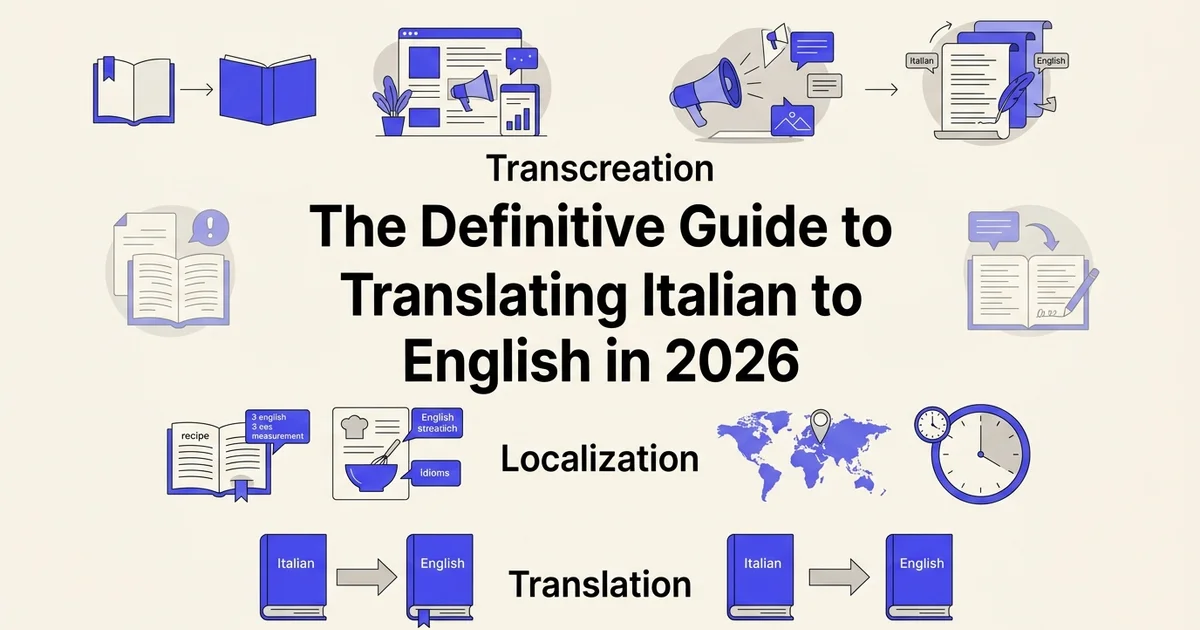
Translation, localization, and transcreation: what is the difference?
These three terms are often used interchangeably, but they describe very different levels of work:
- Translation converts the meaning of a source text into the target language as faithfully as possible. A legal contract or technical manual typically needs translation.
- Localization adapts content for a specific cultural or regional audience. Dates, currencies, idioms, and tone are all adjusted. A software interface or marketing website usually requires localization.
- Transcreation rebuilds content creatively so it resonates emotionally in the target language, even if the original wording is abandoned entirely. Advertising slogans and brand campaigns often demand this approach.
Knowing which level your project needs directly affects your budget, timeline, and the type of professional or tool you should hire.
The unique challenges of the Italian-English language pair
Italian and English diverge in ways that create consistent translation headaches. Italian is a highly inflected language, meaning that verb conjugations, gendered nouns, and formal versus informal registers carry meaning that English simply does not encode the same way. A single Italian sentence can require significant restructuring to read naturally in English.
Specific challenges include:
- False friends: words like morbido (soft, not morbid) or attualmente (currently, not actually) that mislead even experienced translators
- Sentence length: Italian prose tends toward longer, more elaborate constructions that must be broken up for English readability
- Register and formality: Italian distinguishes formally between Lei and tu, a nuance English collapses into a single "you"
Similar structural tensions appear when you translate Portuguese to English, since both Romance languages share this gap with English grammar.
Why accuracy has real consequences
Mistranslation is not just an embarrassment. In legal documents, a single misrendered clause can invalidate a contract or expose a business to liability. In medical or pharmaceutical contexts, errors can carry serious safety implications. Even in marketing, a culturally tone-deaf phrase can undermine an entire campaign.
According to Torjoman (2026), large language models now dominate among the top-performing translation systems for European language pairs, raising the quality ceiling for AI-assisted work significantly. That said, AI output still benefits from human review in high-stakes contexts, a point this guide returns to throughout.
Common misconceptions about translation quality and cost
Several myths persist that lead businesses and individuals to make poor decisions:
- "Free tools are good enough": For casual reading, perhaps. For published content, contracts, or customer-facing materials, the risk of subtle errors is real.
- "All translation costs the same": Rates vary enormously based on subject matter, language pair, turnaround time, and the level of human expertise involved.
- "Longer documents always cost more": Modern AI-powered tools have changed this equation. Tools like DocuGlot Basic handle documents up to roughly 100,000 words with format preservation intact, including headers, tables, and fonts, making large-volume translation far more accessible than traditional per-word pricing models.
Getting these distinctions right from the start saves time, money, and avoidable mistakes down the line.
Types of Italian to English translation: choosing the right approach for your needs
Not every Italian to English translation job calls for the same solution. A legal contract, a product description, a novel, and a medical report each carry different stakes, different vocabularies, and different consequences for error. Matching the right approach to the right task is where smart translation decisions begin.
Machine translation: speed at scale
Machine translation has undergone a dramatic transformation over the past decade. Early rule-based and statistical systems gave way to neural models, and now large language models (LLMs) dominate the field. According to Torjoman (2026), LLMs account for 89% of top-performing machine translation systems, reflecting just how thoroughly AI has reshaped the landscape.
For general-purpose content, such as internal communications, product listings, or informational web pages, modern AI translation delivers fast, cost-effective results that are genuinely usable. The technology handles common Italian sentence structures, idiomatic phrases, and standard vocabulary with impressive accuracy.
Where it struggles is in specialized domains. Legal terminology, medical protocols, and literary nuance all require contextual judgment that current AI systems do not consistently provide. A mistranslated clause in a contract or a misread dosage instruction carries real-world consequences that no speed advantage can offset.
Professional human translation: when precision is non-negotiable
Human translators remain the gold standard for high-stakes content. A certified legal translator understands not just the words but the jurisdictional context behind them. A literary translator preserves voice, rhythm, and cultural resonance in ways that algorithms still cannot replicate reliably.
Use professional human translation when:
- Legal documents require certified accuracy or will be submitted to courts or regulatory bodies
- Medical content involves clinical instructions, patient records, or pharmaceutical labeling
- Literary works depend on tone, style, and authorial voice
- Marketing copy needs cultural adaptation, not just word-for-word conversion
- Technical manuals involve safety-critical instructions or proprietary specifications
The tradeoff is time and cost. Human translation typically takes longer and carries higher per-word pricing, which is why many professionals now look for smarter middle-ground options.
Hybrid workflows: combining AI speed with human expertise
The most efficient approach for many businesses and content creators today is a hybrid model. AI handles the initial draft quickly and consistently, while a human reviewer refines terminology, catches cultural missteps, and ensures the final output meets professional standards. This post-editing workflow, often called machine translation post-editing (MTPE), can cut turnaround times significantly without sacrificing quality.
For document-heavy workflows, tools that preserve original formatting during AI translation are especially valuable. DocuGlot Basic processes PDFs, DOCX files, and other formats while keeping headers, tables, and fonts intact, so a human reviewer receives a clean, structured draft rather than a reformatted mess to untangle.
Specialized translation types at a glance 🗂️
| Type | Best approach | Key consideration |
|---|---|---|
| Legal | Human or hybrid | Certified accuracy required |
| Medical | Human | Safety and regulatory compliance |
| Technical | Hybrid | Domain-specific terminology |
| Literary | Human | Voice and cultural nuance |
| Marketing | Hybrid | Localization over literal translation |
| General/business | AI or hybrid | Speed and cost efficiency |
Understanding where your content sits on this spectrum, whether it is closer to a casual product description or a binding legal agreement, shapes every decision that follows, from tool selection to budget to turnaround expectations.
How Italian to English translation works: from AI to human review
Once you have identified the right approach for your content, the next question is what actually happens to your Italian text between upload and delivery. Modern translation pipelines are more sophisticated than most users realize, combining multiple layers of processing to produce results that would have been impossible just a few years ago.
How AI engines process Italian text
Today's translation systems do not simply swap Italian words for English equivalents. Neural machine translation (NMT) engines analyze entire sentences, paragraphs, and even surrounding context to determine meaning before generating output. Large language models (LLMs) take this further by drawing on vast multilingual training data, allowing them to handle idiomatic expressions, regional vocabulary, and complex grammatical structures that tripped up older rule-based systems.
Italian presents specific challenges here. Its gendered nouns, subjunctive mood, and flexible word order mean that a naive word-for-word approach produces awkward, sometimes misleading English. Modern LLM-based systems navigate these patterns with considerably more accuracy, producing fluent output that preserves the original intent rather than just the surface structure.
According to Torjoman (2026), AI-powered translation tools are now capable of handling nuanced linguistic tasks that previously required specialist human intervention, marking a significant shift in what automated systems can reliably deliver.
Document preprocessing and formatting preservation
Before any word is translated, a well-designed system must parse the source document's structure. Headers, tables, bullet points, footnotes, font weights, and column layouts all carry meaning. Stripping them out to run plain text through a translation engine and then trying to reassemble the formatting afterward is a recipe for broken documents.
This is where purpose-built document translation tools earn their value. DocuGlot, for example, processes PDF, DOCX, TXT, and Markdown files while preserving the original formatting throughout the translation, so headers stay headers, tables stay tables, and your document arrives in English looking exactly as it did in Italian. For business professionals sending translated reports or contracts, this removes a significant manual cleanup step.
Post-editing and quality assurance workflows
Raw AI output, even from the best LLM systems, is rarely production-ready for high-stakes content. The industry standard has shifted toward hybrid workflows where a human post-editor reviews machine-translated text, correcting errors in terminology, tone, and cultural register rather than translating from scratch. According to Future Trans (2026), hybrid human-plus-AI workflows have become the dominant model across professional translation services, balancing speed with the accuracy that sensitive content demands.
For general business documents, a single round of post-editing is often sufficient. For legal or medical content, a second reviewer, typically a subject-matter expert, adds another quality layer before delivery.
Speed vs. accuracy: the real-world tradeoff
The pipeline you choose determines where you land on the speed-accuracy spectrum:
- AI only: Fastest turnaround, lowest cost, best suited for internal documents, drafts, or content where near-accuracy is acceptable
- AI plus light post-editing: Strong balance for business communications, marketing copy, and content similar to what you might encounter when you translate Chinese to English at scale
- Full human review: Slowest and most expensive, but essential for published literary work, legal filings, and regulated industries
Understanding this pipeline gives you realistic expectations before you commit to a tool or service, and it connects directly to the concrete benefits that professional translation delivers, which the next section explores in detail.
Benefits of professional Italian to English translation
Professional Italian to English translation does far more than convert words between two languages. Done well, it opens markets, builds credibility, and compounds value over time. Whether you are localizing a legal contract, a novel, or a product catalog, the returns extend well beyond simple comprehension.

Expanding market reach and audience access
English is the dominant language of global commerce, research, and digital media. Translating Italian content into English immediately makes it accessible to an estimated 1.5 billion English speakers worldwide. For Italian publishers, researchers, brands, and creators, this is not a marginal gain. It is the difference between a regional audience and a global one. According to Torjoman (2026), the translation sector is expanding rapidly into multimedia and SEO-driven content, reflecting exactly how much demand exists for professionally localized material across digital channels.
Improving SEO and discoverability
Search engines index language-specific content separately. A high-quality English translation of an Italian article or product page creates an entirely new set of ranking opportunities in English-language search results. This is especially relevant for content creators and businesses already investing in multilingual strategies. Translated content that preserves natural phrasing, rather than producing awkward machine output, performs better in search because it earns engagement signals: lower bounce rates, longer dwell time, and more backlinks. The same principle applies when you translate English to Vietnamese or any other language pair at scale.
Building trust with international audiences
Poorly translated content signals carelessness. Fluent, culturally aware English translation signals professionalism and respect for the reader. For B2B brands, this trust directly influences purchasing decisions. For authors and content creators, it determines whether an international audience connects with the work or abandons it.
Cost savings through AI-first workflows
The traditional choice between speed and quality no longer holds. AI-first platforms have compressed turnaround times and reduced per-word costs dramatically. Tools like DocuGlot Basic handle documents up to approximately 100,000 words while preserving the original formatting, including headers, tables, fonts, and layout, so there is no expensive reformatting step after translation. For businesses processing large volumes of Italian documents regularly, this workflow efficiency compounds into significant savings.
Maintaining brand voice across languages
Consistency matters. A brand that sounds authoritative in Italian should sound equally authoritative in English. Professional translation, supported by AI trained on domain-specific language, preserves tone, terminology, and cultural nuance rather than flattening them into generic output. This is what separates translation that builds a brand from translation that merely transfers information.
Challenges and limitations: what you need to know before translating
Even with the right tools and intentions, translating Italian to English is rarely a smooth, frictionless process. Understanding the obstacles ahead of time helps you choose the right approach, set realistic expectations, and avoid costly mistakes that only surface after a document has already been delivered.
Idioms, slang, and cultural expressions
Italian is rich with expressions that carry meaning far beyond their literal words. "In bocca al lupo" (literally "in the mouth of the wolf") is a common way to wish someone good luck. Translate it word for word, and you lose the warmth entirely. Regional dialects, colloquial slang, and culturally embedded references compound this challenge. A translator who understands the cultural context, not just the vocabulary, is essential for any content where tone and relatability matter.
Formatting and layout preservation
This is one of the most overlooked challenges in document translation, and one where many tools fall short. Complex documents, such as contracts, reports, or formatted brochures, contain tables, headers, fonts, and nested lists that can collapse or shift during translation. Rebuilding a document's layout from scratch after translation is time-consuming and expensive. Tools that natively preserve document structure, like DocuGlot Basic, which maintains headers, footers, tables, fonts, and colors across PDF and DOCX formats, eliminate this step entirely and save significant post-translation effort.
Domain-specific terminology
Legal contracts, medical records, and technical manuals each carry terminology that demands precision. A mistranslated clause in a legal agreement can alter its meaning entirely. A dosage instruction rendered imprecisely in a medical document carries real risk. According to Verbi Blog (2026), AI tools still struggle with legal, medical, and marketing texts where context and domain knowledge are critical. For these content types, human expertise remains non-negotiable.
Quality consistency across large documents
Translating a 200-page technical manual is not the same as translating a single-page letter. Terminology can drift across sections, tone can shift, and inconsistencies accumulate. Whether you are working with AI tools or a team of human translators, establishing a glossary and style guide before the project begins is one of the most effective ways to maintain consistency throughout. The same principle applies when translating across multiple file types or languages simultaneously, as anyone working on Arabic to English projects will recognise.
Cost and the DIY trade-off
Free tools can handle casual, low-stakes translation reasonably well. But as document complexity, length, or sensitivity increases, the cost of errors outweighs the savings. Professional translation carries a higher upfront cost, while AI-assisted tools offer a middle ground: faster turnaround, lower cost, and acceptable quality for most business documents, provided the tool handles your specific content type well.
Methods for translating Italian to English: comparing your options
Choosing the right translation method depends on your document type, quality expectations, budget, and turnaround time. The landscape in 2026 spans free browser tools, specialized AI platforms, professional human services, and real-time embedded solutions, each with a distinct set of trade-offs worth understanding before you commit.
Discover how DocuGlot Basic approaches translate italian to english DocuGlot Basic.
Free online tools: Google Translate and DeepL
For quick, low-stakes translations, free tools remain the obvious starting point. Google Translate handles Italian well for everyday text, offering instant results and broad language coverage. DeepL has earned a strong reputation for producing more natural-sounding output, particularly for European language pairs, and its free tier is generous enough for short documents.
The limitations become apparent fast, however. Neither tool reliably preserves document formatting. Paste a table-heavy PDF into either platform and you will likely receive a wall of unstructured text. Both also struggle with domain-specific vocabulary, legal phrasing, and culturally embedded idioms, the very challenges covered in the previous section. For anything beyond a paragraph or two, free tools are a starting point, not a solution.
Specialized AI translation platforms
A step up from generic tools, specialized AI platforms are built specifically for translation workflows. According to Torjoman (2026), large language models are now surpassing dedicated machine translation engines on major language pairs, including Italian to English, producing output that is more contextually aware and stylistically consistent.
These platforms typically offer features that free tools lack: format preservation, glossary management, tone control, and support for larger files. For business professionals and content creators working with structured documents, the quality gap between a specialized AI platform and a free tool is significant.
In our experience at DocuGlot, one of the most common frustrations users bring from other tools is formatting loss. A contract arrives as a clean, formatted PDF and comes back as scrambled plain text. DocuGlot Basic addresses this directly: it preserves headers, footers, tables, lists, fonts, and colors throughout the translation process, so your English output looks like a professional document, not a copy-paste job. It supports PDF, DOCX, TXT, and Markdown files up to around 100,000 words, with encrypted transfer and automatic file deletion after 24 hours.
Professional translation services
Human translators remain the gold standard for certified legal documents, literary works, and any content where a mistranslation carries real consequences. Pricing models vary: per-word rates typically range from $0.10 to $0.30 for Italian to English, with certified translations and specialist subject matter commanding a premium. Turnaround times of several days are standard for longer documents.
The trade-off is cost and speed. For a 50-page legal contract, professional translation is often the right call. For a product description, a business report, or an EPUB manuscript, AI-assisted tools now offer quality that is genuinely competitive, at a fraction of the price and time. The same calculation applies to Polish to English and other European language projects where AI quality has matured rapidly.
Document-specific solutions: PDFs, Word files, EPUBs, and web content
Different file types require different approaches. Web content can often be handled through browser extensions or CMS integrations. Word files translate relatively cleanly through most AI platforms. PDFs and EPUBs are more demanding because their formatting is embedded in the file structure rather than the text itself, making format preservation a technical challenge, not just a quality one.
Real-time translation for meetings and communication
According to Future Trans (2026), translation is increasingly shifting toward real-time, embedded experiences. For Italian-speaking business partners or remote teams, tools like Microsoft Teams' live captions, Zoom's real-time translation, and dedicated apps now make multilingual meetings genuinely
Step-by-step guide: how to translate Italian documents to English
Translating an Italian document to English involves more than pressing a button. Done properly, the process follows a clear sequence: prepare your source file, choose the right tool, configure your settings, and verify the output before you share or publish it. Each step protects both accuracy and formatting.
Step 1: Prepare your Italian document
Before you upload anything, a few minutes of preparation will save significant editing time later.
- Clean up the source file. Remove tracked changes, comments, and draft annotations. These elements can confuse translation engines and produce garbled output.
- Check the file format. Most AI translation tools accept PDF, DOCX, and TXT. If your document is in an unusual format, convert it first.
- Note any sensitive content. Legal contracts, medical records, and financial statements may require a tool with encrypted transfer and storage rather than a free browser-based option.
- Flag untranslatable elements. Product names, brand terms, proper nouns, and legal citations often should not be translated. Highlight or list these in advance so you can verify them during review.
Step 2: Choose the right tool for your document type
Not every translation method suits every document. Here is a practical decision framework:
| Document type | Recommended approach |
|---|---|
| Short informal text | Free browser tool or mobile app |
| Business email or letter | AI-powered document translator |
| Legal or certified document | Professional human translator |
| Long report or book | AI tool with format preservation, then human review |
| Real-time meeting | Live caption or embedded translation feature |
For most business and personal documents, an AI-powered tool strikes the best balance between speed, cost, and quality. The critical differentiator is format preservation, which is a gap that many free tools fail to address. Headers, footers, tables, fonts, and column layouts frequently collapse during translation, forcing users to spend more time reformatting than they saved on translation.
Step 3: Upload and configure your settings
Once you have chosen your tool, the upload and configuration step determines much of the output quality.
- Upload your file in its native format where possible. Native DOCX files retain more structural data than a PDF exported from Word.
- Set the source language to Italian and the target language to English. If the tool offers regional variants, choose British or American English based on your audience.
- Select a domain or subject area if the tool offers it. Legal, medical, and technical glossaries improve terminology accuracy significantly.
- Enable format preservation if it is a toggleable option. Tools like DocuGlot Basic handle this automatically, keeping headers, footers, tables, lists, fonts, and colors intact so the translated file mirrors the original layout without manual reconstruction.
Step 4: Handle special elements carefully
Complex documents contain elements that need individual attention even after a clean translation run.
- Tables and lists: Confirm that cell alignment and list hierarchy have been maintained.
- Headers and footers: Check that page numbers, document titles, and legal disclaimers appear correctly on every page.
- Images with embedded text: Most tools cannot translate text inside images. Extract and translate this text separately, then re-embed it.
- Footnotes and endnotes: Verify numbering sequences are intact and that referenced text matches.
Step 5: Review, edit, and quality-check the output
This is the step most users rush, and it is where errors slip through. 🔍
- Read the translated document aloud or use a text-to-speech tool to catch unnatural phrasing.
- Cross-reference any figures, dates, and proper nouns against the original.
- Pay particular attention to false friends, Italian words that resemble English words but carry different meanings (for example, "attuale" means "current," not "actual").
- If the document is high-stakes, a bilingual colleague
Best practices for accurate Italian to English translation
Getting a translation that is technically correct is one thing. Getting one that reads naturally, preserves your intended meaning, and holds up under scrutiny from a native English speaker is another challenge entirely. These practices bridge that gap, whether you are working with AI tools, professional translators, or a combination of both.

Maintaining context and cultural nuance
Italian is a deeply contextual language. A sentence that reads as polite and formal in Italian can come across as stiff or even cold when translated word-for-word into English. Before any translation begins, define the context clearly: who is the audience, what is the purpose of the document, and what tone should the English version carry? Providing this framing to a translator or an AI tool dramatically improves output quality.
Cultural references deserve special attention. Italian business communication often relies on indirect phrasing and relational warmth that English, particularly American English, tends to express more directly. Flagging these moments early prevents the kind of flat, technically accurate translations that still somehow miss the point.
Handling idioms, expressions, and regional variations
Italian idioms rarely survive a literal translation. "In bocca al lupo" (literally "into the wolf's mouth") means "good luck," and rendering it literally would baffle any English reader. The same applies to regional expressions: Italian spoken in Sicily carries different idiomatic flavour from the Italian used in Milan or Rome.
A practical approach is to build a glossary of flagged expressions before translation begins. Mark any phrase that you suspect is idiomatic, then review how the tool or translator has handled each one. This single habit catches the majority of idiom-related errors.
Preserving tone and voice
Tone is one of the most fragile elements in translation. A legal document must remain formal and precise. A marketing brochure needs energy and persuasion. A novel demands that the author's individual voice survive intact. When working with AI translation tools, providing a short sample of the target tone, a few sentences written in the style you want, gives the system a reference point that measurably improves consistency.
According to Torjoman (2026), hybrid human-plus-AI workflows have become the industry standard for exactly this reason: AI handles speed and volume, while human reviewers protect tone, nuance, and cultural accuracy.
Quality assurance checklist for translated content
A structured review process prevents errors from reaching the final version. Work through this checklist before signing off on any Italian to English translation:
- Terminology consistency: Is the same Italian term always rendered the same way in English throughout the document?
- False friends: Have words like "eventuale" (possible, not eventual) and "sensibile" (sensitive, not sensible) been correctly translated?
- Numbers and dates: Italian uses commas where English uses decimal points. Verify every figure.
- Formatting integrity: Tables, headers, and lists should mirror the original structure. Tools like DocuGlot Basic preserve formatting automatically across PDF, DOCX, and other formats, which eliminates a common source of post-translation cleanup work.
- Register and formality: Does the English version match the formality level of the Italian original?
- Back-translation spot check: For critical passages, translate a section back into Italian and compare it to the source to identify meaning drift.
Working effectively with professional translators
When a project demands the highest accuracy, such as legal contracts, medical records, or published literature, a professional translator is not optional. To get the best results, share as much context as possible upfront: the document's purpose, the intended audience, any preferred terminology, and examples of similar content you consider well-written.
According to [Future Trans](https://future-trans.com/5-new
Tools and platforms for Italian to English translation
Choosing the right tool to translate Italian to English depends on your use case, volume, and quality requirements. The market now spans free browser-based utilities, AI-powered document platforms, and enterprise-grade APIs, each with distinct strengths. Understanding what each category offers helps you match the tool to the task.
Free vs. paid translation tools
Free tools like Google Translate and DeepL's free tier are genuinely useful for quick lookups, casual reading, and understanding the gist of a short Italian text. Their limitations become apparent fast, though. They typically cap document size, strip formatting from uploaded files, and offer no version history or collaboration features.
Paid platforms address these gaps directly. They offer:
- Higher word or character limits per translation job
- Format preservation across PDFs, DOCX files, and spreadsheets
- Priority processing for faster turnaround on large files
- Dedicated support and quality guarantees
For business professionals translating contracts, reports, or client-facing materials, the cost of a paid tool is almost always justified by the time and rework it saves.
AI-powered platforms: features and accuracy
According to Torjoman (2026), large language models now represent 89% of top-performing machine translation systems, a shift that has dramatically raised the quality ceiling for automated Italian to English translation. Modern AI platforms do not just swap words; they interpret sentence structure, register, and context.
When evaluating AI translation platforms, look for:
- Contextual accuracy: Does the tool handle idiomatic Italian expressions correctly?
- Domain awareness: Can it recognise legal, medical, or technical vocabulary?
- Consistency: Does it apply the same terminology throughout a long document?
- Security: Are your files encrypted and deleted after processing?
For document translation specifically, DocuGlot Basic handles PDFs, DOCX, TXT, and Markdown files while preserving the original layout, including headers, footers, tables, and font styling. Files are automatically deleted after 24 hours and transferred with encrypted storage, which matters when the content is sensitive. It supports over 100 languages, so the same workflow scales if your projects extend beyond Italian.
Document translation services and specialisations
Not every platform handles every document type well. Specialised services have emerged for distinct content categories:
- Legal and financial documents: Platforms with certified translation options and human review layers
- Books and long-form content: Tools built for chapter-level consistency and narrative flow
- Websites: Solutions that integrate directly with CMS platforms to translate pages without breaking HTML structure
- Multimedia: Services that handle subtitles, transcripts, and dubbed audio scripts
For authors and publishers working on book-length projects, BookTranslator is purpose-built for this scale, maintaining character names, stylistic voice, and chapter structure across tens of thousands of words.
Integration options and team workflows
For teams translating at volume, standalone tools are only part of the picture. APIs allow developers to embed Italian to English translation directly into content management systems, customer support platforms, or internal tools. Plugin ecosystems for WordPress, Shopify, and similar platforms make website localisation accessible without custom development.
Collaboration features matter too. Look for platforms that support shared glossaries, comment threads on translated segments, and role-based access so editors, reviewers, and project managers can work in parallel without overwriting each other's contributions. 🔧
Future trends in Italian to English translation technology
The tools available today for translating Italian to English are impressive, but they represent only an early chapter in a much longer story. The next few years will bring fundamental shifts in how translation is delivered, consumed, and integrated into everyday workflows, driven by advances in AI, growing market demand, and changing expectations from both businesses and individual users.
LLM-based systems and the quality ceiling
Large language models have already transformed translation quality, but the trajectory continues upward. Newer architectures are becoming better at preserving authorial voice, handling idiomatic Italian expressions, and adapting register across different content types. According to Torjoman (2026), AI translation tools are increasingly being trained on domain-specific datasets, which means specialist fields like legal, medical, and financial translation are seeing accuracy improvements that were unthinkable just a few years ago.
For document-heavy workflows, this matters enormously. Tools that combine LLM-quality output with robust format preservation, like DocuGlot's ability to maintain headers, tables, fonts, and layout across PDF and DOCX files, will become the baseline expectation rather than a premium feature.
Real-time translation across calls, meetings, and apps
Translation is rapidly shifting from a discrete task into an embedded, invisible layer within communication tools. Live captions with real-time Italian to English translation are already appearing in video conferencing platforms, and the next wave will bring this capability into customer support chats, voice calls, and mobile applications. The friction of switching between a translation tool and your primary workflow is disappearing.
Video, audio, and multimedia localization 🎬
Text translation is just one dimension. Demand for Italian audio dubbing, subtitle generation, and video localization is accelerating as streaming platforms and e-learning providers expand into European markets. Automated lip-sync dubbing and AI voice cloning are moving from experimental to production-ready.
Market growth and the human translator's evolving role
Italy's translation services sector is part of a broader European market showing robust growth heading into the late 2020s. According to Future Trans (2026), demand is being driven by regulatory requirements, cross-border e-commerce, and multilingual content strategies rather than replacing human expertise entirely.
Employment projections for translators and interpreters remain positive precisely because AI handles volume while humans handle nuance, cultural sensitivity, and high-stakes review. The most successful professionals are those who position themselves as editors and strategists within AI-assisted pipelines, rather than competing against automation directly.
Conclusion: choosing your Italian to English translation strategy
After exploring every dimension of Italian to English translation, from free browser tools to neural machine translation and professional human review, the clearest takeaway is this: no single method wins every situation. The right approach depends on your content type, deadline, budget, and the consequences of an error.
Matching your needs to the right method
Use this simple decision framework before starting any project:
- Casual or personal content (travel notes, informal messages): free tools like Google Translate work well enough
- Business documents, contracts, or marketing copy: AI-powered document translation with human review delivers the best balance of speed and accuracy
- Legal, medical, or literary content: professional translators remain non-negotiable, ideally supported by AI for first-draft efficiency
- High-volume, repeating content: build a workflow combining AI translation, translation memory, and periodic human audits
Getting started with your first project
If you are translating a formatted document, preserving the original layout is often as important as the words themselves. Tools like DocuGlot Basic handle PDF, DOCX, and TXT files while keeping headers, tables, fonts, and colors intact, so you receive a translation that is ready to use rather than one that needs reformatting from scratch.
Building a scalable, improving workflow
Translation quality compounds over time when you treat it as a system rather than a one-off task. Keep a glossary of preferred terminology, collect feedback from native speakers, and revisit your tool choices as your volume grows. Professionals who adopt this mindset consistently produce better results with less effort.
Next steps
Start small: translate one representative document, evaluate the output critically, and identify the gaps. From there, layer in the tools, reviewers, or processes that address those specific weaknesses. 🎯 The goal is not perfection on day one but a workflow that improves with every project.
Related Articles
Frequently asked questions
How can I accurately translate Italian to English without losing the original meaning?
Focus on context over literal word-for-word conversion. Read the full source text before translating, flag culturally specific phrases early, and always review the output against the original. For important documents, a human post-edit pass catches the nuances that even strong AI tools can miss.
What is the best way to translate Italian documents to English while keeping the same formatting?
Use a tool built specifically for document translation rather than a general-purpose chatbot. DocuGlot preserves headers, footers, tables, fonts, and colors automatically across PDF, DOCX, TXT, and Markdown files, so your translated document looks identical to the original in structure.
Is Google Translate good enough for Italian to English, or should I use a professional translator?
Google Translate works for quick personal understanding, but it regularly stumbles on idioms, formal registers, and complex sentence structures. According to the Verbi AI Translation Tools Review (2026), newer AI tools produce Italian output that "reads more like a human wrote it" with "better handling of formality and idiom" compared to older MT engines.
How do I translate an entire Italian PDF or Word document into English?
Upload the file to a dedicated document translation platform. DocuGlot Basic handles documents up to around 100,000 words, returns a fully formatted file, and automatically deletes your data after 24 hours for privacy.
What is the most accurate AI tool to translate Italian to English?
Large language model-based tools currently lead the field. Research from Intento cited by Verbi Blog (2026) found LLMs now power 89% of top-performing translation systems across language pairs.
How can I translate an Italian book or manuscript into English for publication?
Use BookTranslator for long-form literary content, then engage a native English editor familiar with Italian literature to refine tone, rhythm, and cultural references before submission to publishers.
How do I handle idioms and slang when translating from Italian to English?
Build a glossary of recurring idiomatic expressions before you start, and never translate them literally. Research the closest English equivalent in meaning and register, and flag any phrase where no clean equivalent exists so a human reviewer can make the final call.
Can I translate Italian legal or medical documents into English using AI safely?
AI can produce a strong first draft, but specialized documents carry real risk if errors go undetected. As ChatsControl notes in its 2026 industry review, "AI handles general texts in popular languages well, but struggles with legal, medical, marketing texts." Always have a certified translator or subject-matter expert review the final version.
Based on our work at DocuGlot, the teams that get the best results treat AI translation as a powerful starting point rather than a finished product, combining format-preserving automation with targeted human review where accuracy truly matters.
Tags
Ready to translate your documents?
DocuGlot uses advanced AI to translate your documents while preserving formatting perfectly.
Start Translating