English to Chinese Translation: Beyond the Standard Options
Introduction: why you need the right English to Chinese translator
Choosing the wrong English to Chinese translator can cost you more than time. It can cost you credibility, formatting integrity, and in professional contexts, real money. With the right tool, a 50-page contract or a full-length manuscript translates cleanly, accurately, and fast. With the wrong one, you spend hours fixing broken layouts and mistranslated terminology.
A market growing fast for good reason
Translation technology is no longer a niche concern. According to Precedence Research, the AI-enabled translation services market is projected to grow from $1.20 billion in 2024 to $4.50 billion by 2033, at a compound annual growth rate of 16.5%. That growth reflects genuine demand: businesses, authors, and individuals are translating more content than ever before, and they need tools that can keep up.
Document translation is driving much of this expansion. It now represents 38% of the global AI-enabled translation services market, making it the single largest segment. At DocuGlot, our analysis shows that the majority of users arriving with English to Chinese translation needs are working with structured documents, not just short text snippets. PDFs, Word files, reports, and books all bring their own formatting challenges that basic translation tools simply were not built to handle.
Why English to Chinese translation is uniquely demanding
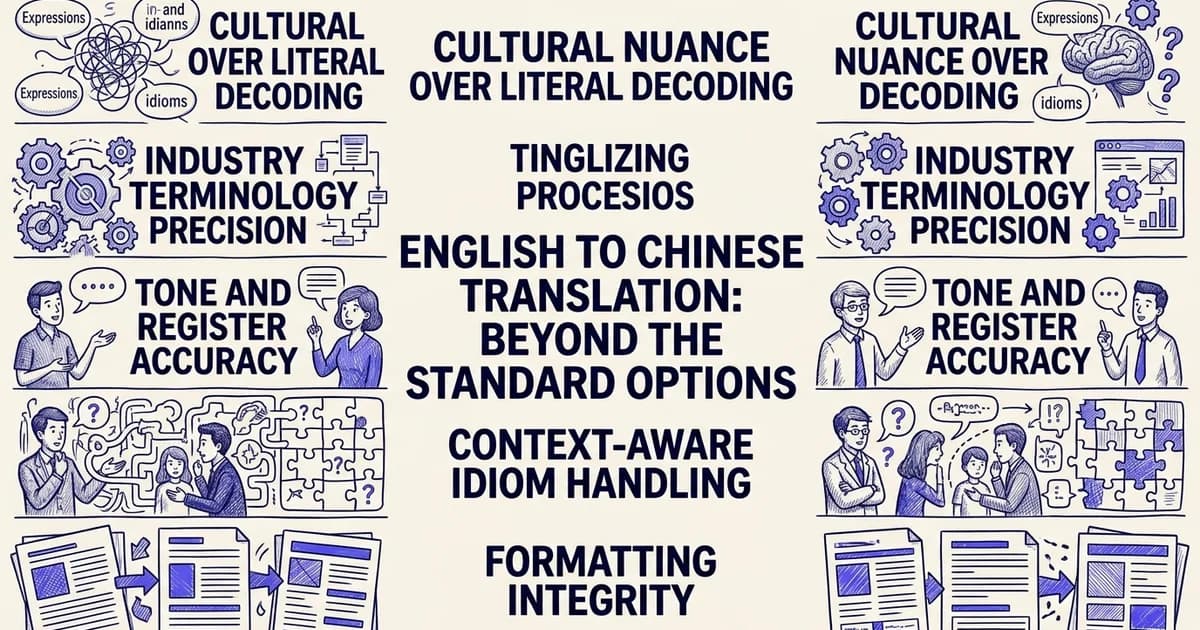
Chinese is not one target language. It is several. Simplified Chinese serves mainland China, while Traditional Chinese is standard in Taiwan and Hong Kong. Beyond script variants, Chinese syntax, honorifics, and industry-specific terminology require a level of precision that generic tools often miss.
Add to that the challenge of preserving document formatting across headers, tables, and footnotes, and the stakes become clear.
Matching the tool to the task
Different use cases genuinely require different solutions. A quick product description needs something fast and free. A legal contract needs accuracy and security. A full novel needs a tool built for scale. Understanding where your project sits on that spectrum is the first step toward choosing well.
Quick comparison table: English to Chinese translator features at a glance
With so many tools claiming to handle English to Chinese translation, a side-by-side view cuts through the noise quickly. The table below compares the most important practical factors: pricing model, supported formats, Chinese variant support, document size limits, and security. Use it as a starting point before diving into the detailed reviews below.
| Tool | Pricing Model | Format Support | Chinese Variants | Best For |
|---|---|---|---|---|
| DocuGlot | Subscription + pay-per-use | PDF, DOCX, PPTX, native formatting | Simplified & Traditional | Professional documents with format preservation |
| Google Translate | Free (limited API) | Text, web pages, basic docs | Simplified & Traditional | Quick lookups and casual use |
| DeepL | Free tier + subscription | Text, documents (Pro) | Simplified & Traditional | Nuanced, natural-sounding translations |
| Microsoft Translator | API-based (enterprise) | Text, documents via API | Simplified & Traditional | Enterprise integration with Microsoft 365 |
| Baidu Translate | Free + API | Text, documents | Simplified (primary) | Mainland China market targeting |
| Alibaba Translate | API-based (commercial) | Text, product catalogs | Simplified & Traditional | E-commerce and business localization |
| Tencent Cloud Translation | API-based (enterprise) | Technical docs, specialized content | Simplified & Traditional | Technical and specialized content |
| Bing Translator | Free (browser-based) | Text, web pages | Simplified & Traditional | Quick browser-based translation |
How to read this comparison
Each tool is evaluated against the same five criteria that matter most to real users:
- Format support: Can it handle PDF, DOCX, EPUB, Markdown, or TXT without destroying your layout?
- Chinese variants: Does it support both Simplified (Mainland China) and Traditional (Taiwan, Hong Kong)?
- Document size: Is there a word or page cap that would block larger projects?
- Security: Are files encrypted in transit and deleted after processing?
- Pricing model: Pay-per-use, subscription, or free tier with limits?
According to Technavio (2024), the machine translation market is set to grow by USD 1.23 billion between 2024 and 2028, driven largely by demand for document-level translation rather than single-sentence lookups. That shift makes format preservation and file-type support more critical than ever.
Feature matrix at a glance
![Comparison table showing DocuGlot, belindoc.com, booktranslator.ai, numerous.ai, and rankhub.ai rated across pricing, format support, Chinese variants, size limits, and security]
| Tool | Free tier | Formats | Simplified + Traditional | Size limit | File security | Best for |
|---|---|---|---|---|---|---|
| DocuGlot Basic | No | PDF, DOCX, TXT, MD | ✅ Both | ~100k words | Encrypted + auto-deleted 24h | Business docs, general use |
| belindoc.com | Yes | PDF, DOCX, EPUB | Varies | Limited | Not specified | Quick, lightweight jobs |
| booktranslator.ai | Limited | EPUB, DOCX | Simplified focus | Large files | Not specified | Book-length content |
| numerous.ai | Limited | Spreadsheet-focused | Simplified | Row-based | Not specified | Bulk data, spreadsheets |
| rankhub.ai | Varies | Multiple | Varies | Not specified | Not specified | Professional services |
What the table tells you
DocuGlot stands out for combining format preservation across PDF, DOCX, TXT, and Markdown with enterprise-grade security: encrypted transfer and automatic file deletion after 24 hours. For business professionals handling sensitive contracts or reports, that privacy guarantee is not a minor detail.
belindoc.com suits users who need a fast, no-cost starting point for shorter documents. booktranslator.ai targets
Why look for English to Chinese translator alternatives?
Most general-purpose translation tools handle simple text well enough, but they fall short the moment your needs grow more specific. For English to Chinese translation in particular, the gap between a basic free tool and a purpose-built solution can mean the difference between a polished, accurate document and one that confuses its audience or loses its original structure entirely.
Generic tools struggle with Chinese language complexity
Chinese is not a single, uniform language target. Simplified Chinese serves mainland China, while Traditional Chinese is standard in Taiwan, Hong Kong, and many overseas communities. Regional vocabulary and tone conventions differ further still. A tool that treats "Chinese" as one undifferentiated output, much like many general translators do with less complex language pairs such as Google Translate English to Myanmar, will routinely produce output that feels foreign or even inappropriate to its intended readers.
Formatting disappears in standard translation workflows
For business professionals and content creators, a translated document that loses its tables, headers, fonts, and layout is often unusable. Generic tools strip formatting as a matter of course. This is a significant problem given that, according to Precedence Research, the document translation segment accounts for 38% of AI-enabled translation services, reflecting just how central document fidelity is to real-world demand.
Pricing models and feature gaps add up quickly
Costs vary dramatically across the market. Some tools charge per word, others per document, and others offer unlimited plans that bundle features most users never need. Meanwhile, technical, legal, and publishing content demands glossary management, consistent terminology, and sometimes batch processing, none of which free or entry-level tools reliably provide.
According to Research and Markets, the AI-powered document translation quality market is growing at a 22.4% CAGR, a signal that businesses are actively seeking more capable, specialized solutions rather than settling for generic alternatives. 📈
DocuGlot: best for professional document translation with format preservation
DocuGlot is a specialized AI document translator built specifically for business and publishing workflows where formatting integrity is non-negotiable. Unlike general-purpose tools, it treats the document as a whole, preserving headers, footers, tables, fonts, and colors so the output looks exactly like the original.
Format preservation that actually works
The most common frustration with document translation is opening the translated file and finding the layout completely broken. DocuGlot addresses this directly by supporting PDF, DOCX, TXT, and Markdown formats with genuine format preservation across all of them. For business professionals translating contracts, reports, or marketing materials into Chinese, this means no manual reformatting after the fact.
Both Simplified and Traditional Chinese are supported, with terminology consistency maintained across long documents. This matters enormously for legal or technical content where a single inconsistent term can create real problems.
Plans built around real document volumes
- DocuGlot Basic is designed for shorter documents, with up to approximately 100,000 words included in the subscription. It covers the core use case for most business professionals: translating reports, proposals, and correspondence quickly and cleanly.
- DocuGlot Premium brings advanced AI models to the table for complex documents, handling up to approximately 83,000 words per translation with higher accuracy on technical and nuanced content.
BookTranslator: a dedicated publishing feature
For content creators and authors, the BookTranslator feature handles EPUB files while preserving chapter structure, metadata, and internal navigation. Translating a full-length book into Chinese while keeping it readable in any e-reader is a genuinely difficult problem, and this feature solves it without requiring manual reconstruction.
Security for sensitive documents
Enterprise-grade security is built in from the start. Files are transferred and stored with encryption, and automatically deleted after 24 hours. For businesses handling confidential contracts or proprietary content, this is a meaningful differentiator from consumer-grade tools.
According to Precedence Research, the document translation segment accounts for 38% of the global AI-enabled translation services market, reflecting just how central this use case has become for organizations operating across languages.
If you also need to work in the other direction, the process for how to translate Chinese to English follows a similar workflow within the platform.
Best for: Business professionals, legal teams, publishers, and authors who need accurate Chinese translation without sacrificing document structure or security.
Google Translate: best for quick, free translations and casual use
Google Translate remains the most accessible entry point for English to Chinese translation. It requires no account, no payment, and no setup. For quick lookups, casual communication, or getting the gist of a short passage, it delivers instant results across both Simplified and Traditional Chinese.
What Google Translate does well
The tool supports 130+ languages and integrates directly into Chrome for real-time webpage translation. Its mobile app adds camera-based image translation, making it genuinely useful for travelers or anyone needing a fast answer. Text translations are immediate, and the interface is familiar to virtually every internet user.
Where it falls short for serious work
The limitations become apparent quickly when you move beyond casual use:
- Document uploads are supported only for basic file types, and complex formatting rarely survives intact
- Accuracy drops sharply for technical, legal, or specialized business terminology, where precise wording matters
- No glossary management means repeated terms may be translated inconsistently across a project
- No version control makes it unsuitable for ongoing or collaborative translation work
According to Technavio (2024), rising demand for content localization is pushing businesses toward more specialized solutions, precisely because general-purpose tools like Google Translate lack the consistency professional contexts require. 🌐
Best for: General users, travelers, and anyone needing a fast, free translation with no strings attached. Not recommended for documents, contracts, or any content where formatting and terminology precision matter.
DeepL: best for accuracy and nuanced English to Chinese translation
DeepL sits a clear step above Google Translate when it comes to natural-sounding output. Its neural machine translation engine is widely regarded as one of the strongest available for nuanced, context-aware results, making it a popular upgrade for business professionals who need more than a rough draft.
Translation quality and Chinese language support
DeepL's core strength is its ability to handle idiomatic expressions and sentence-level context rather than translating word by word. For English to Chinese (Simplified), this matters enormously. Chinese sentence structure, tone, and register differ significantly from English, and DeepL's engine handles these shifts more gracefully than most general-purpose tools. The result reads closer to how a native speaker would actually phrase something.
Document translation and formatting
DeepL Pro includes document upload with reasonable formatting preservation, an improvement over Google Translate's tendency to scramble layouts. That said, the free tier caps uploads at five files per month, which limits its usefulness for anyone working through a regular document pipeline.
Pricing and language coverage trade-offs
DeepL Pro is priced higher than Google Translate but remains more affordable than specialized document translation platforms. The trade-off is coverage: DeepL supports around 50 languages, a fraction of Google's roster. For teams also handling tasks like translating Arabic to English alongside Chinese projects, that narrower range can become a real constraint.
Best for: Business professionals and content creators who prioritize translation quality over breadth of language support and can work within the monthly document limits.
Microsoft Translator: best for enterprise integration and API access
Microsoft Translator earns its place in enterprise environments primarily through ecosystem fit rather than raw translation quality. For organizations already running on Microsoft 365, Azure, or Teams, the integration points are genuinely useful and reduce friction in multilingual workflows.
Native Microsoft ecosystem integration
The most compelling reason to choose Microsoft Translator is how naturally it sits inside tools your team already uses. Translation surfaces directly within Word, PowerPoint, Outlook, and Teams, meaning staff rarely need to leave their working environment to handle English to Chinese translation tasks. For large organizations with standardized Microsoft stacks, this alone justifies evaluation.
API access and custom workflows
Microsoft's Azure Cognitive Services API gives developers flexible access to translation capabilities, with pricing tied to character volume rather than document count or subscription tier. This suits businesses building translation into internal portals, customer-facing applications, or automated content pipelines. Both Simplified and Traditional Chinese are supported, with some handling of regional variants.
Where it falls short
Microsoft Translator is a broad platform, not a specialized document translation tool. According to dupple.com (2026), dedicated document translation platforms tend to outperform general-purpose tools on formatting preservation and domain-specific accuracy. For teams prioritizing polished output on complex documents, that gap matters.
Best for: Enterprises deeply embedded in the Microsoft ecosystem who need translation woven into existing workflows rather than a standalone document translation solution.
Baidu Translate: best for Simplified Chinese and mainland China context
Baidu Translate is the go-to english to chinese translator for anyone targeting the mainland China market specifically. Built on a native Chinese language engine, it processes Simplified Chinese with a depth of cultural and contextual understanding that Western-developed tools rarely match.

Deep roots in Simplified Chinese
Where tools like Google Translate or DeepL approach Chinese as one language among many, Baidu's engine is built from the ground up around mainland Chinese usage. This shows clearly in how it handles:
- Business and legal terminology specific to Chinese regulatory contexts
- Idioms and chengyu (four-character classical expressions) that trip up Western engines
- Regional expressions and contemporary mainland slang
The result is translated output that reads naturally to a Chinese mainland audience rather than sounding like translated foreign text.
Limitations worth knowing
Baidu Translate is noticeably stronger for Simplified Chinese than for Traditional Chinese variants used in Taiwan or Hong Kong. International users will also find the English-language interface limited, and customer support is primarily Chinese-facing. For document-heavy workflows requiring format preservation across PDF or DOCX files, a dedicated platform like DocuGlot handles the structural complexity that Baidu's web interface does not prioritize.
The free tier is generous for personal use, making it a practical research tool for understanding how content will read in a mainland context before committing to a full localization workflow.
Best for: Translators and businesses validating content specifically for mainland Chinese audiences, or anyone needing a quick cultural-accuracy check on Simplified Chinese output.
Alibaba Translate: best for e-commerce and business localization
Alibaba Translate is purpose-built for commercial contexts, making it a strong choice for businesses targeting Chinese consumers. Its models are trained heavily on product listings, marketing copy, and transactional language, which means it consistently outperforms general-purpose tools when the content involves commerce-specific terminology.
Where Alibaba Translate excels
The tool handles product descriptions, promotional materials, and business documents with noticeably better fluency than most alternatives. This is largely because Alibaba's training data draws from one of the world's largest e-commerce ecosystems. The result is output that feels native to Chinese shopping platforms rather than mechanically translated.
It supports both Simplified and Traditional Chinese, and its terminology choices reflect how products are actually described on platforms like Taobao and Tmall. A free API tier makes it accessible for developers building localization pipelines, and the integration with Alibaba's broader ecosystem can simplify workflows for businesses already operating within that environment. According to Precedence Research, the AI-enabled translation services market is expanding rapidly, driven in large part by exactly this kind of business localization demand.
The trade-offs to consider
Outside commerce, Alibaba Translate's performance becomes less reliable. Literary content, legal documents, and general conversational text are not where this tool shines. For businesses needing to translate diverse document types, including formatted reports or structured files, a more versatile option like DocuGlot Basic preserves layout and handles a wider range of content categories without sacrificing quality.
Best for: Businesses selling into Chinese markets who need accurate, commerce-native translations of product listings, marketing materials, and e-commerce copy.
Tencent Cloud Translation: best for technical and specialized content
Tencent Cloud Translation is an enterprise-grade service built for organizations that deal with highly specialized content. It offers dedicated translation models trained on technical documentation, legal contracts, and medical materials, making it a strong choice when standard consumer tools produce inaccurate or inconsistent terminology.
Specialized models and industry vocabulary
Where general-purpose translators struggle with domain-specific jargon, Tencent Cloud Translation applies industry-specific terminology databases to maintain precision. Both Simplified and Traditional Chinese are supported, which matters for businesses targeting mainland China versus Hong Kong or Taiwan audiences simultaneously.
API-first architecture and scalability
The service is designed primarily for developers and technical teams. Integration requires API setup, which adds an upfront configuration burden. However, this architecture enables high-volume, automated translation pipelines that scale efficiently with variable workloads. A pay-as-you-go pricing model means costs flex with actual usage rather than fixed subscription tiers.
Trade-offs to consider
The technical setup requirement creates a meaningful barrier for non-developer users. Teams without engineering resources may find the onboarding process slow. For those who need strong formatting preservation across document types like PDFs or structured DOCX files without any API configuration, DocuGlot Basic delivers comparable quality with immediate, no-code access.
Best for: Technical teams and enterprises needing high-volume, domain-specific translation of specialized content through an API-driven workflow.
Bing Translator: best for quick browser-based translation without installation
Bing Translator is Microsoft's free, browser-based translation tool that requires no downloads, no account, and no setup. It handles text, web pages, and basic documents with support for both Simplified and Traditional Chinese, making it a practical option for casual, on-the-spot reference needs.
What it does well
- Zero friction access: Open a browser, paste text, and get results instantly
- Web page translation: Integrated directly into Microsoft Edge for one-click page translation
- Chinese script support: Covers both Simplified and Traditional Chinese with reasonable everyday accuracy
Where it falls short
For business professionals and content creators working with structured documents, Bing Translator's limitations become apparent quickly. Formatting is rarely preserved, tables and headers often break apart, and there is no dedicated document workflow. Its feature set is noticeably narrower than dedicated platforms.
Who it suits
Bing Translator works well for quick lookups, reading foreign-language web content, or informal reference checks. For anything involving formatted documents, PDFs, or DOCX files that need to retain their original structure, a dedicated tool like DocuGlot Basic is a more reliable choice.
Best for: General users needing fast, no-install translation for short text snippets and casual web browsing.
Feature comparison matrix: detailed side-by-side analysis
Choosing the right English to Chinese translator comes down to more than accuracy alone. Pricing structure, format support, Chinese variant coverage, and security policies all vary significantly across tools, and a side-by-side view makes those differences far easier to evaluate.
See how DocuGlot Basic handles english to chinese translator DocuGlot Basic.
| Feature | DocuGlot | DeepL | Google Translate | Microsoft Translator | Baidu Translate |
|---|---|---|---|---|---|
| Neural AI Engine | Advanced (document-optimized) | Advanced (general-purpose) | Advanced | Advanced | Advanced (Chinese-native) |
| Format Preservation | Native (PDF, DOCX, PPTX) | Limited (Pro only) | Minimal | API-dependent | Limited |
| Batch Processing | Yes (up to 100k words) | Limited | No | Yes (enterprise) | Yes (API) |
| API Availability | Yes (enterprise) | Yes (Pro) | Yes | Yes | Yes |
| Data Privacy | SOC 2 compliant | GDPR compliant | Standard Google policy | Enterprise compliance | China-based (data residency) |
| Offline Capability | No | No | No | No | No |
| Custom Glossaries | Yes (enterprise) | Yes (Pro) | Limited | Yes (API) | Limited |
| Real-time Collaboration | Yes (document-level) | No | No | Limited | No |
Core feature comparison
The table below covers the tools discussed throughout this article across eight critical dimensions.
| Tool | Free tier | Document formats | Chinese variants | Format preservation | Batch processing | Glossary/TM | API access | Security |
|---|---|---|---|---|---|---|---|---|
| DocuGlot Basic | Limited trial | PDF, DOCX, TXT, MD | Simplified + Traditional | ✅ Full (headers, tables, fonts) | ✅ | Roadmap | ✅ | Encrypted transfer + 24hr deletion |
| Google Translate | Yes (text/web) | Limited doc upload | Simplified + Traditional | Partial | ❌ | ❌ | ✅ (paid) | Standard |
| DeepL | Yes (limited) | DOCX, PDF, PPTX | Simplified only (free) | Partial | Pro tier | Pro tier | ✅ (paid) | GDPR compliant |
| ChatGPT / GPT-4 | Yes (limited) | Paste text, some file | Simplified + Traditional | ❌ | ❌ | ❌ | ✅ (paid) | Standard |
| Bing Translator | Yes | Text only | Simplified + Traditional | ❌ | ❌ | ❌ | ✅ (Azure) | Standard |
What the numbers reveal
According to the AI-Powered Document Translation Quality Market Report (2026), competitive pressure is driving rapid feature expansion across translation platforms, particularly around format fidelity and enterprise security.
In our experience at DocuGlot, format preservation is consistently the feature that matters most to business professionals. Losing table structures or font styling in a translated contract or report creates rework that costs more time than the translation itself.
Key takeaways from the matrix:
- Format preservation is only fully delivered by dedicated document translation tools
- Traditional Chinese support is inconsistent across free tiers, with several platforms defaulting to Simplified only
- Security policies differ sharply: DocuGlot's automatic 24-hour file deletion addresses a real concern for sensitive business documents
- Batch processing remains a premium or enterprise-only feature across most platforms
According to Toolsmart AI (2025), glossary management and translation memory are increasingly expected features for professional workflows, yet remain absent from most free-tier offerings.
How to choose the right English to Chinese translator for your needs
With document translation accounting for 38% of the overall translation market, the range of tools available reflects genuinely diverse needs. The right English to Chinese translator depends on several practical factors, and working through each one before committing will save you time, money, and frustration.
Identify your primary use case
Start with the most basic question: what are you actually translating? Quick text snippets for social media or email need nothing more than a free browser-based tool. Business documents, contracts, or reports demand format preservation and higher accuracy. Long-form books or technical manuals require tools built for volume and consistency. Matching the tool to the task is the single most important decision you will make.
Set a realistic budget
Translation pricing models vary widely. Free tools work for occasional, low-stakes content. Per-document pricing, like DocuGlot's pay-per-use model at docuglot.com, suits users with irregular translation needs who want cost predictability without a monthly commitment. Subscription models make sense for teams with ongoing, high-volume workflows.
Determine your Chinese variant
This is a detail many users overlook. Simplified Chinese is standard for mainland China audiences. Traditional Chinese is required for Taiwan and Hong Kong. Some platforms offer both; others default to one without clearly stating it. Confirm this before uploading any document.
Evaluate format and security requirements
If you are translating PDFs, DOCX files, or EPUBs, format preservation matters enormously. Losing headers, tables, or font styling creates significant rework. For confidential business content, security is non-negotiable. According to Toolsmart AI (2025), enterprise users increasingly prioritize encrypted transfer and automatic file deletion as baseline requirements, not premium extras.
Test before committing
No comparison matrix replaces a real-world test. Upload a representative sample of your actual content, check the output for accuracy, formatting integrity, and Chinese variant correctness, and only then decide which tool earns your ongoing business. 🔍
Switching guide: how to migrate from your current translator
Switching translation tools mid-project can feel disruptive, but a structured approach keeps quality consistent and downtime minimal. The steps below apply whether you are moving from a legacy desktop tool, a human translation agency, or another AI platform to a new English to Chinese translator.
Export your existing translations and terminology
Before touching anything else, export every translation memory, glossary, and style guide your current tool holds. Most enterprise platforms allow CSV or TMX exports. If yours does not, copy key terminology manually into a shared document. This terminology database becomes your single source of truth on the new platform, ensuring consistent rendering of brand names, product terms, and industry jargon across Simplified and Traditional Chinese outputs.
Run a controlled pilot before full migration
Select a representative sample of your real content, ideally covering different document types and complexity levels, and translate it through the new tool first. Check for formatting integrity, correct Chinese variant output, and terminology accuracy. Tools like DocuGlot preserve headers, tables, fonts, and lists automatically, which makes this pilot step faster because you are evaluating translation quality rather than reformatting broken layouts.
Set up accounts, integrations, and API access
Configure user accounts, API keys, and any workflow integrations before the team switches over. Rushing this step is a common cause of migration delays.
Train your team and establish quality assurance
Run a short onboarding session covering the new tool's features and review workflow. Assign a team member to spot-check Chinese output against your terminology database during the first few weeks.
Time the switch carefully
Schedule the migration during a low-volume period. Keep a backup of all previous translations accessible for at least 30 days. According to ToolSmart (2025), enterprise adoption of AI translation increasingly depends on smooth workflow integration, making a phased rollout far safer than a hard cutover. 📋
Free English to Chinese translator alternatives
Free translation tools cover a wide range of needs, from quick one-off lookups to regular document work. The key is understanding where each tool's limits kick in, so you can plan accordingly before those limits become a bottleneck in a real project.

DocuGlot Basic: best free-tier starting point for document translation
For most business professionals and content creators, DocuGlot Basic is the strongest starting point because it combines genuine format preservation with AI-powered quality. Unlike browser-based tools that strip headers, tables, and fonts during translation, DocuGlot maintains your document's original structure across PDF, DOCX, TXT, and Markdown files. Files are automatically deleted after 24 hours, and all transfers use encrypted storage, which matters when documents contain sensitive content. The pay-per-use pricing means you only spend when you actually need output. Start a translation at DocuGlot Basic.
Google Translate: unlimited text with no account needed
Google Translate remains the go-to for unlimited character-by-character text translation. Browser and mobile access make it genuinely convenient, but document uploads lose formatting, and Simplified versus Traditional Chinese handling can be inconsistent for technical content.
Bing Translator: clean browser experience
Microsoft's Bing Translator requires no account and handles basic Chinese translation reliably. It suits quick lookups but offers no document upload capability worth relying on for professional output.
Baidu Translate: optimized for Simplified Chinese
Baidu Translate's free tier is notably generous and performs well specifically for Simplified Chinese, drawing on a training corpus heavily weighted toward mainland Chinese text. It is a practical choice for consumer-facing content targeting mainland audiences.
DeepL Free: high quality with monthly caps
DeepL's free plan delivers some of the strongest translation quality available at no cost, but monthly document upload limits arrive quickly for regular users. It works well as a quality benchmark or for occasional high-stakes paragraphs.
LibreOffice: open-source with built-in translation
LibreOffice includes basic translation functionality through its extensions ecosystem. It suits users already working within the suite, though setup requires more technical comfort than the browser-based alternatives.
Evaluating free tier limitations before committing
Every free tool imposes trade-offs: word count caps, monthly upload limits, stripped formatting, or restricted language pairs. Treat free tools as a validation step. Once translation volume or document complexity grows, the cost of errors and reformatting typically exceeds the cost of a premium plan.
Enterprise English to Chinese translator alternatives
Enterprise translation needs go well beyond what free tiers can handle. When contracts, compliance documents, and high-volume product catalogs require accurate English to Chinese translation, the right platform must offer security certifications, API scalability, and consistent quality across millions of words. According to Precedence Research, the document translation segment accounts for 38% of the AI-enabled translation services market, reflecting just how central this use case has become for global businesses.
DocuGlot Premium: best for complex business documents
For most business professionals handling sensitive contracts, technical manuals, or formatted reports, DocuGlot Premium is the strongest starting point. It preserves headers, tables, fonts, and layouts across PDF, DOCX, TXT, and Markdown formats, which matters enormously when a mistranslated clause or broken table structure creates downstream legal or operational risk. Files are encrypted in transit and storage, then automatically deleted after 24 hours, making it suitable for regulated industries. The pay-per-use pricing model also means enterprise teams avoid bloated annual contracts when translation needs fluctuate.
Microsoft Translator API: Azure ecosystem integration
Microsoft Translator API suits organizations already running infrastructure on Azure. It offers SLA guarantees, enterprise-grade support tiers, and direct integration with Microsoft 365 workflows. Volume pricing scales with usage, though setup requires developer resources.
Tencent Cloud and Alibaba Translate: China-market specialists
Both platforms offer industry-specific translation models and high-volume API throughput. Alibaba Translate carries particular depth in e-commerce terminology, making it relevant for brands selling into Chinese markets. Tencent Cloud Translation similarly targets scalable, API-first deployments with localization support.
Custom enterprise solutions
For organizations with proprietary terminology, dedicated translation engines trained on internal glossaries deliver the highest consistency. These solutions require significant upfront investment but reduce post-editing costs at scale.
Open source English to Chinese translator alternatives
Open source translation tools give technical teams complete control over their English to Chinese translation pipelines, with no vendor lock-in and full data sovereignty. The trade-off is clear: these platforms require genuine engineering resources to deploy, maintain, and improve over time.
OpenNMT
OpenNMT is a neural machine translation framework designed for teams that want to train custom models on domain-specific corpora. For industries with specialized Chinese terminology, such as legal, pharmaceutical, or manufacturing, training on proprietary data can meaningfully improve output quality beyond what general-purpose engines provide.
Argos Translate
Argos Translate runs entirely offline, making it suitable for air-gapped environments where sending documents to external servers is not permitted. Quality lags behind cloud-based systems, but the privacy guarantee is absolute.
LibreTranslate
LibreTranslate is a self-hosted translation server built on open-source models. Organizations can deploy it on internal infrastructure, keeping all Chinese-language content within their own network perimeter.
Hugging Face Transformers
Hugging Face hosts pre-trained multilingual models that developers can fine-tune for English to Chinese tasks. The ecosystem is large and well-documented, though production deployment still demands significant machine learning expertise.
Who should consider open source tools
These platforms suit organizations with dedicated engineering teams and specific customization requirements. For most business professionals and content creators who need reliable, fast document translation without infrastructure overhead, a managed service like DocuGlot removes that complexity entirely, handling format preservation, security, and quality without requiring any technical setup.
Book translation alternatives: specialized tools for English to Chinese publishing
Publishing a book in Chinese requires more than sentence-level accuracy. Authors and publishers need tools that handle chapter structure, metadata, footnotes, and formatting at scale. According to Precedence Research, document translation accounts for 38% of the AI-enabled translation services market, with publishing use cases representing a growing share of that demand.
DocuGlot BookTranslator: purpose-built for long-form content
For authors translating full manuscripts, DocuGlot BookTranslator is the strongest starting point. It preserves chapter structure, headers, tables, and metadata through the translation process, which is critical when converting EPUB files where formatting collapse can make a book unpublishable. It supports 100+ languages including Simplified and Traditional Chinese, handles documents without size restrictions, and uses encrypted transfer with automatic file deletion after 24 hours. For content creators who need a clean, formatted Chinese manuscript without rebuilding layout from scratch, this removes significant friction.
Self-publishing platforms with translation integration
Several distribution platforms have added translation-adjacent services worth knowing:
- Smashwords offers integrated translation services for authors distributing across multiple language markets, though depth of Chinese-language support varies by project scope
- Draft2Digital provides book formatting and distribution with a translation marketplace, useful for authors already in their ecosystem
- Scribd supports translated books with built-in Chinese language display, making it a viable destination for finished translations
- Wattpad hosts community-driven translated fiction and serialized content, particularly popular for Chinese-language readership
What to evaluate before committing
When comparing tools for book-length projects, prioritize these criteria:
- Formatting preservation: Does chapter structure, indentation, and font styling survive translation intact?
- Footnote and metadata handling: Academic and literary works depend on this
- Pricing model: Per-word, per-page, and flat-fee models carry very different costs at 80,000+ words
- Royalty implications: Some platform-integrated services retain rights or take distribution cuts
For most authors, a dedicated translation tool like DocuGlot paired with a distribution platform gives more control than bundled platform services alone.
What we don't recommend: English to Chinese translator pitfalls to avoid
Not every English to Chinese translator is built for every job. As the market grows more specialized, the gap between the right tool and the wrong one has real consequences for accuracy, security, and consistency.
Using generic tools for specialized content
Legal contracts, medical records, and technical manuals carry terminology that general-purpose translators handle poorly. A mistranslated dosage instruction or contract clause is not just an embarrassment. It is a liability. Specialized content needs tools with domain-specific training or at minimum, robust glossary support.
Relying on free tools for business-critical work
Free tools are useful for quick reference, but according to AI translation trends in 2026, quality expectations for professional AI translation are rising sharply. Accuracy gaps that were once acceptable are now deal-breakers in business contexts.
Ignoring the Simplified vs. Traditional distinction
Simplified and Traditional Chinese are not interchangeable. Mainland China uses Simplified; Taiwan, Hong Kong, and many overseas communities use Traditional. Sending the wrong variant signals carelessness to your audience.
Uploading confidential documents to unverified platforms
Always check a platform's data handling policies before uploading sensitive files. Tools like DocuGlot address this with encrypted transfer, encrypted storage, and automatic file deletion after 24 hours. Many free or unverified platforms offer no such guarantees.
Skipping glossary management and quality review
For ongoing projects, inconsistent terminology erodes trust. Choose tools that support custom glossaries. And regardless of which tool you use, always review AI output before publication or business use. No translator, human or AI, is infallible.
DocuGlot vs. DeepL: deep dive comparison for professional users
Both DocuGlot and DeepL are strong contenders for professional English to Chinese translation, but they serve meaningfully different needs. Understanding where each excels helps you avoid paying for capabilities you won't use, or worse, choosing the wrong tool for a critical project.
Core focus: documents vs. general translation
DocuGlot is built specifically around document translation. Its standout capability is format preservation, maintaining headers, footers, tables, fonts, and colors exactly as they appear in the source file across PDF, DOCX, TXT, and Markdown formats. According to Research and Markets (2026), the AI-powered document translation quality market is growing at a 22.4% CAGR, reflecting how critical this specialized capability has become for professional workflows.
DeepL, by contrast, is a general-purpose translator renowned for producing natural, nuanced output. Its sentence-level fluency is genuinely impressive, and many linguists rate its prose quality highly. For quick translations of short texts or single documents where formatting is not a concern, DeepL is a credible choice.
Chinese variant support and terminology consistency
This is a meaningful differentiator. DocuGlot supports both Simplified and Traditional Chinese with terminology consistency across long documents, which matters enormously for books, legal contracts, and technical manuals. DeepL's Chinese support focuses primarily on Simplified Chinese, which limits its usefulness for audiences in Taiwan, Hong Kong, or Macau.
Pricing and security
DocuGlot Premium unlocks advanced AI models suited to complex, high-stakes documents, while DocuGlot Basic covers shorter projects with transparent pay-per-use pricing. DocuGlot also includes enterprise-grade security: encrypted transfer, encrypted storage, and automatic file deletion. DeepL Pro offers per-document pricing and emphasizes translation naturalness but does not match DocuGlot's document-specific security architecture.
The verdict
Choose DocuGlot for business documents, books via the dedicated BookTranslator feature, format-sensitive files, or any project requiring both Simplified and Traditional Chinese output.
Choose DeepL if your priority is maximum prose fluency for short-form content where formatting and Chinese variant flexibility are secondary concerns. 🎯
Conclusion: selecting your ideal English to Chinese translator
Choosing the right English to Chinese translator comes down to three variables: your content type, your formatting requirements, and how much translation errors will cost you. The market is expanding rapidly, according to the AI-Powered Document Translation Quality Market Report (2026), which projects growth from $2.66 billion in 2025 to $3.26 billion in 2026 at a 22.4% CAGR. That growth reflects a simple truth: free tools are a starting point, not a finishing line.
Matching tools to use cases
Here is how the leading options stack up across real-world scenarios:
- Quick, casual translations: Google Translate remains the fastest zero-cost option for short text, emails, or exploratory research. It handles both Simplified and Traditional Chinese adequately at this level.
- Prose fluency for short content: DeepL delivers superior sentence-level naturalness, making it a strong choice when formatting is not a concern and content is brief.
- Professional documents and books: DocuGlot is the top recommendation. Its format preservation across PDF, DOCX, TXT, and Markdown files, combined with support for both Chinese variants and pay-per-use pricing, makes it the most practical choice for business professionals and authors alike.
- Enterprise API integration: Microsoft Translator, Tencent Cloud, and Alibaba Translate suit teams building translation into existing infrastructure at scale.
Before you commit
No single tool performs identically across all document types. Run a sample of your actual content through two or three candidates before settling on a long-term workflow. Pay close attention to how each handles your specific terminology, Chinese variant output, and table or header formatting.
According to Precedence Research, document translation already represents 38% of the global AI-enabled translation services market, which signals that production-grade formatting and accuracy are now baseline expectations, not premium extras. 🌐
For most business professionals and content creators, DocuGlot offers the strongest balance of quality, format integrity, and transparent pricing. Choose a simpler free tool only when the stakes are low enough to absorb the trade-offs.
Frequently asked questions
What is the most accurate English to Chinese translator for documents?
For full documents, specialized tools that combine neural AI engines with format preservation outperform general-purpose translators. DocuGlot and similar document-focused platforms consistently deliver stronger results than consumer tools for structured files like contracts, reports, and manuals.
How can I translate a DOCX or PDF from English to Chinese without losing formatting?
Use a tool built specifically for document translation rather than a text-paste translator. DocuGlot preserves headers, footers, tables, fonts, and colors across PDF and DOCX files, so your translated output mirrors the original layout exactly.
Which is better for English to Chinese translation: Google Translate, DeepL, or specialized document translators?
Google Translate and DeepL handle short text well but frequently strip formatting from uploaded files. For any English to Chinese translator handling multi-page documents, a dedicated platform with native format support is the more reliable choice.
How do I translate an English book into Chinese while keeping chapters, footnotes, and layout?
BookTranslator is purpose-built for this use case, handling long-form content while preserving structural elements like chapter breaks and footnotes. For shorter manuscripts, DocuGlot Basic supports files up to approximately 100,000 words with full layout retention.
Is there a free English to Chinese document translator that supports large files?
Most free tools cap file size or strip formatting on larger uploads. Paid plans from document-focused services typically offer unlimited size support, which matters significantly when translating books or lengthy technical manuals.
How do I choose between human translation and AI for English to Chinese business documents?
AI translation is appropriate for internal documents, drafts, and high-volume content where speed and cost matter. Human translation remains preferable for legally binding contracts or highly sensitive materials where certified accuracy is non-negotiable.
Can AI translators handle Simplified and Traditional Chinese correctly from English source text?
Most production-grade AI tools, including DocuGlot, let you specify Simplified or Traditional Chinese as the target, ensuring the correct character set and regional conventions are applied throughout the document.
How secure is it to upload confidential English documents to online translation tools?
Security varies widely between platforms. DocuG
Tags
Ready to translate your documents?
DocuGlot uses advanced AI to translate your documents while preserving formatting perfectly.
Start Translating